The New International Land-Sea Trade Corridor, a key logistics network linking China's western regions to global markets, has transported over 1 million twenty-foot equivalent units (TEUs) of cargo this year as of Thursday, a record high, according to China Railway Nanning Group.
Cargo volume along the corridor totaled 1,001,455 TEUs as of Thursday, up 72.5 percent year on year and marking the first time that annual freight volume has exceeded 1 million TEUs since the corridor began operations in 2017.
As an important project under the Belt and Road Initiative, the New International Land-Sea Trade Corridor plays a vital role in driving socio-economic development in the country's western regions and supporting their opening to global markets.
Railway operators are expanding train services along the corridor, with 24 fixed routes now in operation. Fourteen of them link Beibu Gulf Port in Guangxi and Zhanjiang Port in neighboring Guangdong to major inland hubs in western China, including Chongqing and Chengdu.
Since its launch in 2017, the corridor has handled 4.7 million TEUs of cargo, with volumes growing at double-digit rates each year, official data show.
Goods moved through its rail-sea intermodal services include electronics, vehicles and auto parts, machinery, household appliances and food.

China's land-sea trade corridor sees freight exceed 1 mln TEUs in 2025
Director of the 2025 China Media Group (CMG) Spring Festival Gala Yu Lei took part in the torch relay for the 2026 Milan-Cortina Winter Olympics in Rome on Saturday.
The relay began at the Stadio dei Marmi on Saturday morning, marking the start of a two-month journey ahead of next year's opening ceremony.
"In 2022, I was very fortunate to be part of the core creative team for the opening and closing ceremonies of the Beijing Winter Olympics. The experience, especially witnessing the Milan-Cortina eight-minute presentation at the closing ceremony, is still vivid in my memory. It was broadcast worldwide through CMG. Being here in Rome today for the torch relay, I hope the Olympic spirit and the brilliance of the Winter Olympics will continue from Beijing to Milan," Yu said.
The opening leg of the torch relay began at Rome's Stadio dei Marmi and stretched about 30 kilometers, passing several historic landmarks.
Locals lined the streets to witness the event, proudly celebrating Rome's role in carrying forward the Olympic flame.
"I like it (the torch relay). Rome is an international metropolis that can host all these types of events," said Antonio, an Italian spectator.
The torch will traverse 12,000 kilometers over 60 days across Italy, passing through more than 300 municipalities, featuring celebrations in 60 cities, reaching all 110 Italian provinces, and lighting up UNESCO sites along the route.
More than 10,000 torchbearers from all walks of life will take part in the journey, including figures from the worlds of sports, culture, film, and civil society.
The relay will conclude on February 6 at Milan's San Siro Stadium.
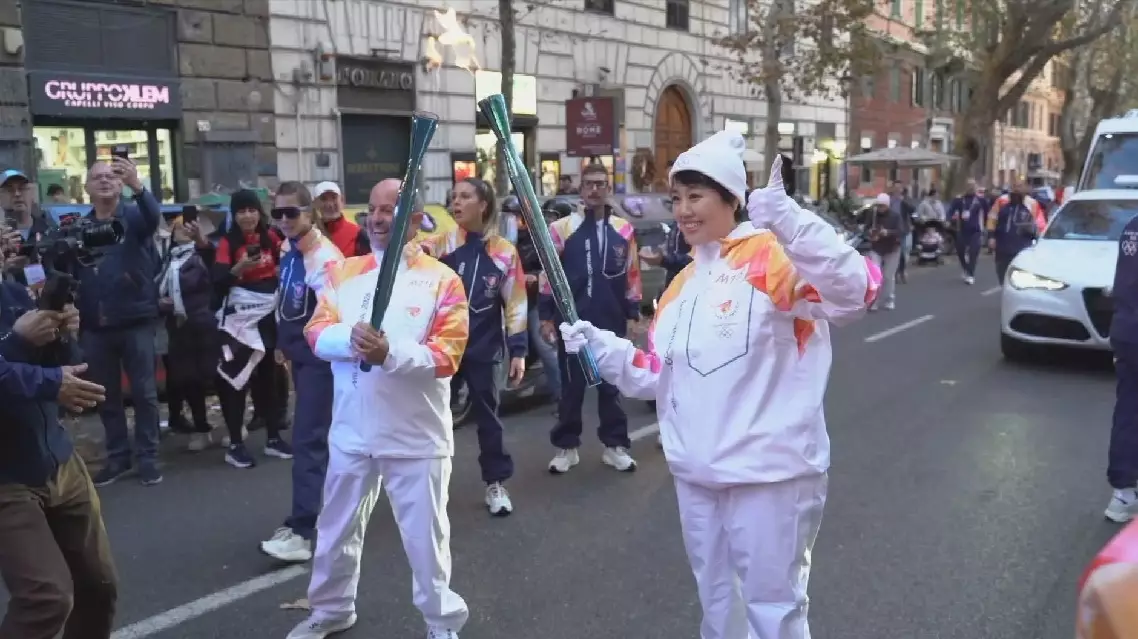
CMG Spring Festival Gala director takes part in Winter Olympics torch relay in Rome