Skip to Content Facebook Feature Image

France's prime minister is ousted as the nation drifts into turmoil

News

France's prime minister is ousted as the nation drifts into turmoil
News

News

France's prime minister is ousted as the nation drifts into turmoil

2025-09-10 01:02 Last Updated At:01:10

PARIS (AP) — Another prime minister gone. Another crisis unfolding. In France, what once shocked is now routine.

Prime Minister François Bayrou submitted his resignation Tuesday after losing a crushing confidence vote in parliament. The third toppling of a head of government in 14 months leaves President Emmanuel Macron scrambling for a successor and a nation caught in a cycle of collapse.

Bayrou, 74, lasted just nine months in office. Even that was three times longer than his predecessor.

He gambled on a budget demanding over €40 billion in savings. The plan froze welfare, cut civil-service jobs, and even scrapped two public holidays that many French see as part of their national rhythm.

Bayrou warned that without action the national debt, which is now 114% of GDP, would bring “domination by creditors” as surely as by foreign powers.

Instead, he united his enemies. The far right of Marine Le Pen and a left-wing alliance voted him down, 364 to 194. By the time lawmakers cast their ballots, Bayrou already had invited allies to a farewell drink.

The president has promised to name a new prime minister “in the coming days.” It will be his fourth in under two years.

There are several possible replacements, among them: Defense Minister Sébastien Lecornu, Justice Minister Gérald Darmanin, former Socialist premier Bernard Cazeneuve and Finance Minister Eric Lombard.

Speculation has grown around Lombard, who has roots in Socialist governments, as Macron considers a leftward shift in order to secure a strong enough coalition.

But the problem is not the personnel. It is the arithmetic.

Whoever takes the job will face the same trap that consumed Bayrou: Pass a budget in a parliament that cannot agree.

Since Macron’s snap election in 2024, parliament has been split into three rival blocs: far left, centrists, and far right. None commands a majority. France has no tradition of coalition-building and every budget becomes a battle.

But Macron’s room to maneuver is shrinking and new elections could hand Le Pen even greater power. Le Pen, convicted of embezzlement and barred from office for five years, is appealing her sentence from January. In the meantime, she promotes her protégé Jordan Bardella as a ready prime minister — a scenario Macron has every reason to avoid.

The president has ruled out another election for now, but Le Pen insists he must call one. Leftist firebrand Jean-Luc Mélenchon has urged a rewrite of the Constitution to weaken what he calls a “presidential monarchy.”

With just 18 months left in his term-limited presidency and his approval rating at 15%, the risk for Macron is existential. Even fresh calls for his resignation can be heard, though Macron has ruled it out.

France is the eurozone’s second-largest economy, its only nuclear power and a permanent United Nations Security Council member. Prolonged instability reverberates far beyond its borders.

France’s political difficulty weakens Europe’s hand against Russia. It rattles investors and undermines the credibility of EU fiscal rules.

At home, it chips away at trust in the state itself. France’s welfare system — pensions, health care, education — is not just policy. It is identity. Each attempt to trim the structure feels like an assault on the model of solidarity that defines modern France.

On Monday night, about 11,000 demonstrators feted Bayrou's ouster outside town halls in “Bye Bye Bayrou” farewell drinks.

Some came for celebration. Many stayed to organize.

Wednesday has been declared a day of action under the slogan “Block Everything.” Protesters plan to shut fuel depots, highways, and city centers. The government is deploying 80,000 police.

France has seen mass uprisings before: pensions in 2023, the Yellow Vests in 2018. The current movement echoes the latter, which at their peak brought France to a standstill. Analysts warn that if Macron once again ignores popular discontent, unrest could spiral.

But this time the anger runs perhaps deeper. It is not just about one reform. It is about austerity, inequality and the sense that governments keep collapsing while nothing changes.

The numbers are stark. France’s deficit stands at nearly 6% of GDP, which is about €198 billion. EU rules demand it be cut below 3%.

Bayrou’s cure was cuts that fell on workers and retirees. Voters saw this as unfair. After years of tax breaks for corporations and the wealthy, patience has snapped.

Earlier this year, the lower house passed a rich tax proposal — a 2% levy on fortunes above €100 million. It would have hit fewer than 2,000 households but raised €25 billion annually. Yet Macron’s pro-business allies, historically wary of scaring off investment, killed it in the Senate.

Bayrou pressed on with cuts that hit the working and middle classes the most.

For many, the contrast was glaring: austerity for millions, protection for billionaires.

Four prime ministers in under two years. A debt crisis grinding the economy. A nation paralyzed by political deadlock. It sounds like France today. In fact, it was France in the late 1950s, when the Fourth Republic collapsed under the weight of drift and division.

Charles de Gaulle built the Fifth Republic, bolstering the presidency to end the revolving-door governments of the Fourth. The new constitution gave the president powers to dissolve parliament, call referendums and appoint the prime minister.

Seven decades later, the system designed to guarantee stability is confronting the same storm.

Gabriel Attal, himself a fallen premier, calls the current cycle of collapse “an absolutely distressing spectacle” and has urged the appointment of a coalition mediator — a role France’s system wasn't supposed to need. His warning is stark: No republic can keep discarding leaders every few months without threatening its survival.

French politics is fractured into three hostile camps. With no tradition of compromise, unlike Germany or Italy, stalemate has become the rule.

“The question posed now is that of the survival of our political system,” political analyst Alain Duhamel told Le Monde. “In 1958 there was an alternative in the form of de Gaulle. Like him or detest him, he unquestionably had a project.”

Today, there is no de Gaulle. Only an embattled president, a divided parliament, and a Republic waiting to prove it can still hold.

Associated Press journalist Masha Macpherson contributed to this report.
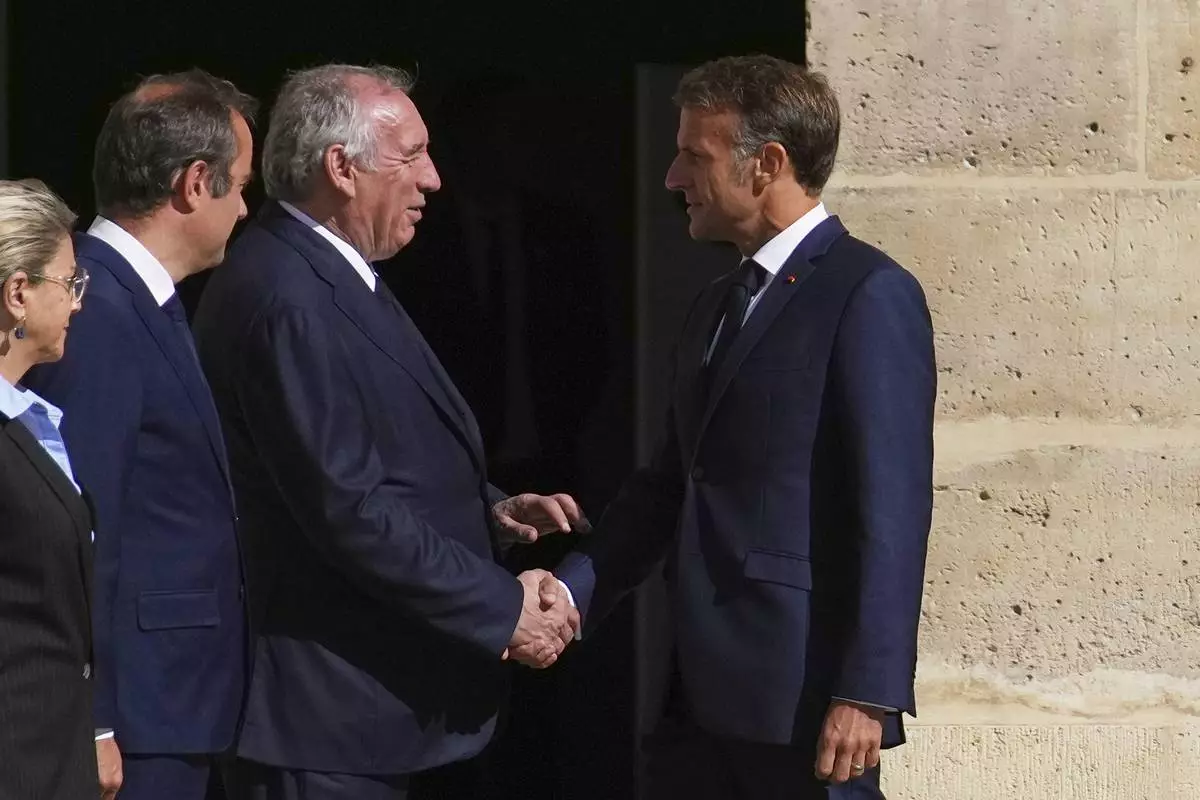
France's President Emmanuel Macron, right, shakes hand with France's Prime Minister Francois Bayrou during the farewell ceremony of Chief of Staff of the French Armed Forces Thierry Burkhard, in the courtyard of the Invalides, in Paris, France, Friday, Sept. 5, 2025. (AP Photo/Christophe Ena, Pool)
France's President Emmanuel Macron, right, shakes hand with France's Prime Minister Francois Bayrou during the farewell ceremony of Chief of Staff of the French Armed Forces Thierry Burkhard, in the courtyard of the Invalides, in Paris, France, Friday, Sept. 5, 2025. (AP Photo/Christophe Ena, Pool)

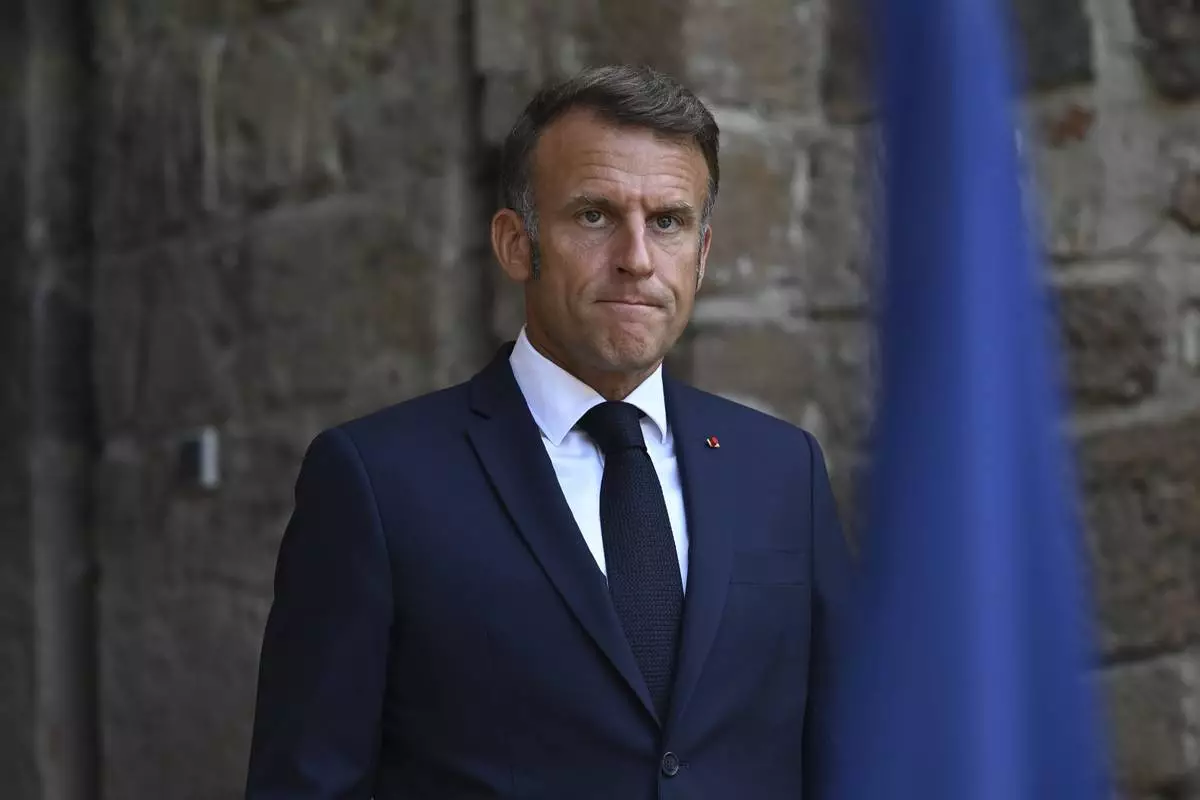
FILE - French President Emmanuel Macron arrives to speak after attending a video conference with members of the so-called "coalition of the willing", Sunday, Aug. 17, 2025 at the Fort de Bregancon in Bormes-les-Mimosas, southern France. (AP Photo/Philippe Magoni, Pool, File)

FILE - French President Emmanuel Macron arrives to speak after attending a video conference with members of the so-called "coalition of the willing", Sunday, Aug. 17, 2025 at the Fort de Bregancon in Bormes-les-Mimosas, southern France. (AP Photo/Philippe Magoni, Pool, File)

MILAN (AP) — Milan’s storied Teatro alla Scala celebrates its gala season premiere Sunday with a Russian opera for the second time since Moscow’s 2022 invasion of Ukraine. But this year, instead of drawing protests for showcasing the invader’s culture, a flash mob demonstrated for peace.

La Scala’s music director Riccardo Chailly conducts Dmitry Shostakovich’s “Lady Macbeth of Mtsensk” for the gala season opener that draws luminaries from culture, business and politics for one of the most anticipated events of the European cultural calendar.

Shostakovich's 1934 opera highlights the condition of women in Stalin’s Soviet Union, and was blacklisted just days after the communist leader saw a performance in 1936, the threshold year of his campaign of political repression known as the Great Purge.

A dozen activists from a liberal Italian party held up Ukrainian and European flags in a quiet demonstration removed from the La Scala hubub that aimed “to draw attention to the defense of liberty and European democracy, threatened today by (President Vladimir) Putin’s Russia, and to support the Ukrainian people.’’

The party underlined that Shostakovich's opera exposes the abuse of power and the role of personal resistance.

Another, larger, demonstration of several dozen people in front of city hall called for freedom for the Palestinians and an end to colonialism, but was kept far from arriving dignitaries by a police cordon. Demonstrations against war and other forms of inequality have long countered the glitz of the gala season premiere.

Chailly began working with Russian stage director Vasily Barkhatov on the title about two years ago, following the 2022 gala season premiere of the Russian opera “Boris Godunov,” which was attended by Italian Premier Giorgia Meloni and European Commission President Ursula von der Leyen, both of whom separated Russia’s politicians from its culture.

But outside the Godunov premiere, Ukrainians protested against highlighting Russian culture during a war rooted in the denial of a unique Ukrainian culture. The Ukrainian community did not announce any separate protests this year.

Chailly called the staging of Shostakovich’s “Lady Macbeth" at La Scala for just the fourth time “a must.’’

“It is an opera that has long suffered, and needs to make up for lost time,’’ Chailly told a news conference last month.

La Scala’s new general manager, Fortunato Ortombina, defended the choices made by his predecessor to stage both Shostakovich’s “Lady Macbeth” and Modest Mussorgsky’s “Boris Godunov " at the theater best known for its Italian repertoire.

‘‘Music is fundamentally superior to any ideological conflict,’’ Ortombina said on the sidelines of the press conference. “Shostakovich, and Russian music more broadly, have an authority over the Russian people that exceeds Putin's own.’’

American soprano Sara Jakubiak is making her La Scala debut in the title role of Katerina, whose struggle against existential repression leads her to commit murder, landing her in a Siberian prison where she dies. It’s the second time Jakubiak has sung the role, after performances in Barcelona last year, and she said Shostakovich's Katerina is full of challenges.

“That I’m a murderess, that I’m singing 47 high B flats in one night, you know, all these things,’’ Jakubiak said while sitting in the makeup chair ahead of the Dec. 4 preview performance to an audience of young people. “You go, ‘Oh my gosh, how will I do this?’ But you manage, with the right kind of work, the right team of people. Yes, we’re just going to go for the ride.”

Speaking to journalists recently, Chailly joked that he was “squeezing” Jakubiak like an orange. Jakubiak said she found common ground with the conductor known for his studious approach to the original score and composer’s intent.

“Whenever I prepare a role, it’s always the text and the music and the text and the rhythms,'' she said. “First, I do this process with, you know, a cup of coffee at my piano and then we add the other layers and then the notes. So I guess we’re actually somewhat similar in that regard.''

Jakubiak, best known for Strauss and Wagner, has a major debut coming in July when she sings her first Isolde in concert with Anthony Pappano and the London Symphony.

Barkhatov, who at 42 has has a flourishing international career, said “Lady Macbeth” was a “very brave and exciting" choice.

Barkhatov's stage direction sets the opera in a cosmopolitan Russian city in the 1950s, the end of Stalin’s regime, rather than a 19th-century rural village as written for the 1930s premier.

For Barkhatov, Stalin’s regime defines the background of the story and the mentality of the characters for a story he sees as a personal tragedy and not a political tale. Most of the action unfolds inside a restaurant appointed in period Art Deco detail, with a rotating balustrade creating a kitchen, a basement and an office where interrogations take place.

Despite the tragic arc, Barkhatov described the story as “a weird … breakthrough to happiness and freedom.’’

“Sadly, the statistics show that a lot of people die on their way to happiness and freedom,’’ he added.

Stage director Vasily Barkhatov sits during an interview with The Associated Press prior to the dressed rehearsal of Dmitri Shostakovich's Lady Macbeth of the Mtsensk District at La Scala Opera House in Milan, Italy, Thursday, Dec. 4, 2025. (AP Photo/Antonio Calanni)

Stage director Vasily Barkhatov sits during an interview with The Associated Press prior to the dressed rehearsal of Dmitri Shostakovich's Lady Macbeth of the Mtsensk District at La Scala Opera House in Milan, Italy, Thursday, Dec. 4, 2025. (AP Photo/Antonio Calanni)

A wig receives final touches ahead of the dress rehearsal of Dmitri Shostakovich's Lady Macbeth of the Mtsensk District at La Scala Opera House in Milan, Italy, Thursday, Dec. 4, 2025. (AP Photo/Antonio Calanni)

A wig receives final touches ahead of the dress rehearsal of Dmitri Shostakovich's Lady Macbeth of the Mtsensk District at La Scala Opera House in Milan, Italy, Thursday, Dec. 4, 2025. (AP Photo/Antonio Calanni)

A wig receives final touches ahead of the dress rehearsal of Dmitri Shostakovich's Lady Macbeth of the Mtsensk District at La Scala Opera House in Milan, Italy, Thursday, Dec. 4, 2025. (AP Photo/Antonio Calanni)

A wig receives final touches ahead of the dress rehearsal of Dmitri Shostakovich's Lady Macbeth of the Mtsensk District at La Scala Opera House in Milan, Italy, Thursday, Dec. 4, 2025. (AP Photo/Antonio Calanni)

External view of Teatro all Scala ahead of the dress rehearsal of Dmitri Shostakovich's Lady Macbeth of the Mtsensk District in Milan, Italy, Thursday, Dec. 4, 2025. (AP Photo/Antonio Calanni)

External view of Teatro all Scala ahead of the dress rehearsal of Dmitri Shostakovich's Lady Macbeth of the Mtsensk District in Milan, Italy, Thursday, Dec. 4, 2025. (AP Photo/Antonio Calanni)

Soprano Sara Jakubiak has her makeup done ahead of the dress rehearsal of Dmitri Shostakovich's Lady Macbeth of the Mtsensk District at La Scala Opera House in Milan, Italy, Thursday, Dec. 4, 2025. (AP Photo/Antonio Calanni)

Soprano Sara Jakubiak has her makeup done ahead of the dress rehearsal of Dmitri Shostakovich's Lady Macbeth of the Mtsensk District at La Scala Opera House in Milan, Italy, Thursday, Dec. 4, 2025. (AP Photo/Antonio Calanni)

The stage is prepared ahead of the dressed rehearsal of the Lady Macbeth of Mtsensk District, by Dmitri Shostakovich, at La Scala Opera House in Milan, Italy, Thursday, Dec. 4, 2025. (AP Photo/Antonio Calanni)

The stage is prepared ahead of the dressed rehearsal of the Lady Macbeth of Mtsensk District, by Dmitri Shostakovich, at La Scala Opera House in Milan, Italy, Thursday, Dec. 4, 2025. (AP Photo/Antonio Calanni)

Recommended Articles