The Taitema Lake, located at the end of the Tarim River in northwest China's Xinjiang Uygur Autonomous Region, the largest inland river in China, has turned into an oasis from a dry lake in recent years, as water replenishment efforts have paid off.
Due to excessive agricultural irrigation, the lake dried up in 1972, but now it is presenting an early autumn landscape with abundant water and grass. Today, more than 20 herders are grazing their livestock here.
"There is much water and grass, so we have many goats," said Rizwangul Turdi, a local herder.
"There are many wild animals, flying and walking everywhere," said Memet Tursun, another herder.
Ten years ago, the lake area was still barren, forcing the herders to move out of their villages.
"When I was young, there was all alkaline soil and sand, and people could hardly walk. The goats had neither water nor grass and died in this place," said Memet.
Now the lake is reviving as water is being transfused from the upper reaches of the Tarim River. Seven large water projects are reserving snowmelt from the Tianshan Mountains, with 10 main flood diversion channels and 78 branch channels delivering the water to the Gobi Desert.
Unmanned drones have been applied to fly across the Gobi to identify where water is needed.
"We carry out targeted movements based on the needs of the plants. We learn about how much they lack and when should we irrigate them. It is a way of precise irrigation," said Ling Hongbo, a researcher from the Xinjiang Institute of Ecology and Geography under the Chinese Academy of Sciences.
Many plants have come back to life after water replenishment.
"The tree can revive. Once it is watered, it will come back very quickly," said Zhang Yu, head of a reservoir management station.
Over the past decade, the ground water level has risen by around seven meters in the one-kilometer surroundings of the lower reaches of the Tarim River, while the desert area has reduced by more than 800 square kilometers, with 2,300 square kilometers of vegetation restored.
When Rizwangul first returned to the pasture, she was only raising over 100 goats. Now, the number of her goats has increased to 500, as the restored vegetation offers enough food to animals,
"The goats used to be thin, but now they are fat. We've bought tractors and cars. Our life is getting better and better," she said.
More than 170 kinds of wild animals, including jerboa and red deer, which had once vanished in the lake area, have also returned to people's view.
"The Mongolian gazelles are no longer afraid of people, strolling leisurely there. This is the harmonious coexistence of man and nature," Ling said when monitoring the movement of wild animals with a drone.
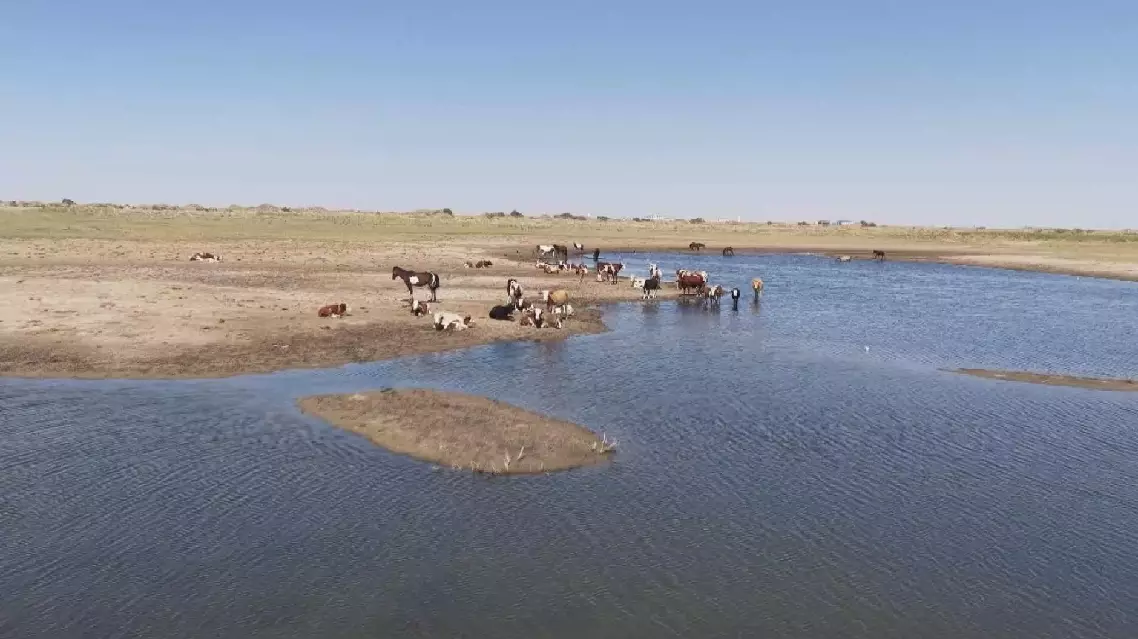
Water diversion project helps revive dry lake once known as "sea of death" in northwest China's Xinjiang