VERONA, Italy (AP) — Jamie Vardy could not rustle up a goal in his Serie A debut and prevent the first scoreless draw between Cremonese and Verona for almost 40 years on Monday.
Vardy, one of England’s most prolific scorers over the last decade, signed for Cremonese on transfer deadline day and came off the bench to replace Federico Bonazzoli in the 58th minute.
Click to Gallery
Como's Maxence Caqueret, left, and Genoa's Brooke Norton-Cuffy, right, challenge for the ball during the Serie A soccer match between Como 1907 and CFC Genoa 1893 in Como, Italy, Monday, Sept. 15, 2025. (Antonio Saia/LaPresse via AP)
Como's Mergim Vojvoda, front, plays the ball during the Serie A soccer match between Como 1907 and CFC Genoa 1893 in Como, Italy, Monday, Sept. 15, 2025. (Antonio Saia/LaPresse via AP)
Verona's Antoine Bernede kicks the ball during the Serie A soccer match between Hellas Verona and Cremonese at the Bentegodi Stadium in Verona, Italy, Monday, Sept. 15, 2025. (Paola Garbuio/LaPresse via AP)
Verona's Gift Orban reacts during the Serie A soccer match between Hellas Verona and Cremonese at the Bentegodi Stadium in Verona, Italy, Monday, Sept. 15, 2025. (Paola Garbuio/LaPresse via AP)
But there was no fairy tale start for the 38-year-old Premier League and FA Cup winner.
Instead, most of the chances were at the other end as Verona pushed for a first win at home since Feb. 23.
Giovane missed a string of chances and Gift Orban was also profligate in a game that nevertheless ended Cremonese’s winning start to the season.
The point moved Cremonese up to third place.
Verona was 16th with two points from three games.
Later Monday, Genoa scored in stoppage time to take a point in a 1-1 draw at Como.
Nico Paz was named the Serie A rising star of the month for August and the 21-year-old Argentine showed why after 13 minutes when he gave Como the lead with a lovely strike from outside the box.
Como coach Cesc Fabregas looked sure to preserve his 100% record against his old Arsenal teammate Patrick Vieira since they both moved into the dugout but Caleb Ekuban slammed home after a goalmouth scramble two minutes into stoppage time to give Genoa a much needed share of the points.
Como’s Jacobo Ramon was sent off three minutes earlier.
The point left Genoa winless after three games but the result lifted it out of joint-last place.
AP soccer: https://apnews.com/hub/soccer

Como's Maxence Caqueret, left, and Genoa's Brooke Norton-Cuffy, right, challenge for the ball during the Serie A soccer match between Como 1907 and CFC Genoa 1893 in Como, Italy, Monday, Sept. 15, 2025. (Antonio Saia/LaPresse via AP)

Como's Mergim Vojvoda, front, plays the ball during the Serie A soccer match between Como 1907 and CFC Genoa 1893 in Como, Italy, Monday, Sept. 15, 2025. (Antonio Saia/LaPresse via AP)

Verona's Antoine Bernede kicks the ball during the Serie A soccer match between Hellas Verona and Cremonese at the Bentegodi Stadium in Verona, Italy, Monday, Sept. 15, 2025. (Paola Garbuio/LaPresse via AP)

Verona's Gift Orban reacts during the Serie A soccer match between Hellas Verona and Cremonese at the Bentegodi Stadium in Verona, Italy, Monday, Sept. 15, 2025. (Paola Garbuio/LaPresse via AP)
KYIV, Ukraine (AP) — Russian strikes killed at least eight people across Ukraine on Friday, including in a “massive” missile and drone attack near the capital, local authorities reported.
Ukrainian officials claim the Kremlin is changing its tactics to increase civilian suffering, shifting to daytime barrages and preparing to target more key infrastructure.
President Volodymyr Zelenskyy has signaled Kyiv's openness to a potential Easter truce. The holiday is celebrated on April 12 in Ukraine and Russia.
Zelenskyy also said that Ukraine is preparing for a shift in Russian aerial tactics, with intelligence indicating that future attacks will move beyond energy infrastructure.
Russia's Defense Ministry said 192 Ukrainian drones were shot down overnight across Russia and occupied Crimea.
“The Kyiv region is once again under a massive Russian missile and drone attack,” said Mykola Kalashnyk, head of the regional military administration, in a Telegram post on Friday.
Kalashnyk said one person died and at least eight others were wounded in strikes on three of Kyiv’s satellite towns — Bucha, Fastiv and Obukhiv. Earlier in the week, residents of Bucha marked the fourth anniversary of atrocities committed in the town by Russia's invading forces.
Obukhiv resident Lesia Podoriako, 37, told The Associated Press she was at work with her child when she learned her building had been struck.
“I found out about it through Telegram channels. Then all my friends and acquaintances started calling me, telling me that our building was attacked. I have no words. The main thing is that everyone is alive and healthy,” she said.
Another person was killed in Ukraine's northern Sumy region after a Russian guided aerial bomb struck an apartment block, local Gov. Oleh Hryhorov reported. Authorities in the Kherson, Zhytomyr, Kharkiv and Donetsk regions also reported casualties from Friday's attacks.
Ukrainian officials highlighted what they said were increased daytime attacks by Russia, which they said could lead to more civilian deaths. For months, Moscow pummeled Ukraine with nighttime missile and drone strikes that could involve hundreds of drones at a time.
Ukraine’s Foreign Minister, Andrii Sybiha, said in a post on X that “almost half a thousand drones and cruise missiles” attacked Ukraine overnight.
“This is how Moscow responds to Ukraine’s Easter ceasefire proposals — with brutal attacks,” Sybiha said.
Zelenskyy on Thursday signaled Kyiv's continued openness to a potential truce on Easter, which falls next week according to the Julian calendar followed by Orthodox churches in Ukraine and Russia.
Zelenskyy told reporters that the proposal had been communicated to Moscow through U.S. channels. He added that the Kremlin's response remains unclear.
Zelenskyy has previously offered a ceasefire for the Easter period — but Kremlin spokesperson Dmitry Peskov said earlier this week that Moscow wants a lasting peace settlement, not a temporary truce.
President Vladimir Putin unilaterally declared a 30-hour ceasefire last Easter, but each side accused the other of breaking it.
Meanwhile, Ukrainian officials said Russia was increasingly striking the country during the day, an apparent departure from months of nighttime barrages.
Andrii Kovalenko, head of the Center for Countering Disinformation within Ukraine's defense ministry, said that the daytime strikes aimed to “increase civilian casualties.”
“That is why the combined attack is carried out on a working day, using a large number of drones and missiles,” Kovalenko wrote on Friday in a Telegram post.
Zelenskyy told reporters on Thursday that Ukraine is preparing for Russian aerial attacks that could target water systems, logistics and other critical networks. After months of sustained strikes on power facilities, Kyiv now expects increased pressure elsewhere.
“According to intelligence documents we have received, the Russians will target logistics – railways and other infrastructure. They will also target the water supply,” Zelenskyy said at a press briefing.
Around midday on Friday, Russian forces dropped five aerial bombs on the city of Kramatorsk, in eastern Ukraine. At least two people were killed and three were injured, according to a Telegram update by Vadym Filashkin, who heads the regional military administration.
Elsewhere in Ukraine on Friday, a Russian drone strike damaged a bus in the southern city of Kherson, leaving the driver seriously wounded and at least eight passengers hurt, according to regional officials.
Separately, authorities reported sustained attacks on Kharkiv, Ukraine’s second-largest city, beginning on Thursday and continuing into early Friday. Drone strikes near the city center caused several injuries. Two people later died in hospital, local Gov. Oleh Syniehubov wrote in separate Telegram updates.
Bohdan Hladykh, head of Kharkiv’s Department of Emergency Situations, said Russia struck the city at least 20 times during the day on Thursday with explosive drones.
Meanwhile, Zelenskyy told reporters that the battlefield situation has stabilized, with recent intelligence assessments pointing to the most favorable conditions for Kyiv in months. While fighting remains intense across eastern sectors, Ukrainian forces have disrupted Russian offensives in recent weeks and regained limited ground.
“On Wednesday I received a report from our intelligence and an analysis from British intelligence. I received MI6’s assessment of the situation at the front: right now, it is the best situation for Ukraine in the past 10 months,” the Ukrainian leader said at a press briefing Thursday.
Zelenskyy added that Ukraine has invited U.S. negotiators to visit Kyiv, as part of ongoing discussions on security guarantees and a broader framework for ending the war. Recent talks have involved senior American officials as well as NATO Secretary General Mark Rutte, with Ukraine seeking clearer commitments on long-term defense support and responses to any future Russian aggression.
Two people were hospitalized on Friday following a Ukrainian drone strike on Russia's Leningrad region, over 1,100 kilometers (684 miles) from the border, said regional Gov. Alexander Drozdenko reported, who added that the drones also set fire to an “unoccupied” building within the Morozov industrial zone.
The settlement of Morozov houses a state-owned plant that makes explosives and components for ammunition, including solid fuel used in Topol-M missile systems. The plant was put under U.S., EU and other Western sanctions following Russia’s full-scale invasion of Ukraine.
Twelve people, including at least three Russian soldiers, were injured in a Ukrainian drone strike late Thursday on Russia’s Belgorod region, which borders Ukraine, local Gov. Vyacheslav Gladkov reported.
Four drones were downed during the night on the approach to Moscow, mayor Sergei Sobyanin reported Friday. He did not reference any casualties or damage.
Associated Press journalists Vasilisa Stepanenko in Obukhiv and Derek Gatopoulos in Kyiv contributed.
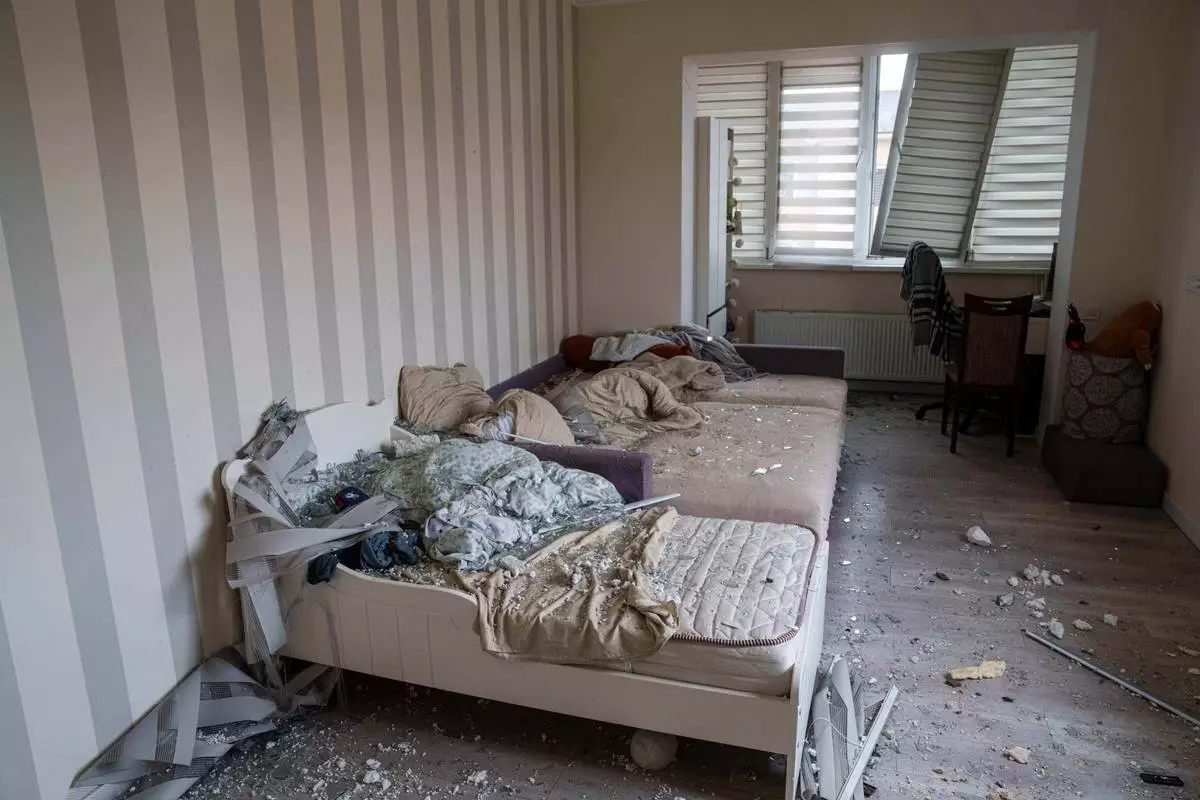
Broken glass is seen on beds at an which was damaged after a Russian strike on residential neighbourhood in Kriukivshchyna, Kyiv region, Ukraine, on Friday, April 3, 2026. (AP Photo/Evgeniy Maloletka)
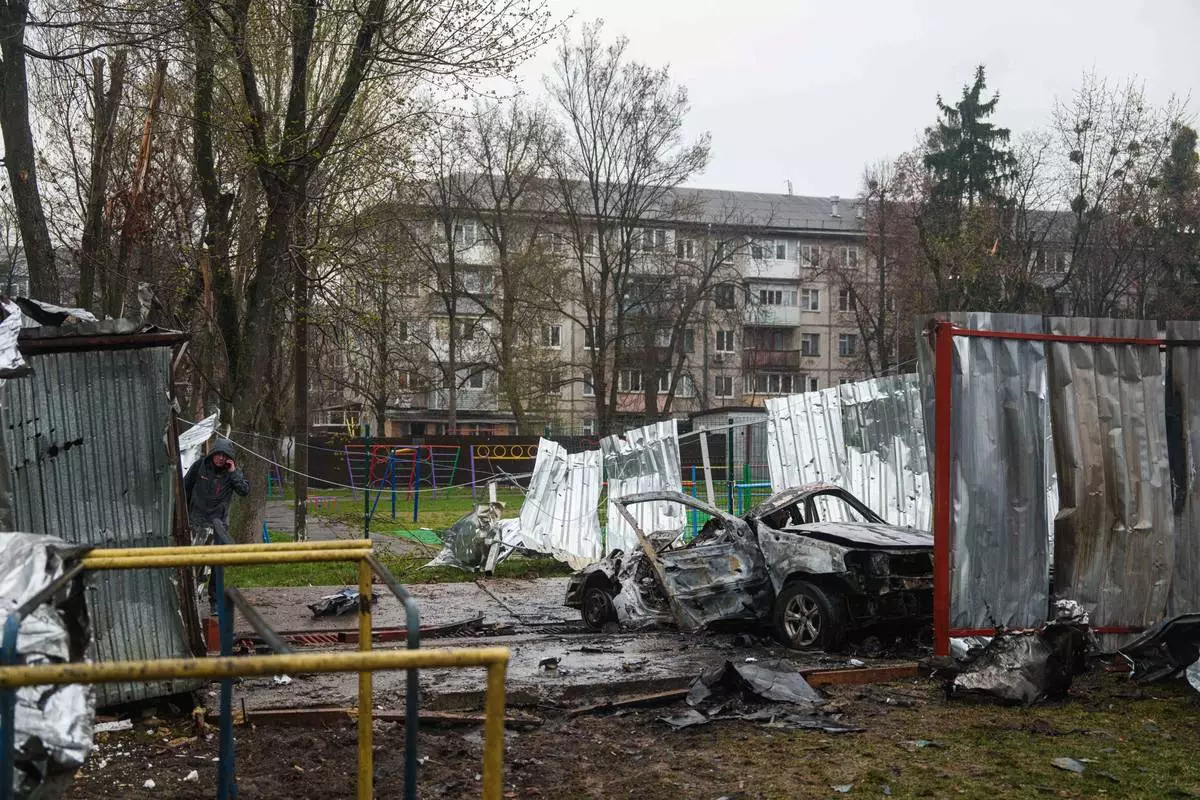
A destroyed car is seen after a Russian strike on residential neighbourhood in Vyshneve, Kyiv region, Ukraine, on Friday, April 3, 2026. (AP Photo/Evgeniy Maloletka)
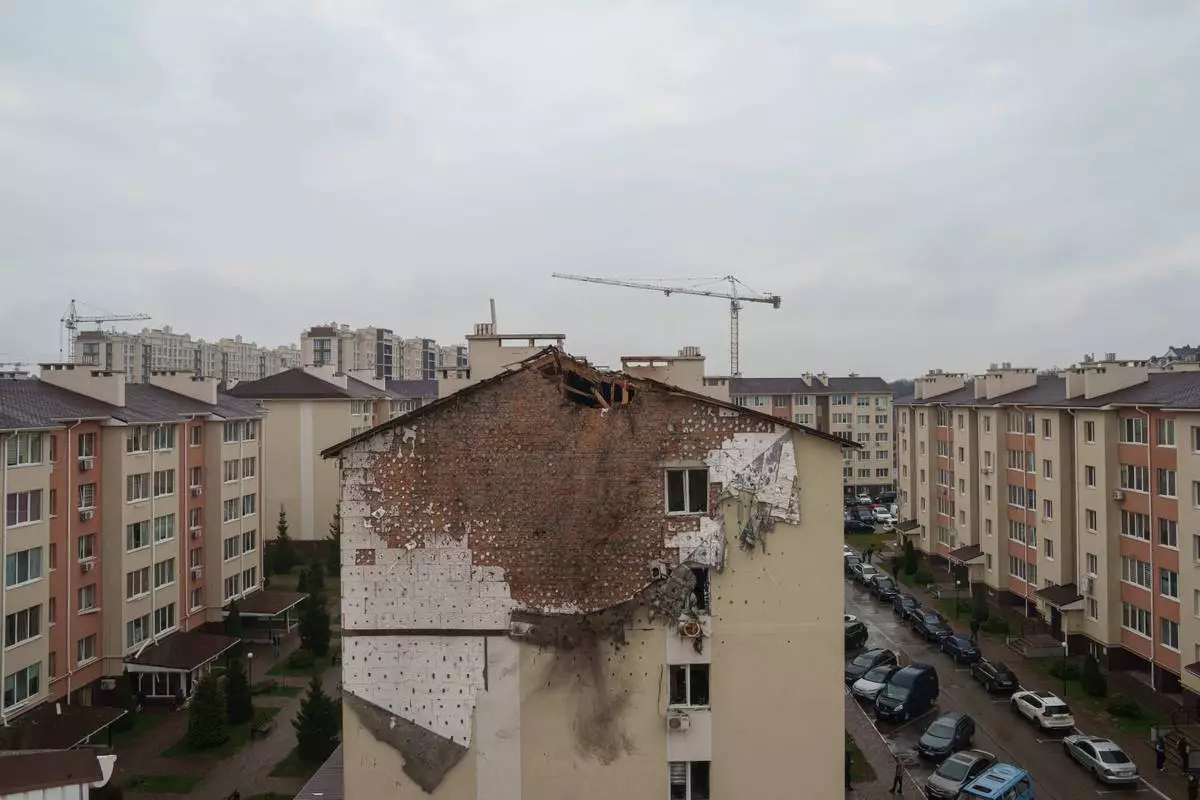
A house is seen damaged after a Russian strike on residential neighbourhood in Kriukivshchyna, Kyiv region, Ukraine, on Friday, April 3, 2026. (AP Photo/Evgeniy Maloletka)
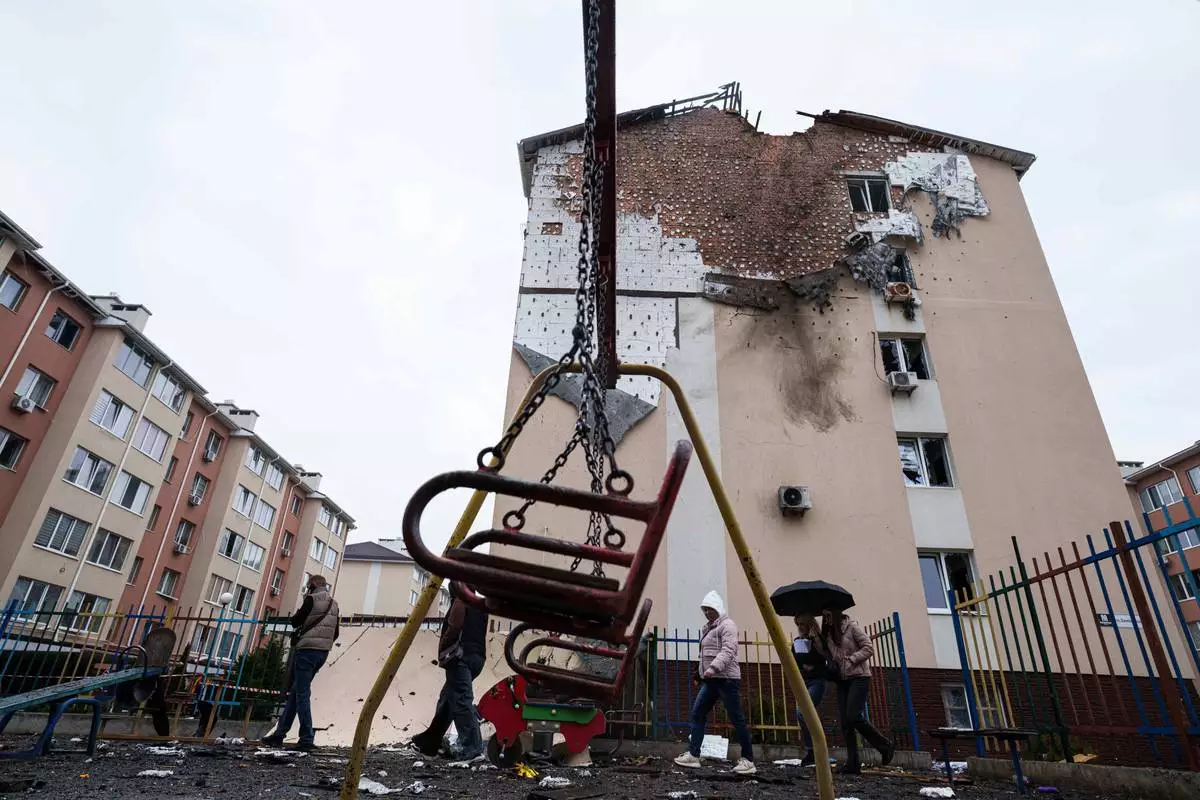
People walk in front of a house which was damaged after a Russian strike on residential neighbourhood in Kriukivshchyna, Kyiv region, Ukraine, on Friday, April 3, 2026. (AP Photo/Evgeniy Maloletka)
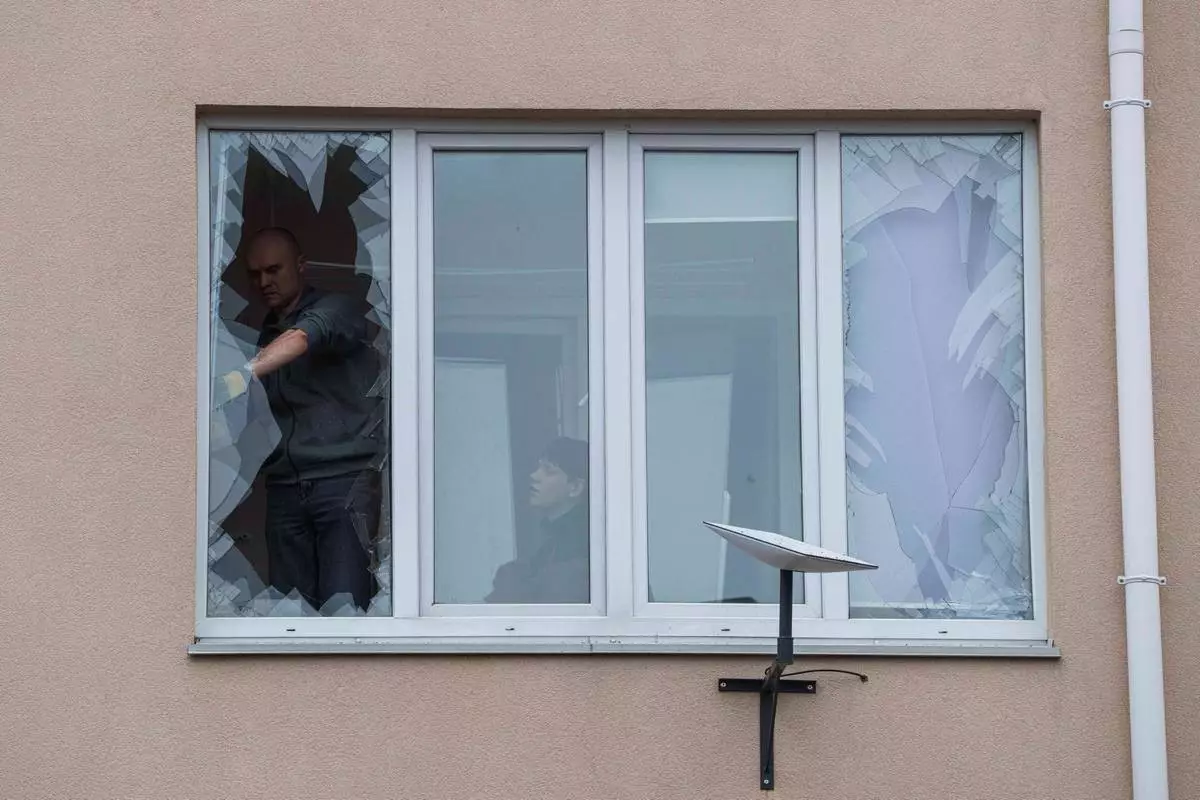
People remove broken glass from their windows after a Russian strike on residential neighbourhood in Kriukivshchyna, Kyiv region, Ukraine, on Friday, April 3, 2026. (AP Photo/Evgeniy Maloletka)
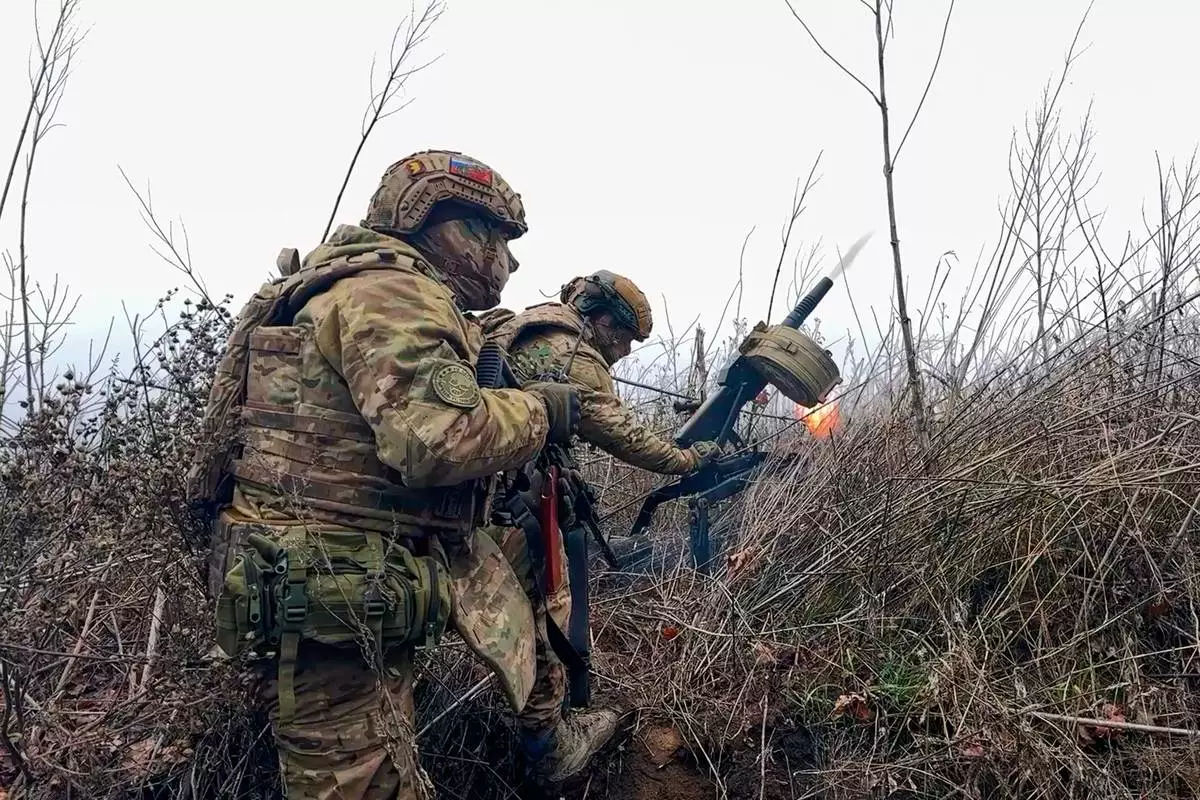
In this image made from video provided by Russian Defense Ministry Press Service on Tuesday, March 31, 2026, Russian soldiers fire a grenade launcher towards Ukrainian positions on an undisclosed location in Ukraine. (Russian Defense Ministry Press Service via AP)