NEW YORK (AP) — For the Boy Scouts of America — recently renamed Scouting America — the past 12 years have been arduous. Opening its programs to gay people and later to girls sparked dismay in some quarters. Its 2020 bankruptcy declaration led to prolonged wrangling over compensation for thousands of men claiming they were sexually abused as scouts.
Yet the 115-year-old organization — though serving far fewer youths than at its peak decades ago — seems to be stabilizing, with a slight uptick in membership last year. A key factor is the abiding loyalty of major religious denominations that still view scouting’s mission as uniquely in tune with their own.
“I tell parents this is the best time to be involved with Scouting America, and the best time to be involved through a Catholic unit,” said Bill Guglielmi, who chairs the National Catholic Committee on Scouting. “There is a hunger out there now for finding a values-based organization.”
Guglielmi and others who are engaged in faith-based scouting praise the manner in which time-honored scouting programs — such as camping and expeditions — have been blended with newfangled activities such as indoor skydiving and an artificial-intelligence merit badge. But foremost, they value the organization’s continued commitment to communal prayer.
“Worship is a big deal here,” said Bill McCalister, who served more than 40 years as scoutmaster of Troop 285 in San Antonio under sponsorship of a United Methodist church.
“Every campout, we have a formal worship service. Sometimes we serve Communion,” he said. “Many scouts come to me and say, ‘Mr. Mac, this is my church.’”
According to Scouting America's latest data, faith-based organizations account for 42% of the nearly 40,000 units operated by chartered organizations. The Catholic Church and its affiliates are No. 1 — overseeing 3,514 units serving more than 87,100 of the roughly 1 million boys and girls now active in scouting.
Other major sponsors include the United Methodists, the Episcopal Church and various Lutheran and Presbyterian denominations. Nearly 250 units, serving more than 6,500 scouts, are sponsored by Muslim, Jewish and Buddhist organizations.
Roger Krone, Scouting America’s president and CEO, took the post in 2023 as the organization emerged from bankruptcy proceedings. He appreciates scouting's religious diversity.
“It really speaks to the alignment of the mission, vision and values that our organization has and what those organizations have,” he told The Associated Press. “It’s character development, it’s spiritual growth, it’s community service.”
The Boy Scouts lifted a ban on openly gay youth members in 2013 and began accepting girls in 2018 — steps Krone depicted as a message of welcome to any family considering scouting.
One step the organization will not take, Krone said, is abandoning the religious credo at the core of its mission. The famed Scout Oath begins, “On my honor I will do my best to do my duty to God,” while the Scout Law’s concluding message is: “Be reverent toward God. Be faithful in your religious duties. Respect the belief of others.”
“There are some places today where you’re not encouraged to talk about spiritual growth and what may be going on outside your little bubble,” Krone said. “In our organization, it’s been core to our principles for years and years and will continue to be core.”
Krone acknowledges that some nonreligious families, while admiring aspects of scouting, might be uncomfortable with the “Duty to God” pledge. He encourages them to try scouting nonetheless.
“You are all welcome in our organization,” he said. “But I want people to know when you come to scouting, there’s this concept of reverence and spiritual growth and saying prayers and being thoughtful.”
“The parent can come and be a volunteer and go through a couple meetings and a couple of campouts and watch what we do, see what effect the way we deal with duty to God and reverence has on the youth of your child’s age, and then make a decision,” Krone said. “Don’t dismiss us out of hand.”
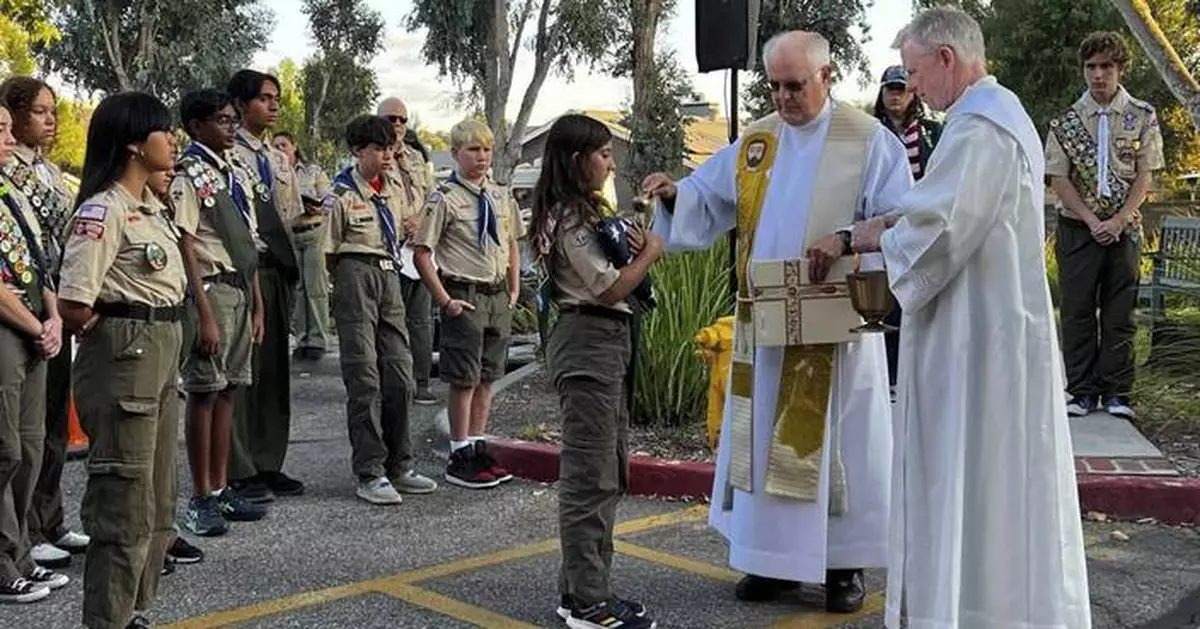
That welcoming approach is fully practiced by Troop 228, chartered by St. Kateri Tekakwitha Catholic Church in the Los Angeles suburb of Santa Clarita, according to one of its adult leaders, Christine Tezai.
She estimates that less than half the troop's 40-plus scouts are Catholic, yet all participate in occasional religion-themed events, including an annual Mass at which religious awards are presented.
“It doesn’t matter if you’re Catholic,” Tezai said. “A scout is reverent — it doesn’t matter how you’re reverent. You don’t have to say prayers. … You know what we do by showing kindness and being helpful.”
Her 17-year-old son, Mykhail Tezai, entered Cub Scouts in the first grade. Now, as a high school senior, he's on track to become an Eagle Scout.
He said several fellow scouts don’t identify with a specific faith but feel comfortable in a church-chartered troop.
“They're very curious about my religion and being Catholic,” he said. “They want to know how it works.”
After the 2013 decision to admit gay youth, some disgruntled conservatives formed a new group, Trail Life USA, which created its own ranks, badges and uniforms. It now claims 65,000 youth members, participating in church-run units aligned with “biblical Christian principles.”
The biggest blow came at the start of 2020, when The Church of Jesus Christ of Latter-day Saints — then the Boy Scouts’ largest faith-based partner — withdrew more than 400,000 scouts in favor of new programs of its own.
Krone said many Latter-day Saints families remain fond of Boy Scout programming and now place their children in units unaffiliated with their church.
“We would love to have more Mormon youth in our program,” Krone said. “They can have their own program … but also maybe embrace Scouting America more than they have the last couple of years to gain the benefits of the program we’ve developed.”
As for Trail Life, Krone acknowledged that its conservative Christian outlook has strong appeal for some families.
“But our program will prepare you better for life,” he said. “Once you get out of high school … you need to learn to get along with others in the world as it is today, outside of the environment that you grew up in.”
The loss of many units affiliated with the Latter-day Saints and conservative Christian churches was part of a broader shrinkage experienced by the Boy Scouts, which served more than 4 million boys in the 1970s. The COVID-19 pandemic and the bankruptcy process were major factors as membership dwindled.
In all, more than 82,000 people filed claims alleging they were sexually abused as scouts. Leading faith-based sponsors of scout units, including Catholic dioceses and Methodist churches, contributed to a $2.4 billion reorganization plan that took effect in 2023, allowing the Boy Scouts to keep operating while compensating abuse survivors.
The Rev. Mark Carr, a Jesuit priest who serves as national chaplain for Catholic scouting, said concerns about liability and insurance were key factors in dissuading some dioceses from continuing with scouting.
Steven Scheid, director of the United Methodists’ Center for Scouting Ministries, sees some upsides for scouting after its previous difficulties. He cited rigorous child-protection policies that he views as effective in curtailing sex abuse.
“The lessons we can gain out of the mistakes of the past can make a better, stronger community, a safer one,” he said.
Back in 2013, the United Methodists accounted for almost 350,000 youth members in the Boy Scouts. The figure now is 52,600.
But Scheid, an assistant scoutmaster of a troop founded in 1916 in Springfield, Tennessee, says adults still loyal to scouting “are deeply committed. … They see this as a calling.”
While Christian churches account for the vast majority of Scouting America’s faith-based units, there are more than 3,500 scouts in Muslim-sponsored units and about 1,560 in Jewish-affiliated units.
“Muslims in America are searching for their identity, and there’s nothing more American than scouting,” said Rashid Abdullah, executive director of the executive director of the National Association of Muslim Americans on Scouting. “It’s aligning perfectly with the values of our faith.”
Abdullah is also a lead organizer of scout units chartered to the Islamic Center of Northern Virginia Trust and the father of three sons who — like himself — made Eagle Scout.
Another Eagle Scout of long standing is Ricky Mason, a bankruptcy attorney who helped negotiate the reorganization plan and who next year will become the second Jewish chair of the Scouts’ National Executive Committee. His mother foresightedly told Mason when he was 7 that he would become an Eagle Scout through their synagogue-sponsored troop in Richmond, Virginia.
Amid concerns that antisemitism is increasing, Mason depicts scouting as a way for the U.S. Jewish community to remain connected with American society.
“In addition to the having fun part, scouting is really about character and leadership development,” Mason said. “This organization is needed now more than ever.”
AP journalist Krysta Fauria in Los Angeles contributed.
Associated Press religion coverage receives support through the AP’s collaboration with The Conversation US, with funding from Lilly Endowment Inc. The AP is solely responsible for this content.
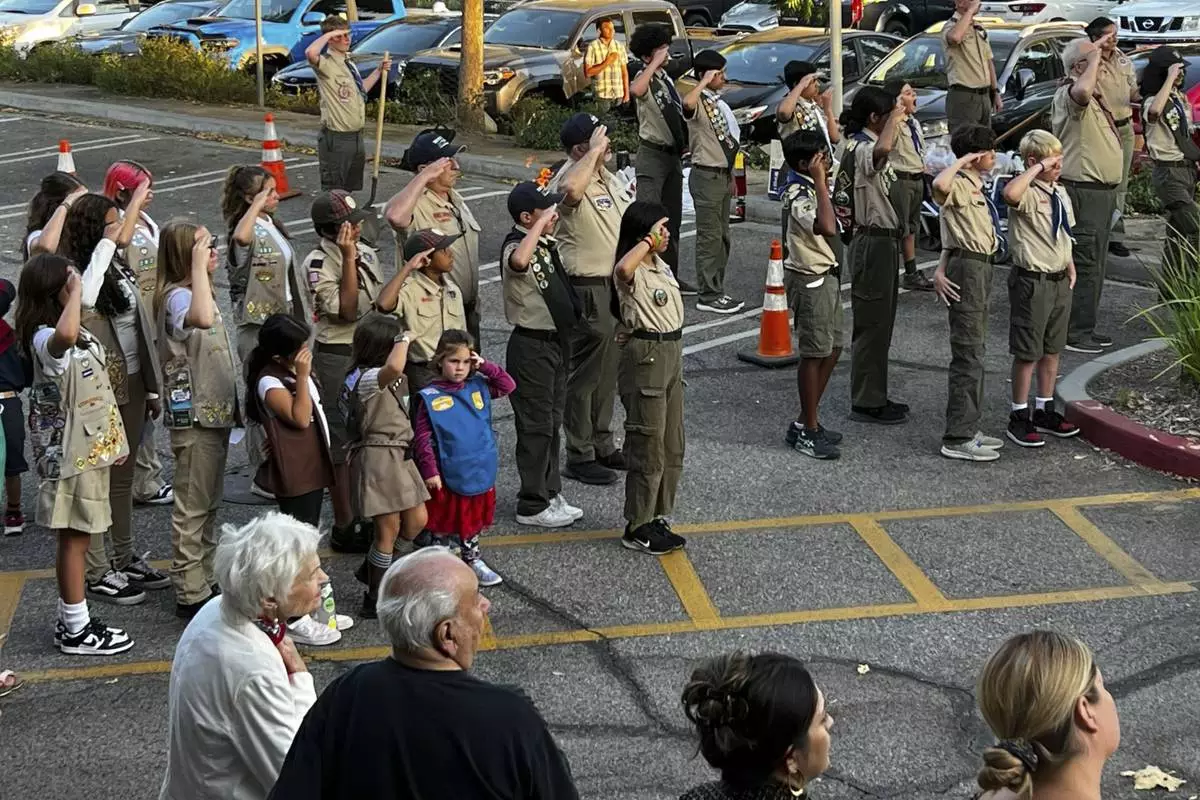
Scout Troop 228 participates in the U.S. flag retirement ceremony for Saint Kateri Tekakwitha Church during the annual Patriots Day observance at the church in Santa Clarita, Calif., on Thursday, Sept. 11, 2025. (AP Photo/Krysta Fauria)
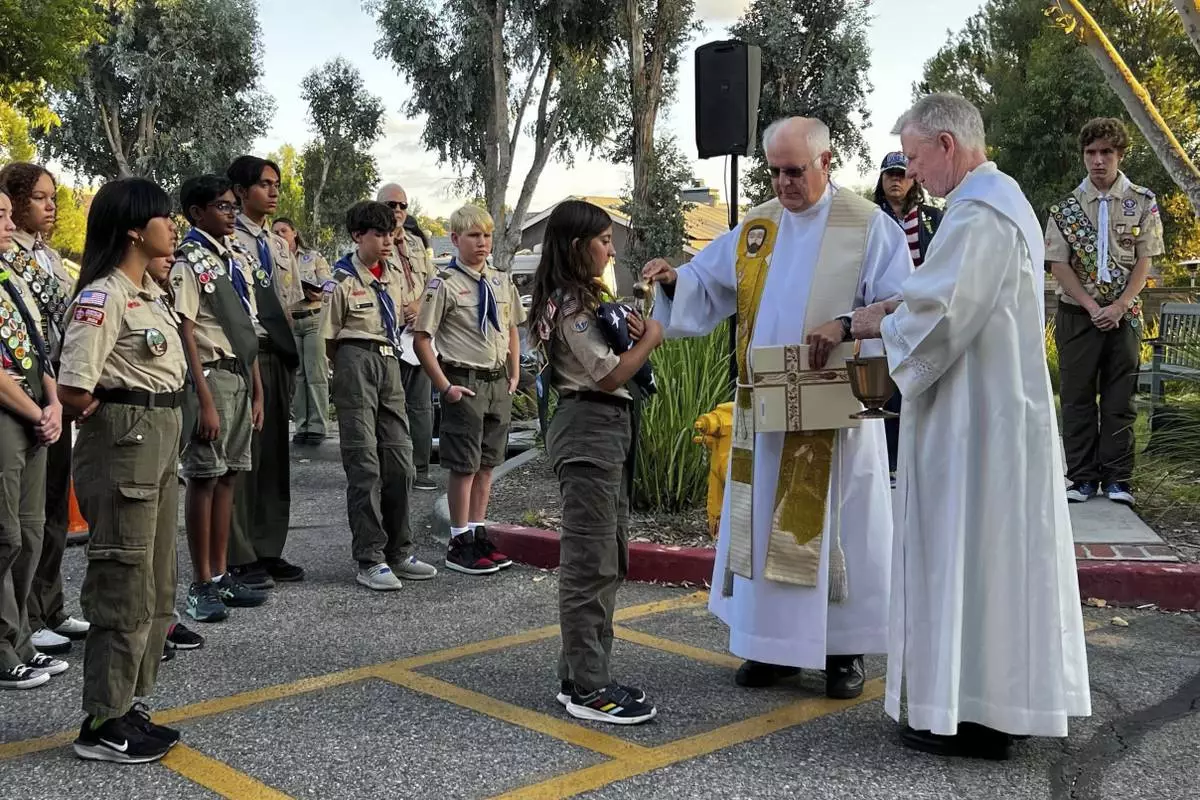
Scout Troop 228 participates in the U.S. flag retirement ceremony for Saint Kateri Tekakwitha Church during the annual Patriots Day observance at the church in Santa Clarita, Calif., on Thursday, Sept. 11, 2025. (AP Photo/Krysta Fauria)