Skip to Content Facebook Feature Image

Huawei Unveils Upgraded Xinghe AI Network Security Solution, Reshaping All-Scenario Protection with Zero-Trust Architecture

Business

Huawei Unveils Upgraded Xinghe AI Network Security Solution, Reshaping All-Scenario Protection with Zero-Trust Architecture
Business

Business

Huawei Unveils Upgraded Xinghe AI Network Security Solution, Reshaping All-Scenario Protection with Zero-Trust Architecture

2025-09-19 17:03 Last Updated At:17:25

SHANGHAI, Sept. 19, 2025 /PRNewswire/ -- At the Data Communication Summit during HUAWEI CONNECT 2025, themed "Xinghe AI Network: Shaping Intelligent Connectivity in the AI Era," Huawei officially launched the newly upgraded Xinghe AI Network Security Solution, which establishes a comprehensive zero-trust security foundation across enterprise branches, campuses, and data centers.

Zero-Trust Branch Access: AI Threat Detection Keeps Risks Out

With the rise of cloud services and remote work, enterprise branches and endpoints have become potential attack vectors. Huawei's Xinghe AI Network Security integrates SASE capabilities and enables unified management of network and security devices, centralized policy orchestration, and automated alarm correlation through the iMaster NCE-Campus controller, achieving a 99% automated threat response rate.

The USG6000F branch security gateway incorporates AI-based threat detection and an Emulator engine for unpacking malware variants, achieving a 95% detection rate for unknown threats. The HiSec Endpoint unified agent ensures consistent zero-trust access across internal and external networks, dynamically assessing risk and continuously verifying access to secure remote endpoints.

Zero-Trust Campus Interconnect: Application-Level Micro-Isolation Prevents Threat Spreading

In campus environments, IoT devices expands the attack surface, and manual policies are often overly permissive, resulting in lateral threat movement. Huawei's Xinghe AI Zero-Trust Campus Security Solution integrates AI clustering and active scanning, achieving over 95% asset identification accuracy.

Using AI to self-learn interconnect relationships, the system automatically generates fine-grained isolation policies to prevent lateral movement. The zero-trust appliance can be deployed at the edge, enabling advanced application-layer threat detection for east-west traffic — enhancing asset visibility, access control, and traffic governance.

Zero-Trust Data Security: End-to-End Protection for Large Models Ensures Data Integrity

Huawei's Xinghe AI Intelligent Computing Security Solution provides end-to-end protection for large models. During training, the XH6655 intelligent computing firewall uses a proprietary antivirus engine to detect embedded malware. During deployment, the lightweight HiSec Endpoint detects and blocks kernel-level vulnerability exploits in real time. In application, a coordinated "endpoint + network" defense mechanism enables one-click recovery of ransomware-encrypted files and protects against prompt injection attacks — ensuring the security of large model data.

Huawei will continue to evolve and innovate its Xinghe AI Network Security products and solutions, and working with global partners and customers to share the benefits of intelligent transformation and safeguard the digital journey of enterprises.

** The press release content is from PR Newswire. Bastille Post is not involved in its creation. **

Huawei Unveils Upgraded Xinghe AI Network Security Solution, Reshaping All-Scenario Protection with Zero-Trust Architecture

Huawei Unveils Upgraded Xinghe AI Network Security Solution, Reshaping All-Scenario Protection with Zero-Trust Architecture

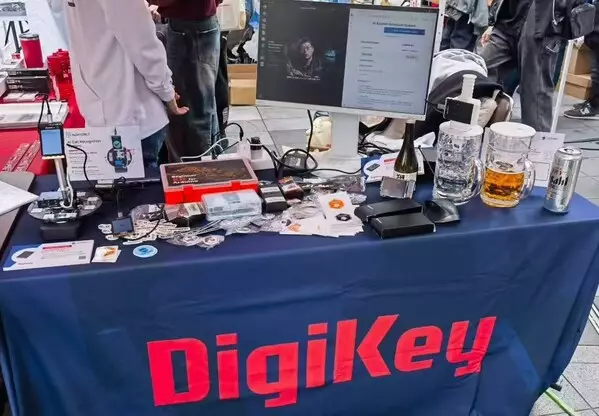
SHANGHAI, April 5, 2026 /PRNewswire/ -- DFRobot, a global leader in open-source hardware, recently participated in the Robot Hokoten @ Akihabara event in Tokyo, appearing at the DigiKey booth. The company presented two AI-driven projects based on open-source hardware—an "Electronic Nose" gas recognition system and an AI-powered cell recognition teaching system—demonstrating how AI and open hardware can be effectively applied in STEAM education and maker scenarios.

Electronic Nose: Integrating TinyML with On-Device AI

The "Electronic Nose" project combines edge AI with embedded hardware. It uses four MEMS gas sensors connected to an ESP32 running a TinyML model for real-time odor analysis. 

During the demonstration, the sensor probe was placed above a glass of beer. Within 20 to 30 seconds, the system completed odor sampling and analysis. The results were then transmitted to the LattePanda Sigma, a compact x86 computing module, which generated descriptive content or tasting notes using a locally deployed language model. The entire process was executed on-device, without relying on network connectivity.

Xia Qing, Senior Engineer at DFRobot, commented: "This demonstration shows how makers can combine TinyML-based sensing with local AI models to transform sensor data into intuitive insights. Potential applications include coffee flavor analysis, fermentation monitoring, and food freshness detection."

AI Cell Recognition: Bringing AI into the STEAM Classroom

Another featured project focused on educational applications. DFRobot presented an AI-powered cell recognition teaching system designed to integrate artificial intelligence into middle school biology education. The system is built using the HUSKYLENS 2 AI vision sensor and the UNIHIKER K10 development board.

Powered by the K230 processor with up to 6 TOPS of AI computing performance, HUSKYLENS 2 can efficiently run both pre-trained and user-trained models with low latency. In the demonstration, the system performed real-time identification and classification of cells under a microscope, making abstract AI and machine learning concepts tangible through hands-on interaction.

The project showcases the complete AI workflow—from data collection and model training to edge inference—highlighting its practical applicability in educational settings.

Partnering with DigiKey to Expand the Open-Source Hardware Ecosystem

DFRobot and DigiKey jointly showcased at Robot Hokoten to promote open-source hardware and AI education. The two parties will continue collaborating on technical content, global marketing, and educational solutions, lowering the barrier to AI and open hardware adoption, and accelerating the transition from maker projects to real STEAM classroom applications.

** This press release is distributed by PR Newswire through automated distribution system, for which the client assumes full responsibility. **

DFRobot Showcases AI Maker Projects at Robot Hokoten in Akihabara

DFRobot Showcases AI Maker Projects at Robot Hokoten in Akihabara

Recommended Articles