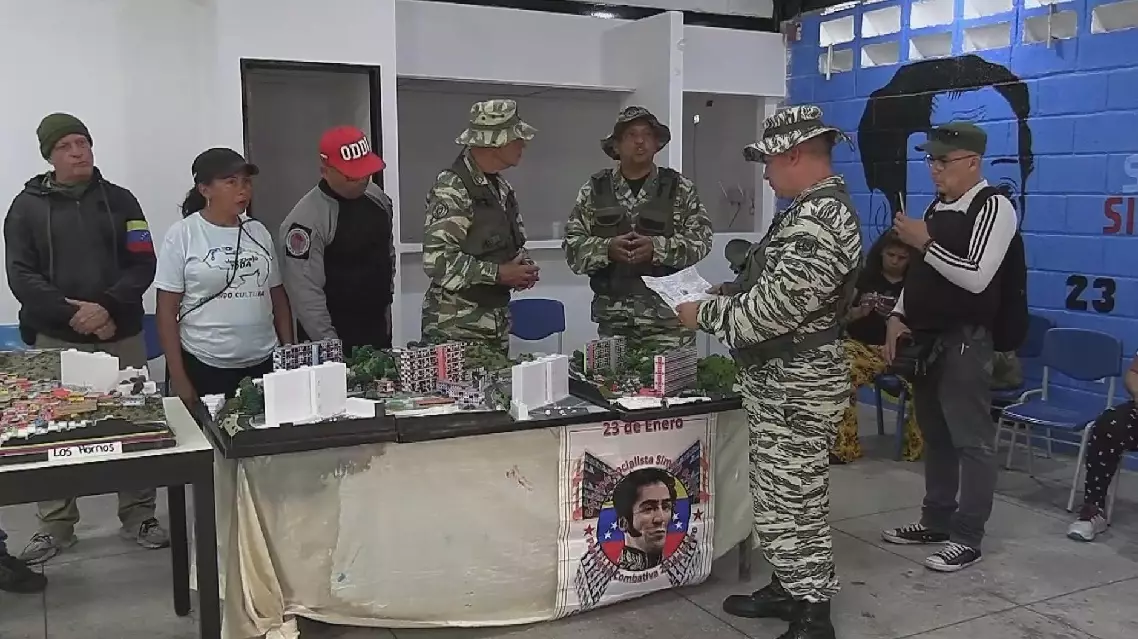
Venezuela on Saturday organized a nationwide military training program for the public, dispatching soldiers to more than 5,300 communities across the country to conduct basic military skills training amid escalating tensions with the United States in the Caribbean.
The United States has deployed several naval warships in the Caribbean Sea near the waters of Venezuela under the pretext of fighting drug trafficking networks in Latin America, leading to continued tensions between the two countries.
Venezuelan President Nicolas Maduro on Saturday said the program was one of the actions taken by the country in response to the U.S. military deployment in the Caribbean and to safeguard peace and sovereignty.
The program not only consolidated the unity between the army and the people, but also enabled the Venezuelan people to complete tactical preparations, according to Maduro.
"All issues should be resolved through politics and dialogue, rather than resorting to force or imposing will. Therefore, we will absolutely not allow the United States to infringe upon or interfere with us," said Vladimir Padrino Lopez, Venezuelan defense minister.
"We declare this to the world that Venezuela deserves respect. We are not, and will never be, a colony of any empire, nor will we allow anyone to trample on Venezuela's sovereignty," said Cortez, a local resident.
Venezuela launches nationwide military training program for public
Russian helicopter manufacturers are looking to take their partnerships with Chinese firms to new heights at the 10th China-Russia Expo, which opened in Harbin of northeast China's Heilongjiang Province on Sunday.
The expo highlights future industries including intelligent equipment, digital security, green building materials, new energy storage and other key fields.
As the largest comprehensive exchange platform between the two countries, Russia's leading helicopter makers are seeing fresh opportunities to team up with Chinese machinery firms, seeking reciprocal partnerships that draw on the strengths of both sides.
Sergei Suchilin, Head of Life Cycle Support at Russian Helicopters, part of the state-owned high-tech conglomerate Rostec, joined the event to present their best products.
"The first one is [Mil] Mi-17, the most common, the most popular model all over the world. It has a lot of different modification and can be used in very many variants of exploitation. First of all, it's for transportation for personnel and cargoes, also it can be used on search and rescue operations," said Suchilin.
Beyond showcasing, Suchilin was particularly keen to connect with Chinese exhibitors and explore potential cooperation, hoping to tap into their manufacturing edge.
"Machines and equipment, I think, it is more interesting -- like a big producing plant for us, and China is famous for its machine and equipment. This field of economics is developing very well nowadays in China," said the Russian exhibitor.
Dozens of meters away from their booth, a variety of aero-engine models for passenger planes, cargo drones and helicopters were on display in the Chinese exhibition zone, covering a comprehensive industrial chain, which is especially appealing for Suchilin.
"It's our first visit and it is really interesting for us, because there are a lot of new developing industries in China and it is very interesting to have a look, and maybe we may have some cooperation in the future, to know the projects of local producers," he said.
The enthusiasm for collaboration is mutual. Zhang Yuliang of Xinghuo Machine Tool in Hebei Province expressed strong confidence in the Russian market, thanks to the high reliability and cost performance of his products.
"We have full confidence in the Russian market. Since 2022, the share of our products exported to Russia has risen from 10 percent to 50 percent. Chinese products boast high-cost performance and stable output. We will keep expanding production capacity to meet the needs of Russian clients," he said.
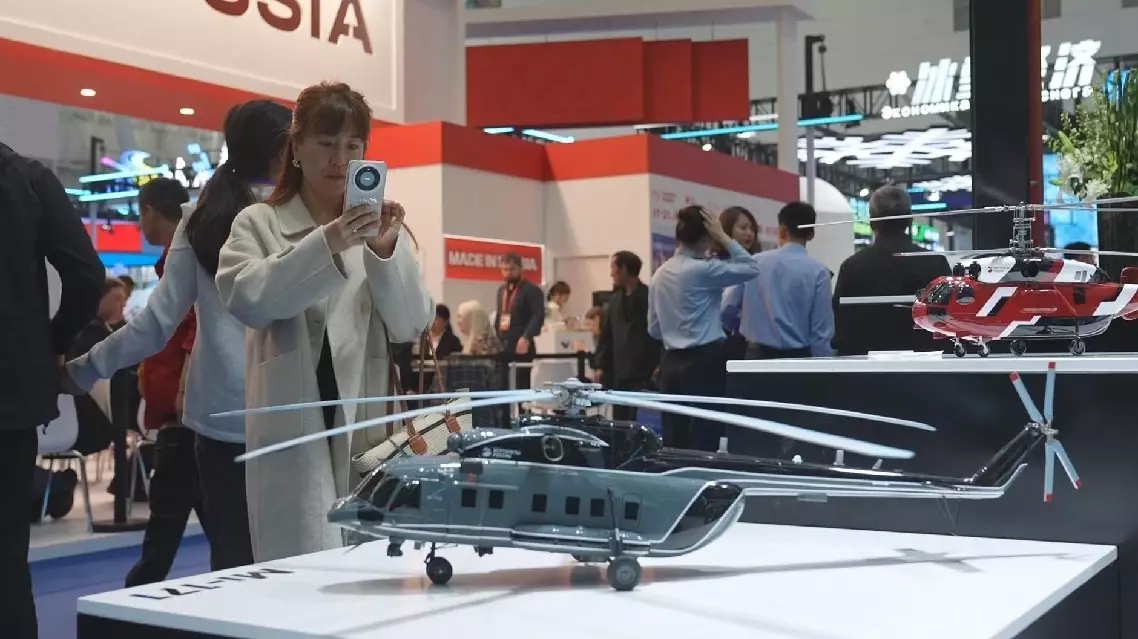
Russian helicopter makers eye collaboration with Chinese firms at China-Russia Expo