Skip to Content Facebook Feature Image

Powell signals Federal Reserve to move slowly on interest rate cuts

News

Powell signals Federal Reserve to move slowly on interest rate cuts
News

News

Powell signals Federal Reserve to move slowly on interest rate cuts

2025-09-24 02:14 Last Updated At:02:31

WASHINGTON (AP) — Federal Reserve Chair Jerome Powell on Tuesday signaled a cautious approach to future interest rate cuts, in sharp contrast with other Fed officials this week who have called for a more urgent approach.

In remarks in Providence, Rhode Island, Powell noted that there are risks to both of the Fed's goals of seeking maximum employment and stable prices. But with the unemployment rate rising, he noted, the Fed agreed to cut its key rate last week. Yet he did not signal any further cuts on the horizon.

If the Fed were to cut rates “too aggressively,” Powell said, “we could leave the inflation job unfinished and need to reverse course later" and raise rates. But if the Fed keeps its rate too high for too long, "the labor market could soften unnecessarily," he added.

Powell's remarks echoed the caution he expressed during a news conference last week, after the Fed announced its first rate cut this year. At that time he said, “it's challenging to know what to do.”

The careful approach he outlined is quite different from that of some other members of the Fed's rate-setting committee, particularly those who were appointed by President Donald Trump, who are pushing for faster cuts. On Monday, Stephen Miran said the Fed should quickly reduce its rate to as low as 2% to 2.5%, from its current level of about 4.1%. Miran was appointed by Trump this month and rushed through the Senate, taking his seat just hours before the Fed met last Tuesday. He is also a top adviser in the Trump administration and expects to return to the White House after his term expires in January, though Trump could appoint him to a longer term.

And earlier Tuesday, Fed governor Michelle Bowman also said the central bank should cut more quickly. Bowman, who was appointed by Trump in his first term, said inflation appears to be cooling while the job market is stumbling, a combination that would support lower rates.

When the Fed cuts its key rate, it often over time reduces other borrowing costs for things like mortgages, car loans, and business loans.

“It is time for the (Fed) to act decisively and proactively to address decreasing labor market dynamism and emerging signs of fragility,” Bowman said in a speech in Asheville, North Carolina. “We are at serious risk of already being behind the curve in addressing deteriorating labor market conditions. Should these conditions continue, I am concerned that we will need to adjust policy at a faster pace and to a larger degree going forward.”

Yet Powell's comments showed little sign of such urgency. Other Fed officials have also expressed caution about cutting rates too fast, reflecting deepening divisions on the rate-setting committee.

On Tuesday, Austan Goolsbee, president of the Federal Reserve's Chicago branch, said in an interview on CNBC that the Fed should move slowly given that inflation is above its 2% target.

“With inflation having been over the target for 4 1/2 years in a row, and rising, I think we need to be a little careful with getting overly up-front aggressive," he said.

Last week the Fed cut its key rate for the first time this year to about 4.1%, down from about 4.3%, and policymakers signaled they would likely reduce rates twice more. Fed officials said in a statement that their concerns about slower hiring had risen, though they noted that inflation is still above their 2% target.

In a question and answer session, Powell said that tariffs, so far, have had a fairly limited impact on inflation, though he suggested that could change.

He said U.S. companies are paying most of the tariffs, which contradicts Trump administration claims that overseas companies are shouldering the payments. But he said that the pass-through of tariff costs to consumers “has been later and less than we expected."

He also said the Fed continues to tune out attacks against it and added that the Fed does not consider politics when making its decisions. Powell and the Fed have been under steady attack from Trump, though Powell did not name him.

“Whenever we make decisions, we’re never, ever thinking about political things,” Powell said. “Truth is, mostly people who are calling us political, it’s just a cheap shot. ... We don’t get into back and forth with external people.”
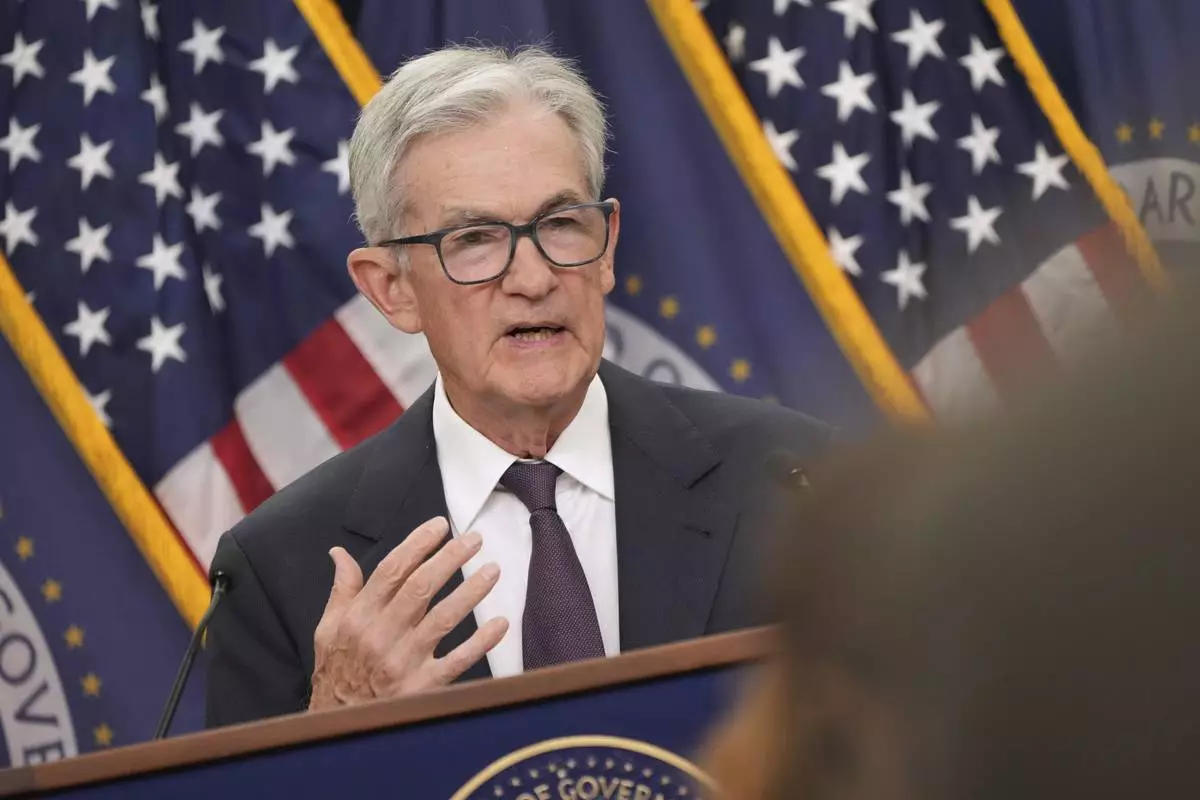
Federal Reserve Chairman Jerome Powell speaks during a news conference following the Federal Open Market Committee meeting, Wednesday, Sept. 17, 2025, at the Federal Reserve Board Building in Washington. (AP Photo/Jacquelyn Martin)
Federal Reserve Chairman Jerome Powell speaks during a news conference following the Federal Open Market Committee meeting, Wednesday, Sept. 17, 2025, at the Federal Reserve Board Building in Washington. (AP Photo/Jacquelyn Martin)
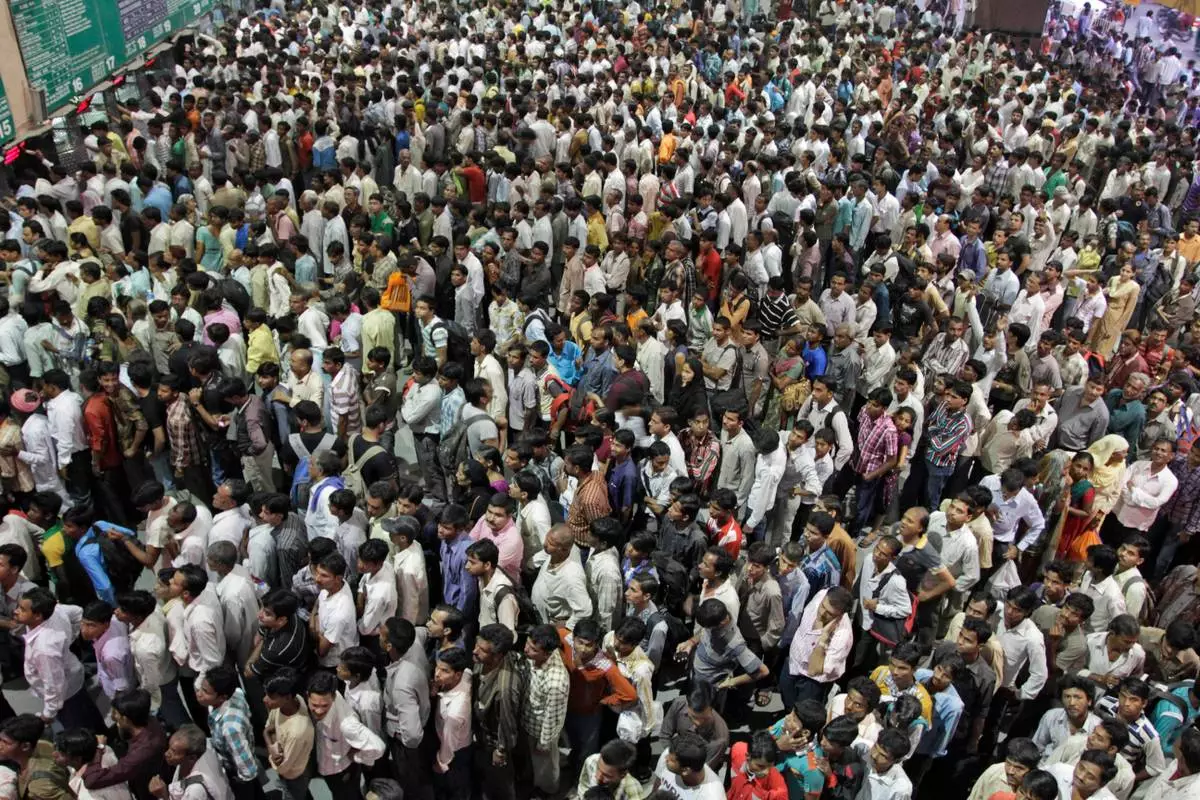
NEW DELHI (AP) — India has begun the world’s largest national population count, which could reshape welfare programs and political representation across the country.

The previous census in 2011 recorded a population of 1.21 billion. It's now estimated to be more than 1.4 billion, making India the most populous nation.

The new census had been planned for 2021 but was postponed due to the COVID-19 pandemic and logistical challenges.

Here’s how India’s census works and why it is significant:

The first phase of the count started Wednesday and will roll out around the country through September. The workers will spend about a month in each area collecting information on homes and available facilities and will document housing stock and living conditions.

The exercise will blend in-person surveys with a digital option where residents can submit information through a multilingual smartphone application that integrates satellite-based mapping.

The second phase to be conducted from September to next April 1 will record more detailed information like people's social and economic characteristics, including religion and caste.

More than 3 million government workers are expected to be deployed over the course of the year. In 2011, nearly 2.7 million enumerators surveyed more than 240 million households nationwide.

The second phase of the census will attempt a broader accounting of caste beyond historically marginalized groups.

Caste is an ancient system of social hierarchy in India and is influential in defining social standing and deciding who gets access to resources, education and economic opportunity. There are hundreds of caste groups based on occupation and economic status across India, particularly among Hindus, but the country has limited or outdated data on how many people belong to them.

The last attempt to gather detailed caste information through a census dates to 1931, during British colonial rule. Since independent India’s first census in 1951, it counted only Dalits and Adivasis, members of marginalized groups known as scheduled castes and tribes.

Successive governments have resisted conducting a full caste count, arguing it could heighten social tensions and trigger unrest.

Population data collected through the census underpins the distribution of government welfare programs and a wide range of public policies.

It could also prompt a redrawing of India’s political map, as seats in the lower house of Parliament and state legislatures may be increased to reflect population growth. A 2023 law reserves one-third of legislative seats for women, so any expansion would raise the number of seats set aside for female representatives.

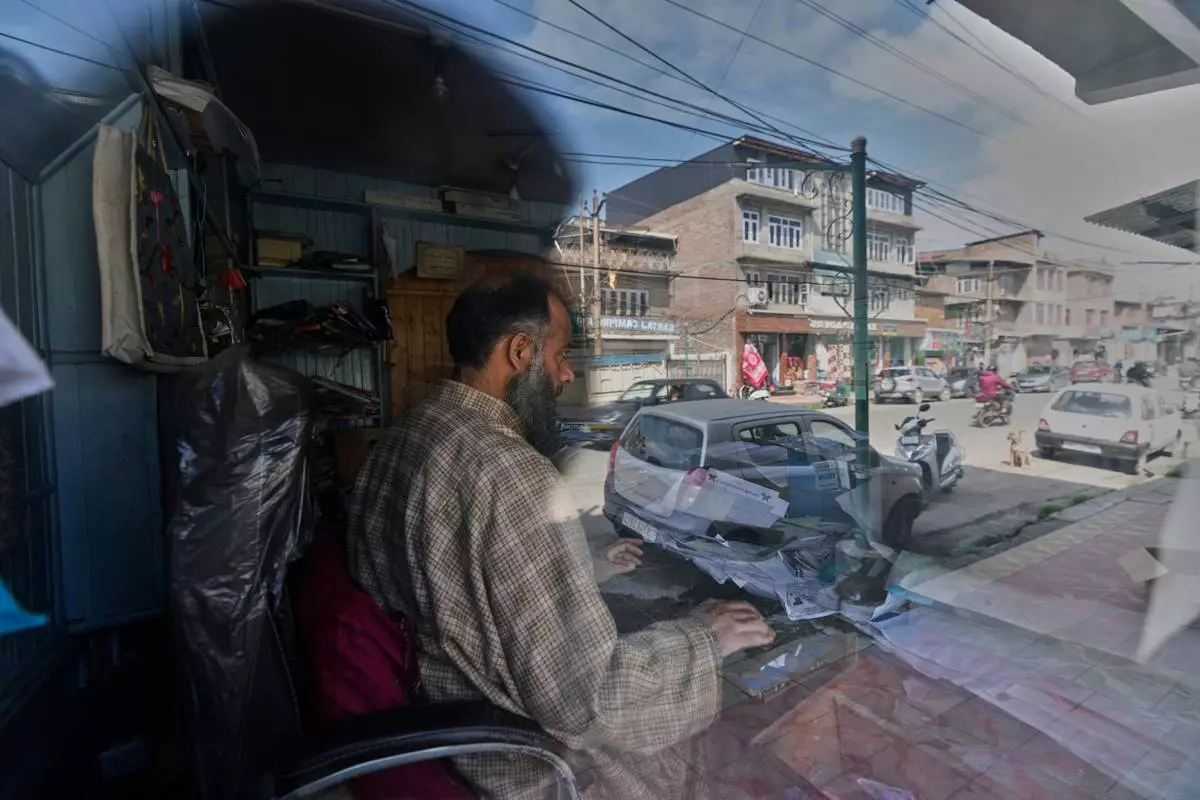
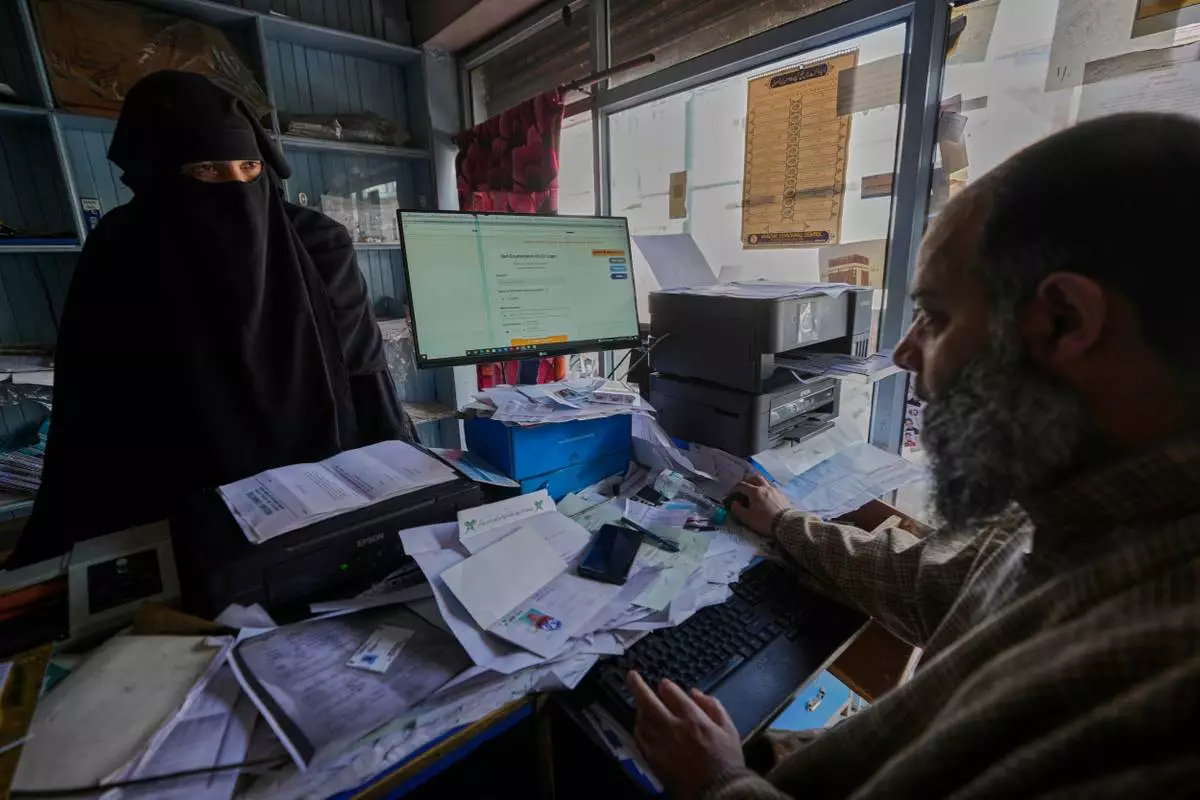
Irfan Ahmad checks census registration online at a registration center as the street is reflected on the glass in Srinagar, Indian controlled Kashmir, April 1, 2026. (AP Photo/Mukhtar Khan)

Irfan Ahmad checks census registration online at a registration center as the street is reflected on the glass in Srinagar, Indian controlled Kashmir, April 1, 2026. (AP Photo/Mukhtar Khan)

A Muslim woman checks her census registration online at a registration center in Srinagar, Indian controlled Kashmir, April 1, 2026. (AP Photo/Mukhtar Khan)

A Muslim woman checks her census registration online at a registration center in Srinagar, Indian controlled Kashmir, April 1, 2026. (AP Photo/Mukhtar Khan)

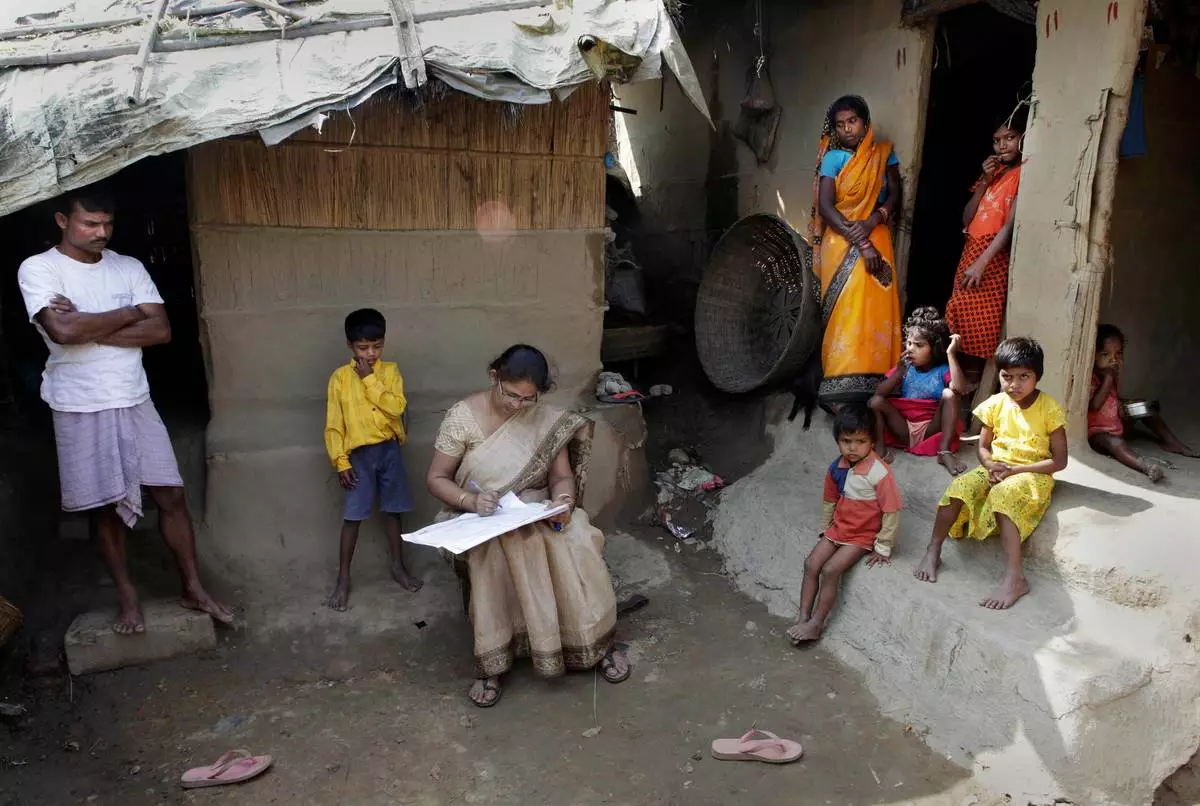
FILE -Mahesh Shah, left, stands as his family members look while census worker Rumima Das, writes the information on a paper on the first day of the national census at Ramsingh Chapori village, east of Gauhati, India, April 1, 2010. (AP Photo/Anupam Nath, File)

FILE -Mahesh Shah, left, stands as his family members look while census worker Rumima Das, writes the information on a paper on the first day of the national census at Ramsingh Chapori village, east of Gauhati, India, April 1, 2010. (AP Photo/Anupam Nath, File)

FILE - Indians crowd ticket counters at a railway station in Ahmadabad, India, Oct. 23, 2011. (AP Photo/Ajit Solanki, File)

FILE - Indians crowd ticket counters at a railway station in Ahmadabad, India, Oct. 23, 2011. (AP Photo/Ajit Solanki, File)

Recommended Articles