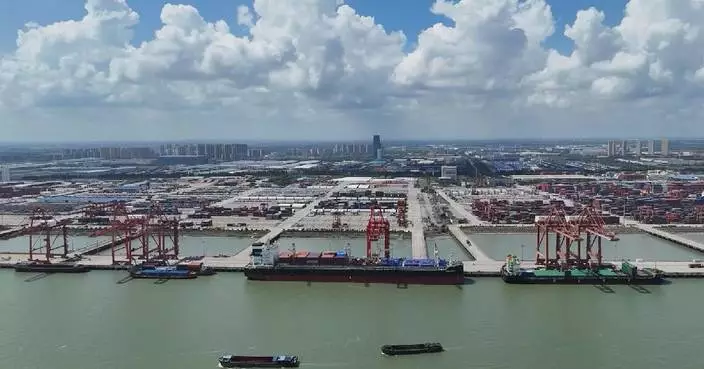
Emergency response measures have been launched in coastal areas across southern and eastern China as super typhoon Ragasa approaches, with authorities closely monitoring the dynamics of the typhoon, calling fishing vessels back ashore, and taking precautionary steps to prevent severe flooding.
According to the Ministry of Emergency Management, the powerful typhoon, the 18th of the year, is expected to make landfall along the coast between the cities of Zhuhai and Zhanjiang in south China's Guangdong Province from midday to late Wednesday.
The Ministry of Water Resources on Tuesday launched a Level IV emergency response for flood prevention in Fujian Province, Hainan Province and Guangxi Zhuang Autonomous Region, while raising that in Guangdong from Level IV to Level III.
Due to the impact of Ragasa, heavy to torrential rain is expected in eastern Fujian, central and southern Guangxi, Guangdong and Hainan until Friday, with some areas experiencing downpours.
As a result of the rainfall, major rivers such as the Jiulong River in Fujian, the Hanjiang River, the Dongjiang River, the Beijiang River and the Xijiang River in Guangdong, the Hejiang River, the Beiliu River, the Yujiang River and the Nanliu River in Guangxi, as well as the Nandu River and the Wanquan River in Hainan will experience significant rises in water levels. Some small and medium-sized rivers in the torrential rain areas are expected to experience floods above the warning levels.
The Ministry of Water Resources is continuously enhancing monitoring, forecasting and early warning efforts, while fine-tuning the flood control engineering system. The authority has coordinated the pre-release of 554 million cubic meters from the reservoirs in the Pearl River basin, fully preparing for flood control operations to minimize the possible damage caused by floods.
In response to the potential impact of Ragasa on Guangxi, the State Flood Control and Drought Relief Headquarters activated a level IV emergency response for flood and typhoon prevention in Guangxi at 20:00 on Tuesday.
Starting Monday, the maritime authorities of Guangxi had evacuated 6,000 tourists from Weizhou Island, with the last group of 572 tourists leaving the Island at 13:30 on Tuesday.
Currently all passenger ferry routes and sea cruise routes, including those from Beihai to Haikou, from Fangchenggang to Haikou, and from Beihai to Weizhou Island, have been suspended, and all 51 passenger ferry vessels in Guangxi's coastal areas have been temporarily shut down.
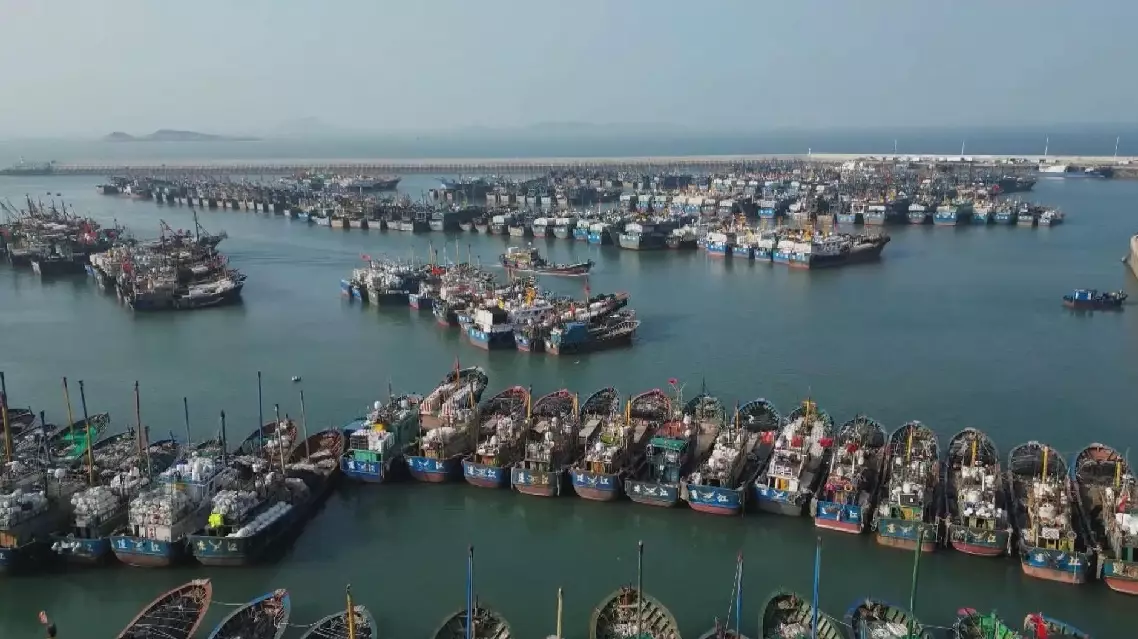
As the typhoon approaches, wind strength in various coastal areas of Fujian is gradually increasing. Local authorities have organized fishing boats to return to ports and relocated personnel engaged in offshore operations.
At around 10:00 on Tuesday, over 200 fishing boats and support vessels had docked at the Huangqi port in Fuzhou's Lianjiang County as typhoon prevention measures. By noon on Tuesday, all the 11,343 vessels in Lianjiang had returned to ports to seek shelter from the wind, and all offshore workers had been safely evacuated.
In the coastal areas of Ningde City, wind strength has gradually increased since Tuesday morning. Local fishery authorities have made early arrangements to ensure the safe return of vessels and personnel to the port for shelter.
The Hutoushan National First-Class Fishing Port in Liu’ao Town of Zhangzhou City's Zhangpu County has been fully closed since noon on Tuesday, with all vessels returning to port for shelter. Meanwhile, several coastal tourist attractions in Zhangpu have also been closed ahead of the typhoon's landfall.
Guangdong's flood control, drought relief and typhoon prevention headquarters activated a Level I emergency response to typhoon prevention at 10:00 on Tuesday.
According to the province's emergency management department, multiple departments in Guangdong have jointly established a emergency rescue team, with six rescue helicopters, one large drone, and 15 medium-sized composite-win drones being on standby for emergency operations.
Guangdong's maritime authorities have deployed 23 large specialized rescue vessels and high-horsepower tugboats, and coordinated 151 tugboats and 55 cleanup vessels, all ready for emergency rescue operations.
In terms of transportation, communication, water resources and electricity, relevant authorities have each deployed emergency rescue teams and dispatched teams to support mostly affected cities. Meanwhile, all 38,000 firefighters in Guangdong are now on standby for immediate response.
As of 11:00 on Tuesday, 10,398 vessels along the coast of Guangdong had been evacuated to safe waters for shelter, and a total of 210 passenger ferry routes had been suspended across the province. Ferry services across the Qiongzhou Strait stopped at 18:00 on Tuesday. As of Tuesday night, a total of 1,044,215 people had been evacuated throughout the province.
China's coastal areas take precautions as super typhoon Ragasa approaches