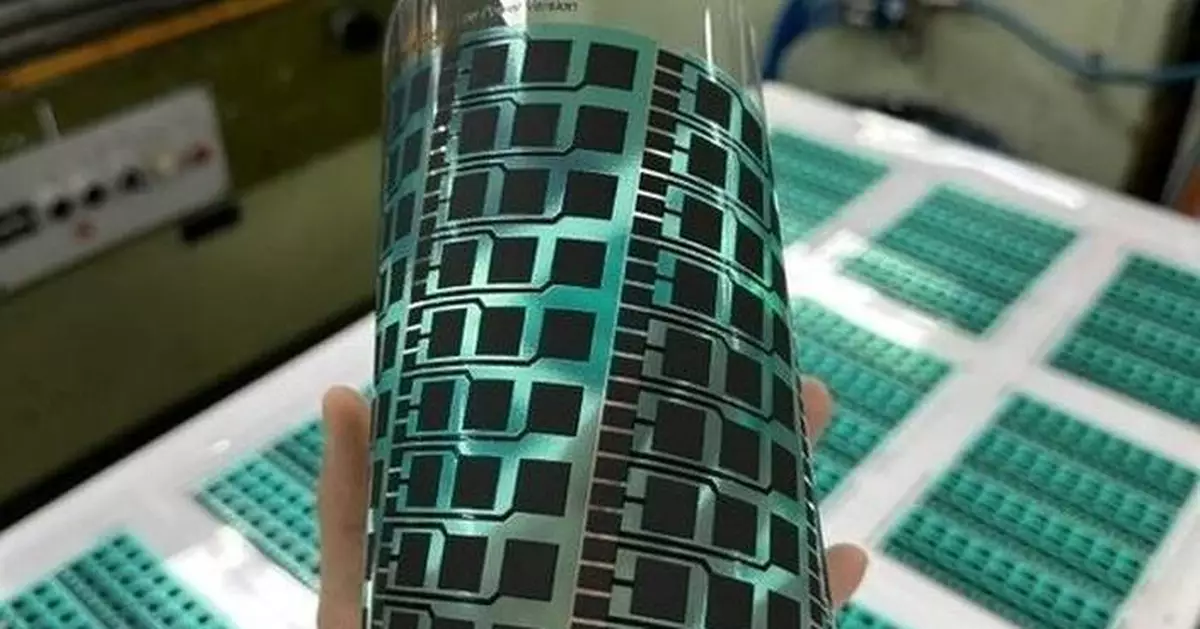
PERTH, Australia, Sept. 25, 2025 /PRNewswire/ -- ASX-listed Strategic Elements Ltd (ASX: SOR) is pleased to announce that Energy Ink — a printable ink that generates electricity from moisture in the air — has, for the first time, been used to manufacture thousands of prototype cells in a commercial facility using printing equipment commonly deployed across consumer, defence and healthcare sectors.
This achievement establishes the foundations for collaboration with international printed electronics centres and potential end-users. Through these partnerships, Energy Ink may be evaluated and co-developed into prototype cells and product demonstrators within industrial-style facilities. Building this capability broadens the opportunity base and creates a clear pathway from research conducted in Australia to active engagement with global industry.
Transfer Program Outcomes
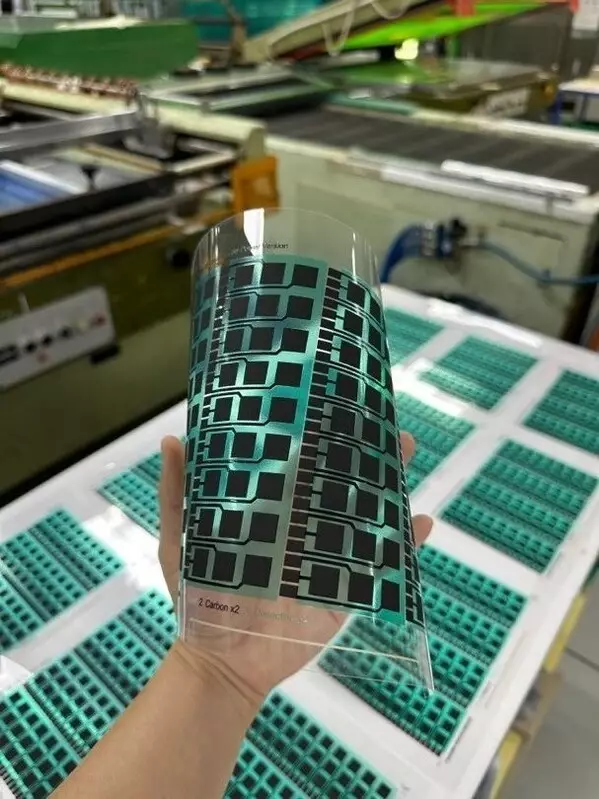
Over 2000 prototype Energy Ink cells were successfully fabricated in a single production run and validated, confirming reproducibility in a commercial facility. In addition, 30 multi-cell arrays were connected and operated continuously for seven days at the target baseline power.
Fabrication in a commercial facility
Energy Ink cells demonstrating reproducibility under industrial processes.
High Yield Achieved
2,051 of 2,052 cells (99.95%) passed compliance testing for open-circuit voltage and short-circuit current.
Connected arrays manufactured
Successfully validated that interconnected cells can operate as functional arrays.
Multiple A5 sheets produced
Marking progress toward sheet-level fabrication, essential for scaling into demonstrators and eventual commercial deployment.
Energy Ink is being developed in collaboration with a world-class materials science team at the University of New South Wales (UNSW). UNSW is globally recognised for its expertise in functional materials and electronic printing with state-of-the-art nanofabrication, printing and characterisation facilities. The technology has been supported with more than $5 million in competitive Australian Research Council (ARC) grants, including prestigious ARC Industry Fellowships.
Further Testing
Earlier development showed the low-power, disposable Energy Ink prototype powering a skin patch with two 4 cm × 4 cm cells (32 cm² total area) at 2.5 µW/cm². The transfer fabrication program scaled this performance across thousands of cells.
In the transfer program, 2,051 cells out of 2,052 achieved 100% yield for both open-circuit voltage (>1.2 V) and short-circuit current compliance. A 7-day constant current test of 30 arrays (27 cells in each array) was then conducted at a capped 10 µA per cell to match the skin patch baseline.
All 30 arrays maintained continuous output, each sustaining 270 µA (0.27 mA) for the 7-day period, with minimum power density of 2.5 µW/cm². Testing was performed under semi-controlled indoor humidity of 55%–70% RH, consistent with printed electronics facility environments.
Development Pathway & Challenges
With reproducible fabrication of prototype Energy Ink cells outside the laboratory now achieved, detailed characterisation will be undertaken to establish a robust dataset. The next objectives are to:
Energy Ink remains at an early stage, with challenges ahead:
- Performance and durability — maintaining stable output over longer periods.
- Scalability — moving from prototype cells and sheets to larger or stacked formats.
- Integration — combining effectively with circuits, sensors, and packaging.
- Timelines — pilot programs may face delays and may not guarantee commercial adoption.
Company Comment
"Congratulations to our team. We look forward to strengthening our relationship with UNSW and collaborating internationally. Deep-tech innovations, especially new power sources, take time to mature but can deliver significant upside. Our Pooled Development Fund structure is designed for this — providing patient capital to capture breakthrough opportunities." — Charles Murphy, Managing Director, Strategic Elements Strategic Elements:
Phone: +61 8 9278 2788 admin@strategicelements.com.au www.strategicelements.com.au
This announcement was authorised for release by the Strategic Elements' Board of Directors.
Strategic Elements Ltd (ASX: SOR) is a registered Pooled Development Fund (PDF) - an Australian Federal Government program stimulating investment into Australian innovation. The PDF structure provides eligible shareholders with significant tax advantages, including tax-free capital gains and dividends, while enabling Strategic Elements to pursue breakthrough innovation with longer development horizons. More information on the program can be found on the Company's website.
** The press release content is from PR Newswire. Bastille Post is not involved in its creation. **
Energy Ink Achieves Key Step Toward Global Collaboration