UNITED NATIONS (AP) — Saudi Arabia, Egypt, the United Arab Emirates and Oman — all nations in the thick of the unrest that has pervaded the Middle East — confronted the crisis in the region at the annual U.N. gathering of world leaders, with Egypt’s top diplomat warning that the Mideast “is at a point of implosion.”
All four countries on Saturday decried Israel’s ongoing pursuit of war in Gaza and the horrific impact on Palestinian civilians – and they bemoaned the failure of the United Nations and the broader international community to achieve a ceasefire and end the bloodshed.
Click to Gallery
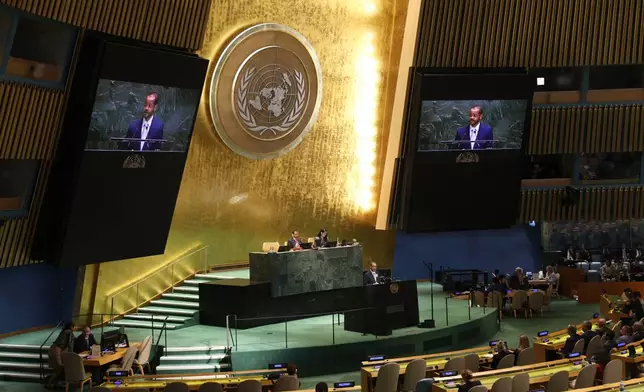
Oman Foreign Minister Badr al-Busaidi addresses the 80th session of the United Nations General Assembly, Saturday, Sept. 27, 2025, at U.N. headquarters. (AP Photo/Pamela Smith)
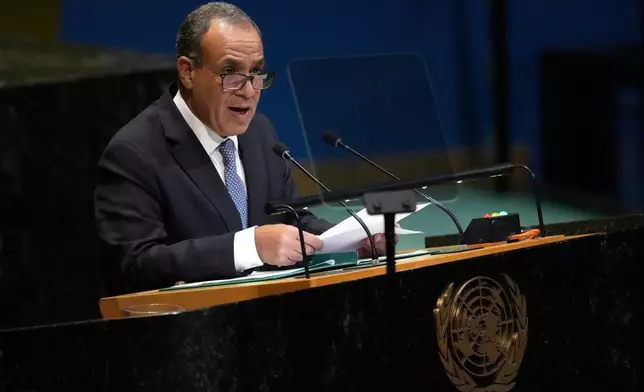
Minister for Foreign Affairs, Emigration and Egyptian Expatriates of Egypt Badr Ahmed Mohamed Abdelatty addresses the 80th session of the United Nations General Assembly, Saturday, Sept. 27, 2025, at U.N. headquarters. (AP Photo/Pamela Smith)
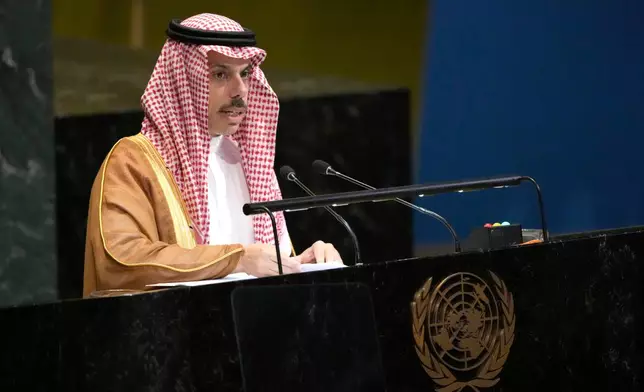
Minister for Foreign Affairs of Saudi Arabia Prince Faisal bin Farhan addresses the 80th session of the United Nations General Assembly, Saturday, Sept. 27, 2025, at U.N. headquarters. (AP Photo/Pamela Smith)
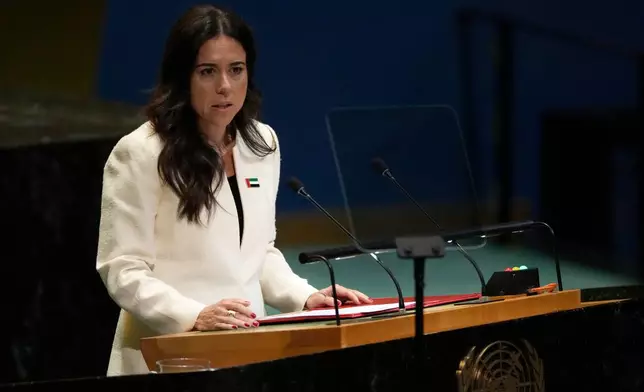
Minister for Foreign Affairs of the United Arab Emirates Lana Nusseibeh addresses the 80th session of the United Nations General Assembly, Saturday, Sept. 27, 2025, at U.N. headquarters. (AP Photo/Pamela Smith)
The four ministers spoke a day after Israeli Prime Minister Benjamin Netanyahu — facing protesters, critics and growing global isolation over his Gaza policies — told the General Assembly his country “must finish the job” against Hamas for its Oct. 7, 2023, surprise attack in southern Israel that killed about 1,200 people. Hamas also took 250 hostages. Israeli forces recently launched an offensive to take control of Gaza City.
Here's a country-by-country look at those four leaders' takes from the U.N. podium on the overall Mideast situation and Gaza in particular.
Foreign Minister Badr Abdelatty, whose country has been a key mediator in Gaza along with the United States and Qatar, sharply criticized the international community “standing idly by as a spectator” while international law is systematically violated in Gaza and elsewhere in the Middle East.
Israel’s “wanton, unjust war waged against defenseless civilians for a sin they did not commit” is “transpiring without accountability, and it has affected one country after another,” he said.
Abdelatty recalled former president Anwar Sadat’s historic visit to Israel in 1977, and Egypt becoming “one of the first to anchor the pillar of peace in the region.” But surveying the turmoiul in the Mideast today, he accused Israel of committing genocide in Gaza – which it vehemently denies – and blocking the Palestinians' fron establishing an independent state.
Abdelatty said Israel can’t be secure unless other countries in the region are secure, and “the region cannot see stability without an independent state of Palestine.”
In the region, he pointed to civil war in Sudan, the need for elections in divided Libya, resolving Yemen’s crisis between the internationally recognized government and Houthi rebels who control the capital and most of the north, and ending repeated Israeli violations of Lebanese and Syrian territory.
Saudi Arabia’s foreign minister, Prince Faisal bin Farhan, whose country hosts Russia-Ukraine-U.S. peace talks, said the suffering of Palestinians and unprecedented humanitarian crisis in Gaza make it imperative for the international community to end the war in Gaza and achieve peace through a two-state solution.
A two-state solution to the nearly 80-year Israeli-Palestinian conflict is “the only path that would guarantee the security of all countries in the region,” he said. “The failure of the international community to take firm actions to end the Israeli aggression and violation will only cause further instability and insecurity regionally and globally” and “will have grave consequences and will escalate war crimes and acts of genocide.”
Farhan said Saudi Arabia, along with Norway and the European Union, launched an international coalition to implement the two-state solution, and it co-sponsored Monday’s high-level meeting with France that saw at least 10 countries officially recognize the state of Palestine, bringing the total to near 160 recognitions.
“Such recognition is an important step towards achieving the two-state solution and bolstering the path towards a just and lasting peace,” he said.
Farhan condemned Israel’s recent attack on Qatar. He also called for “international measures” to stop Israel’s actions, “and to deter it from such criminal behavior that threatens regional security and stability.”
Omani Foreign Minister Badr bin Hamad al-Busaidi, whose country has mediated U.S.-Iran talks, called on the international community “to apply effective pressure to bring Israel to the negotiating table” — and to adopt measures limiting its ability to continue its killings, destruction, occupation and policies “of starvation and blockade against the Palestinian people.”
He condemned Israeli aggression against Iran, Yemen, Syria and Lebanon and called for sanctions against Israel in response to its violation of international law and “unlawful encroachment” on the sovereignty of states.
"We call for a global peaceful campaign to lift the blockade and undo the injustice imposed on the Palestinian people and to secure their freedom through the establishment of an independent and sovereign Palestinian state," al-Busaidi said.
Calling it “a pivotal moment” in a world engulfed in turmoil and conflict, the United Arab Emirates’ deputy foreign minister Lana Nusseibeh said there is no justification for Hamas taking hostages or for Israel targeting “tens of thousands of civilians or besieging them or starving them and forcibly displacing them.”
Israel’s “unacceptable, expansionist ambitions including the threat of annexing the West Bank” are also inexcusable, she said.
Nusseibeh urged all countries to recognize the state of Palestine “as an investment in a better future for the region.”
The UAE has tried to bridge divides elsewhere in the conflict-torn world, she said, pointing to its role in the exchange of thousands of prisoners between Russia and Ukraine, hosting peace talks between Armenia and Azerbaijan, and helping to de-escalate tensions in south Asia and beyond.
“Our aim is not simply to manage conflicts, but to resolve them sustainably,” Nusseibeh told the assembly. “The urgent need for this approach is clear around the world, whether in the Gaza Strip, Ukraine, Sudan, Yemen, Libya or the Sahel.”
Many crises have been exacerbated by extremist ideologies, hate speech and incitement, which is why the UAE is promoting an agenda of tolerance, peace and security, she said. The UAE is also the largest donor of aid to Gaza, she said.
Edith M. Lederer has been covering international affairs for The Associated Press for more than a half centuryt.
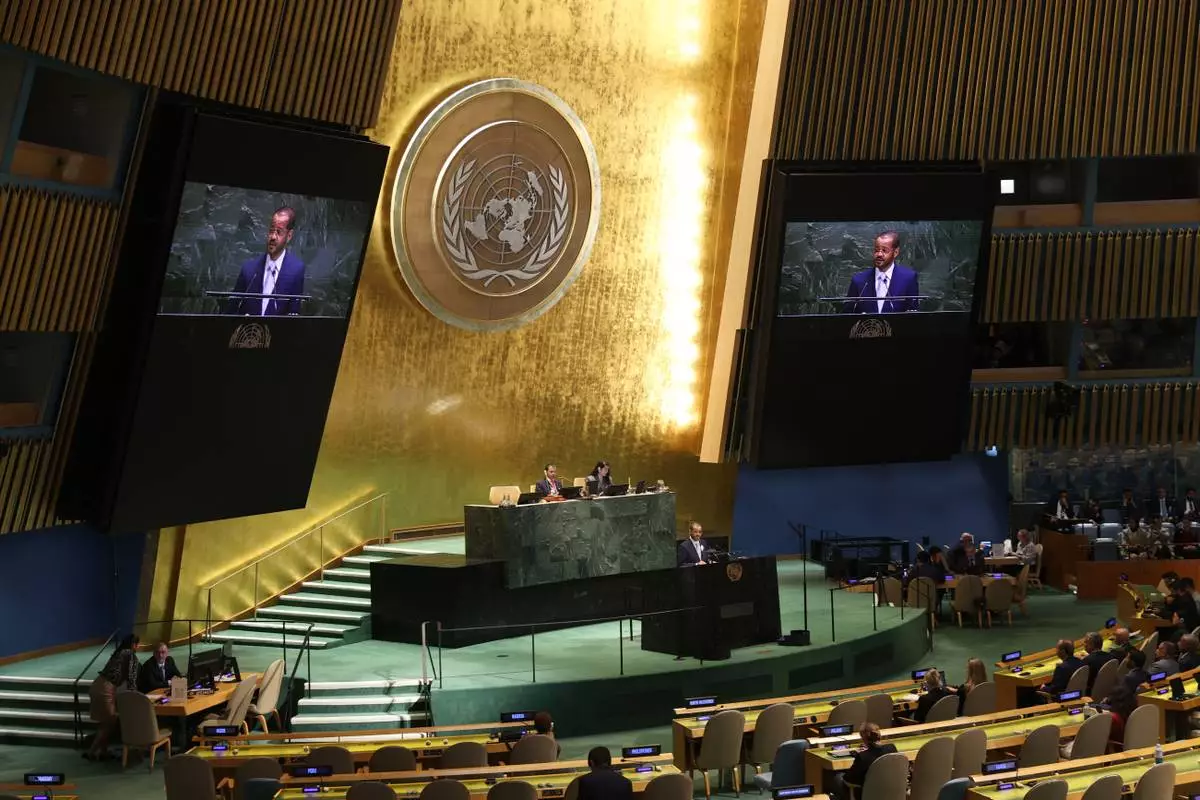
Oman Foreign Minister Badr al-Busaidi addresses the 80th session of the United Nations General Assembly, Saturday, Sept. 27, 2025, at U.N. headquarters. (AP Photo/Pamela Smith)
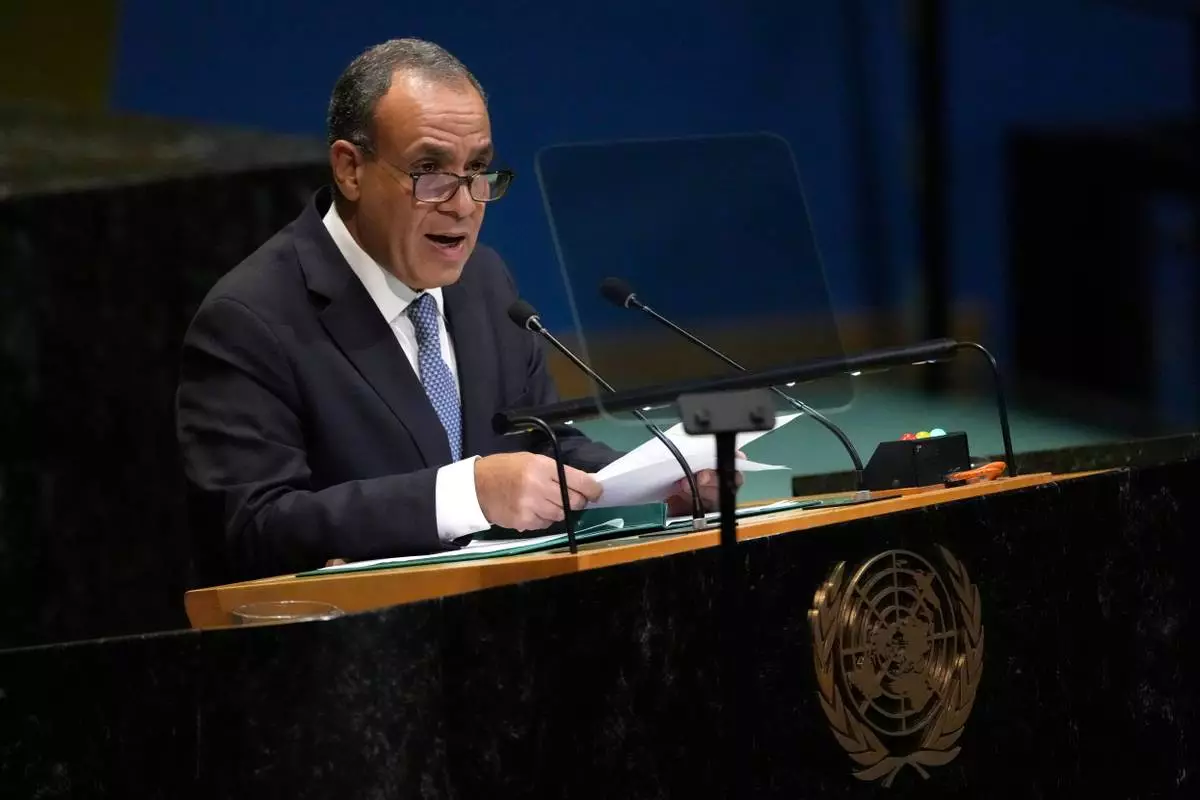
Minister for Foreign Affairs, Emigration and Egyptian Expatriates of Egypt Badr Ahmed Mohamed Abdelatty addresses the 80th session of the United Nations General Assembly, Saturday, Sept. 27, 2025, at U.N. headquarters. (AP Photo/Pamela Smith)
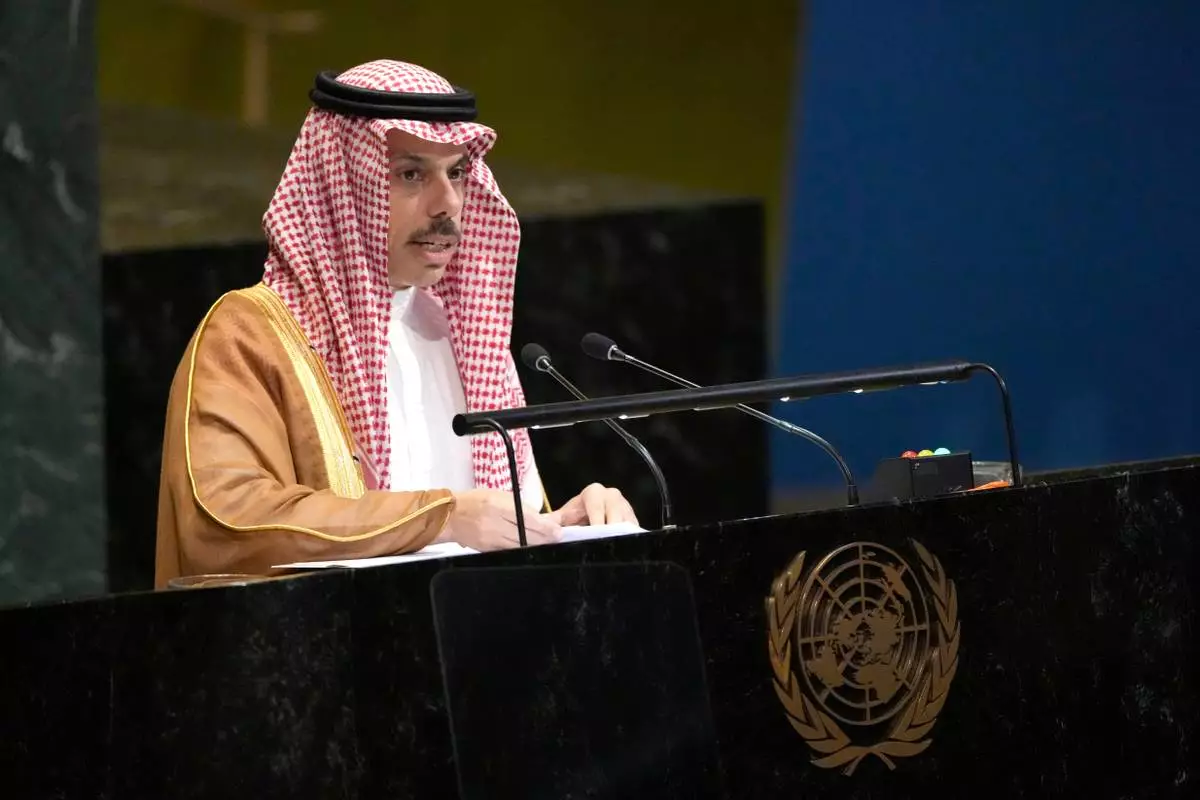
Minister for Foreign Affairs of Saudi Arabia Prince Faisal bin Farhan addresses the 80th session of the United Nations General Assembly, Saturday, Sept. 27, 2025, at U.N. headquarters. (AP Photo/Pamela Smith)
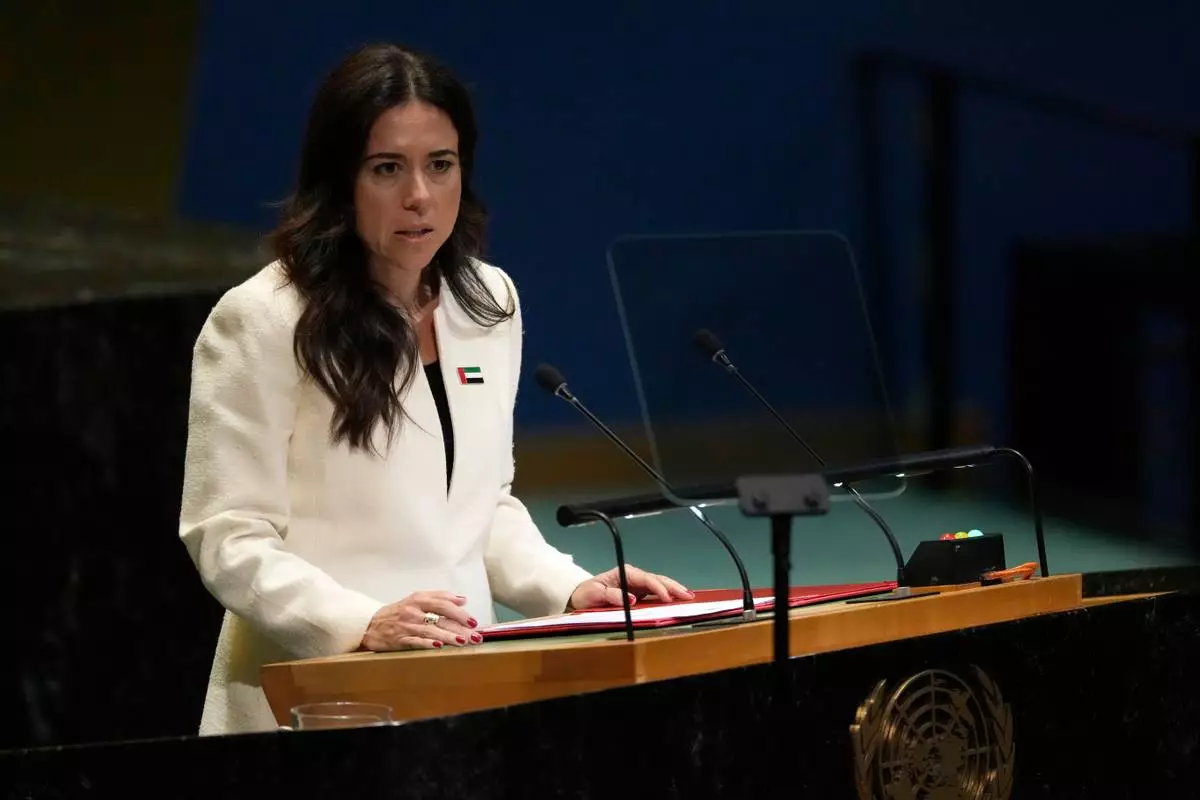
Minister for Foreign Affairs of the United Arab Emirates Lana Nusseibeh addresses the 80th session of the United Nations General Assembly, Saturday, Sept. 27, 2025, at U.N. headquarters. (AP Photo/Pamela Smith)