On her first full day of preschool, Alexander Lane's 3-year-old daughter stayed in the car for an hour at drop-off because she didn't want to go inside. On the second day, she entered class in tears.
But by the third day, she eagerly ran into the classroom.
Starting preschool or kindergarten is a milestone, but also a source of anxiety for some children, including many who are experiencing their first extended period of time away from a parent or guardian.
Lane already knew his daughter was nervous about being away from her parents. She had resisted going to a couple of classes several months ago, so Lane decided to give her a break before enrolling her in preschool.
"It's not productive to tell someone, 'You'll just enjoy this if you push through and do it.' Like, that's not very persuasive," said Lane, of Minneapolis.
Separation anxiety is not uncommon, especially for young children. In fact, experts say that it's a natural part of growing up.
“As we're starting a new school year, we're going into a new classroom, our routine is changing ... there's going to be some of this anxiety and time that you would expect that a child would need to transition,” said Erica Lee, a psychologist at Boston Children’s Hospital.
But if a child demonstrates symptoms of separation anxiety for prolonged periods of time, it can hinder their daily activities and may need a clinical diagnosis. Here's some steps to acclimate young kids to school and make drop-off easier.
In almost two decades of teaching preschool, Kimberly Skukalek, of Pinellas County, Florida, would have a handful of children every year who experienced separation anxiety. Her goal was to show that school was a safe space where they could make new friends.
And that message wasn't just for anxious children — it was for the parents too, she said.
“Some parents ... especially if it's their first kiddo, they're more scared than the kiddo is,” Skukalek said.
Parents who feel their children cannot handle a difficult situation can prevent them from building resilience, said Izabela Milaniak, a psychologist at the Children's Hospital of Philadelphia. Giving into a child's fears, such as letting them avoid school, often worsens separation anxiety because the avoidance breeds more distress, Milaniak said.
That's why she reinforces with parents the importance of raising brave kids. Having children confront scary situations — being alone in this case — shows them they are capable of doing tough tasks, even if it's uncomfortable.
“It's giving them opportunities to learn how to self-soothe, to learn how to be alone, which is part of what we all as humans need to learn,” Milaniak said.
Milaniak suggests a two-pronged approach for a child already dealing with separation anxiety: Validate their feelings, but stay firm. Treating a child's anxieties with respect is important, but “compassionate limit-setting” is essential to building their confidence.
When Patrick Edmondson’s child, Miles, started preschool in 2023, the 3-year-old would resist getting ready in the morning and become emotional when it came time to separate from his parents. While Edmondson and his wife had empathy for their son's fears, he said they didn't want to indulge his anxiety by allowing him to skip school.
“If he was really having a problem, that option exists, but we don't really disclose that to him,” said Edmondson, of Washington, D.C., said. “If that was the case, he would just say ‘I don’t want to do it. It's too scary, I don't want to go today.'”
Miles' parents implemented a few tactics to help their son, including offering reassurance that they would come back for him. Another tool was letting Miles choose a “bravery toy," that made him feel safer at school, such as a Hot Wheels car or a stuffed animal, Edmondson said.
Now in kindergarten, Miles rides the bus to school, and he loves it, Edmondson said.
Gradually exposing a child to separation can help them become more comfortable with it, Lee said. Parents can start by doing short bursts of separation — such as going into another room for 5 minutes — to build their child's tolerance. As a child gets used to it, parents can increase the length of time within reasonable limits.
Creating a brief goodbye ritual can also benefit a child dealing with separation anxiety, Lee said, because it creates a sense of routine without dragging out a parent's departure.
Lane, the father from Minneapolis, eased his daughter's transition into formal preschool by having her attend half-day classes over the summer.
They spend Sunday night talking about what activities she might do in class, as well as packing her lunch and picking out her outfit together, which makes her more comfortable, he said.
“That kind of gets her involved so it's not just something happening to her,” he said.
Many of the symptoms of separation anxiety revolve around delaying or preventing separation from a caregiver. That could mean a child throws tantrums at school drop-off, follows their parent around the house or resists sleeping in their own room.
“That fear of separation is really rooted in a child being scared that something bad will happen to their parents or something bad will happen to themselves if they are apart from their caregivers,” Lee said.
When separation anxiety persists for several weeks or months, Lee said it may be time to check in with a pediatrician. But it’s also something she said kids can overcome at any age because it is “highly treatable.”
——
The Associated Press’ education coverage receives financial support from multiple private foundations. AP is solely responsible for all content. Find AP’s standards for working with philanthropies, a list of supporters and funded coverage areas at AP.org.

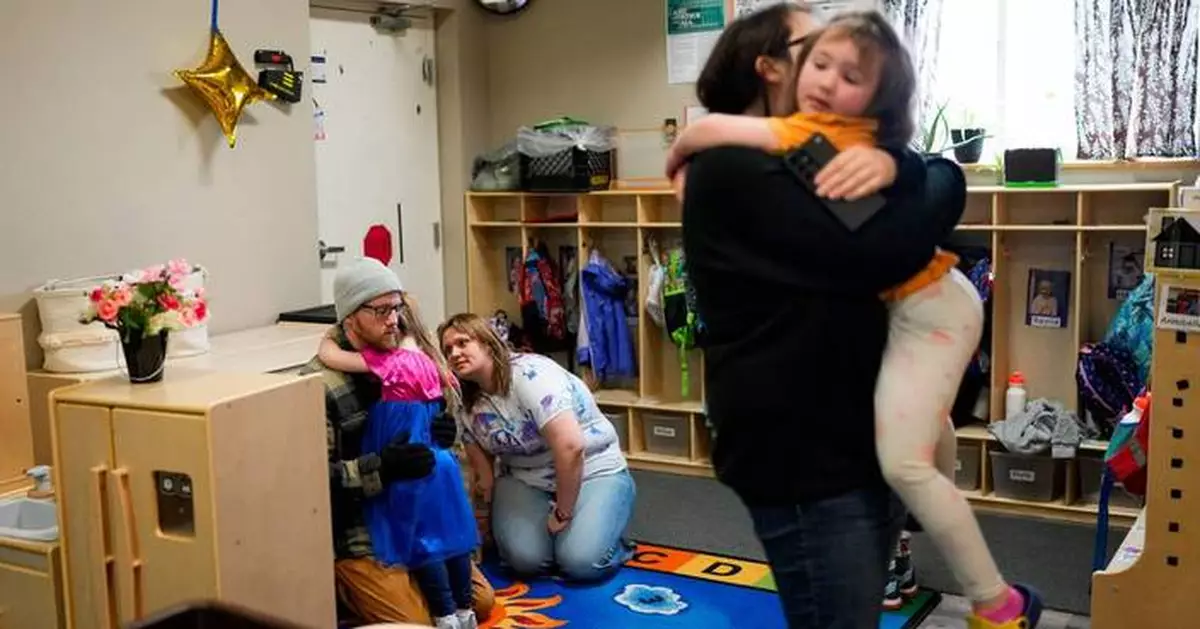
FILE - Olivia Starr clings to her father, Thaxter Hall, as Associate Educator Jessica Clark works to comfort her as she is dropped off for the last day of school at the Meadow Lakes CCS Early Learning, a Head Start center, May 8, 2024, in Wasilla, Alaska. (AP Photo/Lindsey Wasson, File)