Doctors at Tygerberg Hospital in Cape Town have successfully conducted South Africa's first living donor kidney removal using robotic surgery technology, a medical milestone that promises faster recovery, less pain, and greater surgical precision.
In a historic breakthrough for South African healthcare, a team of surgeons at the hospital used the cutting-edge technology to carry out the pioneering operation involving a 54-year-old mother donating her kidney to her 24-year-old daughter.
The success of the procedure stems from the advanced capabilities of the robotic system used, which significantly improves visualization and control during surgery.
"The vision that you have through the robot is 3D HD, but it's up close. You can get much closer to what you're working on than you would with your naked eye. So it makes it much, much more safe, in my opinion. And the margin of error becomes much smaller than it would be before traditional surgery," said Dr. Danelo du Plessis, urologist and senior lecturer at Tygerberg Hospital and Stellenbosch University.
During the operation, surgeons removed a healthy kidney from the mother using robotic instruments and preserved vital structures so the organ could be safely transplanted.
"Donating the kidney is a highly complex surgery because you not only remove the kidney as you would for a cancer, but preserve the blood vessels and the ureter pipe going to the bladder with its blood supply. And you have to make sure that the blood vessels are at their full length," said Dr. du Plessis.
With thousands of South Africans on transplant waiting lists, experts believe robotic surgery may pave the way for safer and more efficient operations, especially in the public sector.
"There is a big need for more kidney donors. But in the government sector, we don't really have the capacity to do many more. But at least if we do it like this with the robot, the efficiency is so high that the ones that we can do can be done more effectively," said Dr. Andre van der Merwe, head of Urology at Tygerberg Hospital and Stellenbosch University.
In recent years, Tygerberg Hospital and Stellenbosch University have invested in robotic training for public-sector doctors through a targeted education program. The initiative not only promotes equity in healthcare access, but also lays the groundwork for South Africa to become a training hub for surgeons across the continent.
"We will definitely move forward to try and push the boundaries and see how much better and more effective and more efficient we can become. With a robot, efficiency and predictability is a big plus," said Dr. van der Merwe.
This milestone goes beyond changing one family's future, it demonstrates how cutting-edge technology is transforming public healthcare in South Africa, paving the way for advanced surgical procedures to become more accessible to all.
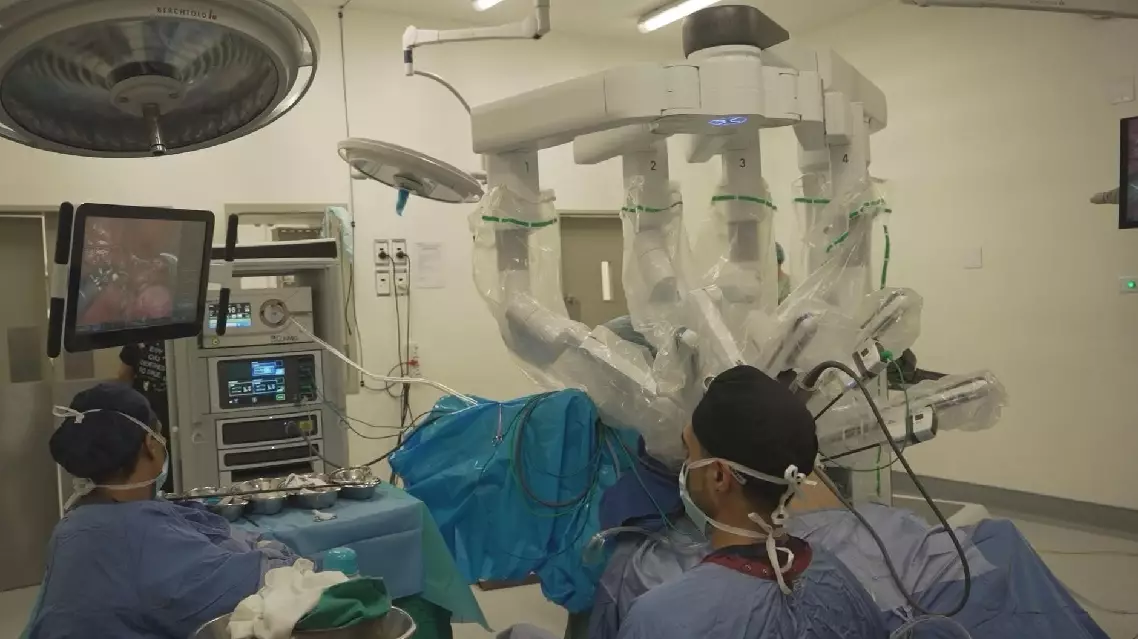
Tygerberg doctors perform South Africa's first robotic-assisted living donor kidney surgery
Tygerberg doctors perform South Africa's first robotic-assisted living donor kidney surgery
Tygerberg doctors perform South Africa's first robotic-assisted living donor kidney surgery