|
- Aiming to strengthen the private-sector-led domestic automotive semiconductor ecosystem, expanding interdisciplinary cooperation across foundries, fabless companies, packaging companies, and more
- The company hosted the inaugural Auto Semicon Korea with the goal to localize automotive semiconductors and create a self-sustaining domestic value chain and business opportunities
- Expected to create new growth engines in the mobility sector and build a stable supply chain by securing independent semiconductor development capabilities and production capacity
SEOUL, South Korea, Sept. 29, 2025 /PRNewswire/ -- To strengthen automotive semiconductor competitiveness and expand the ecosystem in Korea, Hyundai Mobis(KRX 012330) is leading a collaboration of over 20 companies and research institutions. This marks the first private-sector-led 'K-automotive semiconductor' cooperation, expected to contribute to domestic automotive semiconductor industry development alongside core semiconductor localization.
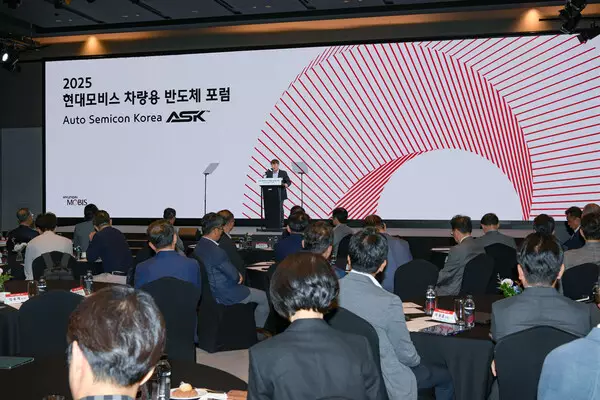
Hyundai Mobis announced that it held the first 'Auto Semicon Korea' (ASK) on 29 at DoubleTree by Hilton Seoul Pangyo, Korea, attended by 23 companies and research institutions, including automakers, fabless companies, foundries, design houses, packaging companies, and design tool specialists.
The event was attended by Hyundai Mobis President Lee Gyu-suk, along with numerous C-suite executives and relevant officers from major companies, including Samsung Electronics, LX Semicon, SK keyfoundry, DB HiTek, GlobalFoundries, Dongwoon Anatech, and Korea Electrotechnology Research Institute (KERI)
This marks the first joint initiative led by private companies, including Hyundai Mobis, to address the automotive semiconductor industry. Until now, the automotive semiconductor sector has been heavily reliant on foreign products from Europe, North America, and Japan. Korean companies have now united to form a self-sustaining value chain and create new business opportunities to improve this situation.
Hyundai Mobis plans to play a leading role in fostering the Korean automotive semiconductor industry alongside the major companies participating in the forum. As a global Tier 1 automotive supplier, Hyundai Mobis occupies a strategic position connecting technology and demand between automakers and semiconductor suppliers. Furthermore, the company is simultaneously a fabless company designing semiconductors and a supply chain manager, positioning it as a prime candidate to lead the domestic semiconductor industry.
The event commenced with a welcome address by Hyundai Mobis President Lee Gyu-suk, followed by presentations and discussions on various topics including 'The Necessity of Establishing a Korean Automotive Semiconductor Ecosystem', 'Strategies for Localizing Core Mobility Semiconductors', and 'Technical Direction for Building a Collaborative Framework'.
"We are securing independent semiconductor design capabilities while pursuing joint development with fabless companies and design houses, and expanding cooperation with major foundries. We actively encourage companies specialized in home appliances or mobile to enter the mobility sector, and through this, we will take the lead in building the domestic ecosystem," Lee said.
Hyundai Mobis plans to play a pivotal role in developing ASK into Korea's leading automotive semiconductor forum starting this year. The forum will be held annually, and starting next year, participation will be encouraged from startups and existing companies possessing semiconductor-related technologies. The forum will also open its doors to relevant associations and major institutions.
- Planning to build a supply chain satisfying both demand companies and suppliers simultaneously also giving an advantage in the race for R&D speed
Park Chul-hong, Executive Vice President and Head of the Semiconductor Business at Hyundai Mobis, emphasized the importance of synergy between automotive semiconductors and controllers, stating, "The key to automotive semiconductors lies in optimal integration with the controller." He added, "To enhance the differentiated competitiveness of domestic companies, Hyundai Mobis defines controller-specific specifications and supports real-vehicle-based validation, enabling significantly faster development cycles."
In fact, Hyundai Mobis projected that for drive systems, which determine electric vehicle range, pursuing integrated development rather than developing power semiconductors and core components separately could shorten the development time by up to nearly two years. This raises expectations that partners newly entering the automotive semiconductor field alongside Hyundai Mobis will be able to achieve results quickly.
The same applies to system semiconductors installed in controllers for core components. Hyundai Mobis is mass-producing a total of 16 types of semiconductors it developed in-house this year, including power, drive, communication, sensor, and data processing semiconductors, through external foundries. The volume reaches 20 million units. Analysis suggests that the more domestic companies participate, the faster results can be achieved in semiconductor localization, with significant economic ripple effects.
Hyundai Mobis plans to leverage this forum to actively support semiconductor companies with strengths in consumer sectors like mobile as they enter the mobility field in the short term. In fact, Hyundai Mobis' semiconductor R&D process recently obtained the international ISO 26262 certification. The company intends to share its accumulated R&D expertise—gained throughout the entire process from design to quality management—with partners, thereby contributing to enhancing the competitiveness of domestic companies.
Among the companies participating in ASK, GlobalFoundries and Dongwoon Anatech recently completed joint development with Hyundai Mobis and are poised to begin mass production of next-generation lamps and power semiconductors. These companies, specialized fabless semiconductor companies in TV and mobile sectors respectively, are seen as examples of expanding their footprint into automotive semiconductors by partnering with Hyundai Mobis.
Meanwhile, according to a global market research firm, the automotive semiconductor market is growing rapidly at an average annual rate of 9%. This market is projected to grow to approximately $135 billion (about 188 trillion won) by 2030. Within this, Hyundai Mobis' key order items—semiconductors for infotainment and connectivity, advanced driver assistance systems (ADAS), and electrification—are expected to account for about 70% of the total market.
About Hyundai Mobis
Hyundai Mobis is the global no. 6 automotive supplier, headquartered in Seoul, Korea. Hyundai Mobis has outstanding expertise in sensors, sensor fusion in ECUs and software development for safety control. The company's products also include various components for electrification, brakes, chassis and suspension, steering, airbags, lighting, and automotive electronics. Hyundai Mobis operates its R&D headquarters in Korea, with four technology centers in the United States, Germany, China, and India. For more information, please visit the website at http://www.mobis.com
Media Contact
Choon Kee Hwang : ckhwang@mobis.com
Jihyun Han : jihyun.han@mobis.com
- Aiming to strengthen the private-sector-led domestic automotive semiconductor ecosystem, expanding interdisciplinary cooperation across foundries, fabless companies, packaging companies, and more
- The company hosted the inaugural Auto Semicon Korea with the goal to localize automotive semiconductors and create a self-sustaining domestic value chain and business opportunities
- Expected to create new growth engines in the mobility sector and build a stable supply chain by securing independent semiconductor development capabilities and production capacity
SEOUL, South Korea, Sept. 29, 2025 /PRNewswire/ -- To strengthen automotive semiconductor competitiveness and expand the ecosystem in Korea, Hyundai Mobis(KRX 012330) is leading a collaboration of over 20 companies and research institutions. This marks the first private-sector-led 'K-automotive semiconductor' cooperation, expected to contribute to domestic automotive semiconductor industry development alongside core semiconductor localization.
Hyundai Mobis announced that it held the first 'Auto Semicon Korea' (ASK) on 29 at DoubleTree by Hilton Seoul Pangyo, Korea, attended by 23 companies and research institutions, including automakers, fabless companies, foundries, design houses, packaging companies, and design tool specialists.
The event was attended by Hyundai Mobis President Lee Gyu-suk, along with numerous C-suite executives and relevant officers from major companies, including Samsung Electronics, LX Semicon, SK keyfoundry, DB HiTek, GlobalFoundries, Dongwoon Anatech, and Korea Electrotechnology Research Institute (KERI)
This marks the first joint initiative led by private companies, including Hyundai Mobis, to address the automotive semiconductor industry. Until now, the automotive semiconductor sector has been heavily reliant on foreign products from Europe, North America, and Japan. Korean companies have now united to form a self-sustaining value chain and create new business opportunities to improve this situation.
Hyundai Mobis plans to play a leading role in fostering the Korean automotive semiconductor industry alongside the major companies participating in the forum. As a global Tier 1 automotive supplier, Hyundai Mobis occupies a strategic position connecting technology and demand between automakers and semiconductor suppliers. Furthermore, the company is simultaneously a fabless company designing semiconductors and a supply chain manager, positioning it as a prime candidate to lead the domestic semiconductor industry.
The event commenced with a welcome address by Hyundai Mobis President Lee Gyu-suk, followed by presentations and discussions on various topics including 'The Necessity of Establishing a Korean Automotive Semiconductor Ecosystem', 'Strategies for Localizing Core Mobility Semiconductors', and 'Technical Direction for Building a Collaborative Framework'.
"We are securing independent semiconductor design capabilities while pursuing joint development with fabless companies and design houses, and expanding cooperation with major foundries. We actively encourage companies specialized in home appliances or mobile to enter the mobility sector, and through this, we will take the lead in building the domestic ecosystem," Lee said.
Hyundai Mobis plans to play a pivotal role in developing ASK into Korea's leading automotive semiconductor forum starting this year. The forum will be held annually, and starting next year, participation will be encouraged from startups and existing companies possessing semiconductor-related technologies. The forum will also open its doors to relevant associations and major institutions.
- Planning to build a supply chain satisfying both demand companies and suppliers simultaneously also giving an advantage in the race for R&D speed
Park Chul-hong, Executive Vice President and Head of the Semiconductor Business at Hyundai Mobis, emphasized the importance of synergy between automotive semiconductors and controllers, stating, "The key to automotive semiconductors lies in optimal integration with the controller." He added, "To enhance the differentiated competitiveness of domestic companies, Hyundai Mobis defines controller-specific specifications and supports real-vehicle-based validation, enabling significantly faster development cycles."
In fact, Hyundai Mobis projected that for drive systems, which determine electric vehicle range, pursuing integrated development rather than developing power semiconductors and core components separately could shorten the development time by up to nearly two years. This raises expectations that partners newly entering the automotive semiconductor field alongside Hyundai Mobis will be able to achieve results quickly.
The same applies to system semiconductors installed in controllers for core components. Hyundai Mobis is mass-producing a total of 16 types of semiconductors it developed in-house this year, including power, drive, communication, sensor, and data processing semiconductors, through external foundries. The volume reaches 20 million units. Analysis suggests that the more domestic companies participate, the faster results can be achieved in semiconductor localization, with significant economic ripple effects.
Hyundai Mobis plans to leverage this forum to actively support semiconductor companies with strengths in consumer sectors like mobile as they enter the mobility field in the short term. In fact, Hyundai Mobis' semiconductor R&D process recently obtained the international ISO 26262 certification. The company intends to share its accumulated R&D expertise—gained throughout the entire process from design to quality management—with partners, thereby contributing to enhancing the competitiveness of domestic companies.
Among the companies participating in ASK, GlobalFoundries and Dongwoon Anatech recently completed joint development with Hyundai Mobis and are poised to begin mass production of next-generation lamps and power semiconductors. These companies, specialized fabless semiconductor companies in TV and mobile sectors respectively, are seen as examples of expanding their footprint into automotive semiconductors by partnering with Hyundai Mobis.
Meanwhile, according to a global market research firm, the automotive semiconductor market is growing rapidly at an average annual rate of 9%. This market is projected to grow to approximately $135 billion (about 188 trillion won) by 2030. Within this, Hyundai Mobis' key order items—semiconductors for infotainment and connectivity, advanced driver assistance systems (ADAS), and electrification—are expected to account for about 70% of the total market.
About Hyundai Mobis
Hyundai Mobis is the global no. 6 automotive supplier, headquartered in Seoul, Korea. Hyundai Mobis has outstanding expertise in sensors, sensor fusion in ECUs and software development for safety control. The company's products also include various components for electrification, brakes, chassis and suspension, steering, airbags, lighting, and automotive electronics. Hyundai Mobis operates its R&D headquarters in Korea, with four technology centers in the United States, Germany, China, and India. For more information, please visit the website at http://www.mobis.com
Media Contact
Choon Kee Hwang : ckhwang@mobis.com
Jihyun Han : jihyun.han@mobis.com
** The press release content is from PR Newswire. Bastille Post is not involved in its creation. **
Hyundai Mobis Partners with Over 20 Companies to Foster the K-Automotive Semiconductor
|
- Will collaborate with the Vietnamese government and educational institutions to train construction equipment professionals
- Plans to provide comprehensive support and technical expertise for the entire process leading to WorldSkills Shanghai in September
- "Committed to fostering young technical talent and bolstering industrial competitiveness in Vietnam."
SEOUL, South Korea, April 5, 2026 /PRNewswire/ -- HD Construction Equipment, the intermediary holding company of HD Hyundai's construction equipment business, will be expanding its commitment to nurturing global technical talent in the construction machinery sector by supporting Vietnam's national team for WorldSkills.
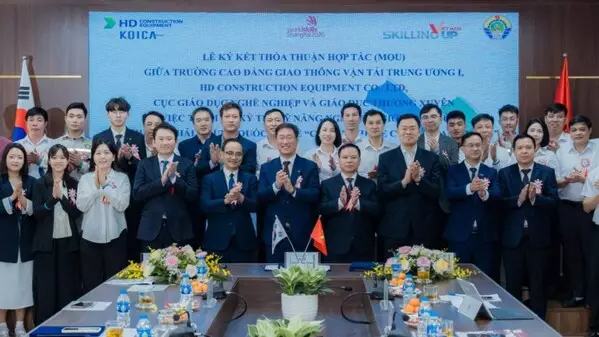
HD Construction Equipment announced on Sunday, April 5 that it signed a tripartite Memorandum of Understanding (MOU) in Hanoi with the Directorate of Vocational Education and Training, or DVET, under the Vietnamese Ministry of Labour, Invalids and Social Affairs, and the Central College of Transport No. 1 (CCT1), a local vocational training college. The agreement aims to support Vietnam's participation in the WorldSkills competition.
Under this agreement, HD Construction Equipment will assist with the entire process—from training to competition entry—for the Vietnamese national representative competing in the Heavy Vehicle Maintenance category at WorldSkills Shanghai 2026, scheduled for this September.
The company plans to offer comprehensive technical training to Nguyen Xuan Khanh, who was selected as the national representative last year. Furthermore, the company will cover all expenses related to this training, including airfare, registration fees, and accommodation, in order to create an optimal environment for the competitor to maximize his performance.
In July of last year, HD Construction Equipment signed an MOU with CCT1, which includes the Green and Smart Construction Equipment Talent Project. This initiative is part of the Korea International Cooperation Agency (KOICA)'s inclusive business program. The collaboration aims to support the development of smart equipment in Vietnam and to create localized training curricula.
The company has deepened its commitment to Vietnam through a series of key initiatives, including hosting government officials and instructors for training in October, supporting national skills trials in November, and awarding scholarships.
An official from HD Construction Equipment stated, "This collaboration is not just a one-time event; it is part of our commitment to sustainable, locally integrated business practices. We will continue to foster Vietnam's young technical talents, helping them compete on the global stage."
- Will collaborate with the Vietnamese government and educational institutions to train construction equipment professionals
- Plans to provide comprehensive support and technical expertise for the entire process leading to WorldSkills Shanghai in September
- "Committed to fostering young technical talent and bolstering industrial competitiveness in Vietnam."
SEOUL, South Korea, April 5, 2026 /PRNewswire/ -- HD Construction Equipment, the intermediary holding company of HD Hyundai's construction equipment business, will be expanding its commitment to nurturing global technical talent in the construction machinery sector by supporting Vietnam's national team for WorldSkills.
HD Construction Equipment announced on Sunday, April 5 that it signed a tripartite Memorandum of Understanding (MOU) in Hanoi with the Directorate of Vocational Education and Training, or DVET, under the Vietnamese Ministry of Labour, Invalids and Social Affairs, and the Central College of Transport No. 1 (CCT1), a local vocational training college. The agreement aims to support Vietnam's participation in the WorldSkills competition.
Under this agreement, HD Construction Equipment will assist with the entire process—from training to competition entry—for the Vietnamese national representative competing in the Heavy Vehicle Maintenance category at WorldSkills Shanghai 2026, scheduled for this September.
The company plans to offer comprehensive technical training to Nguyen Xuan Khanh, who was selected as the national representative last year. Furthermore, the company will cover all expenses related to this training, including airfare, registration fees, and accommodation, in order to create an optimal environment for the competitor to maximize his performance.
In July of last year, HD Construction Equipment signed an MOU with CCT1, which includes the Green and Smart Construction Equipment Talent Project. This initiative is part of the Korea International Cooperation Agency (KOICA)'s inclusive business program. The collaboration aims to support the development of smart equipment in Vietnam and to create localized training curricula.
The company has deepened its commitment to Vietnam through a series of key initiatives, including hosting government officials and instructors for training in October, supporting national skills trials in November, and awarding scholarships.
An official from HD Construction Equipment stated, "This collaboration is not just a one-time event; it is part of our commitment to sustainable, locally integrated business practices. We will continue to foster Vietnam's young technical talents, helping them compete on the global stage."
** This press release is distributed by PR Newswire through automated distribution system, for which the client assumes full responsibility. **
HD Construction Equipment to Support Training for Vietnam's National WorldSkills Team