China's homegrown AS700 manned airship successfully completed its first flight over southwest China's Yunnan-Guizhou Plateau, comprehensively verifying the airship's stability and safety in low-altitude flight environments over plateau areas, said the Aviation Industry Corporation of China (AVIC), the country's leading plane maker, on Monday.
The airship flew at an altitude of 1,200 meters over the Yunnan-Guizhou Plateau. It boasts a maximum range of 700 kilometers and a maximum endurance of 10 hours. Leveraging its unique thrust vector control technology, it can achieve short takeoff and landing, and vertical takeoff and landing in simple sites with a diameter of just 150 meters.
According to the AVIC, the parameters and data on plateau flight performance and environmental adaptation obtained from this flight will further drive product improvements and iterations. This will also enable the airship to better adapt to diverse application scenarios and lay the foundation for expanding into more fields including emergency rescue and aerial monitoring, as well as developing customized flight support solutions.
The AVIC plans to further refine its application solutions for the southwestern region in China, with a particular focus on low-altitude tourism. This initiative is designed to position aviation equipment as a "new engine" for energizing the local low-altitude economy.
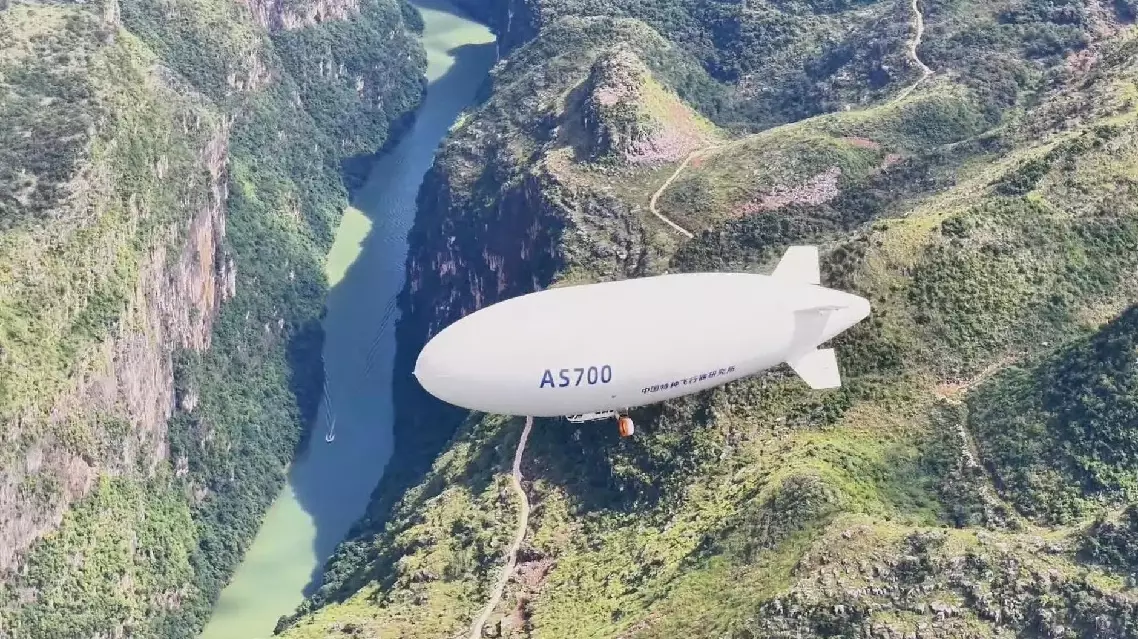
China's AS700 manned airship completes maiden low-altitude flight in plateau region

U.S. President Donald Trump on Friday threatened to increase tariffs on cars and trucks imported from the European Union (EU) to 25 percent next week.
Trump said on Truth Social that he is "pleased" to announce that, based on the fact the EU is not complying with U.S.-EU trade deal, next week he will be "increasing tariffs charged to the European Union for cars and trucks coming into the United States," adding the tariff will be increased to 25 percent.
"It is fully understood and agreed that, if they produce cars and trucks in U.S.A. plants, there will be NO TARIFF," he stressed.
Bernd Lange, chair of the European Parliament's (EP) Committee on International Trade, on the same day strongly condemned the U.S. plan to slap the auto tariff, declaring the move "unacceptable" in a post on X.
Lange said the EU and the EP are honoring the trade agreement reached with the United States in Scotland last year, and are working on legislation to implement it.
"We are currently drafting the legislation; we have a parliamentary position and aim to finalize this in June," Lange said.
Lange said the United States has repeatedly breached the agreement, including imposing tariffs on more than 400 products containing steel and aluminium. Those products are now subject to an average tariff of 26 percent, he said.
He noted that Trump's latest move demonstrates just how "unreliable" the U.S. side is.
A European Commission spokesperson said Friday that the EU will "keep options open" to protect its interests if the United States takes measures inconsistent with the joint statement between the two sides signed last year on reciprocal, fair and balanced trade.
The EU remains fully committed to a predictable, mutually beneficial transatlantic relationship, the spokesperson said, adding that should the United States take measures inconsistent with the Joint Statement, "we will keep our options open to protect EU interests."
The EU is implementing its Joint Statement commitments in line with standard legislative practice, keeping the U.S. administration fully informed throughout, the spokesperson said, adding that the EU maintains close contact with its U.S. counterparts while also seeking clarity on U.S. commitments under the deal.
The U.S.-EU trade deal was reached last year, under which the EU would suspend tariffs on all U.S. industrial products and introduce tariff-rate quotas for a wide range of U.S. agri-food products entering the EU market. In return, the United States would apply a 15-percent import tariff on most EU goods.
The U.S. Supreme Court ruled in February that the Trump administration's tariff policies under the International Emergency Economic Powers Act were unconstitutional. But the Trump administration has since introduced a new set of import taxes based on other laws, seeking to impose a new tariff regime.
According to EU statistical agency Eurostat, the value of EU-U.S. trade in goods and services reached 1.7 trillion euros (about 2 trillion U.S. dollars) in 2024, equivalent to roughly 4.6 billion euros per day.
Trump threatens to raise tariffs on auto imports from EU to 25 pct