China on Monday launched the world's largest centrifuge by capacity, which can generate 300 times Earth's gravity and accommodate loads of up to 20 tonnes.
The machine, coded CHIEF1300, is one of the core components of the Centrifugal Hyper-gravity and Interdisciplinary Experiment Facility (CHIEF) currently under construction in Hangzhou, east China's Zhejiang Province.
It can be harnessed for frontier research spanning deep-ocean and deep-Earth resources extraction, disaster mitigation and prevention, underground waste disposal, and the synthesis of new materials.
Developed by Zhejiang University, CHIEF features three centrifuges and 18 in-flight devices supporting six experimental cabins. Additionally, two more centrifuges with even greater capacity are currently under construction.
Hyper-gravity is defined as any gravitational force stronger than that at Earth's surface. For comparison, a roller-coaster rider briefly endures twice the Earth's gravity, and an astronaut during launch peaks at more than five times gravity (5G). CHIEF, by contrast, is engineered to sustain accelerations of up to 1,500G, according to its designers.
According to Chen Yunmin from Zhejiang University, the chief scientist of the facility, in a hyper-gravity field, researchers can simulate real-world hydrogeological catastrophes, geological evolution and extreme environments in bench-top scale models within reasonable timeframe.
Under such extreme conditions, CHIEF acts like a space-time compressor. At 100G, for instance, a one-meter model simulates events that would occur on a 100-meter scale, and a contaminant-plume journey that would take a century in the field is condensed to only 3.65 days in the lab.
In the "CHIEF1300" machine hall, a 230-square-meter circular basement, a giant arm with a radius of 6.4 meters spins at high speed to generate such massive gravity via centrifugal forces. The faster it spins, the higher the centrifugal acceleration is.
Pilot tests of the facility have already yielded new findings. Researchers simulated strong earthquakes to verify the seismic performance of a hydropower dam foundation, and quantified how a four-meter-high wave and 20-meter tsunami affect the seabed to provide a reference to site selection for offshore wind farms.
Additionally, they reproduced the 2,000-meter deep sea water pressure for evaluation of methane hydrate extraction and safety, and synthesized metal alloys that are low in defects and high in strength and ductility.
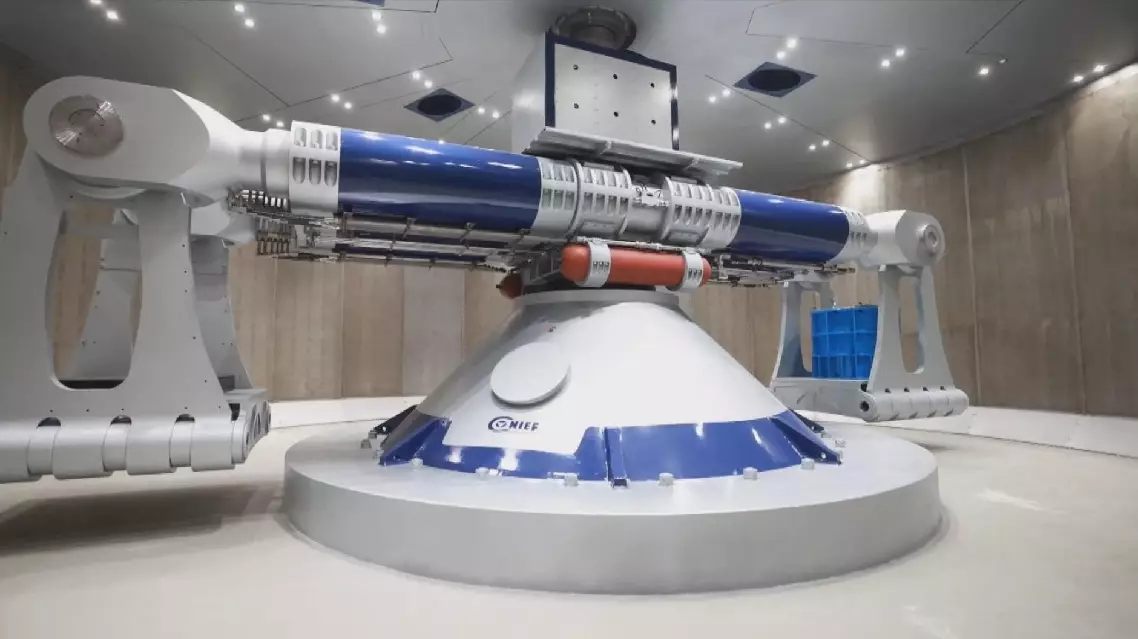
China debuts world's mightiest centrifuge, unleashing ultra-intense gravity