Skip to Content Facebook Feature Image

Judge finds the Trump administration unconstitutionally targeted noncitizens over Gaza war protests

News

Judge finds the Trump administration unconstitutionally targeted noncitizens over Gaza war protests
News

News

Judge finds the Trump administration unconstitutionally targeted noncitizens over Gaza war protests

2025-10-01 06:01 Last Updated At:06:10

BOSTON (AP) — The Trump administration violated the Constitution when it targeted non-U.S. citizens for deportation solely for supporting Palestinians and criticizing Israel, a federal judged said Tuesday in a scathing ruling directly and sharply criticizing President Donald Trump and his policies as serious threats to free speech.

U.S. District Judge William Young in Boston agreed with several university associations that the policy they described as ideological deportation violates the First Amendment as well as the Administrative Procedure Act, a law governing how federal agencies develop and issue regulations. Young also found the policy was “arbitrary or capricious because it reverses prior policy without reasoned explanation.”

“This case -– perhaps the most important ever to fall within the jurisdiction of this district court –- squarely presents the issue whether non-citizens lawfully present here in United States actually have the same free speech rights as the rest of us. The Court answers this Constitutional question unequivocally ‘yes, they do,’” Young, a nominee of Republican President Ronald Reagan, wrote.

Tricia McLaughlin, assistant secretary of the Department of Homeland Security, released a statement that didn't directly address the ruling but said Young was “smearing and demonizing federal law enforcement.”

“Our ICE law enforcement should be thanked for risking their lives every day to arrest murderers, pedophiles, rapists, gang members, and terrorists instead of vilified by sanctuary politicians,” she said. "It’s disheartening that even after the terrorist attack and recent arrests of rioters with guns outside of ICE facilities, this judge decides to stoke the embers of hatred.”

Plaintiffs in the case welcomed the ruling.

“The Trump administration’s attempt to deport students for their political views is an assault on the Constitution and a betrayal of American values," said Todd Wolfson, president of the American Association of University Professors union. “This trial exposed their true aim: to intimidate and silence anyone who dares oppose them. If we fail to fight back, Trump’s thought police won’t stop at pro-Palestinian voices—they will come for anyone who speaks out.”

The ruling came after a trial during which lawyers for the associations presented witnesses who testified that the Trump administration had launched a coordinated effort to target students and scholars who had criticized Israel or showed sympathy for Palestinians.

“Not since the McCarthy era have immigrants been the target of such intense repression for lawful political speech,” Ramya Krishnan, senior staff attorney at the Knight First Amendment Institute, told the court. “The policy creates a cloud of fear over university communities, and it is at war with the First Amendment.”

Young will hold a separate hearing on the relief requested by the plaintiffs, which is likely to be a request that the Trump administration stop engaging in ideological deportations.

Lawyers for the Trump administration put up witnesses who testified there was no ideological deportation policy as the plaintiffs contended.

“There is no policy to revoke visas on the basis of protected speech,” Victoria Santora told the court. “The evidence presented at this trial will show that plaintiffs are challenging nothing more than government enforcement of immigration laws.”

John Armstrong, the senior bureau official in the Bureau of Consular Affairs, testified that visa revocations were based on longstanding immigration law. Armstrong acknowledged he played a role in the visa revocation of several high-profile activists, including Rumeysa Ozturk and Mahmoud Khalil, and was shown memos endorsing their removal.

Armstrong also insisted that visa revocations were not based on protected speech and rejected accusations that there was a policy of targeting someone for their ideology.

One witness testified that the campaign targeted more than 5,000 pro-Palestinian protesters. Out of the 5,000 names reviewed, investigators wrote reports on about 200 who had potentially violated U.S. law, Peter Hatch of ICE’s Homeland Security Investigations Unit testified. Until this year, Hatch said, he could not recall a student protester being referred for a visa revocation.

Among the report subjects was Palestinian activist and Columbia University graduate Khalil, who was released last month after 104 days in federal immigration detention. Khalil has become a symbol of Trump’s clampdown on the protests.

Another was the Tufts University student Ozturk, who was released in May from six weeks in detention after being arrested on a suburban Boston street. She said she was illegally detained following an op-ed she co-wrote last year criticizing her school’s response to the war in Gaza.

Young accused Homeland Security Secretary Kristi Noem, Secretary of State Marco Rubio and their agents of misusing their powers to target noncitizens who were pro-Palestinian in order to silence them and, in doing so, “intentionally denying such individuals (including the plaintiffs here) the freedom of speech that is their right.”

“Moreover, the effect of these targeted deportation proceedings continues unconstitutionally to chill freedom of speech to this day,” he added.

Young also criticized Trump in his 161-page ruling, suggesting he supported the policy, even though he may not have authorized its operation. “The facts prove that the President himself approves truly scandalous and unconstitutional suppression of free speech” on the part of two of his senior Cabinet secretaries, he wrote.

He also used his ruling to draw attention to what he sees as Trump’s broader effort to stifle dissent and attack anyone whom he disagrees while at the same time urging Americans to stand up to these threats. Referencing Reagan speaking about the fragility of freedom when he was the governor of California, Young said he believes that Trump appreciates and understands those words but fears "he has drawn from it a darker, more cynical message.”

“I fear President Trump believes the American people are so divided that today they will not stand up, fight for, and defend our most precious constitutional values so long as they are lulled into thinking their own personal interests are not affected,” he wrote.
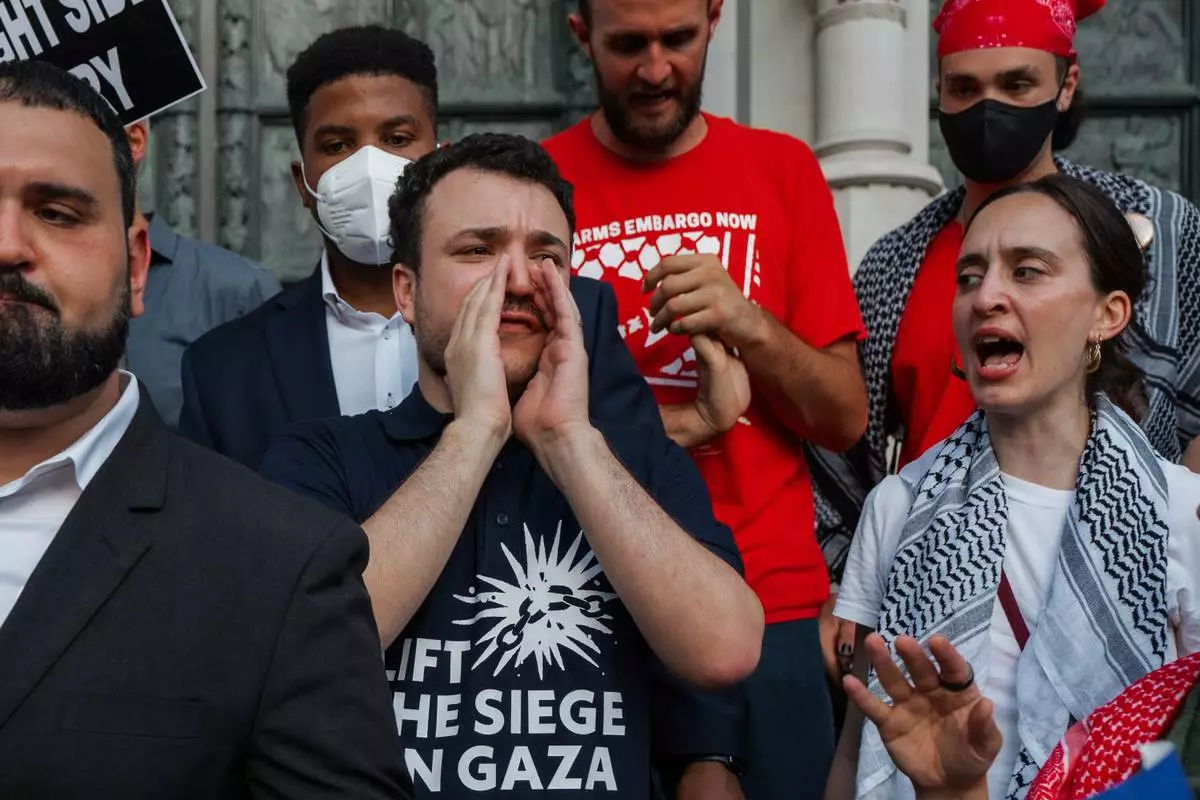
FILE - Pro-Palestinian activist Mahmoud Khalil chants during a rally celebrating his return from immigration detention, June 22, 2025, in New York. (AP Photo/Olga Fedorova, File)
FILE - Pro-Palestinian activist Mahmoud Khalil chants during a rally celebrating his return from immigration detention, June 22, 2025, in New York. (AP Photo/Olga Fedorova, File)

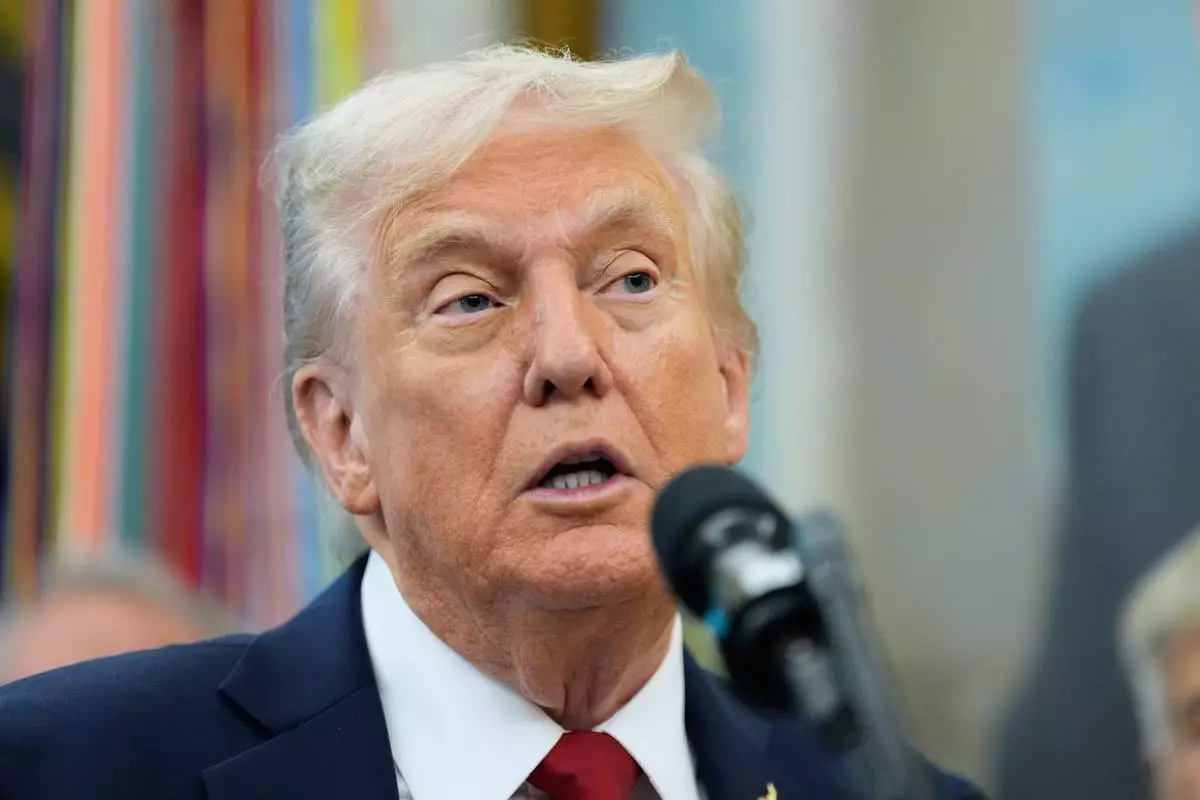
President Donald Trump speaks in the Oval Office of the White House, Tuesday, Sept. 30, 2025, in Washington. (AP Photo/Alex Brandon)
President Donald Trump speaks in the Oval Office of the White House, Tuesday, Sept. 30, 2025, in Washington. (AP Photo/Alex Brandon)

MEXICO CITY (AP) — The sound of construction roared over the most memed metro station in Mexico City as workers hammered at marble floors under a chandelier and rows of lamps reminiscent of a scene from “Harry Potter” or “Titanic,” racing to finish ahead of the FIFA World Cup opening ceremony Thursday.

Mexicans milling through the busy Hidalgo metro station pointed and laughed, occasionally snapping pictures of the face-lift that has become the subject of a cascade of internet memes.

The cosmetic makeover that authorities have attempted to give the capital as visitors arrive from around the globe also has become a symbol of criticisms that the government is prioritizing its superficial appearance for World Cup fans over fixing critical structural issues that have long plagued the city.

“People make fun of it because it's a failed aesthetic, it doesn't make a lot of sense,” said Silvia Escamilla, 28, who was hustling to work among a crowd of Mexican commuters. “All these renovations are like putting makeup on the city, because the infrastructure they could actually invest in just isn’t there.”

For weeks, Mexico City workers have plastered walls and metro cars with cartoon axolotls, the mole salamander that has become a city mascot. They also have painted bridges purple and planted Mexican marigold flowers typical of Day of the Dead celebrations in November.

The 22 million residents of the sprawling capital, known as Chilangos, have jokingly referred to the renovations as the city's “axolotlization.” They have posted videos of flooded underpasses next to freshly painted murals of axolotls and crumbling stairs and potholes painted bright purple.

Hidalgo station, in the heart of the downtown, has perhaps become the subject of more memes than anywhere else in the city.

When city workers installed the chandelier near the metro entrance and rows of Victorian wall lamps in May, social media users were quick to joke that authorities were trying to make the gritty metro system look like it was in a European city.

Residents began to show up at the station in elegant dresses in videos layered over Mozart music. One social media influencer descended the marble stairs dressed as the Beast from the classic Disney cartoon “Beauty and the Beast.” Another arrived as Napoleon Bonaparte in a white wig and French military uniform.

“May you have an elegant metro connection,” one social media influencer said as he strolled through throngs of commuters dressed in a tuxedo and top hat. Another filmed herself selling pink dresses aboard one of the metro trains, yelling to passengers that the items matched the “etiquette” of Metro Hidalgo.

Many more posed next to marble floors and walls torn up by construction ahead of the soccer tournament being hosted by Mexico, the United States and Canada.

The crush of jokes amused Mexicans for weeks, but also cut to the core of a deeper problem in the city, said Aldo Solano Rojas, an art historian in Mexico City who has criticized the remodel.

Failures to prioritize issues like the metro's crumbling infrastructure and holes in the major municipal roadways show the government “doesn't understand the real needs of the city,” he said.

“State presence, at its best, is reflected in well-maintained sidewalks and adequate transportation infrastructure that doesn't collapse every day,” Solano Rojas said. “It's not reflected in frivolous, superficial axolotl murals while the streets are flooding.”

The criticisms come in the midst of wider social unrest in Mexico City as the country's teachers union, families of Mexico's 130,000 missing people and a range of other social movements use the proximity to the event to pressure authorities.

The government also has faced accusations of displacing sex workers and street vendors in an effort to clean up the streets. Despite the tensions, city workers on Wednesday were still racing to complete construction ahead of the opening ceremony and first match.

Mirna Baranco looked fondly on the renovations, but the 46-year-old laughed at the chandelier over Hidalgo construction workers. She nudged her boyfriend and pointed.

“I've already seen it all over the place on Facebook, but not in real life,” she said.

Baranco understood the criticisms, but said she didn't think it was necessarily a bad thing that authorities were making changes to be more attractive to international visitors. The World Cup has helped push local governments to make needed renovations, even if some look a little out of place, she said.

The changes show that “Mexico isn't just how others stereotype us, as a country with narcos,” Baranco said. “Mexico has a lot to give the world.”

A woman puts on makeup at the subway in Mexico City, Tuesday, June 9, 2026. (AP Photo/Marco Ugarte)

A woman puts on makeup at the subway in Mexico City, Tuesday, June 9, 2026. (AP Photo/Marco Ugarte)

A dancer holds a replica of the World Cup trophy as soccer fans stand along Reforma Avenue in Mexico City, Saturday, June 6, 2026 ahead of the FIFA World Cup. (AP Photo/Moises Castillo)

A dancer holds a replica of the World Cup trophy as soccer fans stand along Reforma Avenue in Mexico City, Saturday, June 6, 2026 ahead of the FIFA World Cup. (AP Photo/Moises Castillo)

People walk through a subway station that has new lighting, part of preparations for hosting the World Cup soccer tournament in Mexico City, Wednesday, June 10, 2026. (AP Photo/Marco Ugarte)

People walk through a subway station that has new lighting, part of preparations for hosting the World Cup soccer tournament in Mexico City, Wednesday, June 10, 2026. (AP Photo/Marco Ugarte)

People walk through a subway station that has new lighting, part of preparations for hosting the World Cup soccer tournament in Mexico City, Wednesday, June 10, 2026. (AP Photo/Marco Ugarte)

People walk through a subway station that has new lighting, part of preparations for hosting the World Cup soccer tournament in Mexico City, Wednesday, June 10, 2026. (AP Photo/Marco Ugarte)

Recommended Articles