WASHINGTON (AP) — Historically, the U.S. military has been an engine for cultural and social change in America. Defense Secretary Pete Hegseth’s vision for the armed forces he leads runs counter to that.
In comments Tuesday to hundreds of military leaders and their chief enlisted advisers, Hegseth made clear he was not interested in a diverse or inclusive force. His address at the Marine Corps base in Quantico, Virginia, verbalized what Hegseth has been doing as he takes on any program that can be labeled diversity, equity or inclusion, as well as targeting transgender personnel. Separately, the focus on immigration also is sweeping up veterans.
For too long, “the military has been forced by foolish and reckless politicians to focus on the wrong things. In many ways, this speech is about fixing decades of decay, some of it obvious, some of it hidden,” Hegseth said. “Foolish and reckless political leaders set the wrong compass heading, and we lost our way. We became the woke department, but not anymore.”
Hegseth's actions — and plans for more — are a reversal of the role the military has often played.
“The military has often been ahead of at least some broader social, cultural, political movements,” said Ronit Stahl, associate professor of history at the University of California, Berkeley. ”The desegregation of the armed forces is perhaps the most classic example."
President Harry S. Truman's desegregation order in 1948 came six years before the Supreme Court ordered school desegregation in the Brown vs. Board of Education case — and, Stahl said, "that obviously takes a long time to implement, if it ever fully is implemented.”
Truman's order was not a short progression through American society. Although the military was one of the few places where there was organizational diversity, the races did not mix in their actual service. Units like the Tuskegee Airmen, the Navajo Code Talkers and the Buffalo Soldiers, formed in 1866, were segregated until the order opened the door to integrated units.
Women were given full status to serve in 1948 with the Women’s Armed Services Integration Act. There were restrictions on how many could serve and they were generally not allowed to command men or serve in combat. Before then, they had wartime roles and they did not serve in combat, although hundreds of nurses died and women were pilots, including Women Airforce Service Pilots, or WASPs.
The WASPs and Tuskegee Airmen were among the first groups this year to be affected when Hegseth issued his DEI order. The Air Force removed training videos of the airmen along with ones showing the World War II contributions of the WASPs at the basic training base in San Antonio. The videos were restored after widespread bipartisan outcry over their removal.
Other issues over time have included “don't ask, don't tell,” the policy that allowed gay and lesbian service members to serve as long as their sexual orientation was not public. That was repealed during the Obama administration. Women were allowed to serve on combat aircraft and combat ships in the early 1990s — then all combat positions after a ban was lifted in 2015.
“The military has always had to confront the question of social change and the question of who would serve, how they would serve and in what capacity they would serve. These are questions that have been long-standing back to the founding in some ways, but certainly in the 20th century,” said David Kieran, distinguished chair in Military History at Columbus State University in Columbus, Georgia. “These are not new questions.”
Generally the answer has come down to what “the military writ large” has concluded. “'How do we achieve our mission best?'" Kieran said. "And a lot of these things have been really hotly debated.”
Kieran offered one example: changes the Army made in the 1960s when it was dealing with a climate of racism and racial tensions. Without that, he said, "the military can't fight the war in Vietnam effectively.”
The same considerations were given to how to address the problem of sexual harassment. Part of the answer involved what was morally right, but “the larger issue is: If soldiers are being harassed, can the Army carry out its mission effectively?”
While "it is important to see these actions as part of a longer history and a larger debate," Kieran said, "it’s certainly also true that the current administration is moving at a far more aggressive and faster pace than we’ve seen in earlier administrations."
Michael O’Hanlon, director of research in the foreign policy program at the Brookings Institution, questioned some of the actions that Trump's Defense Department has taken, including replacing the chairman of the joint chiefs, Air Force Gen. CQ Brown Jr.
“He was a fine Air Force officer,” O'Hanlon said. Even if he got the job in part because of his race, “it wouldn't be disqualifying in my book, unless he was unqualified — and he wasn't.”
Matthew Delmont, a professor of history at Dartmouth College, said the current attitudes he is seeing toward the military suggest a misunderstanding of the armed forces and why the changes have been made.
“The military, for more than seven decades now, has been more on the leading edge in terms of figuring out how to put together an organization that tries to take advantage of the talents and capacities of all Americans,” Delmont said. Since Truman signed his executive order, “the military has moved faster and farther than almost any other organization in thinking about issues of racial equality, and then later thinking about the issues related to gender and sexuality.”
Delmont said bias, prejudice and racism remain in the military, but the armed services have done more “than a lot of corporations, universities, other organizations to try to address those head-on."
“I wouldn’t say it was because they were particularly interested in trying to advance the social agenda,” he said. "I think they did it because they recognized you can’t have a unified fighting force if the troops are fighting each other, or if you’re actively turning away people who desire to serve their country."

U.S. military senior leadership listen as Secretary of Defense Pete Hegseth speaks at Marine Corps Base Quantico, Tuesday, Sept. 30, 2025 in Quantico, Va. (Andrew Harnik/Pool via AP)

Secretary of Defense Pete Hegseth speaks to senior military leaders at Marine Corps Base Quantico, Tuesday, Sept. 30, 2025 in Quantico, Va. (Andrew Harnik/Pool via AP)
WASHINGTON (AP) — President Donald Trump on Saturday presented the 2025 Kennedy Center honorees with their medals during a ceremony in the Oval Office, hailing the slate of artists he was deeply involved in choosing as “perhaps the most accomplished and renowned class” ever assembled.
This year's recipients are actor Sylvester Stallone, singers Gloria Gaynor and George Strait, the rock band Kiss and actor-singer Michael Crawford.
Trump said they are a group of “incredible people” who represent the “very best in American arts and culture” and that, “I know most of them and I've been a fan of all of them.”
“This is a group of icons whose work and accomplishments have inspired, uplifted and unified millions and millions of Americans,” said a tuxedo-clad Trump. "This is perhaps the most accomplished and renowned class of Kennedy Center Honorees ever assembled.”
Trump ignored the Kennedy Center and its premier awards program during his first term as president. But the Republican has instituted a series of changes since returning to office in January, most notably ousting its board of trustees and replacing them with GOP supporters who voted him in as chairman of the board.
Trump also has criticized the center's programming and its physical appearance, and has vowed to overhaul both.
The president placed around each honoree's neck a new medal that was designed, created and donated by jeweler Tiffany & Co., according to the Kennedy Center and Trump.
It's a gold disc etched on one side with the Kennedy Center's image and rainbow colors. The honoree's name appears on the reverse side with the date of the ceremony. The medallion hangs from a navy blue ribbon and replaces a large rainbow ribbon decorated with three gold plates that rested on the honoree's shoulders and chest and had been used since the first honors program in 1978.
Strait, wearing a cowboy hat, was first to receive his medal. When the country singer started to take off the hat, Trump said, “If you want to leave it on, you can. I think we can get it through.” But Strait took it off.
The president said Crawford was a “great star of Broadway” for his lead role in the long-running “Phantom of the Opera.” Of Gaynor, he said, “We have the disco queen, and she was indeed, and nobody did it like Gloria Gaynor.”
Trump was effusive about his friend Stallone, calling him a “wonderful” and “spectacular” person and “one of the true, great movie stars” and "one of the great legends."
Kiss is an “incredible rock band," he said.
Songs by honorees Gaynor and Kiss played in the Rose Garden just outside the Oval Office as members of the White House press corps waited nearby for Trump to begin the ceremony.
The president president said in August that he was “about 98% involved” in choosing the 2025 honorees when he personally announced them at the Kennedy Center, the first slate chosen under his leadership. The honorees traditionally had been announced by press release.
It was unclear how they were chosen. Before Trump, it fell to a bipartisan selection committee.
“These are among the greatest artists, actors and performers of their generation. The greatest that we’ve seen,” Trump said. “We can hardly imagine the country music phenomena without its king of country, or American disco without its first lady, or Broadway without its phantom — and that was a phantom, let me tell you — or rock and roll without its hottest band in the world, and that’s what they are, or Hollywood without one of its greatest visionaries."
“Each of you has made an indelible mark on American life and together you have defined entire genres and set new standards for the performing arts,” Trump said.
Trump also attended an annual State Department dinner for the honorees on Saturday. In years past, the honorees received their medallions there but Trump moved the ceremony to the White House.
Meanwhile, the glitzy Kennedy Center Honors program and its series of tribute speeches and performances for each recipient is set to be taped on Sunday at the performing arts center for broadcast later in December on CBS and Paramount+. Trump is to attend the program for the first time as president, accompanied by his wife, first lady Melania Trump.
The president said in August that he had agreed to host the show, and he seemed to confirm on Saturday that he would do so, predicting that the broadcast would garner its highest ratings ever as a result. Presidents traditionally attend the program and sit with the honorees in the audience. None has ever served as host.
He said he looked forward to Sunday's celebration.
“It’s going to be something that I believe, and I’m going to make a prediction: this will be the highest-rated show that they’ve ever done and they’ve gotten some pretty good ratings, but there’s nothing like what’s going to happen tomorrow night,” Trump said.
The president also swiped at late-night TV show host Jimmy Kimmel, whose program was briefly suspended earlier this year by ABC following criticism of his comments related to the killing of conservative activist Charlie Kirk in September.
Kimmel and Trump are sharp critics of each other, with the president regularly deriding Kimmel's talent as a host. Kimmel has hosted the Primetime Emmy Awards and the Academy Award multiple times.
Trump said he should be able to outdo Kimmel.
“I've watched some of the people that host. Jimmy Kimmel was horrible,” Trump said. “If I can't beat out Jimmy Kimmel in terms of talent, then I don't think I should be president.”
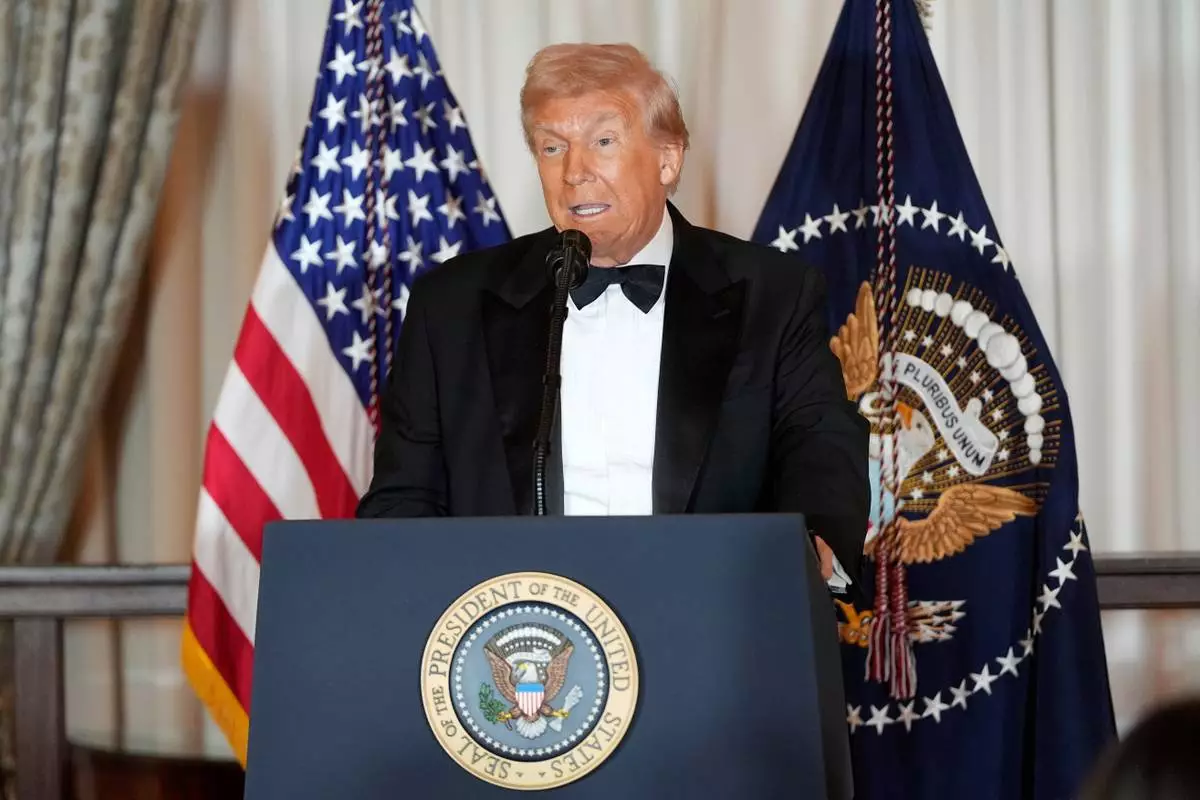
President Donald Trump speaks at a Kennedy Center Honors reception for recipients Sylvester Stallone, George Strait, Kiss, Gloria Gaynor and Michael Crawford at the State Department, Saturday, Dec. 6, 2025, in Washington. (AP Photo/Julia Demaree Nikhinson)
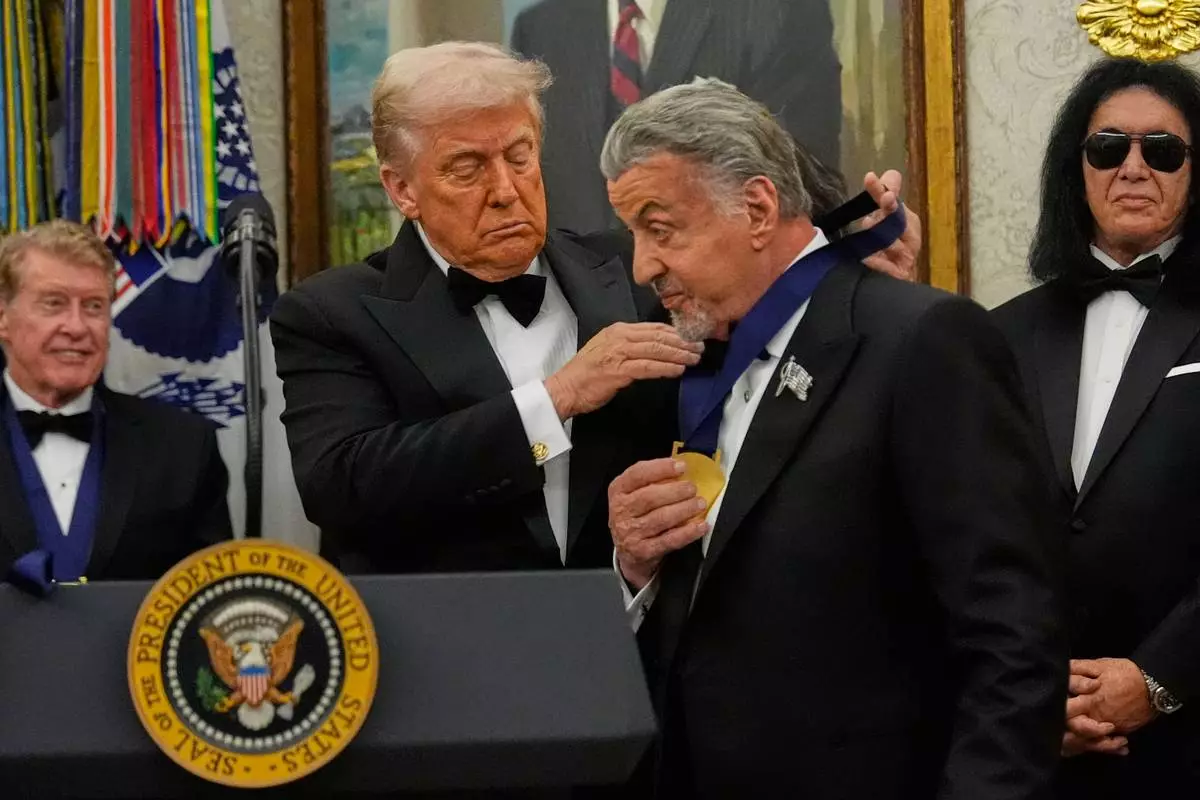
President Donald Trump, left, presents Sylvester Stallone with his Kennedy Center Honors medal in the Oval Office of the White House, Saturday, Dec. 6, 2025, in Washington. (AP Photo/Julia Demaree Nikhinson)

President Donald Trump, center, speaks as he presents Sylvester Stallone, George Strait, KISS, Gloria Gaynor and Michael Crawford with their Kennedy Center Honors medals in the Oval Office of the White House, Saturday, Dec. 6, 2025, in Washington. (AP Photo/Julia Demaree Nikhinson)

President Donald Trump, center, speaks as he presents Sylvester Stallone, George Strait, KISS, Gloria Gaynor and Michael Crawford with their Kennedy Center Honors medals in the Oval Office of the White House, Saturday, Dec. 6, 2025, in Washington. (AP Photo/Julia Demaree Nikhinson)
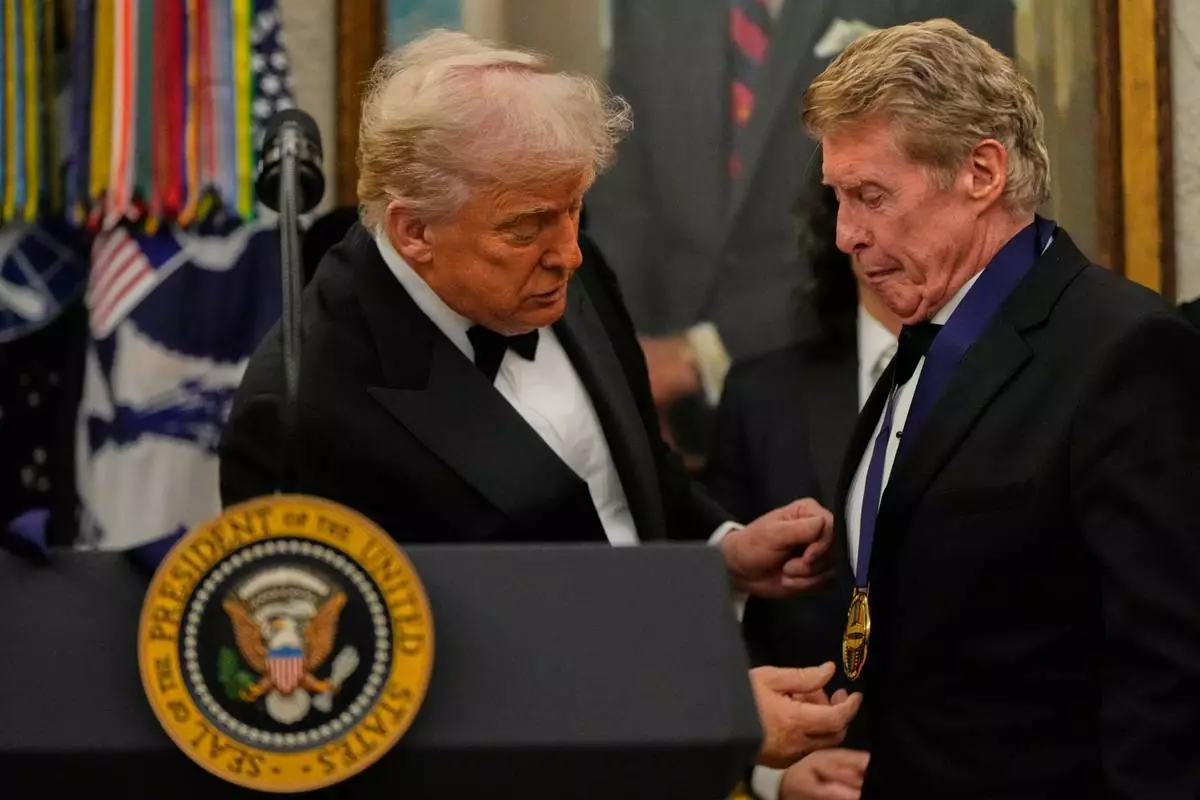
President Donald Trump, left, presents Michael Crawford with his Kennedy Center Honors medal in the Oval Office of the White House, Saturday, Dec. 6, 2025, in Washington. (AP Photo/Julia Demaree Nikhinson)

President Donald Trump, left, speaks as he presents Sylvester Stallone, George Strait, KISS, Gloria Gaynor and Michael Crawford with their Kennedy Center Honors medals in the Oval Office of the White House, Saturday, Dec. 6, 2025, in Washington. (AP Photo/Julia Demaree Nikhinson)
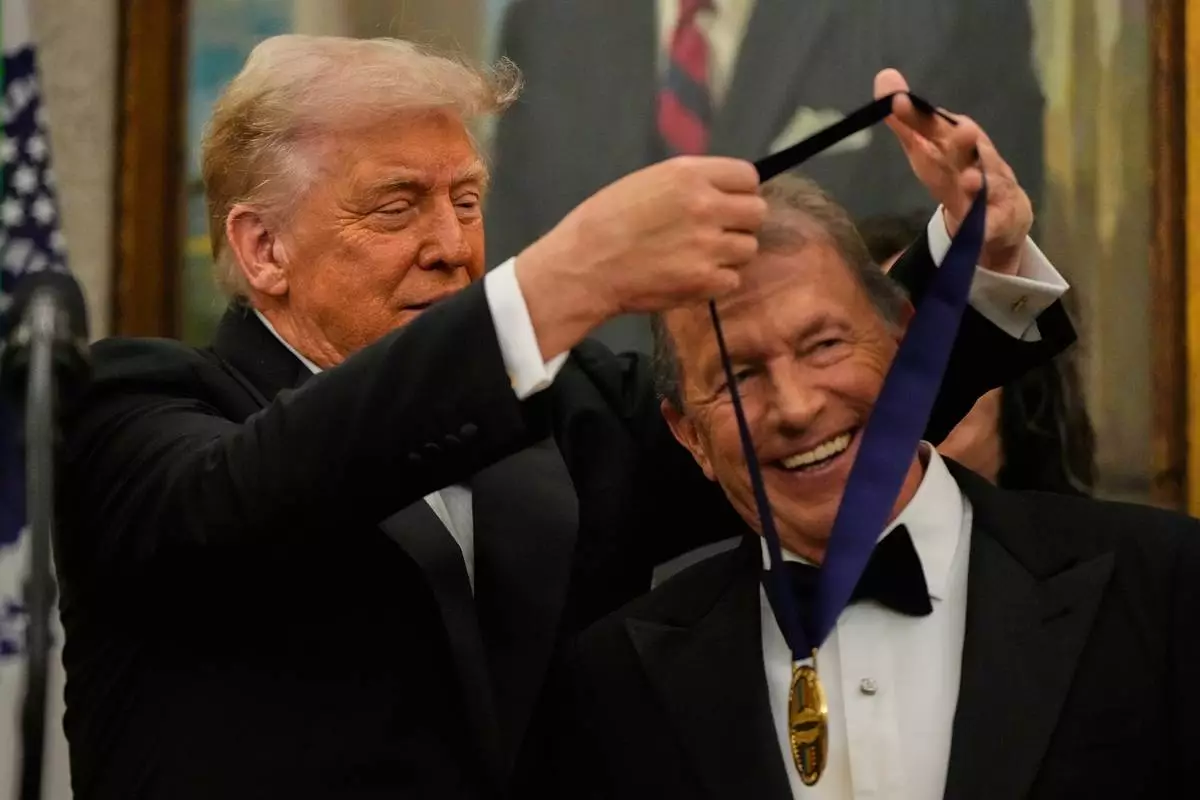
President Donald Trump, left, presents George Strait with his Kennedy Center Honors medal in the Oval Office of the White House, Saturday, Dec. 6, 2025, in Washington. (AP Photo/Julia Demaree Nikhinson)

FILE - The Hall of Nations at the John F. Kennedy Memorial Center for the Performing Arts, Nov. 22, 2025, in Washington. (AP Photo/Rahmat Gul, file)

Kiss band member Gene Simmons speaks to members of the media at the White House, Friday, Dec. 5, 2025, in Washington. (AP Photo/Allison Robbert)
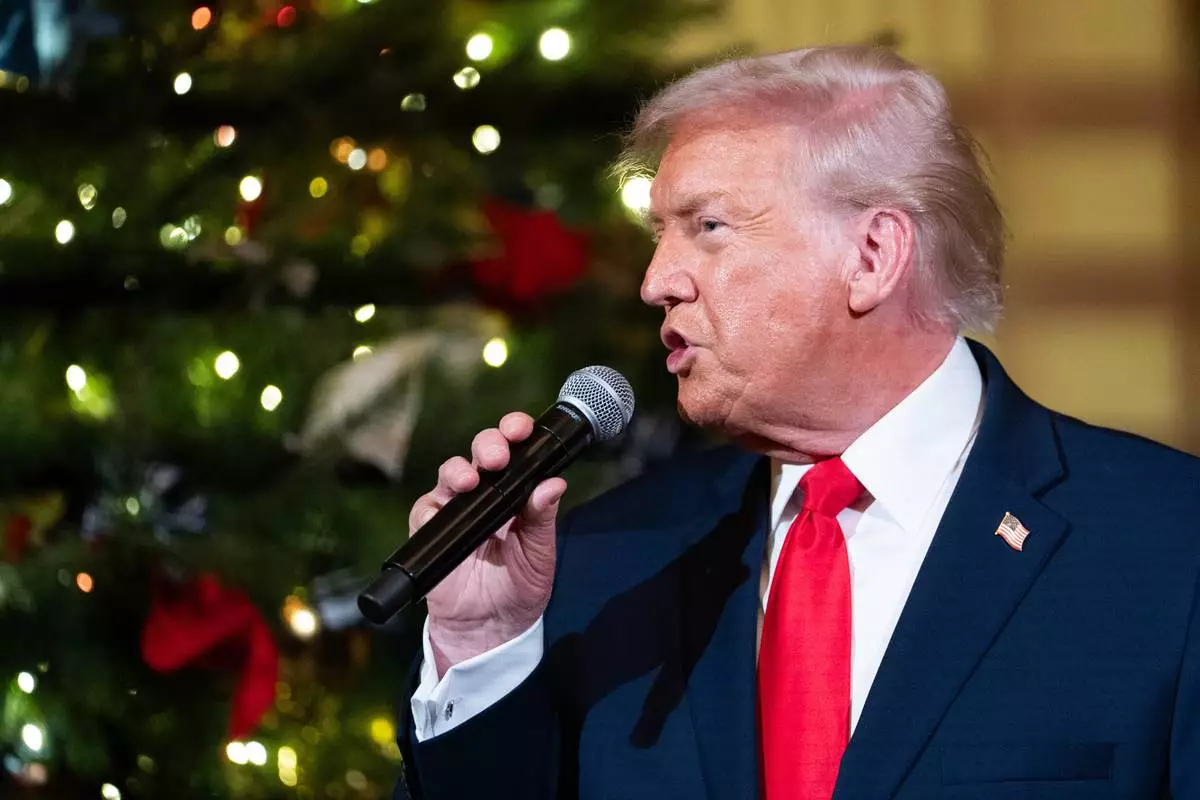
President Donald Trump speaks before a concert by Andrea Bocelli in the East Room of the White House walking towards the East Room, Friday, Dec. 5, 2025, in Washington. (AP Photo/Allison Robbert)