Skip to Content Facebook Feature Image

Gatorade and Cheetos are among the Pepsi products getting a natural dye makeover

ENT

Gatorade and Cheetos are among the Pepsi products getting a natural dye makeover
ENT

ENT

Gatorade and Cheetos are among the Pepsi products getting a natural dye makeover

2025-10-02 21:29 Last Updated At:21:31

VALHALLA, New York (AP) — Pepsi has a new challenge: keeping products like Gatorade and Cheetos vivid and colorful without the artificial dyes that U.S. consumers are increasingly rejecting.

PepsiCo, which also makes Doritos, Cap'n Crunch cereal, Funyuns and Mountain Dew, announced in April that it would accelerate a planned shift to using natural colors in its foods and beverages. Around 40% of its U.S. products now contain synthetic dyes, according to the company.

But just as it took decades for artificial colors to seep into PepsiCo’s products, removing them is likely to be a multi-year process. The company said it’s still finding new ingredients, testing consumers’ responses and waiting for the U.S. Food and Drug Administration to approve natural alternatives. PepsiCo hasn’t committed to meeting the Trump administration’s goal of phasing out petroleum-based synthetic dyes by the end of 2026.

“We’re not going to launch a product that the consumer’s not going to enjoy,” said Chris Coleman, PepsiCo’s senior director for food research and development in North America. “We need to make sure the product is right.”

Coleman said it can take two or three years to shift a product from an artificial color to a natural one. PepsiCo has to identify a natural ingredient that will have a stable shelf life and not change a product’s flavor. Then it must ensure the availability of a safe and adequate supply. The company tests prototypes with trained experts and panels of consumers, then makes sure the new formula won’t snag its manufacturing process. It also has to design new packaging.

Tostitos and Lay’s will be the first PepsiCo brands to make the shift, with naturally dyed tortilla and potato chips expected on store shelves later this year and naturally dyed dips due to be on sale early next year. Most of the chips, dips and salsas in the two lines already are naturally colored, but there were some exceptions.

The reddish-brown tint of Tostitos Salsa Verde, for example, came from four synthetic colors: Yellow 5, Yellow 6, Red 40 and Blue 1. Coleman said the company is switching to carob powder, which gives the chips a similar color, but needed to tweak the recipe to ensure the addition of the cocoa alternative wouldn’t affect the taste.

In its Frito-Lay food labs and test kitchens in Plano, Texas, PepsiCo is experimenting with ingredients like paprika and turmeric to mimic the bright reds and oranges in products like Flamin’ Hot Cheetos, Coleman said.

The company is looking at purple sweet potatoes and various types of carrots to color drinks like Mountain Dew and Cherry 7Up, according to Damien Browne, the vice president of research and development for PepsiCo’s beverage division based in Valhalla, New York.

Getting the hue right is critical, since many consumers know products like Gatorade by their color and not necessarily their name, Browne said.

“We eat with our eyes,” he said. “If you look at a plate of food, it’s generally the different kinds of colors that will tell you what you would like or not.”

When the Pepsi-Cola Company was founded in 1902, the absence of artificial dyes was a point of pride. The company marketed Pepsi as “The Original Pure Food Drink” to differentiate the cola from rivals that used lead, arsenic and other toxins as food colorants before the U.S. banned them in 1906.

But synthetic dyes eventually won over food companies. They were vibrant, consistent and cheaper than natural colors. They are also rigorously tested by the FDA.

Still, PepsiCo said it started seeing a small segment of shoppers asking for products without artificial colors or flavors more than two decades ago. In 2002, it launched its Simply line of chips, which offer natural versions of products like Doritos. A dye-free organic Gatorade came out in 2016.

“We’re looking for those little signals that will become humongous in the future,” Amanda Grzeda, PepsiCo’s senior director of global sensory and consumer experience, said of the company's close attention to consumer preferences.

Grzeda said the whisper PepsiCo detected in the early 2000s has become a roar, fueled by social media and growing consumer interest in ingredients. More than half of the consumers PepsiCo spoke to for a recent internal study said they were trying to reduce their consumption of artificial dyes, Grzeda said.

Some states, including West Virginia and Arizona, have banned artificial dyes in school lunches. But Browne said he thinks consumers are driving the push to overhaul processed foods.

“Consumers are definitely leading, and I think what we need to do is have the regulators catching up, allowing us to approve new natural ingredients to be able to meet their demand,” he said.

The U.S. Food and Drug Administration has said it's expediting approval of natural additives after calling on companies to halt their use of synthetic dyes. In May, the FDA approved three new natural color additives, including a blue color derived from algae. In July, the agency approved gardenia blue, which is derived from a flowering evergreen.

The FDA banned one petroleum-based dye, Red 3, in January because it was shown to cause cancer in lab rats. And in September, the agency proposed a ban on Orange B, a synthetic color that hasn't been used in decades.

Six synthetic dyes remain FDA-approved and widely used, despite mixed studies that show they may cause neurobehavioral problems in some children. Red 40, for example, is used in 25,965 food and beverage items on U.S. store shelves, according to the market research firm NIQ.

But even if decades of research has shown that synthetic colors are safe, PepsiCo has to weigh public perceptions, Grzeda said.

“We could just blindly follow the science, but it probably would put us at odds with what our consumers believe and perceive in the world,” she said.

PepsiCo also has to balance the needs of consumers who don’t want their favorite snacks and drinks to change or get more expensive because of the costs of natural dyes. NIQ data shows that unit sales of products advertised as free of artificial colors fell sharply in 2023 as prices rose.

Susan Mazur-Stommen, a small business owner in Hinton, West Virginia, picked up some Simply brand Cheetos Puffs recently at a convenience store because they were the only variety available. She found the texture to be much different from regular Cheetos Puffs, she said, and their pallid color made them less appetizing.

Mazur-Stommen said she agrees with the move away from petroleum-based dyes, but it’s not a critical issue for her.

“What I am looking for is the original formulation,” she said.

Ultimately, PepsiCo does not want customers to have to choose between natural colors and familiar flavors and textures, Grzeda said.

“That's where it requires the deep science and ingredients and magic,” she said.

Durbin reported from Detroit.

Damien Browne, vice president of research and development for PepsiCo's beverages, tastes a beverage at the company's R&D Campus, in Valhalla, NY, Friday, Sept. 19, 2025. (AP Photo/Richard Drew)

Damien Browne, vice president of research and development for PepsiCo's beverages, tastes a beverage at the company's R&D Campus, in Valhalla, NY, Friday, Sept. 19, 2025. (AP Photo/Richard Drew)

Damien Browne, vice president of research and development for PepsiCo's beverages, is interviewed at the company's R&D Campus, in Valhalla, NY, Friday, Sept. 19, 2025. (AP Photo/Richard Drew)

Damien Browne, vice president of research and development for PepsiCo's beverages, is interviewed at the company's R&D Campus, in Valhalla, NY, Friday, Sept. 19, 2025. (AP Photo/Richard Drew)
Damien Browne, vice president of research and development for PepsiCo's beverages, is interviewed at the company's R&D Campus, in Valhalla, NY, Friday, Sept. 19, 2025. (AP Photo/Richard Drew)
Damien Browne, vice president of research and development for PepsiCo's beverages, is interviewed at the company's R&D Campus, in Valhalla, NY, Friday, Sept. 19, 2025. (AP Photo/Richard Drew)
DUBAI, United Arab Emirates (AP) — U.S. President Donald Trump said Iran wants to negotiate with Washington after his threat to strike the Islamic Republic over its bloody crackdown on protesters, a move coming as activists said Monday the death toll in the nationwide demonstrations rose to at least 544.

Iran had no immediate reaction to the news, which came after the foreign minister of Oman — long an interlocutor between Washington and Tehran — traveled to Iran this weekend. It also remains unclear just what Iran could promise, particularly as Trump has set strict demands over its nuclear program and its ballistic missile arsenal, which Tehran insists is crucial for its national defense.

Iranian Foreign Minister Abbas Araghchi, speaking to foreign diplomats in Tehran, insisted “the situation has come under total control” in fiery remarks that blamed Israel and the U.S. for the violence, without offering evidence.

“That’s why the demonstrations turned violent and bloody to give an excuse to the American president to intervene,” Araghchi said, in comments carried by the Qatar-funded Al Jazeera satellite news network. Al Jazeera has been allowed to report from inside the country live despite the internet being shut off.

Meanwhile Monday, Iran called for pro-government demonstrators to head to the streets in support of the theocracy, a show of force after days of protests directly challenging the rule of 86-year-old Supreme Leader Ayatollah Ali Khamenei. Iranian state television aired chants from the crowd, who shouted “Death to America!” and “Death to Israel!”

Trump and his national security team have been weighing a range of potential responses against Iran including cyberattacks and direct strikes by the U.S. or Israel, according to two people familiar with internal White House discussions who were not authorized to comment publicly and spoke on condition of anonymity.

“The military is looking at it, and we’re looking at some very strong options,” Trump told reporters on Air Force One on Sunday night. Asked about Iran’s threats of retaliation, he said: “If they do that, we will hit them at levels that they’ve never been hit before.”

Trump said that his administration was in talks to set up a meeting with Tehran, but cautioned that he may have to act first as reports of the death toll in Iran mount and the government continues to arrest protesters.

“I think they’re tired of being beat up by the United States,” Trump said. “Iran wants to negotiate.”

He added: “The meeting is being set up, but we may have to act because of what’s happening before the meeting. But a meeting is being set up. Iran called, they want to negotiate.”

Iran through country's parliamentary speaker warned Sunday that the U.S. military and Israel would be “legitimate targets” if America uses force to protect demonstrators.

More than 10,600 people also have been detained over the two weeks of protests, said the U.S.-based Human Rights Activists News Agency, which has been accurate in previous unrest in recent years and gave the death toll. It relies on supporters in Iran crosschecking information. It said 496 of the dead were protesters and 48 were with security forces.

With the internet down in Iran and phone lines cut off, gauging the demonstrations from abroad has grown more difficult. The Associated Press has been unable to independently assess the toll. Iran’s government has not offered overall casualty figures.

Those abroad fear the information blackout is emboldening hard-liners within Iran’s security services to launch a bloody crackdown. Protesters flooded the streets in the country’s capital and its second-largest city on Saturday night into Sunday morning. Online videos purported to show more demonstrations Sunday night into Monday, with a Tehran official acknowledging them in state media.

In Tehran, a witness told the AP that the streets of the capital empty at the sunset call to prayers each night. By the Isha, or nighttime prayer, the streets are deserted.

Part of that stems from the fear of getting caught in the crackdown. Police sent the public a text message that warned: “Given the presence of terrorist groups and armed individuals in some gatherings last night and their plans to cause death, and the firm decision to not tolerate any appeasement and to deal decisively with the rioters, families are strongly advised to take care of their youth and teenagers.”

Another text, which claimed to come from the intelligence arm of the paramilitary Revolutionary Guard, also directly warned people not to take part in demonstrations.

“Dear parents, in view of the enemy’s plan to increase the level of naked violence and the decision to kill people, ... refrain from being on the streets and gathering in places involved in violence, and inform your children about the consequences of cooperating with terrorist mercenaries, which is an example of treason against the country,” the text warned.

The witness spoke to the AP on condition of anonymity due to the ongoing crackdown.

The demonstrations began Dec. 28 over the collapse of the Iranian rial currency, which trades at over 1.4 million to $1, as the country’s economy is squeezed by international sanctions in part levied over its nuclear program. The protests intensified and grew into calls directly challenging Iran’s theocracy.

Nikhinson reported from aboard Air Force One.

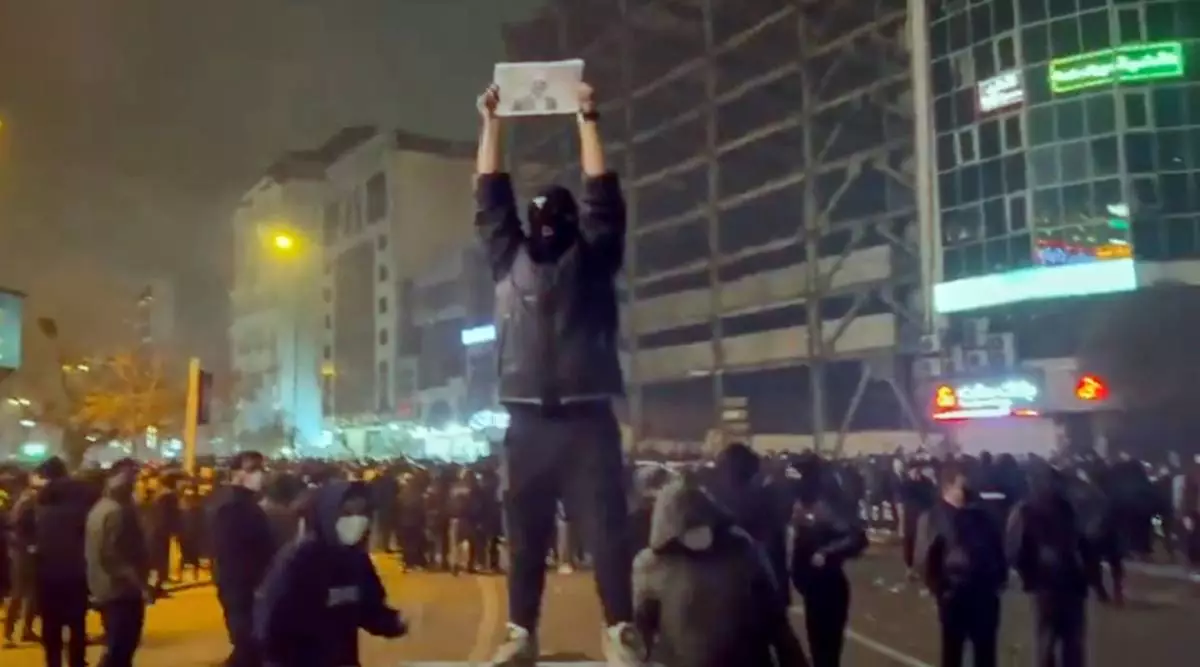
In this frame grab from video obtained by the AP outside Iran, a masked demonstrator holds a picture of Iran's Crown Prince Reza Pahlavi during a protest in Tehran, Iran, Friday, January. 9, 2026. (UGC via AP)

In this frame grab from video obtained by the AP outside Iran, a masked demonstrator holds a picture of Iran's Crown Prince Reza Pahlavi during a protest in Tehran, Iran, Friday, January. 9, 2026. (UGC via AP)

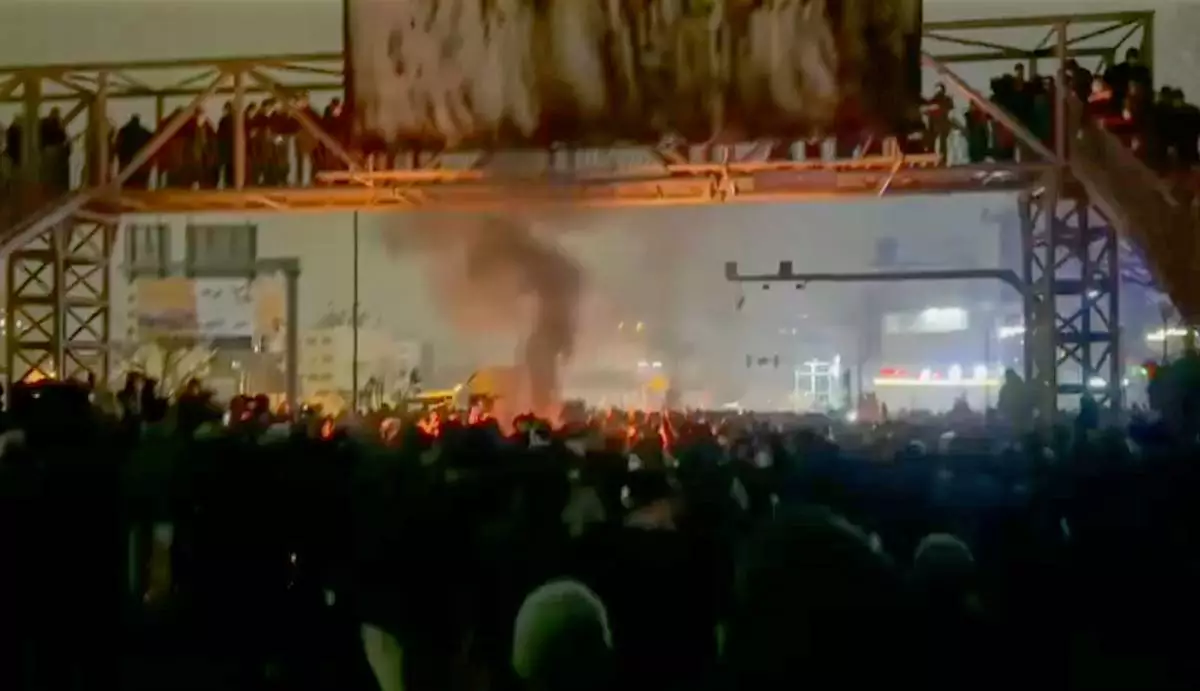
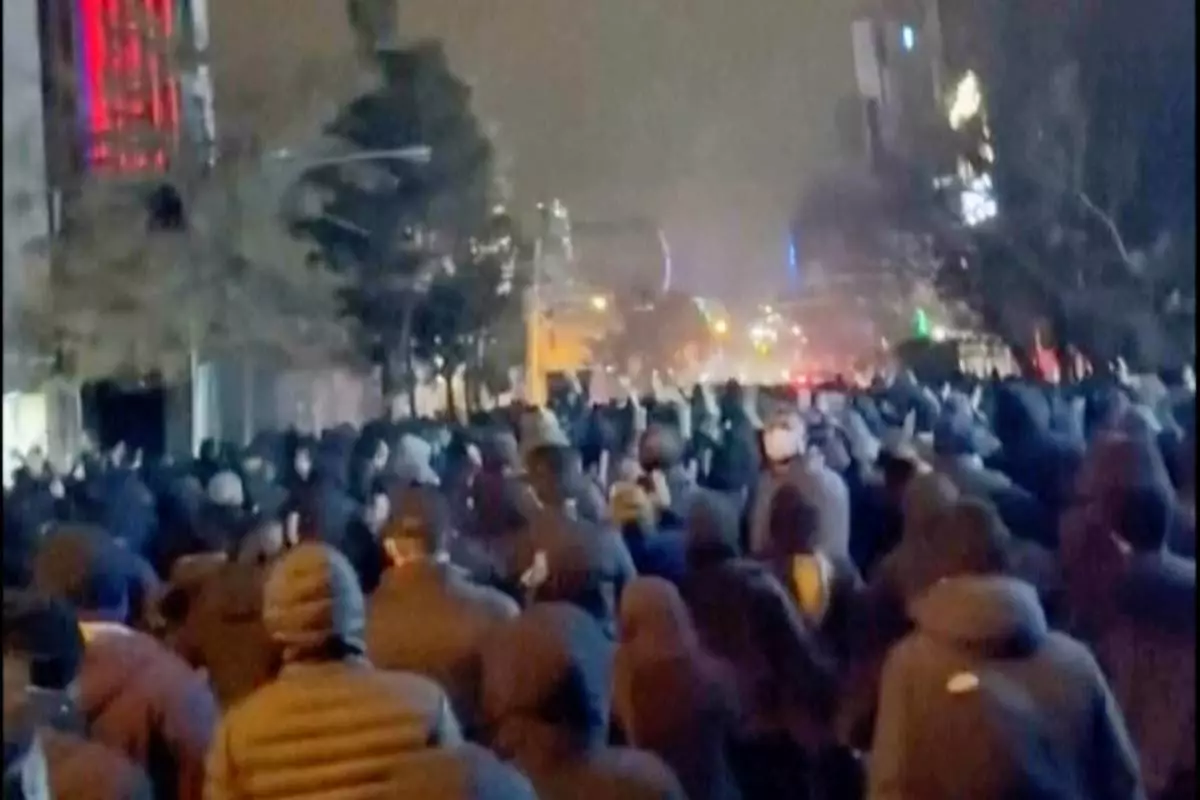
In this frame grab from footage circulating on social media from Iran shows protesters taking to the streets despite an intensifying crackdown as the Islamic Republic remains cut off from the rest of the world in Tehran, Iran, Friday, Jan. 9, 2026.(UGC via AP)

In this frame grab from footage circulating on social media from Iran shows protesters taking to the streets despite an intensifying crackdown as the Islamic Republic remains cut off from the rest of the world in Tehran, Iran, Friday, Jan. 9, 2026.(UGC via AP)

In this frame grab from footage circulating on social media from Iran showed protesters once again taking to the streets of Tehran despite an intensifying crackdown as the Islamic Republic remains cut off from the rest of the world in Tehran, Iran, Saturday Jan. 10, 2026. (UGC via AP)

In this frame grab from footage circulating on social media from Iran showed protesters once again taking to the streets of Tehran despite an intensifying crackdown as the Islamic Republic remains cut off from the rest of the world in Tehran, Iran, Saturday Jan. 10, 2026. (UGC via AP)

Recommended Articles