Apple and Google blocked downloads of phone apps that flag sightings of U.S. immigration agents, just hours after the Trump administration demanded that one particularly popular iPhone app be taken down.
U.S. Attorney General Pam Bondi said such tracking puts Immigration and Customs Enforcement officers at risk. But users and developers of the apps say it’s their First Amendment right to capture what ICE is doing in their neighborhoods — and maintain that most users turn to these platforms in an effort to protect their own safety as President Donald Trump steps up aggressive immigration enforcement across the country.
ICEBlock, the most widely used of the ICE-tracking apps in Apple’s app store, is among the apps that have been taken down. Bondi said her office reached out to Apple on Thursday “demanding that they remove ICEBlock" and claiming that it “is designed to put ICE agents at risk just for doing their jobs.”
Apple soon complied, sending an email Thursday to the app's creator, Joshua Aaron, that said it would block further downloads of the app because new information “provided to Apple by law enforcement” showed the app broke the app store rules.
According to the email, which Aaron shared with The Associated Press, Apple said the app violated the company’s policies “because its purpose is to provide location information about law enforcement officers that can be used to harm such officers individually or as a group.”
In a Friday interview, Aaron decried the company for bending to what he described as “an authoritarian regime.” And immigration rights advocates like Kica Matos, president of the National Immigration Law Center, added that these actions marked “a disturbing example of how tech companies are capitulating to Trump.”
“These apps are a lifeline for communities living in uncertainty and fear of when ICE might show up to tear their families apart,” Matos said in a statement.
Downloads of apps like ICEBlock have surged since Trump took office for his second term earlier this year. Aaron said he launched the app in April as a way to help immigrant communities protect themselves from surprise raids or potential harassment. It had more than 1 million users, he said.
While not specifying details on the total number of platforms removed, Apple confirmed to the AP on Friday that they removed “similar apps” due to potential safety risks that were raised by law enforcement. Google followed their move, saying that several similar apps violated their policies for Android platforms.
While some advocates don't find all of these apps particularly useful — pointing to potential misinformation and false alarms — they echoed criticism of moves to suppress them.
“What really worries me is the kind of precedent that this sets” where the government can “basically dictate what kinds of apps people have on their phones,” said civil rights attorney Alejandra Caraballo, who works at Harvard University's Cyberlaw Clinic.
Caraballo said outside the U.S., government pressure to block apps has been “kind of a hallmark of an authoritarian regime,” such as when Chinese pressure in 2019 led Apple to remove an app that enabled Hong Kong protesters to track police.
Bondi warned over the summer against apps that allow people to communicate about the location of law enforcement officers and specifically called out ICEBlock’s Aaron.
“We are looking at him and he better watch out because that’s not a protected speech,” Bondi said in a July interview on Fox News.
Those warnings escalated last month after a gunman opened fire on an ICE facility in Dallas. Officials including FBI Director Kash Patel said the gunman had searched for apps that tracked the presence of ICE agents, though they haven't said if he actually used one of the apps or whether any of them played a role in the attack.
Aaron said tying the gunman to the apps made little sense because the app only works if somebody else is reporting ICE activity within a 5-mile radius of another iPhone user.
“You don’t need an app to know that ICE agents are at an ICE detention facility,” he said. “This is just an easy excuse for them to use their power and leverage to take down something that was exposing what they are doing — and that is the terror that they are invoking on the people of this nation every single day."
He also said the app worked similarly to popular navigation apps like Waze, Google Maps and Apple’s own Maps app, which allow users to report police speed traps.
It's “not illegal in any way, shape or form, nor does it dox anybody,” he said, adding that ICEBlock is similarly “an early warning system for people.”
Those who use the apps or other online methods to monitor ICE activity say most people who use them do so for their own safety or out of concern for their loved ones.
“People are extremely scared right now," said Sherman Austin, who founded Stop ICE Raids Alert Network in February. He pointed to rising fears around racial profiling and violent arrests impacting families.
"They want to know what’s going on in their neighborhood and what’s going on in their community,” Austin said, describing people getting violently thrown to the ground by ICE agents in broad daylight.
Also known as StopICE.Net, Austin’s platform similarly uses crowdsourcing, but instead allows its users to track ICE activity more broadly online or through text alerts, without the need to download a separate app. Austin says the platform has reached more than 500,000 subscribers as of Friday.
The group has similarly criticized the Trump administration for what it says are retaliatory attacks targeting those who are exercising their First Amendment rights. Last month, the platform said it learned that the Department of Homeland Security has subpoenaed Meta for data on StopICE.Net's Instagram account.
Austin said StopICE.Net immediately challenged the action, adding on Friday that the subpoena is now temporarily blocked and pending a hearing with a judge.
Meta declined comment Friday. DHS did not directly respond to a request for comment about the subpoena on Friday, instead directing the AP to a statement from Assistant Secretary Tricia McLaughlin, who reiterated that “ICE tracking apps put the lives of the men and women of law enforcement in danger" and criticized media outlets for framing Apple's “correct decision” to remove apps like ICEBlock as "caving to pressure instead of preventing further bloodshed.”
Developers like Austin, meanwhile, say removals of these apps and other federal threats should alarm everyone.
“We’re up against a regime, an administration that’s going to operate any way it wants to — and threatens whoever it wants in order to get its way, in order to control information and in order to control a narrative," he said. “We have to challenge this and fight this any way we can.”
FILE - Buildings are reflected behind the logo at an Apple Store, in downtown Chicago, Oct. 19, 2017. (AP Photo/Kiichiro Sato, File)
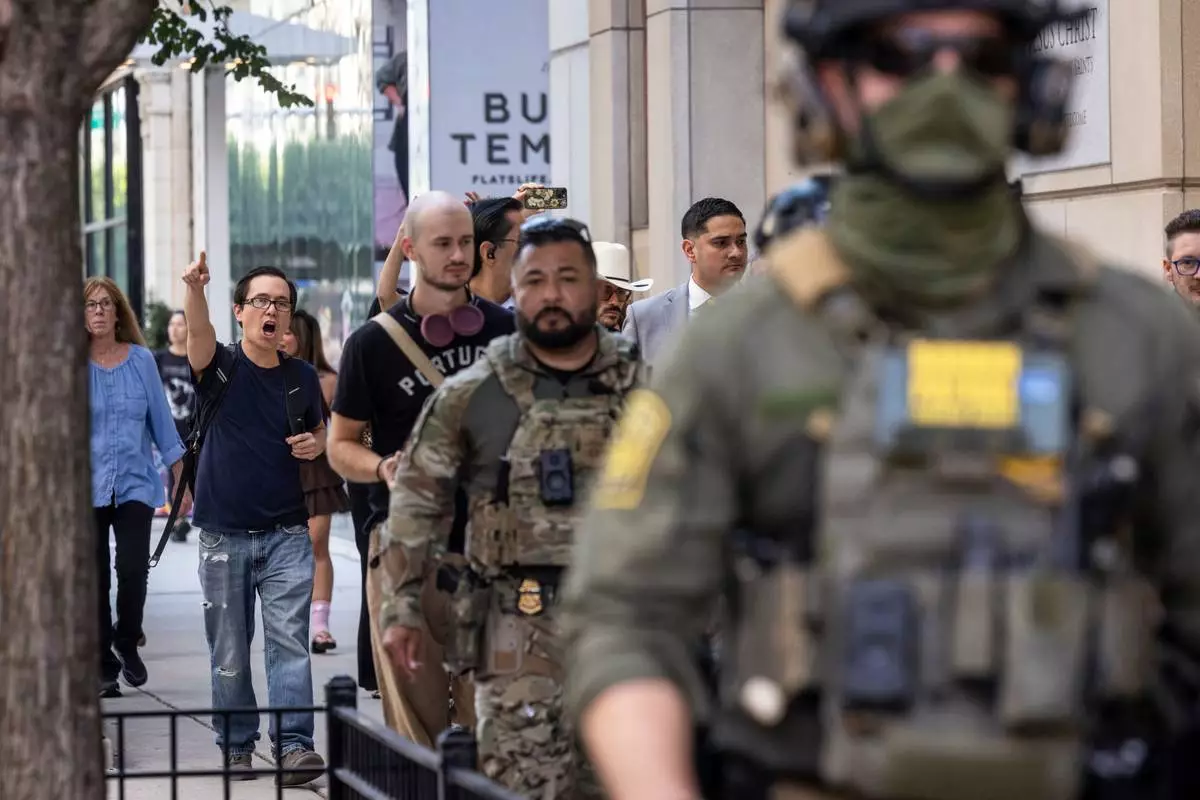
Pedestrians chant, "ICE go home!" as federal immigration agents walk along North Clark Street in the River North neighborhood, Sunday, Sept. 28, 2025, in Chicago. (Ashlee Rezin/Chicago Sun-Times via AP)
NEW YORK (AP) — Live Nation and the U.S. government announced a deal this week that they say would give artists and venues more choice when it comes to selling concert tickets to music fans. But critics say meaningful changes are far from guaranteed.
It's no secret that buying concert tickets can be a frustrating and costly process. And Live Nation, the parent company of Ticketmaster since 2010, has been the target for much of the backlash from concertgoers, artists and regulators.
On Monday, days into a trial, the Justice Department said it reached a tentative agreement to settle charges that Live Nation runs a monopoly squelching competition and driving up prices for live music. The DOJ hailed new options for promoters and venues that it said would end this illegal control. While continuing to maintain the allegations were without merit, Live Nation said the deal would give artists more flexibility for ticketing while also keeping costs affordable for fans.
What the settlement didn't do was separate Ticketmaster from Live Nation, an original goal of the DOJ's 2024 complaint.
Critics described the deal, which still needs court approval, as a win for the company over consumers. More than two dozen states vowed to keep fighting the case.
Meanwhile, industry experts say a lot more needs to be done beyond this legal battle to actually relieve concertgoers’ biggest headaches. Here's what we know.
Ticketmaster is widely considered to be the world’s largest ticket seller for live events. According to an annual report, it distributed 646 million tickets through its systems in 2025. And Live Nation owned, operated, had exclusive booking rights or an equity interest in 460 venues around the world, 78 of which were amphitheaters.
But this case targets major concert venues that sell tickets through Ticketmaster, generally locations with 8,000 seats or more. A “term sheet” spelling out the details said Live Nation agreed to let these venues essentially sign new agreements to sell a certain portion of tickets through entities other than Ticketmaster. Still, fully exclusive options with Ticketmaster would also be on the table for up to four years.
Specifically for amphitheaters that Live Nation already owns or operates out of, the company also pledged to cap service fees at 15%. Also for the amphitheaters, promoters may choose how to distribute up to 50% of the tickets at their own discretion.
In theory, expanding selling options could mean consumers see more choices. But the deal only requires it to be an option, not an immediate threshold, for venues to turn to competitors like SeatGeek or AXS.
On the tech side, while Ticketmaster also agreed to develop back-end technology for listing and delivering tickets for “any third-party primary marketplaces," but only for applicable venues that chose to do so.
Live Nation would “continue to benefit from the synergy of selling both the shows and the tickets,” said Bill Werde, director of Syracuse University’s Bandier music business program. And even if others tap into Ticketmaster’s tech, he added, “I have to imagine they will always have a competitive advantage as the company that owns it.”
Werde is skeptical about consumers benefits. He says the agreement addresses just “one small part” of concertgoers' top frustrations: fees. Even there, the proposed 15% cap is limited to amphitheaters, not all venues that Live Nation owns or operates out of.
Others say it is still unclear how that compares to current charges overall. Service fees are shared between both venues and ticketing sites.
Shubha Ghosh, director of intellectual property law at Syracuse, said at best he expects to see a small dent in ticket prices. He doubts high-profile acts will suddenly start charging less or that aggressive resellers will slow down anytime soon — which he and Wede noted account for the bulk of the sky-high prices U.S. consumers face today, but is beyond the scope of this case.
Meanwhile, Live Nation maintained it made significant concessions to the government. Dan Wall, executive vice president of Live Nation's corporate and regulatory affairs, called the agreement a “very good outcome for artists and venues” and said the terms were stronger than what the government has been able to obtain in past competition cases.
“People who are trying to dismiss this as inadequate are not being realistic,” Wall said.
Monday's tentative deal would create a $280 million settlement fund for the states' damage claims.
Critics called the amount a drop in the bucket when compared to Live Nation's total revenue of $25.2 billion last year.
But the $280 million, all or a portion, would only be paid out if states sign on to the deal. Attorneys general of more than two dozen states — including New York and California — pledged to keep fighting. That could potentially lead to more money, or what they argue are better benefits for consumers and artists than the Justice Department deal provides.
“There is an opportunity for the states, if they want to keep litigating, to continue to try to break (Live Nation) up,” said Kenneth Dintzer, a partner at law firm Crowell & Moring and former senior trial counsel in the DOJ’s Antitrust Division. “So this creates a floor, not a ceiling necessarily."
Again, the tentative settlement still needs court approval. Dintzer, who worked at the DOJ for over 30 years, said the terms outlined now seem like the "bare bones" — noting key details need to be filled in before a final order.
And all eyes are on future litigation. The states that rejected the DOJ deal have vowed to press on, although they have asked the judge to scrap the current trial and start with a new jury in a month or two.
“We will keep fighting this case without the federal government so that we can secure justice for all those harmed by Live Nation’s monopoly,” New York Attorney General Letitia James said following Monday's announcement.
A DOJ spokesperson said the states were free to pursue their claims — but that the federal government “sought meaningful relief for consumers now” rather than draw-out litigation. The official added that the settlement would “open up” the ticketing marketplace and “enable competition which will lower prices.” Monday’s pact arrives amid wider shifts at the DOJ under the Trump administration, which ousted the agency’s antitrust division head last month.
Meanwhile, industry experts stress more needs to be done to help concertgoers that isn't covered in this case. Werde pointed to the largely unregulated reselling market in the U.S. — where a “typical fan can’t even buy a ticket" amid overwhelming demand during mass ticket drops and attacks from bots, which quickly scoop up tickets to resell them at steeper prices.
Werde called for stronger laws to combat aggressive scalping, including a ban on the resale of tickets for more than they were originally listed for, along with more sweeping caps on fees. Beyond the federal level, several states have moved to try to address these concerns.
“We’ve seen this work in other countries. It’s not that complicated,” Werde said. “The ideal scenario would be one where every fan and everyone in business knows that artists set the prices — and that once artists set those prices, that’s basically what fans are going to pay.”
FILE - The Ticketmaster logo is seen along the sideline of the field before an NFL football game, Sept. 15, 2024, in Jacksonville, Fla. (AP Photo/Phelan M. Ebenhack, File)