Skip to Content Facebook Feature Image

New Supreme Court term confronts justices with Trump's aggressive assertion of presidential power

News

New Supreme Court term confronts justices with Trump's aggressive assertion of presidential power
News

News

New Supreme Court term confronts justices with Trump's aggressive assertion of presidential power

2025-10-05 08:15 Last Updated At:08:20

WASHINGTON (AP) — A monumental Supreme Court term begins Monday with major tests of presidential power on the agenda along with pivotal cases on voting and the rights of LGBTQ people.

The court's conservative majority has so far been receptive, at least in preliminary rulings, to many of President Donald Trump's aggressive assertions of authority. Liberal Justice Ketanji Brown Jackson invoked the Calvin and Hobbes comic strip after one such decision allowing the cut of $783 million in research funding.

"This is Calvinball jurisprudence with a twist,” Jackson wrote. “Calvinball has only one rule: There are no fixed rules. We seem to have two: that one, and this administration always wins.”

The conservative justices could be more skeptical when they conduct an in-depth examination of some Trump policies, including the president's imposition of tariffs and his desired restrictions on birthright citizenship.

If the same conservative-liberal split that has marked so many of Trump's emergency appeals endures, "we are in for one of the most polarizing terms yet,” said Irv Gornstein, executive director of the Supreme Court Institute at Georgetown University’s law school.

The justices will pass judgment in the next 10 months on some of Trump's most controversial efforts.

The justices are hearing a pivotal case for Trump’s economic agenda in early November as they consider the legality of many of his sweeping tariffs. Two lower courts have found the Republican president does not have the power to unilaterally impose wide-ranging tariffs under an emergency powers law.

States and small businesses argue Trump cannot usurp Congress’s taxation powers by declaring national emergencies and using tariffs to address them.

The administration, though, says the law does give the president the power to regulate importation, and that includes tariffs. Four dissenting judges on a federal appeals court in Washington bought that argument, mapping out a possible legal path at the high court.

In December, the justices will take up Trump's power to fire independent agency members at will, a case that probably will lead the court to overturn, or drastically narrow, a 90-year-old decision. It required a cause, like neglect of duty, before a president could remove the Senate-confirmed officials from their jobs.

The outcome appears to be in little doubt because the conservatives have allowed the firings to take effect while the case plays out, even after lower-court judges found the firings illegal. The three liberal justices have dissented each time.

Another case that has arrived at the court but has yet to be considered involves Trump's executive order denying birthright citizenship to children born in the United States to parents who are in the country illegally or temporarily.

The administration has appealed lower-court rulings blocking the order as unconstitutional, or likely so, flouting more than 125 years of general understanding and an 1898 Supreme Court ruling. The case could be argued in the late winter or early spring.

The future of electoral districts with majorities of Black, Hispanic or Native American voters hangs in the balance in a case about congressional redistricting in Louisiana that will be argued in mid-October.

The Republican-led state has abandoned its defense of a political map that elected two Black members of Congress. Instead, Louisiana wants the court to reject any consideration of race in redistricting in a case that could bring major changes to the Voting Rights Act.

Chief Justice John Roberts and the other five conservative justices have been skeptical of the consideration of race in public life, including a decision in 2023 that ended affirmative action in college admissions.

Louisiana's position would allow it and other Republican-controlled states in the South to draw new political maps that eliminate virtually all majority Black House districts, which have been Democratic strongholds, voting rights experts say.

The justices failed to decide the case in June after hearing arguments during its last term. The court does not need to go as far as Louisiana wants to reject the congressional map.

But a second round of arguments is a rare occurrence at the Supreme Court, and sometimes presages a major change by the justices. The Citizens United decision in 2010 that led to dramatic increases in independent spending in U.S. elections came after it was argued a second time.

Republicans, including the Trump administration, also are behind a drive to wipe away limits on how much political parties can spend in coordination with candidates for Congress and president.

The justices are reviewing an appellate ruling that upheld a provision of federal election law that is more than 50 years old. Democrats had asked the court to leave the law in place, and the Supreme Court upheld it in 2001.

But Roberts, who just marked his 20th anniversary as chief justice, has led a court that has struck down one campaign finance regulation after another.

No date for arguments has been set.

More than two dozen states have enacted laws barring transgender women and girls from participating in certain sports competitions.

The justices are hearing cases from Idaho and West Virginia, where transgender athletes won lower court rulings.

The Supreme Court in June upheld a ban on gender-affirming care for transgender youth, but pointedly did not decide any broader issues about transgender rights.

They quickly agreed to take up the state appeals, which raised questions under the Constitution's guarantee of equal treatment and the federal law known as Title IX that dramatically expanded the participation of girls and women in sports in public schools and colleges.

The court has yet to set an argument date.

Alito turns 76 in April, young by Supreme Court standards. But he might not want to stay around and gamble on the possibility of Democrats flipping the Senate in next year's elections and seeing a Democrat capture the White House two years later.

Retiring next summer would allow Trump to name a similarly conservative but much younger replacement who would almost certainly win confirmation from the Republican-led Senate.

For close watchers of the court, Alito has done only one thing out of the ordinary: signed a contract to write a book that is expected out next year. Even as his junior colleagues have moved quickly to sign book deals. Alito, by contrast, waited nearly 20 years.

He did not respond to a request for comment for this story.

Alito is not the oldest justice. Clarence Thomas is 77, but he has shown no signs of leaving, certainly not before he is set to become the longest-serving justice in U.S. history in 2028.
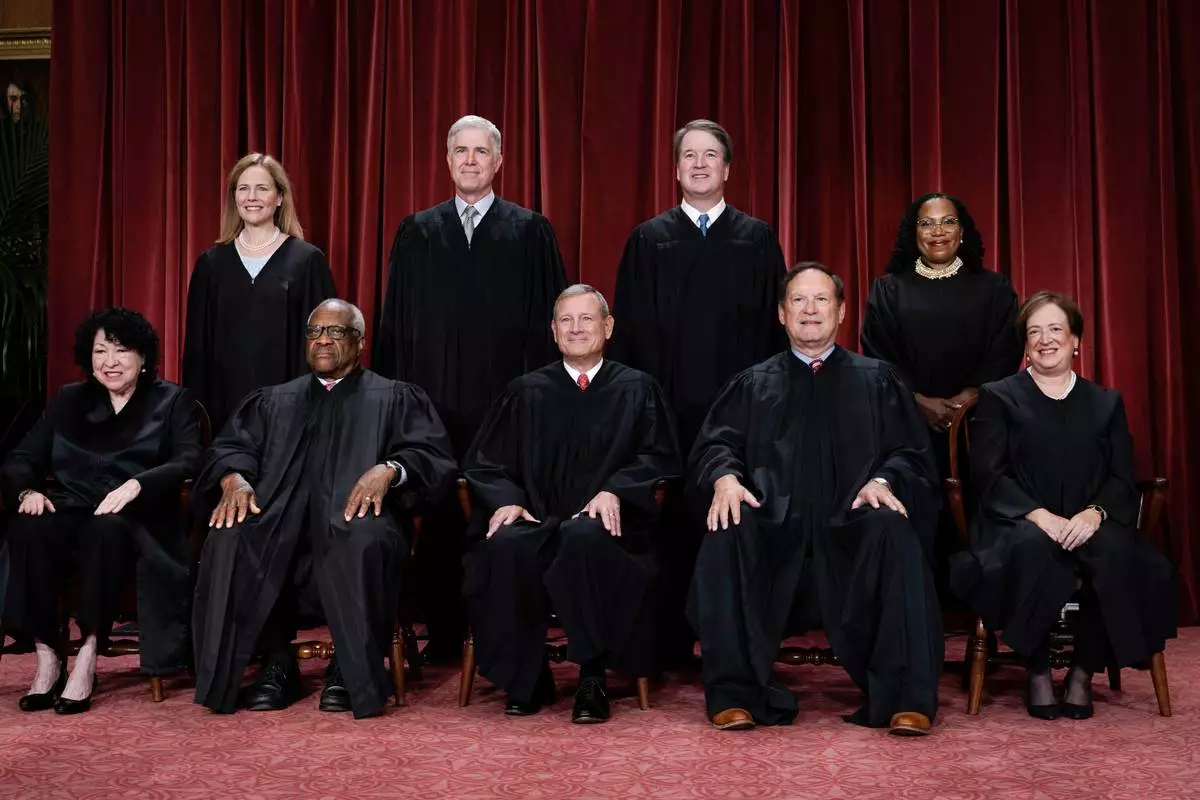
FILE - Members of the Supreme Court sit for a new group portrait at the Supreme Court building in Washington, Oct. 7, 2022. (AP Photo/J. Scott Applewhite, File)


FILE - Members of the Supreme Court sit for a new group portrait at the Supreme Court building in Washington, Oct. 7, 2022. (AP Photo/J. Scott Applewhite, File)

President Donald Trump's call for Republicans to redraw U.S. House districts ahead of next year's election has triggered an unusual outbreak of mid-decade gerrymandering among both Republican- and Democratic-led states.

Democrats need to gain just three seats to wrest control of the House away from Republicans. And Trump hopes redistricting can help stave off historical trends, in which the president's party typically loses seats in midterm elections.

Here's what states are doing:

Texas — The first state to take up congressional redistricting at Trump's prodding. Republican Gov. Greg Abbott signed a new U.S. House map into law on Aug. 29 that could help Republicans win five additional seats. Republican currently hold 25 of the 38 seats. The new map faces a legal challenge.

California — The first Democratic-led state to counter Trump's redistricting push. A new U.S. House map approved Nov. 4 by voters circumvents districts adopted by an independent citizens commission after the 2020 census and replaces them with districts that could help Democrats win five additional seats. Democrats currently hold 43 of the 52 seats. The U.S. Department of Justice has joined a Republican lawsuit challenging the new districts.

Missouri — The second Republican-led state to approve new House districts sought by Trump. Republican Gov. Mike Kehoe signed a new map into law Sept. 28 that could help Republicans win an additional seat by reshaping a Democratic-held district in Kansas City. Republicans currently hold six of Missouri's eight seats. Opponents are gathering signatures for a petition that could force a statewide referendum on the map and have filed several lawsuits.

North Carolina — The third Republican-led state to approve new House districts sought by Trump. The Republican-led General Assembly gave final approval Oct. 22 to changes that could help Republicans win an additional seat by reshaping a Democratic-held district in eastern North Carolina. No gubernatorial approval is needed. Republicans currently hold 10 of the 14 seats. The revised map faces a legal challenge.

Ohio — A panel of elected officials who are primarily Republicans voted Oct. 31 to approve new U.S. House districts that could boost the GOP's chances of winning two already competitive seats. Republicans currently hold 10 of the 15 seats. Redistricting was required by the state constitution because the previous map was enacted without bipartisan support.

Utah — A judge imposed new U.S. House districts on Nov. 11 that could allow Democrats to win a seat centered in the Salt Lake County. The judge rejected a revised map that had been approved Oct. 6 by the Republican-led Legislature in response to her original ruling invalidating districts adopted after the 2020 census because lawmakers had circumvented anti-gerrymandering standards passed by voters. Republicans currently hold all four seats.

Louisiana — Republican Gov. Jeff Landry in October signed legislation to delay the state’s primary elections from April 18 to May 16. The change could give lawmakers extra time to redraw U.S. House districts in case the U.S. Supreme Court overturns the state’s current congressional map. Republicans currently hold four of the six seats.

Virginia — The Democratic-led General Assembly in October endorsed a proposed a constitutional amendment allowing mid-decade redistricting in response to similar efforts elsewhere. Democrats currently hold six of the 11 U.S. House districts under a map imposed by a court in 2021 after a bipartisan commission failed to agree on a plan. The amendment needs another round of legislative approval next year to be placed on the statewide ballot.

Maryland — Democratic Maryland Gov. Wes Moore has announced a commission on congressional redistricting, even though the Democratic Senate president has said his chamber won’t move forward with redistricting because of concerns the effort to gain another Democratic seat could backfire. Democrats currently hold seven of the eight seats.

Colorado — Democratic Attorney General Phil Weiser, a gubernatorial candidate, has expressed support for a constitutional amendment to allow mid-decade redistricting. The measure would need to go on a statewide ballot. Democrats and Republicans each currently hold four seats.

Florida — Republican state House Speaker Daniel Perez has created a special committee on congressional redistricting. Republicans currently hold 20 of the state’s 28 seats.

Illinois — U.S. House Minority Leader Hakeem Jeffries and the Democratic Congressional Campaign Committee have urged state lawmakers to redraw Illinois’ districts. Democrats currently hold 14 of the 17 seats.

Indiana — Trump and Vice President JD Vance have urged Republican lawmakers to redraw congressional districts. But lawmakers declined to convene a special session on redistricting that Republican Gov. Mike Braun had called in November. And the state Senate leader said his chamber won't meet in a December session for redistricting. Republicans currently hold seven of the nine seats.

Kansas — Republican lawmakers dropped a petition drive to call themselves into a special session on congressional redistricting in November. But they still could redraw districts during the next regular session that begins in January. Republicans currently hold three of the four seats.

New York — Democratic state lawmakers have filed a proposed constitutional amendment to allow mid-decade redistricting. The measure would need to be approved by the Legislature in two separate sessions, then placed on the statewide ballot. Democrats currently hold 19 of the 26 seats.

Nebraska — Republican Gov. Jim Pillen has expressed support for mid-decade redistricting. Republicans already hold all three House seats but could try to shore up a competitive district that includes Omaha.

Demonstrators hold signs during a rally protesting a proposed election redistricting map Tuesday, Oct. 21, 2025, in Raleigh, N.C. (AP Photo/Chris Seward)

Demonstrators hold signs during a rally protesting a proposed election redistricting map Tuesday, Oct. 21, 2025, in Raleigh, N.C. (AP Photo/Chris Seward)

FILE - Opponents of California Proposition 50, also known as the Election Rigging Response Act, a California ballot measure that would redraw congressional maps to benefit Democrats hold a rally in Westminster, Calif., on Wednesday, Sept. 10, 2025. (AP Photo/Damian Dovarganes, File)

FILE - Opponents of California Proposition 50, also known as the Election Rigging Response Act, a California ballot measure that would redraw congressional maps to benefit Democrats hold a rally in Westminster, Calif., on Wednesday, Sept. 10, 2025. (AP Photo/Damian Dovarganes, File)

North Carolina state Sen. Warren Daniel, R-Burke (left and standing), presides over the Senate Committee on Elections while it considers legislation to redraw the state's U.S. House district map at the Legislative Office Building in Raleigh N.C., Monday, Oct. 20, 2025. (AP Photo/Gary D. Robertson)

North Carolina state Sen. Warren Daniel, R-Burke (left and standing), presides over the Senate Committee on Elections while it considers legislation to redraw the state's U.S. House district map at the Legislative Office Building in Raleigh N.C., Monday, Oct. 20, 2025. (AP Photo/Gary D. Robertson)

Recommended Articles