ATHENS, Ga. (AP) — Gunner Stockton and the No. 12 Georgia Bulldogs wasted no time showing they had moved on from a tough loss to Alabama.
Stockton and Dillon Bell each had a pair of touchdown runs, leading the Bulldogs to a 35-14 victory over Kentucky on Saturday.
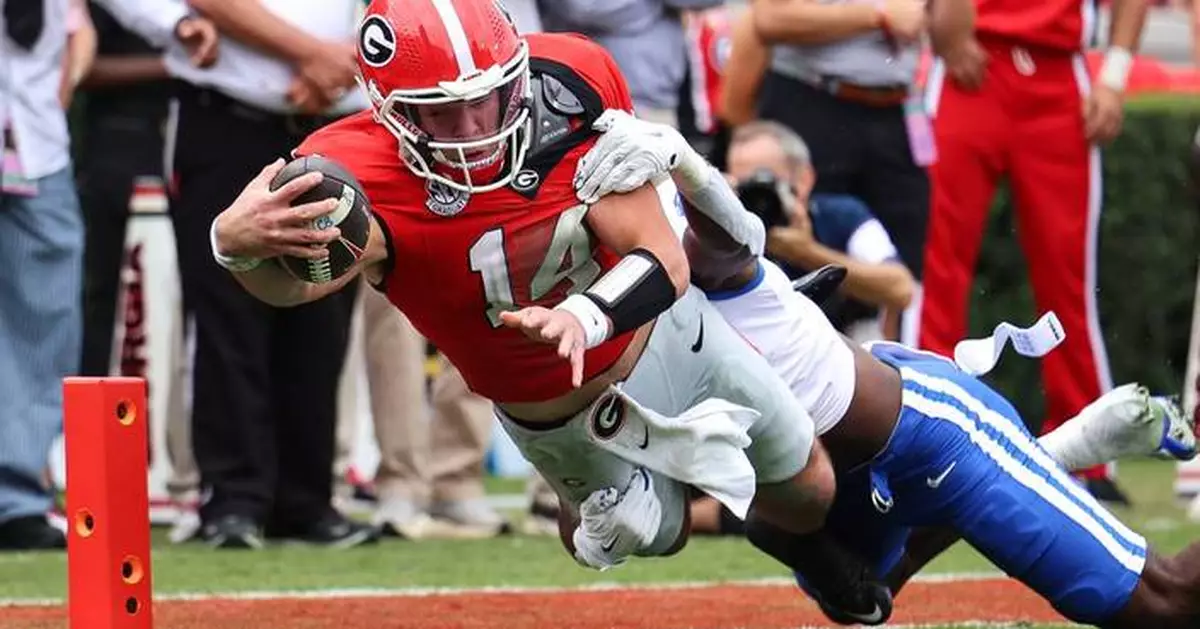
Georgia (4-1, 2-1 Southeastern Conference) finally got off to a quick start, capping its first two possessions with scoring runs from quarterback Stockton.
There were no signs of anyone still pouting about what happened a week ago, when Alabama won 24-21 to snap Georgia's 33-game home winning streak.
“I wasn't shocked at all by the response of the team,” coach Kirby Smart said. “If we continue to get better, we’ll be where we need to be.”
Stockton had 48 yards on six carries. He completed 15 of 23 passes for 196 yards, including a 16-yard scoring play to Cash Jones.
Bell, a receiver who also has played running back, tacked on a pair of 3-yard TD runs with an end around and a reverse. He set up the scoring pass to Jones with a 33-yard catch.
Cutter Boley had 225 yards passing with a couple of touchdowns for Kentucky (2-3, 0-3), but it wasn't nearly enough to prevent Georgia from winning its 16th straight game in the series.
The Bulldogs haven't lost to Kentucky since 2009.
“I'm excited about our guys getting off to a fast start. That was the goal. That’s always the goal,” Smart said. “We still have a long way to improve to get where we need to go. But we are physical and we are resilient. That's gonna keep you competitive.”
Georgia had trailed at halftime in its two previous games. No such issues in this one.
The Bulldogs took the opening kickoff and went 75 yards in 12 plays, capped by Stockton diving at the pylon for a 7-yard scoring run.
Georgia went nearly the length of the field on its next possession — 96 yards over 13 plays — and Stockton finished it off again. He trotted in for a 6-yard TD after a nifty fake on linebacker Sam Greene.
Kentucky coach Mark Stoops, the longest-tenured coach in the SEC, angrily denied that he has talked with school officials about a possible buyout.
“I’d hate to give anything like that legs,” he said. "There’s zero chance I’m walking away. There’s no quit in me, so that’s unequivocally 100% false. Anyone who tells you that is lying.”
In his 13th season, Stoops has a record of 69-76 overall and 28-65 in the SEC.
“I don't want to address that crap no more," he added.
Kentucky: The Wildcats simply made too many mistakes to have any chance of an upset. Poor time management at the end of the first half and a fumble on their first possession of the third quarter allowed the Bulldogs to pull away. And Jacob Kauwe missed a 26-yard field goal to end the first half. Kentucky has now gone 3-9 since a huge upset at Mississippi early last season, with no wins against Power Four opponents.
Georgia: The Bulldogs haven't lost back-to-back games in the regular season since 2016. They turned in another strong performance in the trenches, despite losing left tackle Monroe Freeling with a leg injury. Chauncey Bowens ran for 70 yards and Georgia finished with 180 rushing overall. On the other side of the line, the Bulldogs limited Kentucky to 45 yards running the ball and collected their first fumble recovery of the season.
Receiver London Humphreys set up Georgia’s third touchdown with a brilliant play on special teams.
Brett Thorson sent a booming punt toward the left pylon and Humphreys tiptoed along the goal line to bat it out of bounds at Kentucky 1.
The Wildcats went three-and-out after Thorson’s 60-yard punt, and Georgia got the ball back at the Kentucky 40.
Taking advantage of the short field, the Bulldogs needed only six plays to reach the end zone on Bell’s first TD run.
Kentucky had an opportunity to cut into Georgia’s two-touchdown lead before halftime, only to squander a prime scoring chance.
After driving across midfield, the Wildcats wasted more than 20 seconds trying to get lined up before finally being forced to call their second timeout to avoid a delay penalty.
They could have used that extra time with a first-and-goal at the Georgia 8 but could only take one shot at the end zone. Boley threw it away when he couldn’t find anyone open, and Kauwe yanked the chip-shot field goal wide of the left upright.
Kentucky: After an off week, it's another stiff challenge when the Wildcats host No. 9 Texas on Oct. 18.
Georgia: Travels to Auburn next Saturday for the renewal of the Deep South's oldest rivalry.
Get poll alerts and updates on the AP Top 25 throughout the season. Sign up here and here (AP News mobile app). AP college football: https://apnews.com/hub/ap-top-25-college-football-poll and https://apnews.com/hub/college-football

Georgia quarterback Gunner Stockton (14) dives in for a touchdown during the first half of an NCAA college football game against Kentucky, Saturday, Oct. 4, 2025, in Athens, Ga. (AP Photo/Colin Hubbard)
MIAMI (AP) — It has been nearly three decades since a Democrat held the mayor’s office in Miami, a span of futility the party is hoping to reverse during a special runoff election this week in one of the last electoral showdowns before next year’s midterms.
While it is a local race, this election has become the latest test of the nation’s political mood nearly a year into President Donald Trump’s second term.
Trump and other big-name Florida Republicans, including Gov. Ron DeSantis and Sen. Rick Scott, have weighed in for the conservative candidate, former city manager Emilio Gonzalez, in the otherwise nonpartisan race. Nationally known Democrats, including former Transportation Secretary Pete Buttigieg, have offered support on behalf of Eileen Higgins, a Democrat who served on the county commission before winning a runoff spot last month.
An upset for the Democrats on Tuesday would give the party an additional burst of momentum heading into a crucial election year when control of Congress will be at stake, especially in a region that has become increasingly friendly turf for Republicans and where Trump plans to build his presidential library.
Higgins, who lives in the Cuban enclave of Little Havana and had represented a district that leans conservative, proudly wears the label of “La Gringa,” a term Spanish speakers use for white Americans. A Spanish speaker herself, Higgins has focused her campaign relentlessly on local issues such as the cost of housing while capitalizing on national ones, including the treatment of immigrants under the Trump administration in a city with sizable Hispanic and foreign-born populations.
“I have been a Democrat serving in a primarily Republican district, and all I have done is work for the people,” she told The Associated Press.
Miami is Florida’s second most populous city, behind Jacksonville, but is the epicenter of the state’s diverse culture and is among the nation’s most prominent international destinations, giving its mayor an outsize platform.
The city of 487,000 is part of Miami-Dade County, which Trump flipped last year, handily defeating Democrat Kamala Harris after losing the county to Democrat Joe Biden in 2020. A loss for Gonzalez would be perceived in Florida as a setback for the GOP and Trump.
Christian Ulvert, Higgins’ campaign manager, said early returns of mail ballots are encouraging. About 44% had been cast by registered Democrats as of Thursday, a day before early in-person voting began, compared with about 30% by registered Republicans.
“What you’re seeing is great Democratic enthusiasm and turnout that matches that enthusiasm,” he said.
Higgins, who would be the first non-Hispanic mayor of Miami in almost 30 years if elected, said she is confident she will receive support not only from Democrats, but also from unaffiliated voters and some Republicans because of her work as an elected official.
Her pitch to voters includes finding city-owned land that could be turned into affordable housing and cutting unnecessary spending. She was asked during a recent forum sponsored by the Greater Miami Chamber of Commerce if she would try to turn the more ceremonial role of mayor into a full-time job and not take on other work, something that raised ethical concerns for the current mayor, term-limited Francis Suarez.
“I do not have outside employment now. I was a full-time commissioner. I’m going to be a full-time mayor,” Higgins said as the interviewer continued to press her about whether that meant not accepting any outside employment.
In a blunt-talking style, Higgins responded sternly: “All right, do I have to say it more clearly? No! It’s a full-time job.”
While Latino voters nationally have traditionally leaned Democratic, Republicans in Florida have found strong backing among Cuban, Venezuelan and Nicaraguan immigrants, who resist socialist inclinations likened to the ones from the governments they fled. Trump tapped into those sentiments in winning Miami-Dade County last year, a turnaround from his 30 percentage point loss there to Democrat Hillary Clinton in 2016.
Yet some Florida Republicans began sounding the alarm after November’s elections, when Democrats secured wins in nationally watched governor’s races in New Jersey and Virginia. Both winning candidates had strong performances with nonwhite voters, and the Democratic winner in the New Jersey race received two-thirds of the Hispanic vote, according to the AP Voter Poll.
Those results were largely seen as a reflection of concerns over rising prices and the Trump administration’s aggressive immigration policies.
U.S. Rep. Maria Elvira Salazar, a Republican whose district includes the city of Miami, called the elections elsewhere a “wake-up call.” Ileana Garcia, a Florida state senator who in 2016 founded the group Latinas for Trump, has said about immigration arrests that “what we are witnessing is inhumane.”
Gonzalez, a former director of the U.S. Citizenship and Immigration Services under Republican President George W. Bush, said during a debate sponsored by Miami's CBS affiliate that he supported immigration arrests against those who committed crimes. But he demurred when the moderator said most of those arrested had not committed violent offenses: “But this is a federal issue," Gonzalez said. "This is not an issue that has to do with the mayor of Miami.”
Higgins has spoken about Miami’s signing on to a federal program that delegates immigration authority to local police, county sheriffs and state agencies and said she would find legal options to unwind that decision to rebuild trust between residents and law enforcement.
“When we start to enforce whatever shenanigans is coming out of the federal government to just randomly pick people up, we could erode that trust,” she said.
Higgins has received support from Florida Democrats looking to show the party still has a foothold in the formerly swing state.
Some Democrats who could be considering a presidential run in 2028 also are backing her campaign. Buttigieg encouraged voters in a video to make a plan to vote for her, and U.S. Sen. Ruben Gallego of Arizona planned to join her on Sunday for early voting stops.
Many of the local issues at play in the race resonate nationally, including income inequality and one of the nation’s least affordable housing markets.
Gustavo Ascani, a 30-year-old Miami voter, said the city has long-standing problems that need addressing. He said he has not decided whom he will vote for, but said tackling homelessness and traffic is a priority for him.
“Maybe Republicans have overlooked, after having locally been in power for so long, certain issues that are important for the people in Miami,” Ascani said.
Robin Peguero, a former prosecutor who is running for the chance to challenge Salazar for her congressional seat, said voters’ concerns center around affordability, an issue that has become a focal point of both parties after Democrats' wins in New Jersey and Virginia.
That includes the sharp health insurance premium spikes expected to start Jan. 1 after subsidies under the Affordable Care Act expire. The Obama-era health law remains popular in South Florida, and recent polling shows most people who will be affected by the increases blame Trump and Republicans.
“It’s kitchen table issues, whether it’s an election for local officials or whether there is an election for the president,” Peguero said. “It’s a rejection of what is happening in this country.”

Gustavo Ascani, a digital content creator, speaks about the upcoming Miami mayor runoff election, Thursday, Dec. 4, 2026, in Miami. (AP Photo/Marta Lavandier)

Former Miami-Dade County Commissioner and candidate for Miami mayor Eileen Higgins, speaks at a Miami Chamber of Commerce event Thursday, Dec. 4, 2026, in Miami. (AP Photo/Marta Lavandier)

FILE - Florida Gov. Rick Scott, right, laughs with Emilio Gonzalez, director and chief executive officer of the Miami-Dade Aviation Department, center, and Jose "Pepe" Diaz, Miami-Dade County commissioner, left, after a news conference at Miami International Airport, Wednesday, Aug. 19, 2015, in Miami. (AP Photo/Lynne Sladky, File)

Former Miami-Dade County Commissioner and candidate for Miami mayor Eileen Higgins, speaks at a Miami Chamber of Commerce event Thursday, Dec. 4, 2026, in Miami. (AP Photo/Marta Lavandier)