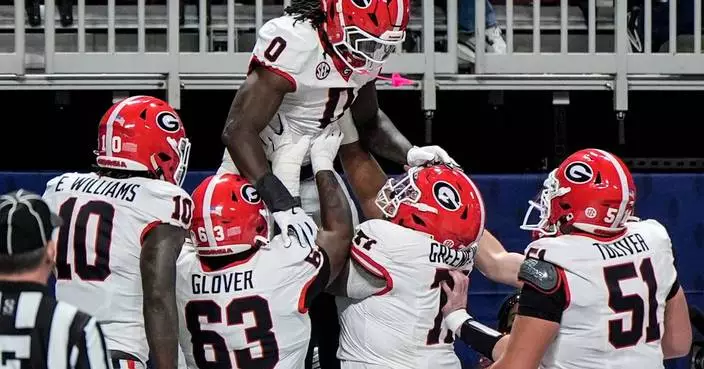
ANN ABROR, Mich. (AP) — Bryce Underwood and the 20th-ranked Michigan Wolverines were clinging to a three-point lead after two quarters against Wisconsin when the freshman quarterback said the messaging in the locker room was clear.
“We went into halftime saying we’re going to dominate,” he said.
Michigan (4-1, 2-0 Big Ten) pulled away in the second half when Underwood threw a 29-yard touchdown pass to Donaven McCulley late in the third quarter and Justice Haynes had his second short touchdown run early in the fourth.
Underwood, the nation’s No. 1 recruit last year, completed 19 of 28 passes for a season-high 270 yards with a touchdown and gave grace to teammates for dropping some passes.
“Good play, bad play — next play,” he said. “If you’re stuck on the last play, you’ll be stuck on the next one.”
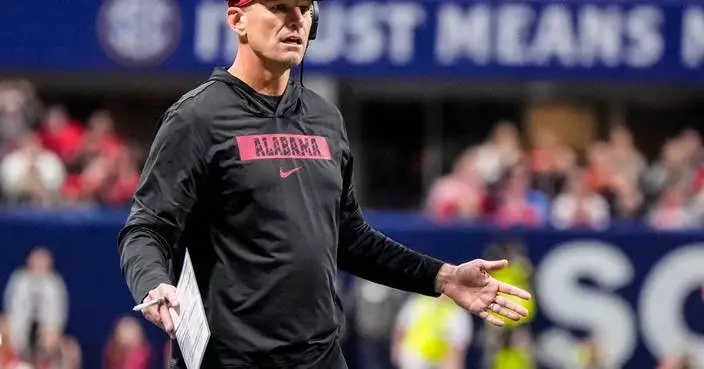
Haynes had 19 carries, including one for 43 yards against a defense that led major college football by allowing just 50 yards rushing per game, and finished with 117 yards on the ground. The Alabama transfer has run for 100-plus yards in each game this season.
McCulley had six catches for a season-high 112 yards and a score.
The Badgers (2-3, 0-2) opened the game with a 12-play, 75-yard touchdown drive that took nearly seven minutes off the clock and didn't score again until Nathanial Vakos kicked a 39-yard field goal late in the game.
“We’re not here to sugarcoat anything," Wisconsin coach Luke Fickell said. "There obviously is some good, but our ability to sustain and finish, we still are not close to where we need to be. The second half showed that.”
Southern Illinois transfer QB Hunter Simmons made his first start for the Badgers in place of Danny O’Neil, who had as many touchdowns (five) as interceptions while filling in for injured quarterback Billy Edwards Jr.
Simmons was 18 of 29 for 177 yards with an interception.
“Hunter showed some poise," Fickell said.
Dilin Jones had 17 carries for 63 yards, mostly on the game-opening drive, and scored on a 5-yard run to put the Badgers ahead briefly. Wisconsin's Vinny Anthony had nine receptions for 97 yards.
Wisconsin: Fickell has a losing record (15-16) in his third season with the Badgers. Fickell fell to 0-8 against AP Top 25 teams while at Wisconsin.
He said every play will be analyzed to see which players have a competitive spirit.
“We’re going to find out who the ones are who don’t look at the scoreboard," Fickell said, "don't look at the record, don’t worry about who the next opponent is, but are willing to fight their way through this thing.”
Michigan: In his first home game since beating Ohio State in 2024, safety Rod Moore intercepted a pass at the Michigan 17 late in the third quarter. Moore made his season debut at Nebraska after two knee surgeries sidelined him last year.
“I couldn’t be more proud of this young man,” coach Sherrone Moore said. “Everything you want, he does it the right way. He’s special.”
Moore returned from a school-imposed, two-game suspension stemming from the program's previous sign-stealing scheme.
He said it was “torture” to be away from the team for two weeks.
“We felt his energy,” McCulley said. “That’s something that really helps us.”
Michigan plays at USC and Wisconsin hosts Iowa on Oct. 11.
Get poll alerts and updates on the AP Top 25 throughout the season. Sign up here and here (AP News mobile app). AP college football: https://apnews.com/hub/ap-top-25-college-football-poll and https://apnews.com/hub/college-football
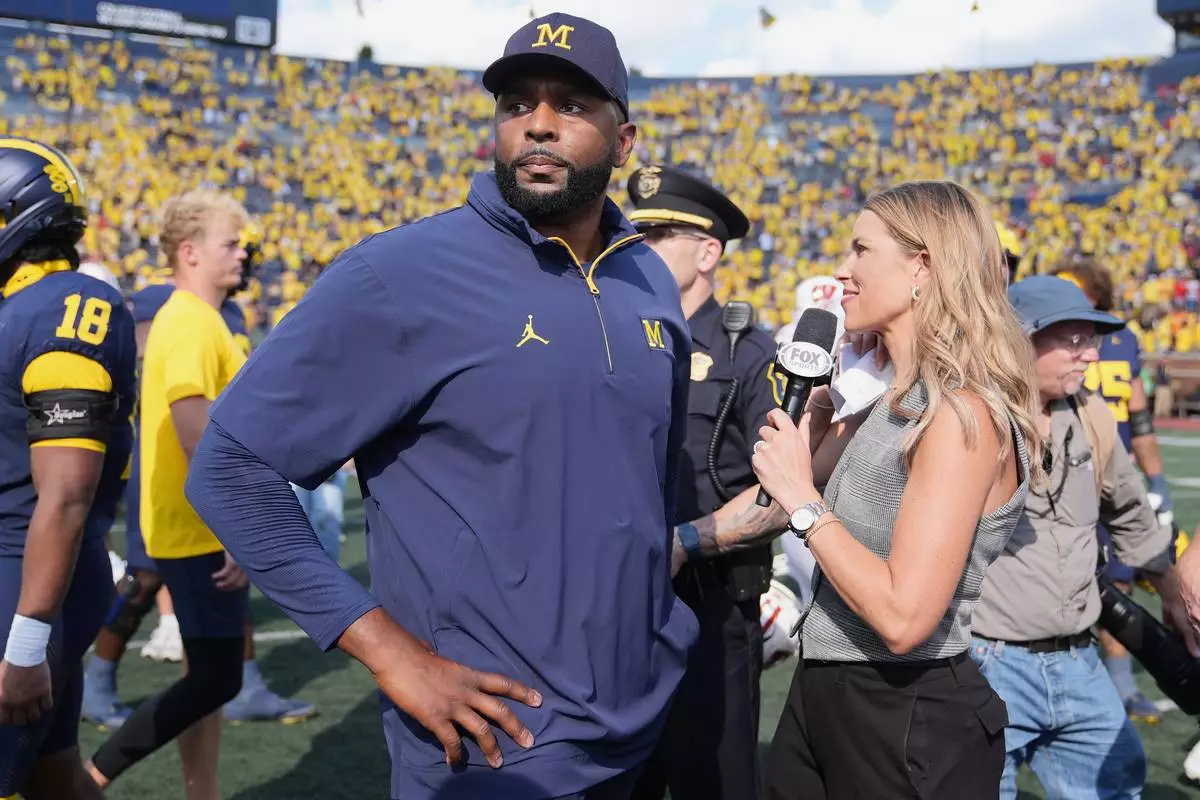
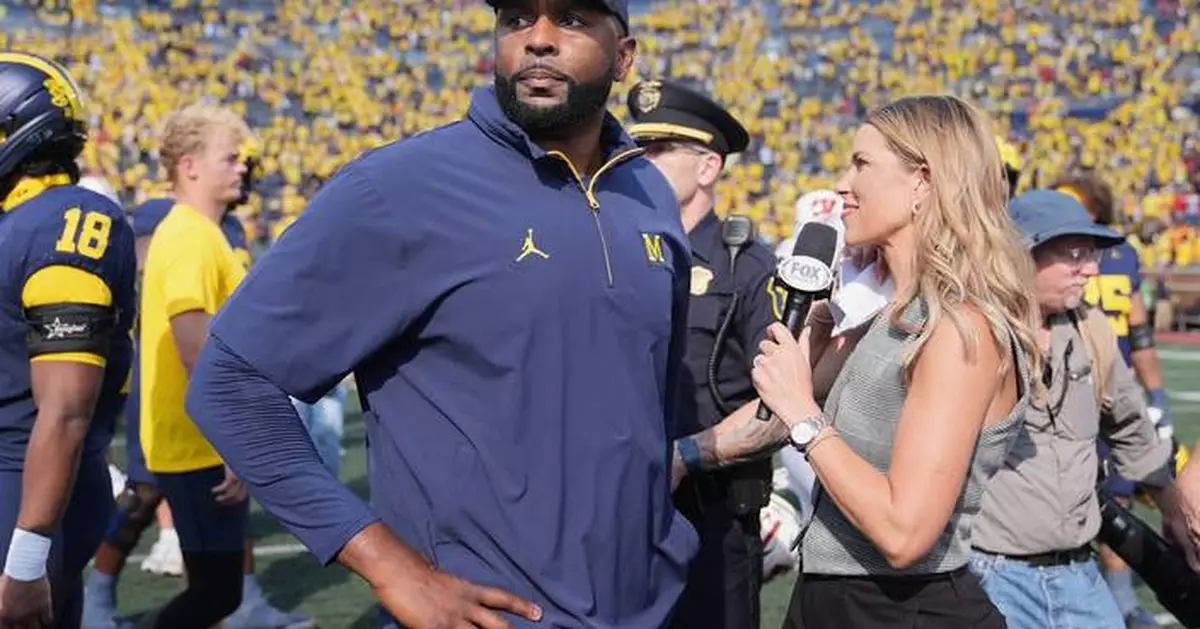
Michigan head coach Sherrone Moore gives a news interview after the team's win in an NCAA college football game against Wisconsin, Saturday, Oct. 4, 2025, in Ann Arbor, Mich. (AP Photo/Ryan Sun)

CAIRO (AP) — Palestinian President Mahmoud Abbas turns 90 on Saturday, still holding authoritarian power in tiny pockets of the West Bank, but marginalized and weakened by Israel, deeply unpopular among Palestinians, and struggling for a say in a postwar Gaza Strip.
The world’s second-oldest serving president — after Cameroon’s 92-year-old Paul Biya — Abbas has been in office for 20 years, and for nearly the entire time has failed to hold elections. His weakness has left Palestinians leaderless, critics say, at a time when they face an existential crisis and hopes for establishing a Palestinian state, the centerpiece of Abbas’ agenda, appear dimmer than ever.
Palestinians say Israel’s campaign against Hamas that has decimated Gaza amounts to genocide. Israel denies the accusation and has tightened its lock on the West Bank, where Jewish settlements are expanding and attacks by settlers on Palestinians are increasing. Right-wing allies of Israeli Prime Minister Benjamin Netanyahu are pressing for outright annexation, a step that would doom any remaining possibility for statehood.
For now, the U.S. has bent to Israel’s refusal to allow Abbas’ Palestinian Authority to govern postwar Gaza. With no effective leader, critics fear Palestinians in the territory will be consigned to live under an international body dominated by Israel’s allies, with little voice and no real path to statehood.
Abbas “has put his head in the sand and has taken no initiative,” said Khalil Shikaki, head of the People’s Company for Polls and Survey Research, a Palestinian pollster.
“His legitimacy was depleted long ago," Shikaki told The Associated Press. "He has become a liability to his own party, and for the Palestinians as a whole.”
Within the pockets of the West Bank that it administers, the PA is notorious for corruption. Abbas rarely leaves his headquarters in the city of Ramallah, except to travel abroad. He limits decision-making to his tight inner circle, including Hussein al-Sheikh, a longtime confidant whom he named as his designated successor in April.
An October poll by Shikaki’s organization found that 80% of Palestinians in the West Bank and Gaza want Abbas to resign. Only a third want the PA to have full or shared governance of the Gaza Strip. The survey of 1,200 people had a margin of error of 3.5 percentage points.
It’s a long way from 20 years ago, when Abbas was elected president after the death of Palestinian leader Yasser Arafat amid hopes he could negotiate an independent state.
The first blow came in 2007, when Hamas drove the PA out of the Gaza Strip in a violent takeover. Hamas’ rule entrenched a split between Gaza and the West Bank, the Israeli-occupied territories that the Palestinians seek for a state.
Abbas was left in charge of pockets around the West Bank’s main population centers. But his power is crippled because Israel has a chokehold on the economy, controlling the West Bank’s resources, most of its land and its access to the outside world.
Netanyahu, who took power in 2009, rejects the creation of a Palestinian state. His “strategy from Day 1” has been to weaken the PA, said Ehud Olmert, who preceded Netanyahu as prime minister and perhaps came the closest to reaching a peace deal with Abbas shortly before being forced from office.
Netanyahu’s aim, Olmert said, is to “prevent any genuine chance to come along with some compromise that could have been implemented into a historical agreement.”
The campaign of weakening the PA comes even though Abbas has abided by a major role demanded by Israel and the international community: security cooperation with Israel. The PA trades intelligence with Israel on militants and often cracks down on armed groups.
To many Palestinians, that makes the PA a subcontractor of the occupation, suppressing opponents while Israel swallows up an increasing amount of the West Bank.
“It has chosen to put itself hand-in-hand with the Israeli occupation, even as (Israel) acts to make it more fragile and weaker,” said Abdaljawad Omar, an assistant professor of philosophy and cultural studies at the West Bank’s Bir Zeit University.
Netanyahu frequently accuses Abbas of not genuinely seeking peace and of inciting violence against Israel. Netanyahu's government has repeatedly withheld transfers of tax money that Israel collects for the PA, because of stipends paid to families of those imprisoned or killed by Israel.
Despite reforms to the stipend system, Israel is withholding some $3 billion, according to the PA. That has worsened an ongoing economic crisis in the West Bank.
Israel’s campaign against the PA is “pushing it to the edge of collapse,” said Ghassan Khatib, who was Palestinian planning minister under Abbas in 2005-06.
Khatib defended what Abbas’ supporters call his policy of “practical realism." By working to prevent violence, Abbas has stayed credible on the international stage, he said, trying to build international backing and winning official recognition of a Palestinian state by a growing list of countries.
But that hasn’t brought any successful pressure from the U.S. or Europe against Israel to stop settlement expansion or reach a peace deal.
At a time when Israel's far right is pushing for “the eradication of the Palestinians,” Omar said, Abbas' pragmatic realism is “a form of national suicide.”
Fearing rivals, Abbas has prevented widescale participation in government, alternative leadership or popular movements even for significant non-violent resistance or civil disobedience against Israel, he said.
“Politics has been removed as a way for young people to engage, to stand against occupation,” said Omar, who was 17 when Abbas came to office.
Shikaki said Abbas' inaction only fuels support for Hamas, which portrayed its Oct. 7, 2023, attack on southern Israel as aimed at ending Israel’s occupation.
Even if some Palestinians believe the attack was disastrous, “they see Hamas as trying to do something on behalf of the Palestinian people," he said. "They see Abbas is doing nothing.”
U.S. President Donald Trump's plan calls for an international council to run the Gaza Strip after Hamas is removed, with a Palestinian administration carrying out day-to-day services. It holds out the possibility of the PA taking control if it carries out unspecified reforms to the council’s satisfaction.
Abbas has made some gestures toward change.
He has promised legislative and presidential elections within a year after the war in Gaza ends. This week, meeting with French President Emmanuel Macron, he announced a Palestinian-French commission to draw up a new constitution. In a high-profile move against corruption, the transport minister was removed in October and put under investigation on allegations of bribery, according to local media.
Palestinians are skeptical. In the PCPSR poll, 60% of respondents said they doubted Abbas will hold elections. It found that if a vote were held, the clear winner would be Marwan Barghouti, a senior figure from Abbas’ Fatah faction imprisoned by Israel since 2002. Abbas would come a distant third behind any Hamas candidate.
Ines Abdel Razak, co-director of Palestine Institute for Public Diplomacy advocacy group, said the U.S. and Israel don't have an interest in real democratization..
“That would mean all Palestinians would actually have a voice,” she said. “Any effective ruler would confront the Israeli occupation.”
Khatib said Israel will likely be able to keep the PA out of Gaza, since uniting it with the West Bank would only boost Palestinian demands for statehood.
“Israel is the party that is calling the shots on the ground,” he said.
AP correspondent Josef Federman in Jerusalem contributed.
FILE.- President Donald Trump greets Palestinian President Mahmoud Abbas during a summit to support ending the more than two-year Israel-Hamas war in Gaza after a breakthrough ceasefire deal, Monday, Oct. 13, 2025, in Sharm El Sheikh, Egypt. (AP Photo/Evan Vucci, File)
FILE.- Palestinians chant national slogans and carry posters with pictures of President Mahmoud Abbas and read "you kept your promise," during a rally in support for Gaza and celebrating the latest western nations recognitions of the Palestinian state ahead of the United Nations General Assembly meetings, in the West Bank city of Ramallah Tuesday, Sept. 23, 2025. (AP Photo/Nasser Nasser,File)
FILE - Interim Palestinian leader Mahmoud Abbas, is carried by the Al Aqsa Martyrs' Brigades leader in West Bank, Zakaria Zubeidi, center left, during a campaign visit to the Jenin refugee camp Dec. 30, 2004.(AP Photo/Enric Marti, File)
FILE.- Palestinian leader Yasser Arafat makes the victory sign as he leaves the confidence vote session of the Palestinian Legislative Council accompanied by Prime Minister-designate Mahmoud Abbas, right, at his headquarters in the West Bank town of Ramallah Tuesday, April 29, 2003. (AP Photo/Ricardo Mazalan, File)
FILE.- Interim Palestinian leader and the front-runner in the upcoming Jan. 9, 2005 presidential election Mahmoud Abbas talks during his first official campaign speech in the West Bank town of Ramallah, Saturday Dec. 25, 2004.(AP Photo/Nasser Nasser, File)