Skip to Content Facebook Feature Image

Iran declares Cairo deal with IAEA invalid following UN sanctions snapback

China

China

China

Iran declares Cairo deal with IAEA invalid following UN sanctions snapback

2025-10-06 14:02 Last Updated At:18:07

Iranian Foreign Minister Seyed Abbas Araghchi has emphasized that the recently reached agreement to resume cooperation with the United Nations (UN) nuclear watchdog can no longer be considered a valid basis for bilateral engagement.

Speaking at a press conference on Sunday, Araghchi noted that the enforcement of the snapback mechanism had "changed the circumstances," adding that they are facing a new situation.

In September, Iran and the International Atomic Energy Agency (IAEA) reached an agreement in Cairo on a new framework of cooperation to address Iran's security and safety concerns. The deal came after Tehran suspended its cooperation with the IAEA in late June following Israeli-U.S. strikes on its nuclear facilities and the assassinations of Iranian nuclear scientists. Under the arrangement, any IAEA inspections would require approval from Iran's Supreme National Security Council.

Araghchi stressed that "the Cairo agreement can no longer serve as the basis for our cooperation with the agency."

He said there was no "justified" reason for invoking the snapback mechanism, warning that it would only further complicate negotiations and hinder diplomatic efforts.

Araghchi stressed that Iran had demonstrated in practice that it neither sought to develop nuclear weapons nor to create conflict or escalate tensions, reiterating that diplomacy remained the only viable path to resolving the nuclear issue.

"They have now resorted to the snapback mechanism and have seen the outcomes: nothing has changed, and the issues remain unresolved. In fact, it has made diplomacy even more challenging and complicated. Experience has shown that there is no solution to the Iranian nuclear issue other than through diplomatic negotiations," said Araghchi.

The E3 -- Britain, France, and Germany -- triggered the snapback mechanism in August, leading to the UN's reimposition of sanctions after the Security Council failed to extend sanctions relief in September.

Iran declares Cairo deal with IAEA invalid following UN sanctions snapback

Iran declares Cairo deal with IAEA invalid following UN sanctions snapback

Iran declares Cairo deal with IAEA invalid following UN sanctions snapback

Iran declares Cairo deal with IAEA invalid following UN sanctions snapback
Iran declares Cairo deal with IAEA invalid following UN sanctions snapback
Iran declares Cairo deal with IAEA invalid following UN sanctions snapback

U.S. stocks finished lower on Friday, with technology shares extending sharp declines amid renewed investor concerns over potential over-investment in artificial intelligence (AI).

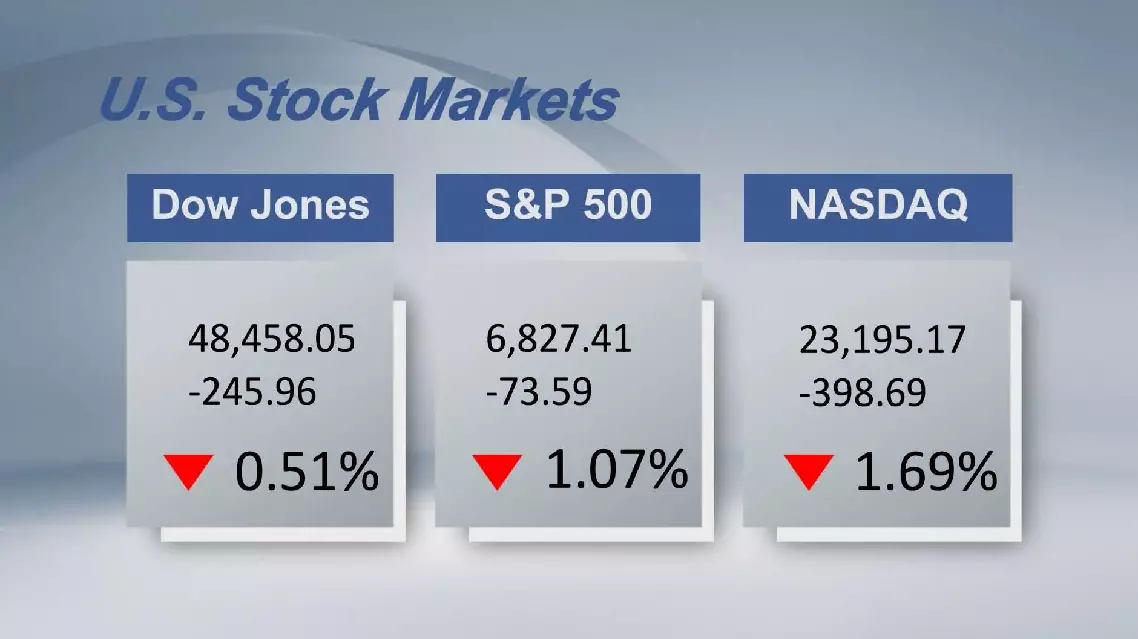
The Dow Jones Industrial Average dropped 245.96 points, or 0.51 percent, to 48,458.05. The Standard and Poor's 500 sank 73.59 points, or 1.07 percent, to 6,827.41, while the Nasdaq Composite Index tumbled 398.69 points, or 1.69 percent, to 23,195.17.

Six of the 11 primary Standard and Poor's 500 sectors ended in red, with technology and energy leading the declines at 2.87 percent and 0.93 percent, respectively. Consumer staples and health care were the best performers, rising 0.93 percent and 0.3 percent, respectively.

U.S. chipmaker Broadcom plunged 11.43 percent despite reporting better-than-expected fiscal fourth-quarter earnings late Thursday, as investors focused on the semiconductor giant's elevated capital spending plans and questioned the near-term profitability of AI-related investments. Nvidia, AMD, Palantir Technologies, and Micron Technology also posted losses on Friday.

Meanwhile, the fashion brand Lululemon provided one bright spot, surging 9.6 percent after announcing that its CEO Calvin McDonald will step down at the end of January 2026.

The U.S. 10-year Treasury yield rose to nearly 4.2 percent from 4.15 percent at Thursday's close, adding modest pressure on growth-sensitive equities.

Despite the weekly weakness in large-cap technology, small-cap stocks continued to outperform following the Fed's latest rate cut, with the Russell 2000 index gaining nearly 2 percent for the week and posting multiple record highs.

U.S. stocks sink as AI concerns weigh on tech sector

U.S. stocks sink as AI concerns weigh on tech sector

Recommended Articles