The latest research findings on lunar samples by Chinese scientists have deepened people's understanding of the lunar dichotomy phenomenon.
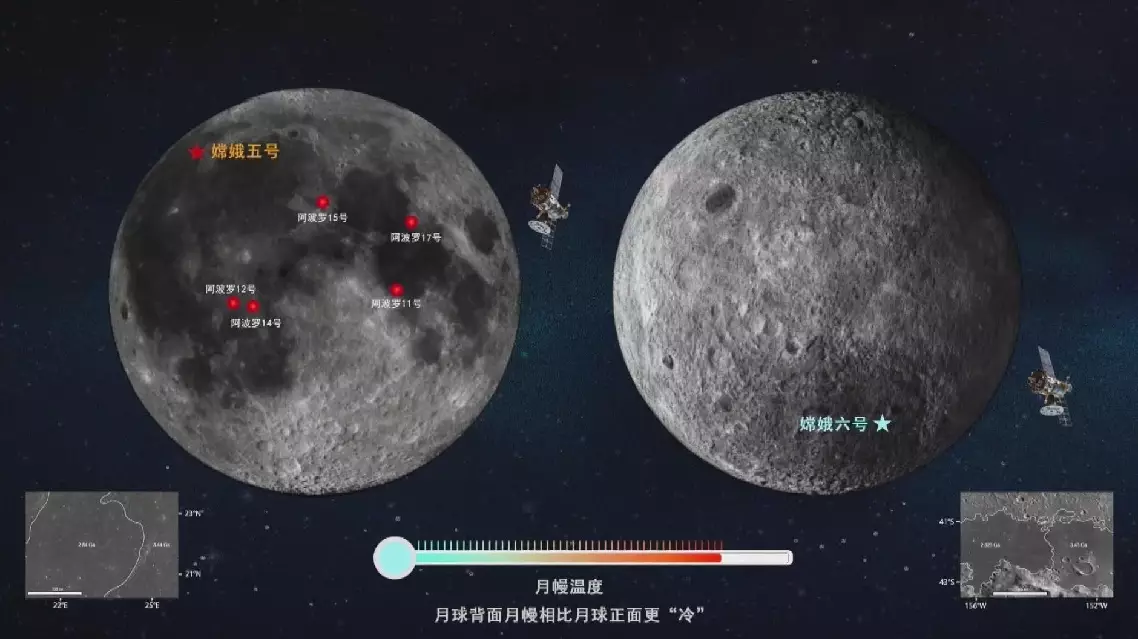
Chinese scientists found that the far side of the Moon is colder deep within its interior than the side that always faces Earth.
They discovered that the rocks were formed from lava deep within the moon's interior at a temperature of about 1,100 degrees Celsius, about 100 degrees Celsius cooler than existing samples from the near side.
Beyond being colder than the near side, the far side of the Moon exhibits numerous other differences from its near counterpart - a phenomenon known as "lunar dichotomy". The near side of the Moon features a flat terrain dominated by vast basaltic mares, while the far side is characterized by highlands, sparse mares, and a thicker lunar crust. Scientists speculate that these surface contrasts may stem from deep internal causes, such as differences in mantle temperature or composition. However, prior to the Chang'e-6 mission, all lunar samples had been collected exclusively from the near side. Now, with access to samples from the far side, scientists are able to dig deeper into lunar dichotomy.
"The lunar dichotomy is actually a topic of great interest, but the most frustrating aspect has been the lack of direct samples for study. Chang'e-6 reached the far side, and now we have direct samples. The samples collected from the lunar far side by Chang'e-6 have yielded numerous findings, many of which pertain to the lunar dichotomy," said He Sheng, a researcher at Beijing Research Institute of Uranium Geology (BRIUG) under China National Nuclear Corporation (CNNC). He Sheng explained that their newly released research findings provide scientific evidence including petrological and geochemical data for the temperature differences between the lunar mantle on the near side and far side of the moon, offering crucial scientific data for lunar evolution studies. "In the future, more people may delve deeper into research on lunar evolution if they find it interesting. I believe the most important thing is that a discovery can offer others some inspiration," said the researcher.
China's Chang'e-6 mission in 2024 accomplished humanity's first-ever sampling from the South Pole-Aitken Basin on the far side of the Moon.
Latest lunar sample research deepens understanding of lunar dichotomy