|
SINGAPORE, Oct. 9, 2025 /PRNewswire/ -- The ASEAN+3 Macroeconomic Research Office (AMRO) today released its ASEAN+3 Financial Stability Report (AFSR) 2025 and the ASEAN+3 Regional Economic Outlook (AREO) October Update, highlighting the region's broad resilience in the face of heightened uncertainties driven by US trade policy shifts and geopolitical tensions.
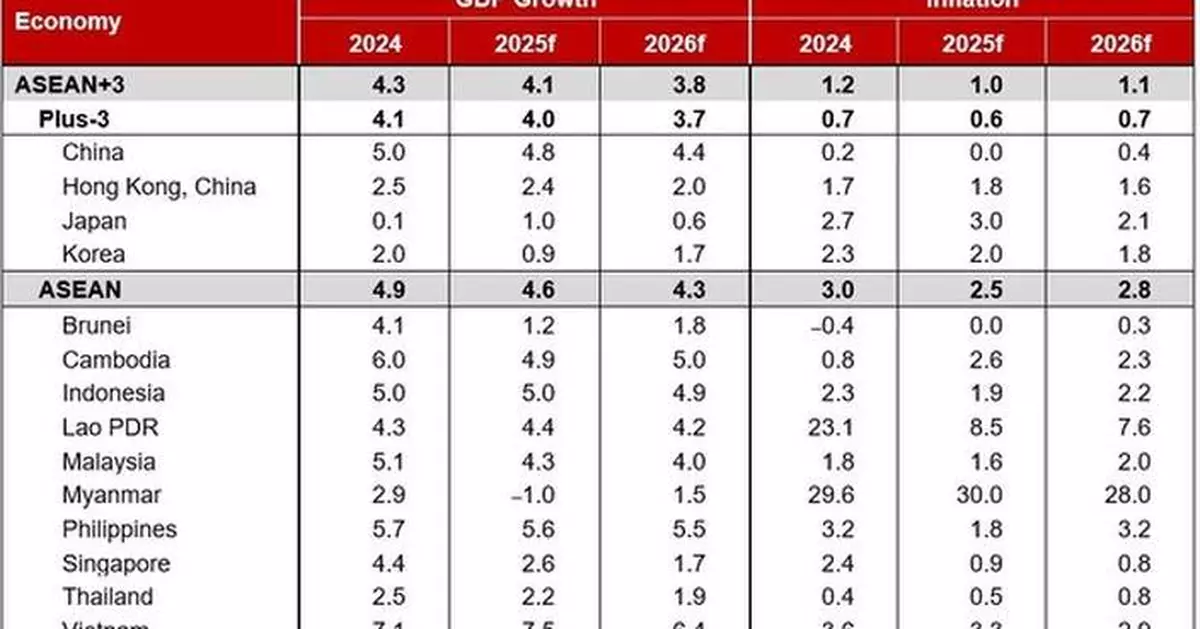
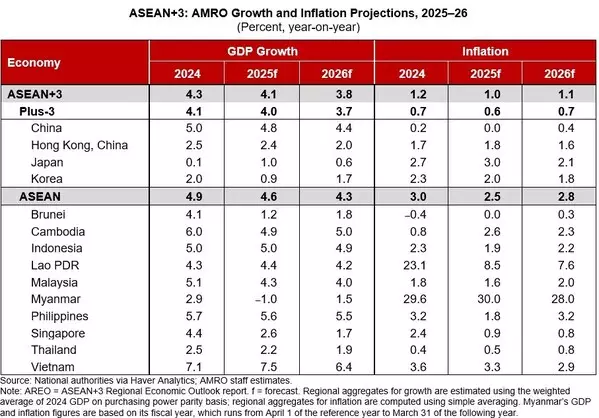
Growth in the ASEAN+3 region is projected at 4.1 percent in 2025 and 3.8 percent in 2026, an upward revision from July's forecast, supported by robust first-half performance and stronger-than-expected export momentum. Market pressures have gradually eased since peaking in April following the announcement of the "Liberation Day" tariffs.
"While intra-regional trade and domestic demand have become increasingly important growth drivers across ASEAN+3, the region remains deeply connected to the global financial system and is therefore not insulated from global shocks," said AMRO Chief Economist Dong He. "Overall, the region's financial system remains resilient, although pockets of vulnerabilities persist."
Export-oriented corporate sectors—particularly smaller firms with high exposure to US demand—may face pressures on profit margins amid shifting trade dynamics. Inflation pressures in the US could persist amid higher import tariffs, complicating the Fed's monetary policy stance and potentially triggering spillovers to other parts of the world. Additionally, growing uncertainty around the US dollar's safe-haven status could further fragment the global financial landscape.
Despite these challenges, ASEAN+3 economies remain well-positioned to navigate global headwinds. Well-calibrated policy mixes and strong fundamentals—including robust banking systems, deepening financial markets, ample foreign reserves, and available policy space—have provided critical buffers. With inflation largely subdued and expectations well-anchored in most economies, central banks can maintain accommodative monetary policy to support growth.
At the same time, macroprudential tools, along with foreign exchange and capital flow management measures, offer additional safeguards to maintain financial stability and mitigate external spillovers. However, AMRO underscores that support should be carefully targeted to vulnerable sectors and deployed prudently to preserve policy space amid elevated external uncertainty.
Beyond near-term risks, the region is undergoing deeper structural transitions. Most notably, the rapid digitalization of financial services presents opportunities for greater financial inclusion and efficiency, while also introducing new challenges to financial stability.
"Digitalization of the banking sector is reshaping the market structure, offering new pathways for inclusion and efficiency," said Runchana Pongsaparn, AMRO Group Head for Financial Surveillance. "But it also alters the nature and distribution of financial stability risks. Policymakers must adopt a multi-pronged strategy that promotes innovation while managing risks, calibrated to the maturity of each market segment."
As ASEAN+3 manages near-term uncertainties, AMRO emphasizes the importance of reinforcing policy frameworks, improving transparency, and deepening domestic markets and buffers to mitigate spillover risks from external shocks.
Dr. He concluded: "With coordinated actions and deeper financial cooperation and integration, ASEAN+3 can turn today's challenges into tomorrow's opportunities, and emerge stronger, more connected, and more resilient."
For more insights, refer to AMRO's latest flagship publications: the ASEAN+3 Financial Stability Report 2025, and the ASEAN+3 Regional Economic Outlook October Update.
About AMRO
The ASEAN+3 Macroeconomic Research Office (AMRO) is an international organization established to contribute toward securing macroeconomic and financial resilience and stability of the ASEAN+3 region, comprising 10 members of the Association of Southeast Asian Nations (ASEAN) and China; Hong Kong, China; Japan; and Korea. AMRO's mandate is to conduct macroeconomic surveillance, support regional financial arrangements, and provide technical assistance to the members. In addition, AMRO also serves as a regional knowledge hub and provides support to ASEAN+3 financial cooperation.
Visit our website and follow us on LinkedIn for more updates.
SINGAPORE, Oct. 9, 2025 /PRNewswire/ -- The ASEAN+3 Macroeconomic Research Office (AMRO) today released its ASEAN+3 Financial Stability Report (AFSR) 2025 and the ASEAN+3 Regional Economic Outlook (AREO) October Update, highlighting the region's broad resilience in the face of heightened uncertainties driven by US trade policy shifts and geopolitical tensions.
Growth in the ASEAN+3 region is projected at 4.1 percent in 2025 and 3.8 percent in 2026, an upward revision from July's forecast, supported by robust first-half performance and stronger-than-expected export momentum. Market pressures have gradually eased since peaking in April following the announcement of the "Liberation Day" tariffs.
"While intra-regional trade and domestic demand have become increasingly important growth drivers across ASEAN+3, the region remains deeply connected to the global financial system and is therefore not insulated from global shocks," said AMRO Chief Economist Dong He. "Overall, the region's financial system remains resilient, although pockets of vulnerabilities persist."
Export-oriented corporate sectors—particularly smaller firms with high exposure to US demand—may face pressures on profit margins amid shifting trade dynamics. Inflation pressures in the US could persist amid higher import tariffs, complicating the Fed's monetary policy stance and potentially triggering spillovers to other parts of the world. Additionally, growing uncertainty around the US dollar's safe-haven status could further fragment the global financial landscape.
Despite these challenges, ASEAN+3 economies remain well-positioned to navigate global headwinds. Well-calibrated policy mixes and strong fundamentals—including robust banking systems, deepening financial markets, ample foreign reserves, and available policy space—have provided critical buffers. With inflation largely subdued and expectations well-anchored in most economies, central banks can maintain accommodative monetary policy to support growth.
At the same time, macroprudential tools, along with foreign exchange and capital flow management measures, offer additional safeguards to maintain financial stability and mitigate external spillovers. However, AMRO underscores that support should be carefully targeted to vulnerable sectors and deployed prudently to preserve policy space amid elevated external uncertainty.
Beyond near-term risks, the region is undergoing deeper structural transitions. Most notably, the rapid digitalization of financial services presents opportunities for greater financial inclusion and efficiency, while also introducing new challenges to financial stability.
"Digitalization of the banking sector is reshaping the market structure, offering new pathways for inclusion and efficiency," said Runchana Pongsaparn, AMRO Group Head for Financial Surveillance. "But it also alters the nature and distribution of financial stability risks. Policymakers must adopt a multi-pronged strategy that promotes innovation while managing risks, calibrated to the maturity of each market segment."
As ASEAN+3 manages near-term uncertainties, AMRO emphasizes the importance of reinforcing policy frameworks, improving transparency, and deepening domestic markets and buffers to mitigate spillover risks from external shocks.
Dr. He concluded: "With coordinated actions and deeper financial cooperation and integration, ASEAN+3 can turn today's challenges into tomorrow's opportunities, and emerge stronger, more connected, and more resilient."
For more insights, refer to AMRO's latest flagship publications: the ASEAN+3 Financial Stability Report 2025, and the ASEAN+3 Regional Economic Outlook October Update.
About AMRO
The ASEAN+3 Macroeconomic Research Office (AMRO) is an international organization established to contribute toward securing macroeconomic and financial resilience and stability of the ASEAN+3 region, comprising 10 members of the Association of Southeast Asian Nations (ASEAN) and China; Hong Kong, China; Japan; and Korea. AMRO's mandate is to conduct macroeconomic surveillance, support regional financial arrangements, and provide technical assistance to the members. In addition, AMRO also serves as a regional knowledge hub and provides support to ASEAN+3 financial cooperation.
Visit our website and follow us on LinkedIn for more updates.
** The press release content is from PR Newswire. Bastille Post is not involved in its creation. **
ASEAN+3 Remains Resilient Amid Heightened Global Uncertainties
BEIJING, Jan. 11, 2026 /PRNewswire/ -- On December 29, the "Forging the Path to National Strength: China's Manufacturing Achievements Under the 14th Five-Year Plan," jointly organized by the National Museum of China and the Ministry of Industry and Information Technology, officially opened at the National Museum of China, showcasing more than 300 top national achievements. GAC's "National Outstanding Engineer Team" successfully developed both the Magazine Battery and the Solid-State Battery, which were selected for the exhibition.
The GAC Magazine Battery is the first battery system to pass both the nail penetration no-flame and non-ignition safety tests. By utilizing ultra-high intrinsic safety cells, an all-weather "vehicle-end + cloud-based" active safety monitoring system, and a multi-dimensional safety protection system, the Magazine Battery achieves three layers of protection: core, active, and passive. Its safety performance far exceeds the electric vehicles traction battery safety requirements (GB38031-2025), which will take effect on July 1, 2026. Currently, the Magazine Battery has a cumulative deployment of 1.3 million vehicles with zero spontaneous combustion and over 50 billion kilometers of safe travel, providing users with robust safety assurance for every journey.
GAC's self-developed large-capacity solid-state battery has achieved an energy density exceeding 400 Wh/kg and easily passes rigorous safety tests such as 200°C thermal chamber and nail penetration tests, effectively addressing users' range anxiety and safety concerns. Innovations in materials and processes have placed the solid-state battery at the forefront of the industry in key indicators such as safety, energy density, and cycle life, providing a superior power solution for the future development of NEVs. Currently, a pilot production line for GAC's solid-state battery has been established, capable of mass-producing vehicle-grade solid-state batteries over 60 Ah, marking a critical step toward the goal of full vehicle integration by 2026.
Over the years, GAC has been steadily enhancing its competitiveness through innovations across intelligent connectivity, NEV powertrains technologies, and forward-looking technologies. Looking ahead, GAC will continue to deepen its efforts in the intelligent connected NEV field, leveraging more leading technological achievements to drive industry progress.
** The press release content is from PR Newswire. Bastille Post is not involved in its creation. **

GAC Magazine Battery and Solid-State Battery Win Top National Honor