Opening remarks by STL at LSCM Logistics Summit 2025
Following are the opening remarks by the Secretary for Transport and Logistics, Ms Mable Chan, at the LSCM Logistics Summit 2025 today (October 10):
Alan (Chairman of the Board of Directors of the Logistics and Supply Chain MultiTech R&D Centre (LSCM), Professor Alan Lam), Simon (Chief Executive Officer of the LSCM, Mr Simon Wong), Frankie (Legislative Council member Mr Frankie Yick), distinguished guests, ladies and gentlemen, friends,
We have so many friends and partners with us here today, current, past and future, who have contributed to logistics, to technology, and in particular to the PCS (Port Community System). I wish I would not miss key messages in my speech that my team would like me to deliver. Alan just mentioned inviting me to join this Summit; it is indeed my great honour and privilege to be able to participate among you, to witness the ceremony today. I also vividly remember that I came to this venue back in 2023, in my days as the Permanent Secretary of the Transport and Logistics Bureau. Throughout these past few years, the passion and dedication demonstrated by various partners and stakeholders in the logistics sector have remained the same, if not higher. I am really impressed by all the friendship, collaboration and relationship that we have built among ourselves over all these years.
Today's theme is particularly topical, and not only embraces the term PCS. I think naming is very important. On the Mainland, when we go to visit different provinces and ports, they have big screens showing data platforms, and it is really a daunting task. In Hong Kong, we seem to start in a very humble manner: we call it PCS, Port Community System. Nobody else on the Mainland or overseas knows what we are talking about. Port, community, system - those three words cannot relate to them, and they are not familiar to them. When I just hear what Professor Alan Lam said, port community system means different things to me. Port, P - I think we can brand it as "platform", 平台. Community - we should brand it as "collaboration". System, S - we should brand it as "smart". I think PCS really embraces all these three concepts, that is, platform, collaboration, and the need to work smart. We need to build a smart system.
Reflecting on our progress, it seems like just yesterday that we gathered for the PCS launching ceremony in May. I think the momentum we have gathered and maintained has been truly remarkable. It is not just a demonstration or promulgation of an action plan, but it means a lot of actions by you all and also by my team. I am really thrilled to witness all the substantial achievements and advancements made in just this past five months or so. This rapid progress underscores our unwavering commitment in our logistic sector. This is also articulated in both the 2024 and 2025 Policy Addresses. Without clear leadership and very deep commitment by our senior echelon of the Government, I do not think the community can unite so quickly and rapidly together. By now, I can see that we have already created a synergy and awareness, so we can unite together and then we can move even faster ahead. At the HKMA Data Summit in July, I emphasised that "whoever masters data defines the future". Data is power. Today, I am very proud to say that through the PCS, we are not just mastering data; we are harnessing it to redefine what is possible for Hong Kong's future, in particular for the maritime, port and logistics industry. I am very confident that we have a very bright future for our industry and for our young generations ahead.
The PCS represents not just a technological upgrade, but it is also the cornerstone of our Action Plan on Maritime and Port Development Strategy. It is a very fundamental piece of digital infrastructure nowadays for our city. Thanks to the ITF (Innovation and Technology Fund), Ivan (Commissioner for Innovation and Technology, Mr Ivan Lee), and also to the Commissioner for Customs and Excise, our bureau has been working very closely with all the policy bureaux and departments to work ahead for logistics development and technological upgrade. As a government-funded and government-led initiative scheduled for launch in January 2026, which is just two months ahead, the PCS is designed to be a transformative force. It will provide a comprehensive, real-time cargo tracking function, creating a seamless digital thread that connects sea, land, and air networks like never before. I think for Hong Kong's future roadmap, we need to harness and build on our advantage of intermodal logistics and cargo transportation and transshipment. So PCS, you were born at the right moment. This digital backbone is poised to significantly bolster trade and capital flows, directly enhancing Hong Kong's competitiveness as an international trade, finance, and logistics hub. As Simon always says, and I am sure all of you present here are very well familiar with, we would like to highlight three points. It is easier to hammer into our audience's heads. If I can summarise or highlight three fundamental cornerstones or pillars that underpin the PCS:
First, it establishes a single, unified platform whereby we can connect all supply chain partners, and most importantly, through this connection, we break the information silos. The silos not only exist within the Government, but also in the trade, in the sector. We are here to serve, to break all the information silos so that we will not overlap; we will not duplicate the efforts, but we can synergise. Second, by its nature, it is government-run, official, so in a way it instils and upholds a high level of confidence in the trade. I think digital system is not new to the trade. Willy (Chairman of Hong Kong Shippers' Council, Mr Willy Lin) always says that to me. In the past, we have different kinds of experimental systems, but this time, it is government-run, government-led. So, in a way, we will try to reduce, if not eliminate, the industry's concern over commercial sensitivity or favouritism. We are open, we are neutral, we are frank. So we are there to open up and attract different people to join and participate in the system. Amy (Deputy Secretary for Transport and Logistics, Miss Amy Chan), my team, recently did a presentation, and we are so amazed and blessed that we win high recognition for the technology software that we use for the PCS, and they said that it is actually among the top in the world. Third, and very crucially, we finally get a taste of how blockchain technology can help and guarantee us a very trusted, immutable, and verifiable record of the cargo flow. This is not just academic or theoretical; we are already seeing several various practical applications. I mentioned just now our collaboration with the Hong Kong Monetary Authority (HKMA). I am very happy to see that through collaboration with the HKMA, they have a Project CargoX Expert Group, in which nearly all banks in Hong Kong are actively using PCS data for robust cargo verification, streamlining their financing verification processes, reducing credit costs for SMEs, and unlocking new opportunities for financial innovation. Henry (President of the Hong Kong E-Commerce Logistics Association, Professor Henry Ko), who is present here, you are the President of the Hong Kong E-Commerce Logistics Association, in which a lot of small and medium enterprises participate. I think trade finance and loan finance are very important to help overcome any cash flow problems in order to unlock a huge amount of potential and opportunities for new entrants to join our logistics centre.
Our ambition, however, extends well beyond Hong Kong's boundaries. To genuinely future-proof our role in the Guangdong-Hong Kong-Macao Greater Bay Area (GBA) and the global supply chain, strategic connectivity is paramount. The Memorandum of Understanding (MOU) we signed with Guangdong e-Port Management Company Limited in May was a critical first step, laying the groundwork for more transformative services like the one we provide with the Guangdong e-Port Management Company, which is the "One-Data-Multiple-Declarations", 一單多報, and the pre-declaration of sea-cargo manifest, 海上船務貨物預報. Such initiatives will dramatically reduce administrative burdens, accelerate customs clearance, and bring tangible efficiency, economic gains to businesses operating across the GBA. We are actively pursuing similar dialogues with other Mainland and international ports and logistics platforms to ensure Hong Kong remains at the heart of the digital shipping world. I would like to emphasise that you did not hear me wrong: Hong Kong will definitely remain at the heart of the world's digital shipping sector.
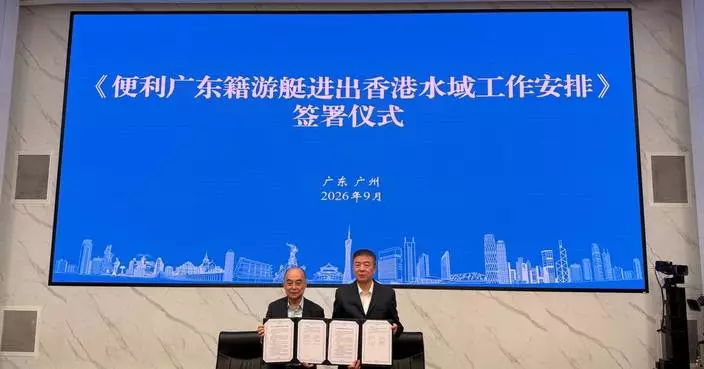
This naturally brings me to a highlight of today's event, the signing of further MOUs. These partnerships embody the very collaboration highlighted in this summit's theme, collaboration and innovation. Such collaborations are the testament to the spirit of this summit and will be instrumental in further enriching the PCS ecosystem, 生態圈, driving innovation, and building a more vibrant and resilient port community.
Talking about the geopolitical challenges worldwide and also the US tariff war, I think it is of paramount importance that we, the logistics sector, help ourselves among each other, in particular the small ones, the medium ones, who may not afford to diversify their market and business in such a short period of time. So we really need to build the resilience of our ecosystem. Every part of the supply chain counts and works, and we should not lose sight of their sustainability and business viability. I am very grateful to be able to witness the MOUs signing ceremony that will take place later today.
Again, the PCS represents a strategic investment in Hong Kong's high-quality development. It serves as the critical digital link that synergises our status as a financial centre, a trade and industry hub, and a maritime gateway, creating a powerful virtuous cycle for sustainable economic growth. The journey ahead, I assure you, requires a collective effort, and it will involve a very bright future.
(Please also refer to the Chinese portion of the speech.)
Source: AI-found images