A rural primary school in northwest China's Xinjiang Uygur Autonomous Region has witnessed comprehensive improvements in education quality and infrastructure during the 14th Five-Year Plan period (2021-2025).
Twenty-four-year-old Rukye Memet Tursun, who was a student at the Tuokezhake Central Primary School in southern Xinjiang's Kashgar Prefecture, became a teacher there after graduating from university in 2024. In her memory, there was only a teaching building and a dirt playground. Now, there are four modern teaching buildings on campus with complete supporting facilities.
"I came back and wanted to tell more children to go out and see the world. They don't know what this school was like before. After learning about the past, they will cherish the current learning environment even more," she said.
Starting from the fall semester of 2021, the daily meal allowance for rural compulsory education students increased from four yuan (about 0.5 U.S. dollars) to five yuan per student, resulting in more abundant and diverse meals on the dining table.
The school has put into use new teaching buildings, a cafeteria, and a basketball court in succession in just the last five years.
Since 2023, specialized teaching facilities such as an embroidery and paper-cutting room, a campus radio and television station, and an audio-visual library have been opened, and every classroom's multimedia equipment has been upgraded, enabling teachers and students to explore knowledge and pursue their dreams on a broader stage.
"There are e-books and VR glasses in the audio-visual library. Through the VR glasses, I truly experienced the joy of the new world," said Subi Nur Kadir, a fifth grader.
The number of teachers at the school has increased from approximately 70 five years ago to 96 now. In the past five years, the school has welcomed three groups of teachers from Guangdong Province. They have not only introduced advanced teaching concepts but also offered more than a dozen community courses, such as embroidery, football, and hosting, to help children develop their interests into skills.
"The biggest change I've noticed is the increasing diversity of our teaching content. We now offer 26 diverse club courses, including paper-cutting, calligraphy, Peking Opera, clapper talk, and embroidery, allowing students to experience the charm of China's fine traditional culture," said Su Zhanhong, a calligraphy teacher at the school.
During the 14th Five-Year Plan period, Xinjiang (excluding the Xinjiang Production and Construction Corps) invested a total of 14.94 billion yuan (about 2.1 billion U.S. dollars) in improving the hardware and software of primary and secondary schools, and built, renovated and expanded 2.626 million square meters of primary and secondary school buildings.
The proportion of full-time teachers with a bachelor's degree or higher in Xinjiang's primary, middle, and high schools increased by 11.2 percent, 3.6 percent, and 0.5 percent, respectively, from 2021 to 2024.
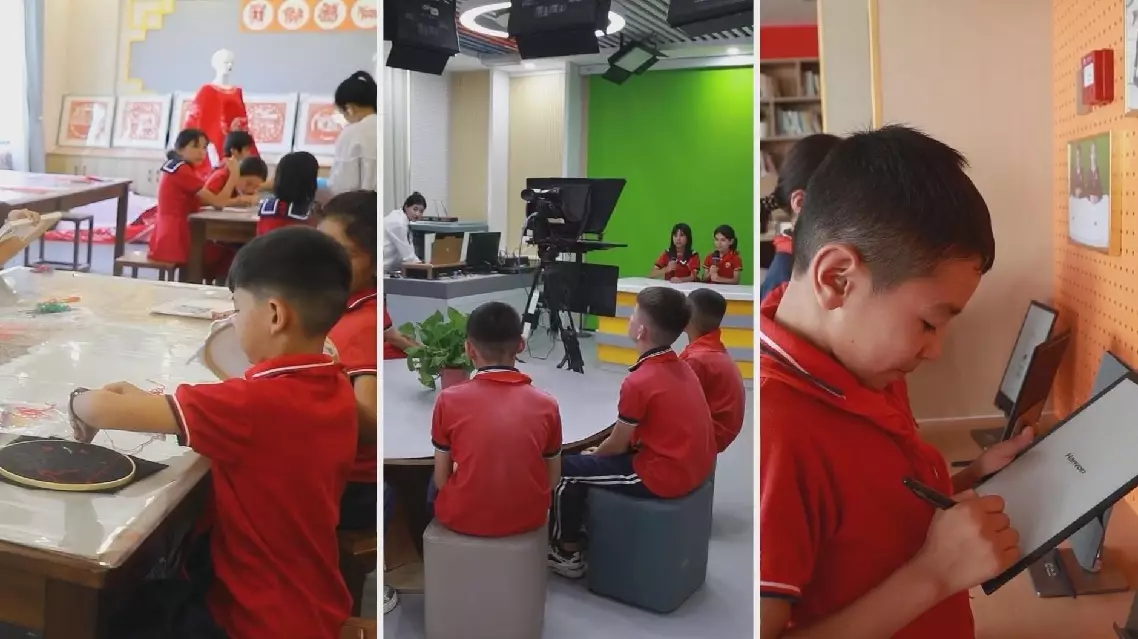
Xinjiang's rural primary school sees fast education improvement