Columbia University economist Jeffrey Sachs has warned that the Europe Union is risking decline in global influence without a cohesive strategy in a time of mounting geopolitical tension and rapid technological shifts.
In an exclusive interview with China Media Group (CMG) aired on Friday, Sachs, who is also a former special advisor to three UN secretaries-general, expressed deep concern over Europe's lack of strategic autonomy.
He stressed that the continent's technological and political stagnation stems from both external manipulation and internal fragmentation. Speaking also at the European Parliament, Sachs stressed the urgency for Europe to assert an independent foreign policy and find a unified voice.
"One basic point for Europe is we're living in a world where economies of scale and economies of scope in the economy are very important. In other words, you have to be big to be able to be at the center of some of these new, crucial technologies, crucial innovations. And China, the U.S. are big. They're unified. They're in the forefront of artificial intelligence, in the forefront of the digital age, in the forefront of many technologies. Where is Europe right now? It's got great scientists, it's got great universities, but it's a no show when it comes to some of these key sectors. You don't have a leading European AI for example, there's no European Deepseek, there's no European OpenAI, there's no European tech giant, actually, very strange," said Sachs.
Sachs pointed to the displacement of major European companies as a sign of weakened sovereignty, claiming many have effectively been absorbed into the U.S. economic and political ecosystem, even in sectors vital to the future digital economy.
"Lots of major companies came from Europe, but the U.S. grabbed them, brought them into the U.S. ecosystem, even the world's leading producer of the advanced semiconductors. The extreme ultraviolet technology lithography is a Dutch company, ASML, but it operates essentially in the U.S. political space. The U.S. decides where ASML exports, to stop exports to China. That's not the Netherlands or the European Union deciding these things, that's the United States, deciding these things. So Europe gave up its strategic autonomy. And by remaining too divided among the 27 members of the European Union, Europe has to act like a unity," he said.
The economist said that Europe already possesses many of the attributes necessary to act as a global power, including population size and economic strength, but has failed to act collectively. While the continent has the potential to be a decisive actor, its current geopolitical posture leaves it dependent on the United States.
"Europe is 450 million together. It's a 20 trillion dollar economy. If Europe acts like a unity, that's a big player. But right now, it does not act that way. It has been for 30 years under the U.S. thumb. The U.S. has determined the foreign policy. The U.S. has determined the security policy. The U.S. has determined when the West goes to war or doesn't go to war. Europe had no say. Interestingly, just an example, in 2008, the U.S. said NATO should enlarge to Ukraine. This was very provocative. If I would use a technical term, I'd say very stupid, because it was the way to war obviously, many diplomats knew that. The Europeans knew that. I've talked to many European leaders, even at the time, they said, 'What is your president doing? That's so provocative.' The EU is more people than the United States. It's 27 countries, but they can't find their voice to the U.S.," said Sachs.
He urged European nations to reclaim their diplomatic capacity and act with unity and purpose.
"Can they get their act together? Can they unify? Can they act in a straightforward way? They're very confused. They're very divided. They don't understand diplomacy because they forgot it for a long time. They don't understand Russia. It's not a simple situation, but I am hoping that they pull together. It's a wonderful part of the world, they ought to get their act together," said Sachs.
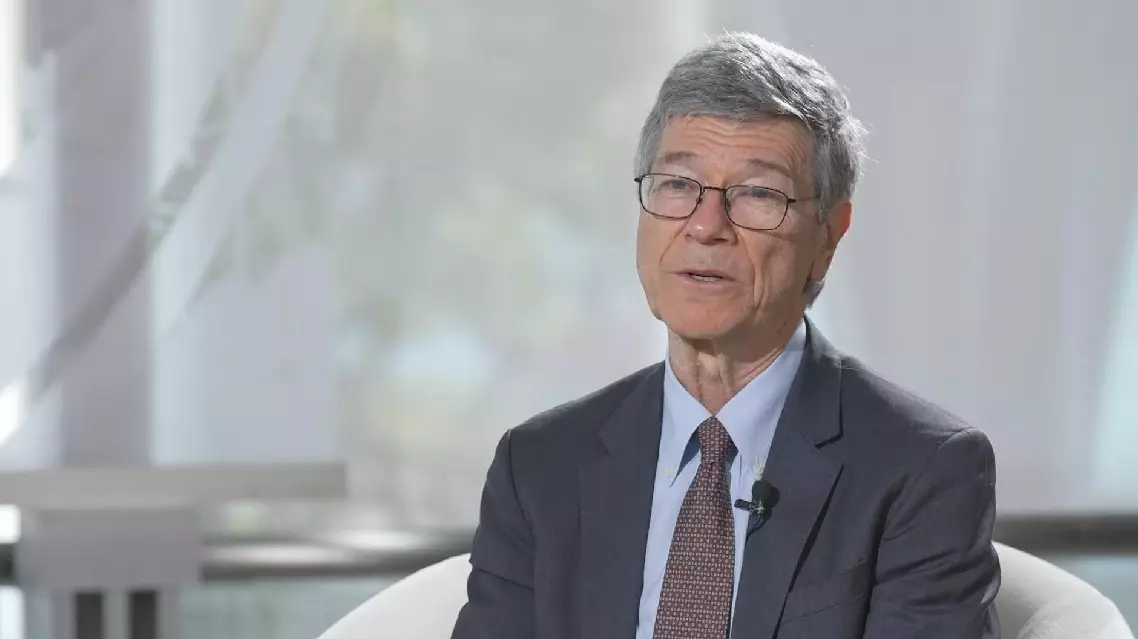
US economist calls on EU to reclaim strategic autonomy, unite to avoid global decline