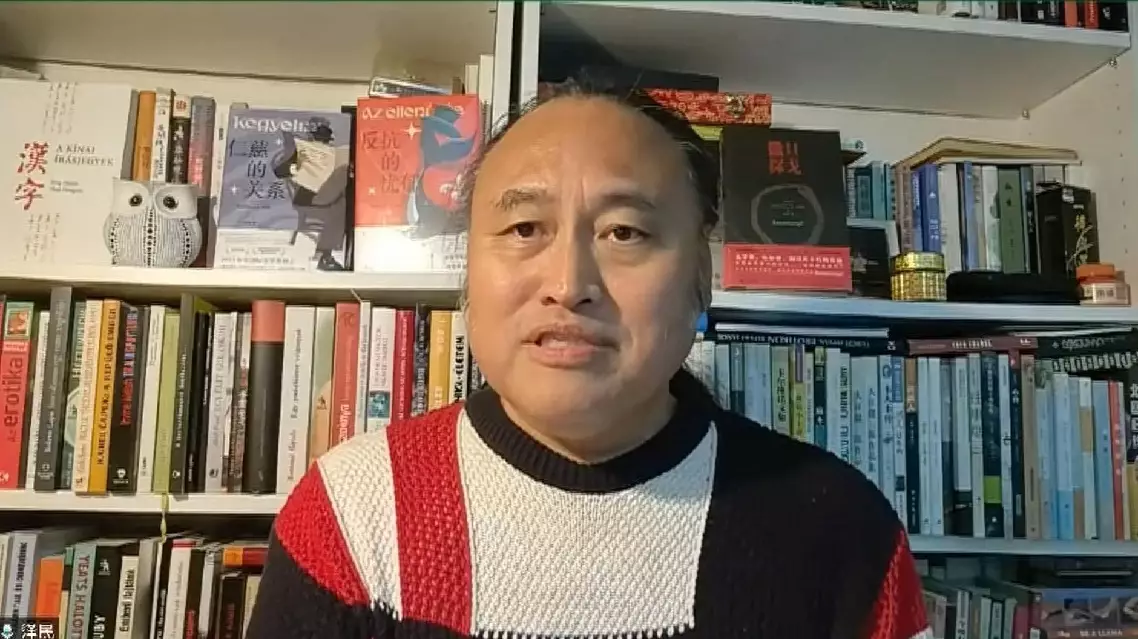
Hungarian Nobel laureate Laszlo Krasznahorkai's win is both a literary triumph and a gateway to global recognition of Hungary's rich storytelling tradition, said Chinese translator Yu Zemin, who has spent decades bringing the writer's works to Chinese readers.
Krasznahorkai was awarded the 2025 Nobel Prize in Literature, becoming the second Hungarian author ever to receive the honor, the Swedish Academy announced on Thursday.
He was recognized "for his compelling and visionary oeuvre that, in the midst of apocalyptic terror, reaffirms the power of art," the academy said in a statement.
Yu Zemin, Chinese translator of Laszlo Krasznahorkai's novel "Satantango," said that his relationship with Krasznahorkai goes beyond translation, rooted in deep friendship and shared admiration for Chinese culture.
"Laszlo and I are not simply translator and author -- our relationship goes much deeper. We first met in 1993, shortly after I arrived in Hungary. We became friends through our conversations about Li Bai, whom he deeply admired along with Chinese culture. In 1998, I accompanied him on a visit to China. After we returned to Hungary, I began reading his works and found them truly unique -- I was immediately captivated by his style. That's when I began reading and eventually translating his writing," said Yu.
Born in 1954 in the small town of Gyula in southeastern Hungary near the Romanian border, Krasznahorkai achieved his literary breakthrough with his debut novel "Satantango" (1985). The book became a sensation in Hungary and established him as one of Central Europe's most distinctive literary voices.
"In 2006, I translated his first short story. At that time, few people in China knew who Laszlo was. Perhaps that was the first time his work encountered Chinese readers. In 2015, when Laszlo won the International Booker Prize, I persuaded a publisher to translate his novel "Satantango" into Chinese. His Nobel Prize win comes as no surprise -- the quality of his work has long been recognized. I feel almost as if I've won the prize myself, because we've known each other so well for so long, and I have a deep emotional connection to his writing," said Yu.
Yu said that while Krasznahorkai's works may be language-challenging, their universal themes deeply resonate with readers, reflecting on humanity's cyclical history and self-reflection.
"Laszlo's works are actually quite difficult to read -- even for Hungarians. For Chinese readers, the language may feel unfamiliar, but the themes resonate deeply. For example, "Satantango" portrays the human condition during the Cold War, yet it reads more like a fable -- a reflection on the plight of humankind. I think Chinese readers can understand this sense of warning in his books -- that human history sometimes moves forward, and sometimes backward. Another Nobel laureate I've translated for, Imre Kertesz, expressed a similar reflection -- he believes that within human civilization there is always an ongoing self-interrogation. That, I think, is what the two writers share in common: a profound warning about the destiny of humankind, a kind of thought that resonates with readers everywhere," he said.
Yu said Krasznahorkai's Nobel recognition will broaden global appreciation for Hungarian literature and foster deeper cultural exchanges, especially between China and Hungary.
"I think his Nobel win has opened an even larger window. Since Kertesz received the Nobel Prize in 2002, the world's readers have turned their eyes toward Hungary, this small nation with a great literary tradition. After that, I went on to translate many more works, including Laszlo's. Now, with the Belt and Road Initiative, there's even greater emphasis on cultural exchange among the countries along the route -- especially since relations between China and Hungary are very close. I feel truly fortunate to have a platform in the Hungarian language, one that allows me to introduce outstanding writers to Chinese readers. From the interviews I've done these past few days, I can feel the enthusiasm. I hope his Nobel Prize is not just a momentary joy, but a chance for readers to gain deeper and broader appreciation for great writers from Hungary and Eastern Europe. As a writer myself, I've also learned so much through translation. I believe literary exchange of this kind is deeply meaningful," he said.
Hungarian Nobel laureate's win sparks global spotlight on nation's literary legacy: Chinese translator