Ayqihra Abliz, a 20-year-old Peking Opera performer born into a family of musicians and dancers in Urumqi, capital of northwest China's Xinjiang Uygur Autonomous Region, embodies in her own story the blending of manifold art forms in a multicultural region.
The young Uygur girl was bitten by the bug of traditional Chinese opera at an early age. At 12, she was admitted to the Middle School Affiliated to the National Academy of Chinese Theatre Arts, where she specialized in Qingyi (a role usually used to depict mature, elegant and reserved women) of the Mei School of Peking Opera.
"When I was in the first grade of the middle school, my mother took me to see 'Reunion at Wujia Slope,' which planted a small seed of curiosity in my heart about the art of Peking Opera. Then it happened that at that time, in 2018, the Middle School Affiliated to the National Academy of Chinese Theatre Arts came to Xinjiang to recruit students. With the support of my parents, I enthusiastically signed up for the examination. When I received the admission letter, I really couldn't express the joy and pleasure in my heart with words because this really allowed me to embark on the path of learning the art of Peking Opera," said Ayqihra.
After going to the school, Ayqihra found that the senior students there had been practicing since childhood. They all started at the age of four, five or six years old.
"I entered the school relatively late, at around the age of 12. So I had to study and practice really hard in order to catch up with the others," she said.
After graduating from the middle school, Ayqihra said that she wanted to continue studying Peking Opera in depth because she felt she had not learned enough in the past three years.
She applied for advanced studies at the National Academy of Chinese Theatre Arts and continued to study the entire play of 'Farewell My Concubine' -- a story about a valiant general's farewell to his beloved on the brink of defeat.
"This play integrates various performance forms of our Peking Opera, such as singing, recitation, acting, combat and so on. And it has had a great influence on my journey studying Peking Opera, as it has made me grow very quickly and make progress," said Ayqihra.
She grew up in a family full of artistic atmosphere. Her mother is a dancer of the Xinjiang Art Theater Song and Dance Troupe, and her father is a director and actor in the film and television department of Xinjiang Art Theater.
Both of them have been imperceptibly influencing Ayqihra since she was a child. According to Ayqihra, their conversations at home often revolve around art. She said in her family, art is not only a profession, but also a spiritual force that drives them forward.
People in Xinjiang like to be exposed to many different arts and cultures. They can turn open spaces in parks into giant stages with impromptu singing and dancing.
"When I return home during every winter and summer vacation, I like to take a walk in the park because I can feel strong vibrant vibes there," Ayqihra said.
In the hearts of the older generation in Xinjiang, their hometown today is witnessing increasingly diverse art forms, greater unity among all ethnic groups, and more prosperous lives.
"The literature and art in Xinjiang are quite diverse," said a local resident.
"The unity and cultural integration of all ethnic groups across the country are indeed expanding day by day," said another resident.
When Ayqihra sees local elders playing instruments, singing and dancing in the park, she will join them and perform a segment of Peking Opera.
"I think the first thing I learned from the elderly is persistence. Another one is their open mind. When I performed that part of the play for them, I could see their affirmation of me from their eyes," she said.
In her opinion, Peking Opera and Xinjiang's folk song and dance traditions, both treasures of China's rich cultural heritage, can swirl into each other, take root and flourish in the culturally diverse land of Xinjiang.
Ayqihra is now in college, majoring in drama, film, and television performance. She said her goal is to use diverse methods to allow more people to experience the charm of Peking Opera culture.
"I really hope to incorporate the essence of traditional Chinese culture into our dramas and film and television performances, whether in Xinjiang or elsewhere, so to bring the charm of Peking Opera to more people," said Ayqihra.
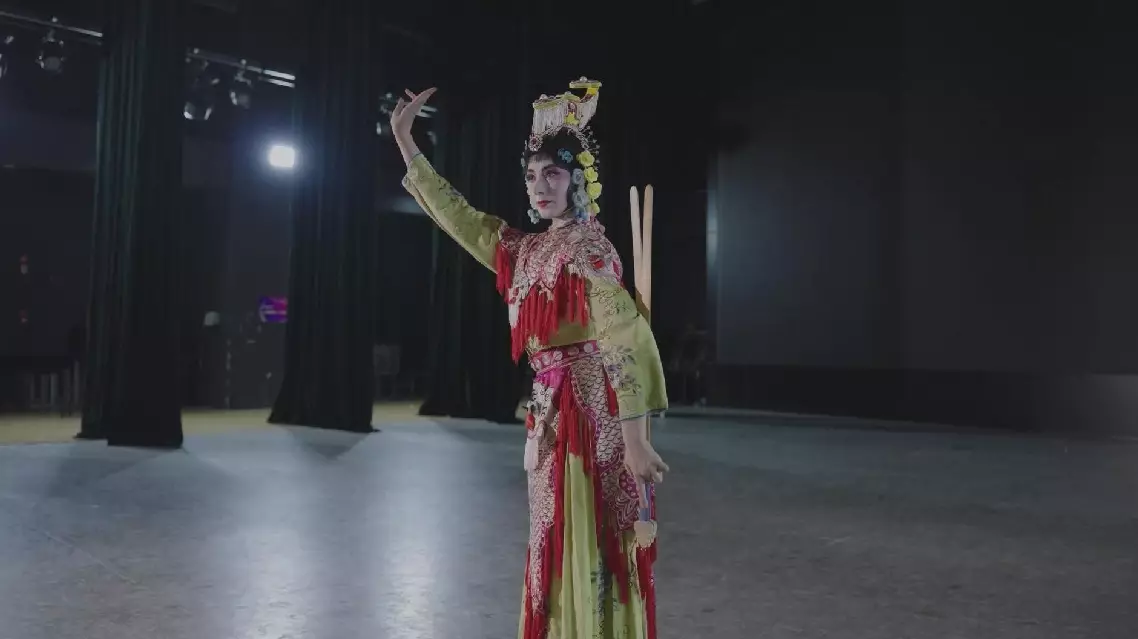
Uygur girl's Peking Opera journey epitomizes Xinjiang's cultural diversity