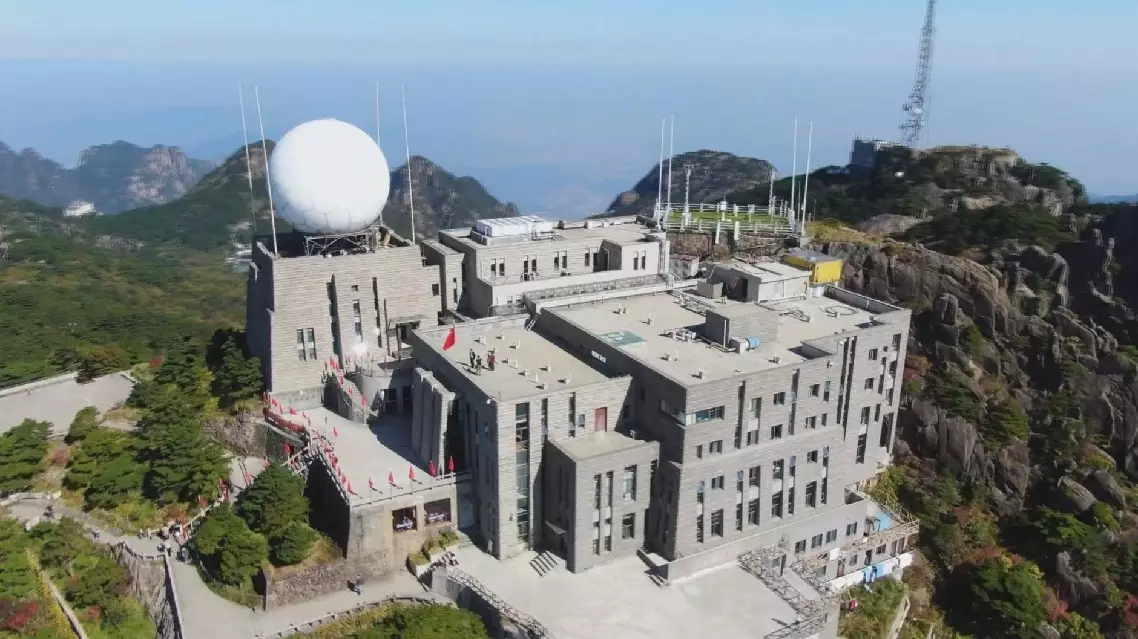
China has established the world's largest and most comprehensive coordinated meteorological observation system, featuring a coverage of land, sea, air and space, according to a press conference in Beijing on Saturday.
Chen Zhenlin, head of the China Meteorological Administration (CMA), and Bi Baogui, deputy head of the CMA, briefed on China's high-quality development in the meteorological field during the 14th Five-Year Plan period (2021-2025), saying that the comprehensive observation system consists of nine Fengyun meteorological satellites, 842 weather radars, and over 90,000 ground-based meteorological observation stations.
The CMA officials noted that China's independently-developed BeiDou system has broke the GPS system's monopoly in meteorological air sounding.
Over the past five years, China's weather radar monitoring system has been further improved and reached an international advanced level. It covers over 90 percent of densely populated areas, featuring monitoring products with complete independent intellectual property rights.
The radar monitoring system can identify over 80 percent of disastrous weather, with a better performance in monitoring small- and medium-scale severe weather like heavy rains, hail, tornadoes, and thunderstorms, according to the officials.
"China has established the world's largest and most comprehensive coordinated meteorological observation system, covering land, sea, air [and space], with meteorological satellites and radars as the mainstay, and ground meteorological stations, high-altitude meteorological detectors, ground-based remote sensing vertical observation systems and greenhouse gas observation systems as important components," said Bi.
According to the CMA, China, for the first time, has integrated 35 small commercial meteorological satellites, as supplements to Fengyun satellites in data collection, into its operational meteorological system.
China establishes world's largest, most comprehensive coordinated meteorological observation system

A civil group in Japan held a study session on Saturday to tell the historical truth about the Nanjing Massacre and called on the Japanese government and society to reflect on history and avoid repeating the tragedy of war of aggression.
Saturday marks China's 12th National Memorial Day for the Victims of the Nanjing Massacre which took place when Japanese troops occupied the then-Chinese capital on Dec 13, 1937, killing approximately 300,000 Chinese civilians and unarmed soldiers in one of the most barbaric episodes of WWII over the course of six weeks.
"Japan's army committed a brutal atrocity -- the Nanjing Massacre 88 years ago in 1937. Today, on this important day, let us observe a moment of silence for 30 seconds for the victims," said an organizer of the study session.
This study session was led by Jomaru Yoichi, a former journalist with the Asahi Shimbun, a Japanese daily newspaper. Yoichi compiled numerous articles published in Japanese newspapers after the Nanjing Massacre. Among them, an article published on December 24, 1937 detailed the atrocities committed by the invading Japanese army in China.
"Around 08:00, about 400-500 defeated Chinese soldiers fled. The Japanese soldiers drove them into houses and bamboo groves, setting fires on all sides. Many of them were driven out by thick smokes. The Japanese soldiers killed them one by one with rifles and bayonets. The Japanese soldiers lost track of how many they had stabbed and killed all of them by 16:00," Yoichi recounted.
Many Japanese citizens said the Japanese government and society must confront the truth of history, and it's important to disseminate accurate historical information in contemporary Japan.
"The Nanjing Massacre is a real incident. The remarks that 'The Nanjing Massacre didn't exist' or 'The Japanese army was powerful and righteous' ignore historical evidence and deny the facts outright. I believe these are all attempts to hide the truth of history. I think these are all wrong. Facts are facts, and we must face history squarely," said a participant at the study session.
"I used to teach history in high school. In 1988, I spent two weeks in China and visited for the first time the site documenting the war crimes of the invading Japanese army. On the 80th anniversary of the end of World War II, the social atmosphere in Japan is gradually becoming strange. We must seriously examine Japan's past history, and disseminating accurate history has become even more important," said another participant.
Some expressed their concern that the Japanese government's historical revisionism, its attempt to cover up the truth of history, and its path towards military expansion will prevent Japan from facing the future.
"The fact that the Japanese army's war of aggression is not taught in social studies or history courses. I have no choice but to learn this myself even now at my age. The idea of upholding the pacifist constitution is becoming increasingly strong. Current Japanese politicians are pursuing a military expansion strategy, which I find incomprehensible," said another participant.
In 2014, China's top legislature designated December 13 as a national memorial day for the massacre victims.
Japanese civil group calls for remembrance of Nanjing Massacre victims