Skip to Content Facebook Feature Image

An estimated 1 million cats prowl the streets of Cyprus as officials scramble to check their numbers

News

An estimated 1 million cats prowl the streets of Cyprus as officials scramble to check their numbers
News

News

An estimated 1 million cats prowl the streets of Cyprus as officials scramble to check their numbers

2025-10-14 13:36 Last Updated At:13:40

NICOSIA, Cyprus (AP) — The island of cats has a cat problem.

Officials in Cyprus, the small island nation in the eastern corner of the Mediterranean, estimate there is roughly one feral cat for every one of its 1 million inhabitants — though activists contend the actual population is hundreds of thousands higher.

More Images
Cats are seen at a park in Lakatamia area, of capital Nicosia, Cyprus, Oct. 4, 2025. (AP Photo/Petros Karadjias)
Cats are seen at a park in Lakatamia area, of capital Nicosia, Cyprus, Oct. 4, 2025. (AP Photo/Petros Karadjias)

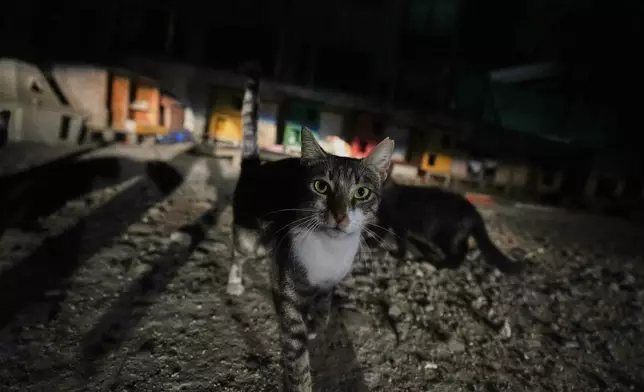
A cat is seen at a park in Lakatamia area of capital Nicosia, Cyprus, Oct. 4, 2025. (AP Photo/Petros Karadjias)
A cat is seen at a park in Lakatamia area of capital Nicosia, Cyprus, Oct. 4, 2025. (AP Photo/Petros Karadjias)

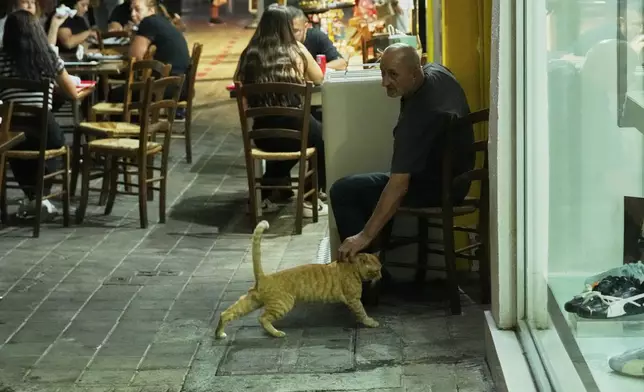
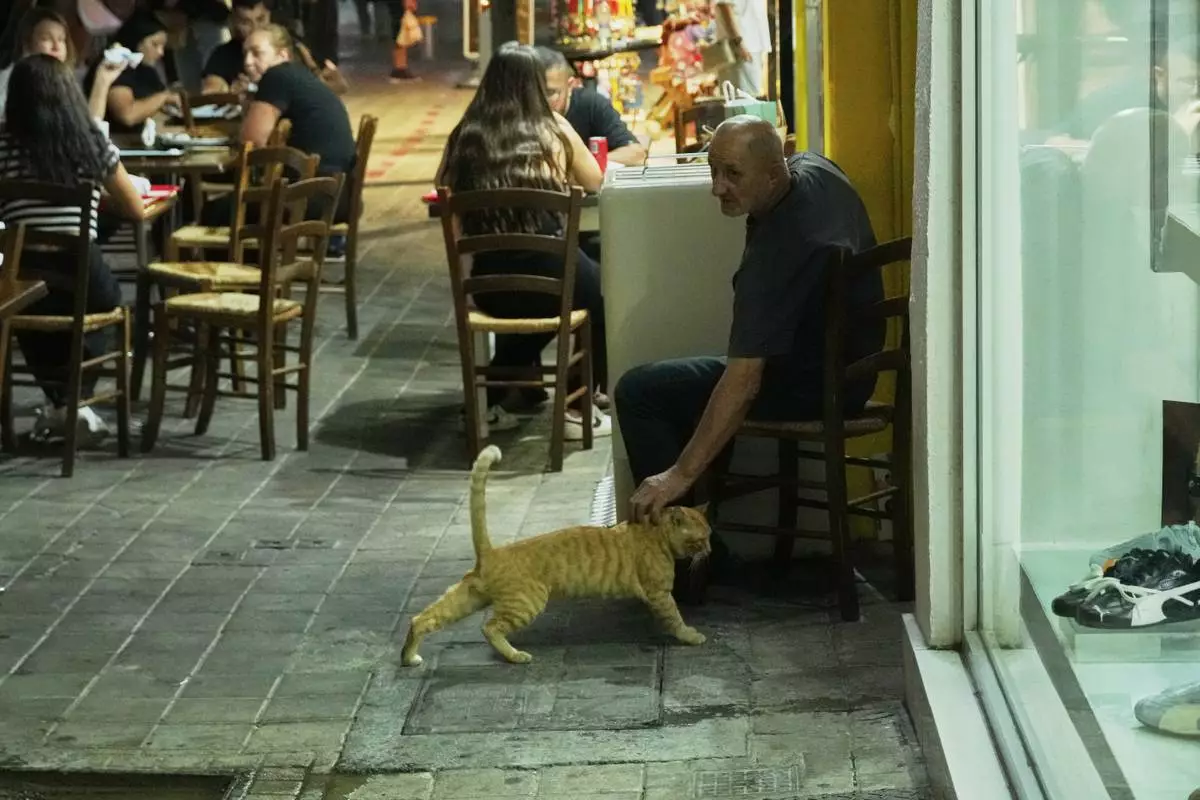
A man caresses a cat outside a restaurant in capital Nicosia, Cyprus, Sept. 26, 2025. (AP Photo/Petros Karadjias)
A man caresses a cat outside a restaurant in capital Nicosia, Cyprus, Sept. 26, 2025. (AP Photo/Petros Karadjias)

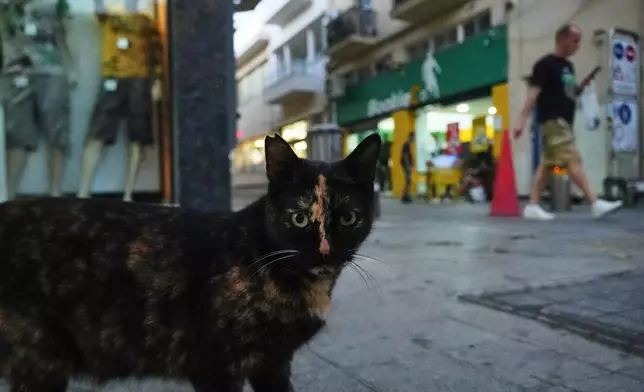
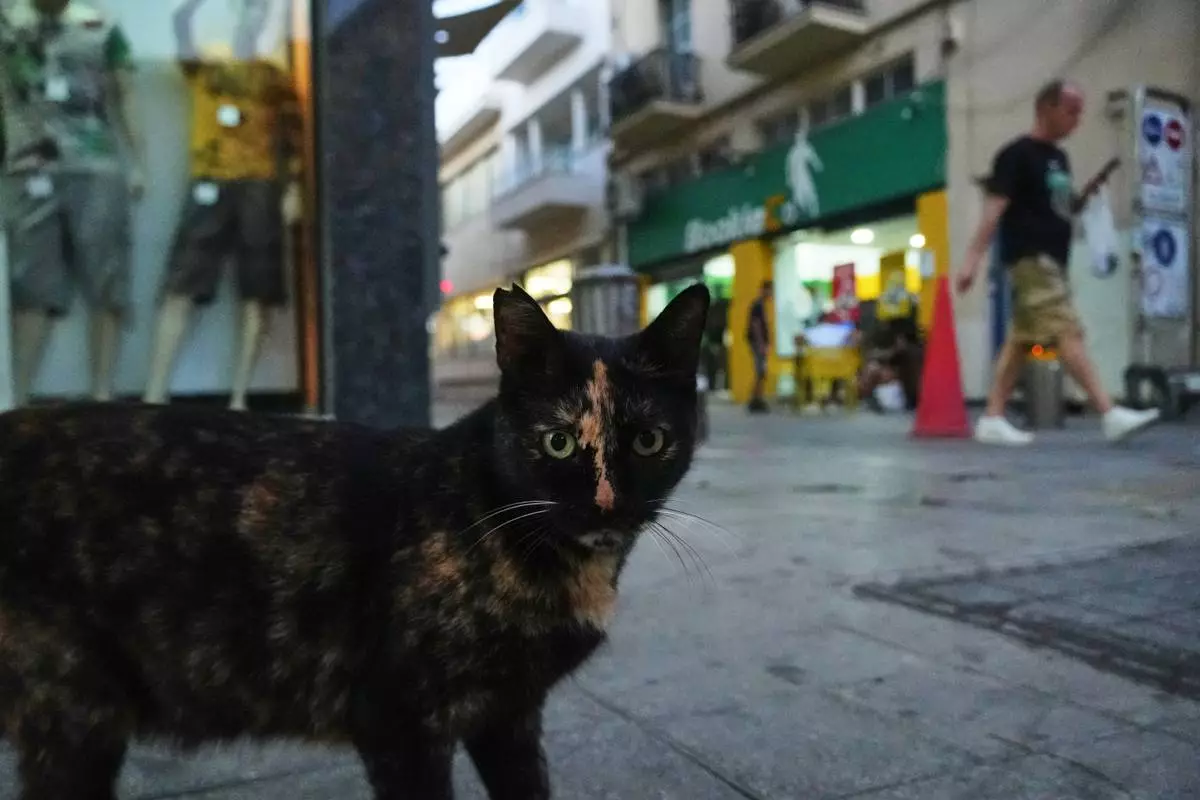
A cat is seen in capital Nicosia, Cyprus, Sept. 26, 2025. (AP Photo/Petros Karadjias)
A cat is seen in capital Nicosia, Cyprus, Sept. 26, 2025. (AP Photo/Petros Karadjias)

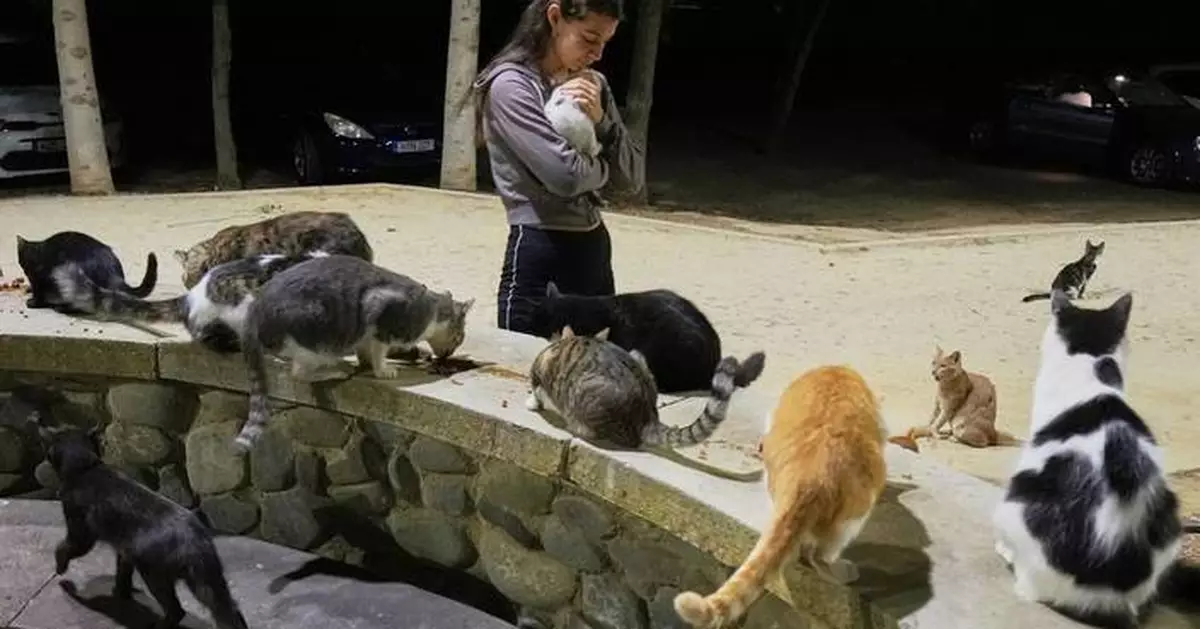
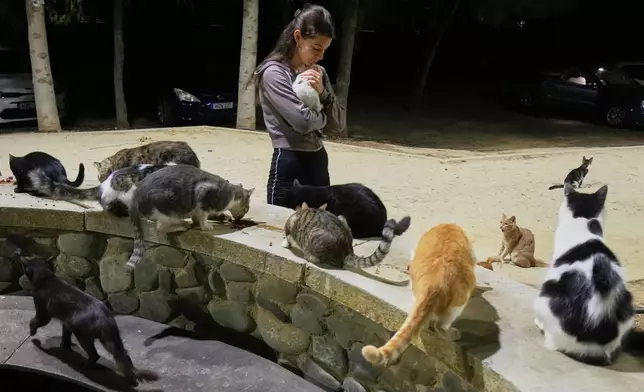
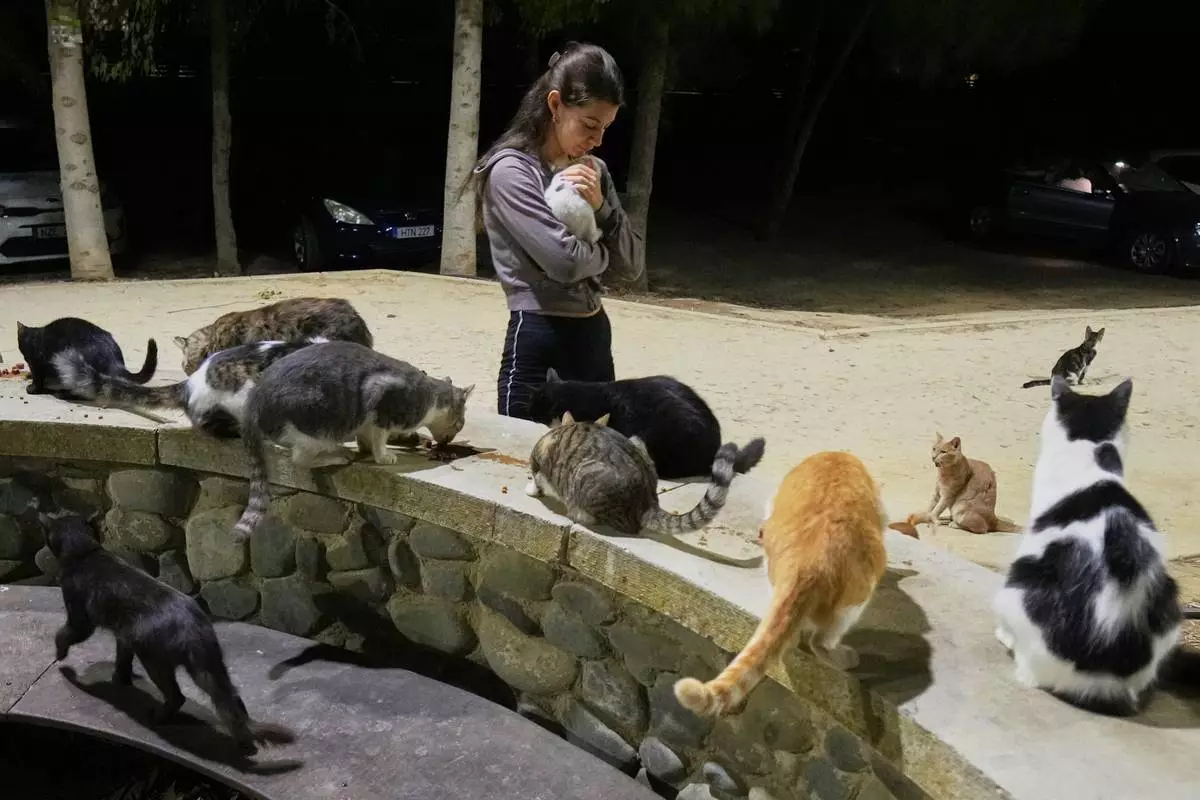
A woman holds a cat at a park in Strovolos area of capital Nicosia, Cyprus, Oct. 6 2025. (AP Photo/Petros Karadjias)

A woman holds a cat at a park in Strovolos area of capital Nicosia, Cyprus, Oct. 6 2025. (AP Photo/Petros Karadjias)

In late September, the island’s parliamentary committee on the environment was told that an existing sterilization program is too limited to contain the burgeoning cat population.

“It’s a good program, but it needs to expand,” said Environment Commissioner Antonia Theodosiou, noting that the program conducts only about 2,000 sterilizations annually on a budget of just 100,000 euros ($117,000).

While there is no official comparative data, Theodosiou said Cyprus has gained a reputation for having a cat population that is exceptionally large relative to its human inhabitants.

Change might be on the way, but funding alone won’t solve Cyprus’s cat problem.

Appearing to heed calls for more funding, Environment Minister Maria Panayiotou announced on Oct. 4 — World Animal Day — that the government would raise cat sterilization funding to 300,000 euros annually. The decision was hailed as a significant step forward.

However, Charalambos Theopemptou, chairman of the Parliamentary Environment Committee, warned against relying on money alone. “There has to be a plan," he said. "We can't just go ahead with sterilizations without having a plan,” he said.

Given cats’ predatory nature, a large population not only has the potential to wreak havoc with the island’s ecosystem, but it could cause undue suffering for feral felines roaming car-choked streets in search of food and shelter.

Cyprus has a long history as a cat-loving nation where cat food dispensaries and clusters of tiny houses are a regular sight along popular footpaths.

Two decades ago, French archaeologists unearthed what they believed to be the earliest evidence of a domesticated cat in a 9,500-year-old neolithic village. They found the bones of a cat close to the skeletal remains of a human, suggesting that they were buried together.

Adding to this long history of human-feline connection is the 4th century legend of Saint Helen who, after finding the True Cross in the Holy Lands, brought over a couple of boatloads of cats to deal with a snake infestation. A monastery that serves as a feline safe haven, St. Nicholas of the Cats, still exists today.

With tourism a key economic driver for Cyprus, the island’s cats have become a major attraction for the millions of vacationers who descend on the island every year. The well-fed felines are a common sight, often seen feasting on leftovers provided by visitors at the plethora of restaurants where they like to hang out.

Demetris Epaminondas, president of the Veterinary Association, attributes the exploding population to unchecked breeding, particularly in high-concentration urban areas, and to more kittens surviving birth, thanks to ordinary folks offering care.

The current government-run program disburses its budget to municipalities which, in turn, fund private veterinarians to sterilize cats brought in by animal conservation groups.

Authorities acknowledge the program is ineffective.

The country’s state-run Veterinary Services, which is in charge of sterilizations, conceded that the program’s capabilities are "lesser than the real need.” To reassess where available funding could be redistributed, it has asked local government authorities to submit reports on locations with large feral cat concentrations.

Elias Demetriou who runs the private sanctuary Friends of Larnaca Cats said tripling sterilization funds won't have the desired effect unless conservationist groups who have the know-how are recruited to round up cats for sterilization.

Eleni Loizidou, head of Cat Alert, a volunteer organization caring for strays in Nicosia, said her organization’s recent efforts to round up 397 feral cats from the city center were a mere drop in the ocean — and that too few females are being sterilized, partly because of the difficulty in trapping feral cats.

Epaminondas, the Veterinary Association president, said Cyprus' cat population can be brought under control in as few as four years. This would be possible, he said, if authorities cobble together a unified sterilization plan that would put private clinics at the forefront of the effort by offering free-of-charge neutering without all the red tape that complicates the process.

“People will be more motivated to get cats neutered if we make it easier for them to do so,” he said.

His association has proposed a plan that would identify major cat concentration centers where authorities can round them up and take them for sterilization at designated vets. The initiative includes the creation of a smartphone application that would allow anyone to help authorities locate such large cat concentrations.

The state can avoid bearing the full cost of the program by setting up a fund where people and businesses can donate, according to Epaminondas. The minister's announcement about tripling the sterilization budget, he said, could act as a significant incentive for more corporate donations.

The cost of sterilizing a female feral cat in Cyprus is 55 euros ($64), which goes up to 120 euros for domesticated cats brought in by owners, as they receive more specialized care.

Theodosiou, the environment commissioner, said her staff have worked on a long-term strategy that would bring together government, conservationists, and volunteers to establish a precise cat population count and pave the way for a mass sterilization program. The plan would also legalize private cat sanctuaries.

“There are solutions,” Cat Alert's chief Loizidou said.
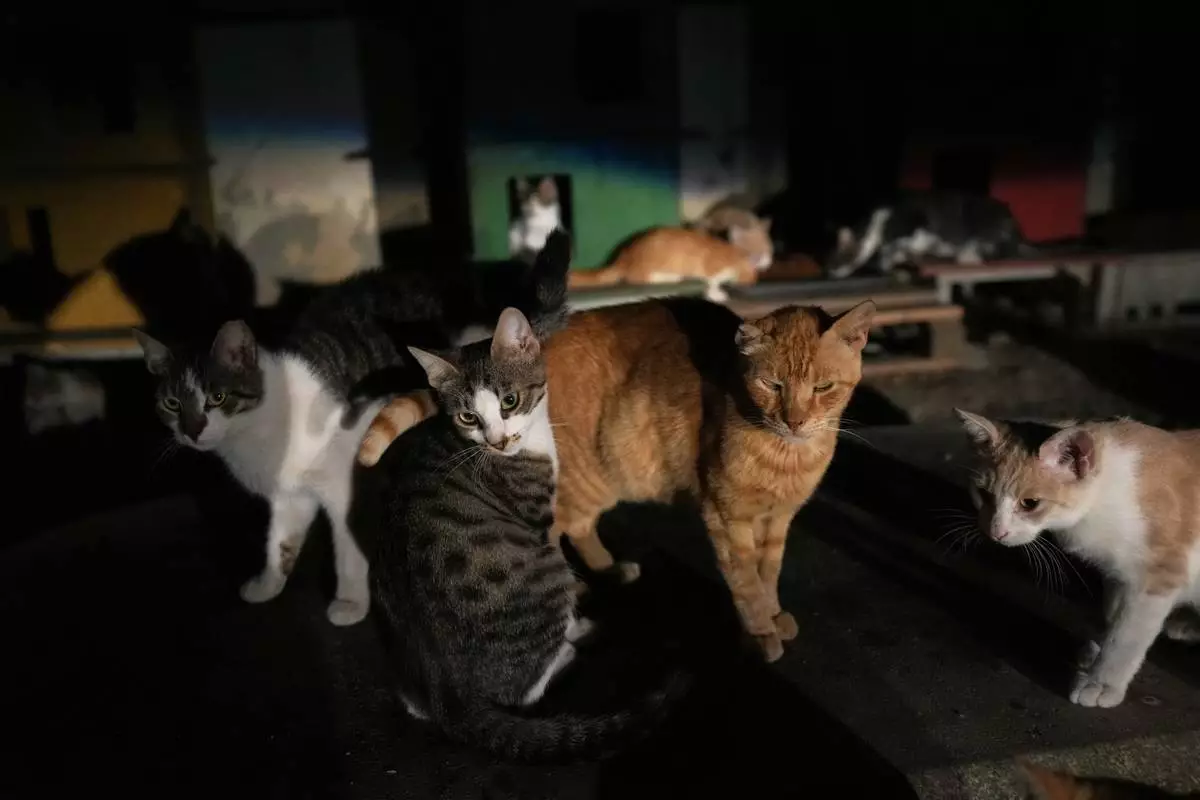
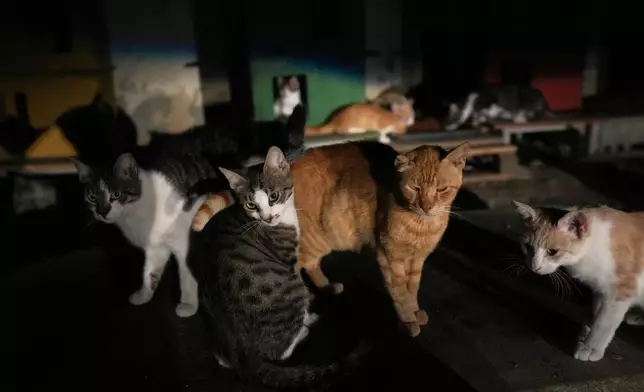
Cats are seen at a park in Lakatamia area, of capital Nicosia, Cyprus, Oct. 4, 2025. (AP Photo/Petros Karadjias)
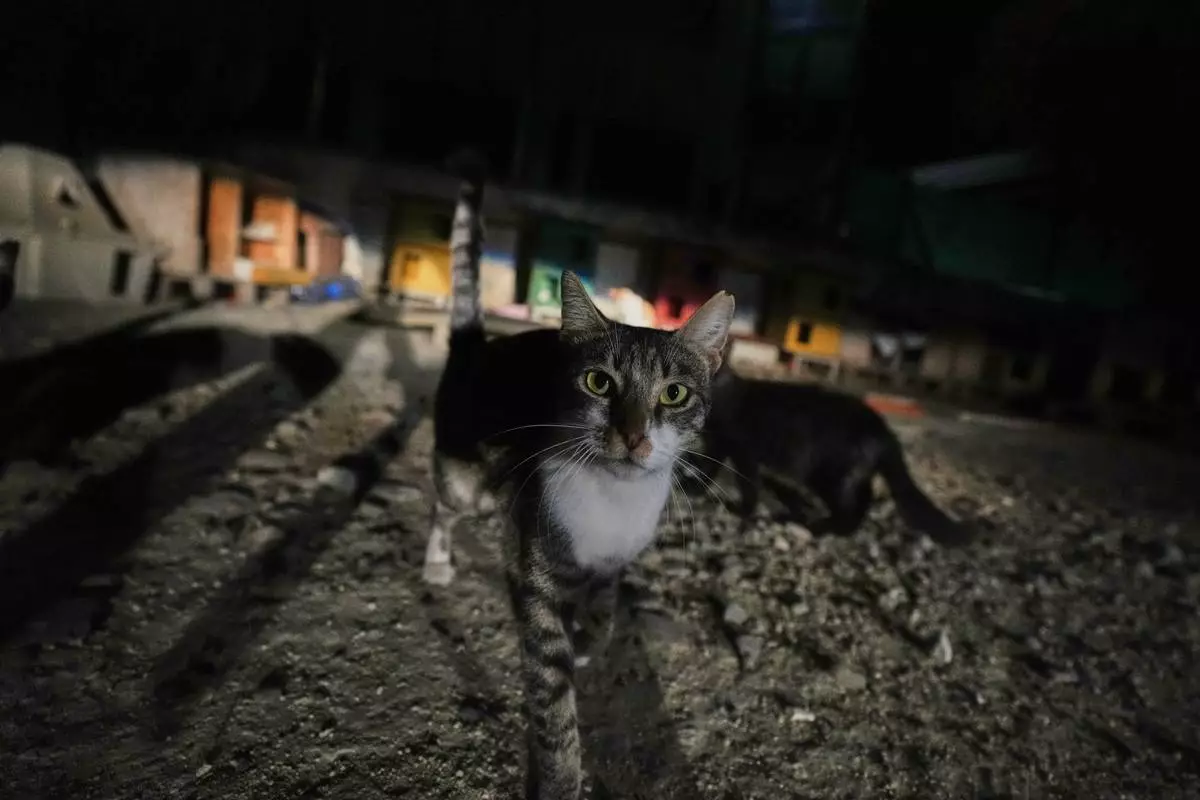
Cats are seen at a park in Lakatamia area, of capital Nicosia, Cyprus, Oct. 4, 2025. (AP Photo/Petros Karadjias)

A cat is seen at a park in Lakatamia area of capital Nicosia, Cyprus, Oct. 4, 2025. (AP Photo/Petros Karadjias)
A cat is seen at a park in Lakatamia area of capital Nicosia, Cyprus, Oct. 4, 2025. (AP Photo/Petros Karadjias)

A man caresses a cat outside a restaurant in capital Nicosia, Cyprus, Sept. 26, 2025. (AP Photo/Petros Karadjias)
A man caresses a cat outside a restaurant in capital Nicosia, Cyprus, Sept. 26, 2025. (AP Photo/Petros Karadjias)

A cat is seen in capital Nicosia, Cyprus, Sept. 26, 2025. (AP Photo/Petros Karadjias)
A cat is seen in capital Nicosia, Cyprus, Sept. 26, 2025. (AP Photo/Petros Karadjias)

A woman holds a cat at a park in Strovolos area of capital Nicosia, Cyprus, Oct. 6 2025. (AP Photo/Petros Karadjias)

A woman holds a cat at a park in Strovolos area of capital Nicosia, Cyprus, Oct. 6 2025. (AP Photo/Petros Karadjias)
RHO, Italy (AP) — No ice is colder and harder than speedskating ice. The precision it takes has meant that Olympic speedskaters have never competed for gold on a temporary indoor rink – until the 2026 Milan Cortina Winter Games.

In the pursuit of maximum glide and minimum friction, Olympic officials brought on ice master Mark Messer, a veteran of six previous Olympic speedskating tracks and the ice technician in charge of the Olympic Oval in Calgary, Canada — one of the fastest tracks in the world with over 300 records.

Messer has been putting that experience to work one thin layer of ice at a time since the end of October at the new Speed Skating Stadium, built inside adjacent trade fair halls in the city of Rho just north of Milan.

“It’s one of the biggest challenges I’ve had in icemaking,’’ Messer said during an interview less than two weeks into the process.

If Goldilocks were a speedskater, hockey ice would be medium hard, for fast puck movement and sharp turns. Figure skating ice would be softer, allowing push off for jumps and so the ice doesn’t shatter on landing. Curling ice is the softest and warmest of all, for controlled sliding.

For speedskating ice to be just right, it must be hard, cold and clean. And very, very smooth.

“The blades are so sharp, that if there is some dirt, the blade will lose the edge,’’ Messer said, and the skater will lose speed.

Speedskater Enrico Fabris, who won two Olympic golds in Turin in 2006, has traded in his skates to be deputy sports manager at the speedskating venue in Rho. For him, perfect ice means the conditions are the same for all skaters — and then if it's fast ice, so much the better.

"It's more of a pleasure to skate on this ice,'' he said.

Messer’s first Olympics were in Calgary in 1988 — the first time speedskating was held indoors. “That gave us some advantages because we didn’t have to worry about the weather, wind blowing or rain,’’ he said. Now he is upping the challenge by becoming the first ice master to build a temporary rink for the Olympics.

Before Messer arrived in Italy, workers spent weeks setting up insulation to level the floor and then a network of pipes and rubber tubes that carry glycol — an antifreeze — that is brought down to minus 7 or minus 8 degrees Celsius (17.6 to 19.4 degrees Fahrenheit) to make the ice.

Water is run through a purification system — but it can’t be too pure, or the ice that forms will be too brittle. Just the right amount of impurities “holds the ice together,’’ Messer said.

The first layers of water are applied slowly, with a spray nozzle; after the ice reaches a few centimeters it is painted white — a full day’s work — and the stripes are added to make lanes.

“The first one takes about 45 minutes. And then as soon as it freezes, we go back and do it again, and again and again. So we do it hundreds of times,’’ Messer said.

As the ice gets thicker, and is more stable, workers apply subsequent layers of water with hoses. Messer attaches his hose to hockey sticks for easier spreading.

What must absolutely be avoided is dirt, dust or frost — all of which can cause friction for the skaters, slowing them down. The goal is that when the skaters push “they can go as far as possible with the least amount of effort,’’ Messer said.

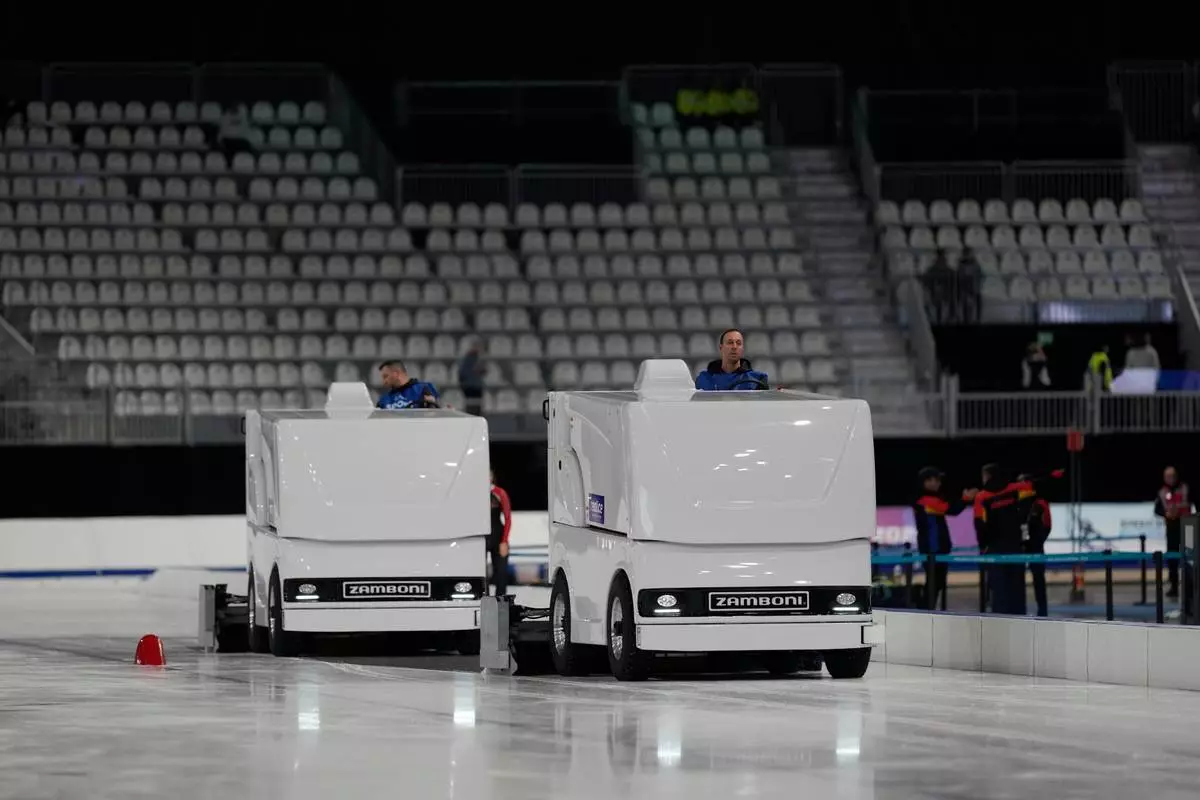
The Zamboni ice resurfacing machine plays a key role in keeping the track clean, cutting off a layer and spraying water to make a new surface.

One challenge is gauging how quickly the water from the resurfacing machine freezes in the temporary rink.

Another is getting the ice to the right thickness so that the Zamboni, weighing in at six tons, doesn’t shift the insulation, rubber tubing or ice itself.

“When you drive that out, if there’s anything moving it will move. We don’t want that,’’ Messer said.

The rink got its first big test on Nov. 29-30 during a Junior World Cup event. In a permanent rink, test events are usually held a year before the Olympics, leaving more time for adjustments. “We have a very small window to learn,’’ Messer acknowledged.

Dutch speedskater Kayo Vos, who won the men’s neo-senior 1,000 meters, said the ice was a little soft — but Messer didn’t seem too concerned.

“We went very modest to start, now we can start to change the temperatures and try to make it faster and still maintain it as a safe ice,’’ he said.

Fine-tuning the air temperature and humidity and ice temperature must be done methodically — taking into account that there will be 6,000 spectators in the venue for each event. The next real test will be on Jan. 31, when the Olympians take to the ice for their first training session.

“Eighty percent of the work is done but the hardest part is the last 20 percent, where we have to try to find the values and the way of running the equipment so all the skaters get the same conditions and all the skaters get the best conditions,’’ Messer said.

AP Winter Olympics: https://apnews.com/hub/milan-cortina-2026-winter-olympics

Serpentines are set on the ice of the stadium where speed skating discipline of the Milan Cortina 2026 Winter Olympics will take place, in Rho, outskirt of Milan, Tuesday, Nov. 11, 2025. (AP Photo/Luca Bruno)

Serpentines are set on the ice of the stadium where speed skating discipline of the Milan Cortina 2026 Winter Olympics will take place, in Rho, outskirt of Milan, Tuesday, Nov. 11, 2025. (AP Photo/Luca Bruno)

Ice Master Mark Messer poses in the stadium where speed skating discipline of the Milan Cortina 2026 Winter Olympics will take place, in Rho, outskirt of Milan, Tuesday, Nov. 11, 2025. (AP Photo/Luca Bruno)

Ice Master Mark Messer poses in the stadium where speed skating discipline of the Milan Cortina 2026 Winter Olympics will take place, in Rho, outskirt of Milan, Tuesday, Nov. 11, 2025. (AP Photo/Luca Bruno)

Workers clean the ice surface during a peed skating Junior World Cup and Olympic test event, in Rho, near Milan, Italy, Saturday, Nov. 29, 2025. (AP Photo/Luca Bruno)

Workers clean the ice surface during a peed skating Junior World Cup and Olympic test event, in Rho, near Milan, Italy, Saturday, Nov. 29, 2025. (AP Photo/Luca Bruno)

Ice Master Mark Messer poses in the stadium where speed skating discipline of the Milan Cortina 2026 Winter Olympics will take place, in Rho, outskirt of Milan, Tuesday, Nov. 11, 2025. (AP Photo/Luca Bruno)

Ice Master Mark Messer poses in the stadium where speed skating discipline of the Milan Cortina 2026 Winter Olympics will take place, in Rho, outskirt of Milan, Tuesday, Nov. 11, 2025. (AP Photo/Luca Bruno)

Ice Master Mark Messer poses in the stadium where speed skating discipline of the Milan Cortina 2026 Winter Olympics will take place, in Rho, outskirt of Milan, Tuesday, Nov. 11, 2025. (AP Photo/Luca Bruno)

Ice Master Mark Messer poses in the stadium where speed skating discipline of the Milan Cortina 2026 Winter Olympics will take place, in Rho, outskirt of Milan, Tuesday, Nov. 11, 2025. (AP Photo/Luca Bruno)

Recommended Articles