Skip to Content Facebook Feature Image

Two New Imported Chikungunya Fever Cases Reported in Hong Kong

HK

Two New Imported Chikungunya Fever Cases Reported in Hong Kong
HK

HK

Two New Imported Chikungunya Fever Cases Reported in Hong Kong

2025-10-14 18:38 Last Updated At:18:48

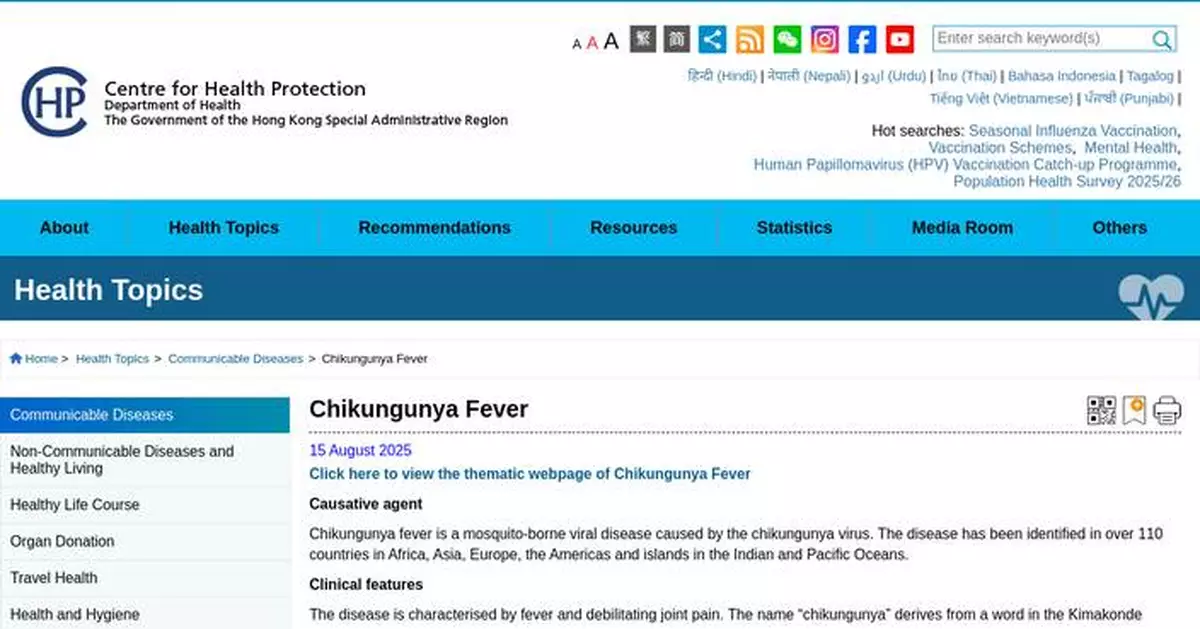
Update on chikungunya fever

The Centre for Health Protection (CHP) of the Department of Health announced that as of 5pm today (October 14), two new cases of chikungunya fever (CF) had been recorded.

Latest case information

The first case involves a 28-year-old male living in Kowloon City District. A preliminary investigation revealed that he visited Zhongshan in Guangdong between October 6 and 9. He developed joint pain on October 12 and a fever on the following day (October 13). He sought medical attention at the Accident and Emergency Department of Kwong Wah Hospital and was admitted for treatment in a mosquito-free environment on the same day. He is now in stable condition. His blood sample tested positive for the CF virus upon laboratory testing.

The patient has one household contact, who visited Zhongshan around the same time. His household contact is currently asymptomatic and under medical surveillance.

The other case involves a 47-year-old male living in Kowloon City District. A preliminary investigation revealed that he visited Jiangmen in Guangdong alone between October 5 and 7. He developed a fever, rash and joint pain on October 13. He sought medical attention at the Accident and Emergency Department of Kwong Wah Hospital and was admitted for treatment in a mosquito-free environment on the same day. He is now in stable condition. His blood sample tested positive for the CF virus upon laboratory testing.

The patient has one household contact, who is currently asymptomatic and under medical surveillance.

Since the two patients stayed in Guangdong Province during their incubation periods, the CHP considered that they were infected during travel. The cases were classified as imported. The CHP's epidemiological investigation is ongoing, and it has reported the cases to the health authority of Guangdong Province.

Latest surveillance data

So far this year, Hong Kong has recorded a total of 35 confirmed CF cases. All are imported cases. From 2016 to 2019, Hong Kong recorded between one and 11 imported cases annually.

According to information from the Guangdong Provincial Disease Control and Prevention Administration, there were 2 257 new CF cases in Guangdong last week (October 5 to 11), showing a decrease compared to the previous two weeks, which reported 3 181 cases (September 28 to October 4) and 3 153 cases (September 21 to 27) respectively. Most of the cases (1 255 cases) were recorded in Jiangmen last week, followed by Guangzhou (201 cases) and Foshan (196 cases). All cases were mild, with no severe or fatal cases reported. Although the number of CF cases in Jiangmen has fluctuated downward recently, the level remained relatively high.

Since the beginning of 2025, and as of September 30, a total of 445 271 suspected and confirmed CF cases and 155 CF-related deaths have been reported in 40 countries/territories. Cases have been reported in the Americas, Africa, Asia, and Europe. CF outbreaks currently occur in many countries worldwide. Members of the public should check the situation of the destinations before travelling abroad.

Continuously strengthening prevention and control

The Food and Environmental Hygiene Department (FEHD) continues to conduct vector investigations and targeted mosquito control operations, and intensify mosquito prevention and control measures at the residences of recently confirmed patients, as well as at locations visited after the onset of symptoms. These measures include:
  • carrying out intensive fogging in scrubby areas within a 250-metre radius of the relevant locations to kill adult mosquitoes;
  • carrying out inspections of the locations, removing stagnant water, applying insecticides and disposing of abandoned water containers every week with a view to preventing mosquito breeding; and
  • enhancing public education efforts through organising health talks, setting up mobile education stations, and distributing publicity leaflets.
  • The CHP urged schools to follow the FEHD's anti-mosquito guidelines to strengthen efforts to clear stagnant water on school premises and eliminate mosquito breeding sites. It is also imperative to remind staff members and students to consistently implement mosquito prevention and personal protective measures to guard against the spread of mosquito-borne diseases within school premises.

    Additionally, the CHP's Port Health Division continues to step up inspections at boundary control points and remind cross-boundary public transport operators and other relevant parties to ensure good environmental hygiene and effective implementation of anti-mosquito measures. Furthermore, staff members of the Port Health Division distribute leaflets to travellers, conduct temperature screenings for inbound travellers, conduct health assessments for travellers with fever or related symptoms and refer them to hospitals for follow-ups when necessary.

    Proper use of DEET-containing insect repellents or other effective active ingredients can prevent mosquito bites, but the following precautions should be taken when using them:

  • read the label instructions carefully first;
  • apply right before entering an area with a risk of mosquito bites;
  • apply on exposed skin and clothing;
  • use DEET of up to 30 per cent for pregnant women and up to 10 per cent for children (For children who travel to countries or areas where mosquito-borne diseases are endemic or epidemic and where exposure is likely, those aged 2 months or above can use DEET-containing insect repellents with a DEET concentration of up to 30 per cent);
  • apply sunscreen first, then insect repellent;
  • reapply only when needed and follow the instructions; and
  • in addition to DEET, there are other insect repellents available on the market containing different active ingredients, such as IR3535 and picaridin. When using any insect repellent, the public should follow the usage instructions and precautions on the product label.
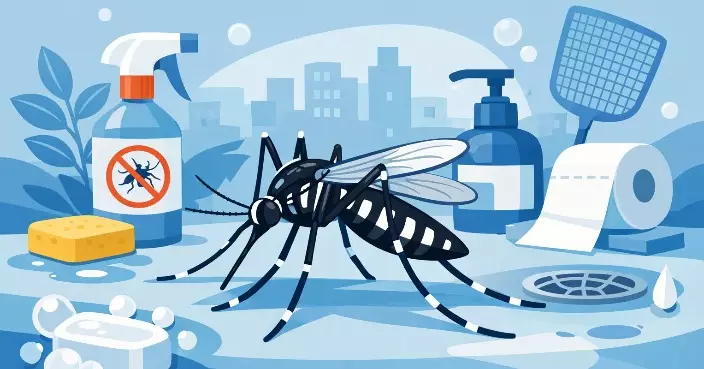
  • ​​The FEHD also appeals to members of the public to continue to stay alert and work together to carry out mosquito prevention and control measures early, including inspecting their homes and surroundings to remove potential breeding grounds, changing water in vases and scrubbing their inner surfaces, removing water in saucers under potted plants at least once a week, and properly disposing of containers such as soft drink cans and lunch boxes. The FEHD also advises members of the public and estate management bodies to keep drains free of blockage and level all defective ground surfaces to prevent the accumulation of water. They should also scrub all drains and surface sewers with an alkaline detergent at least once a week to remove any mosquito eggs.

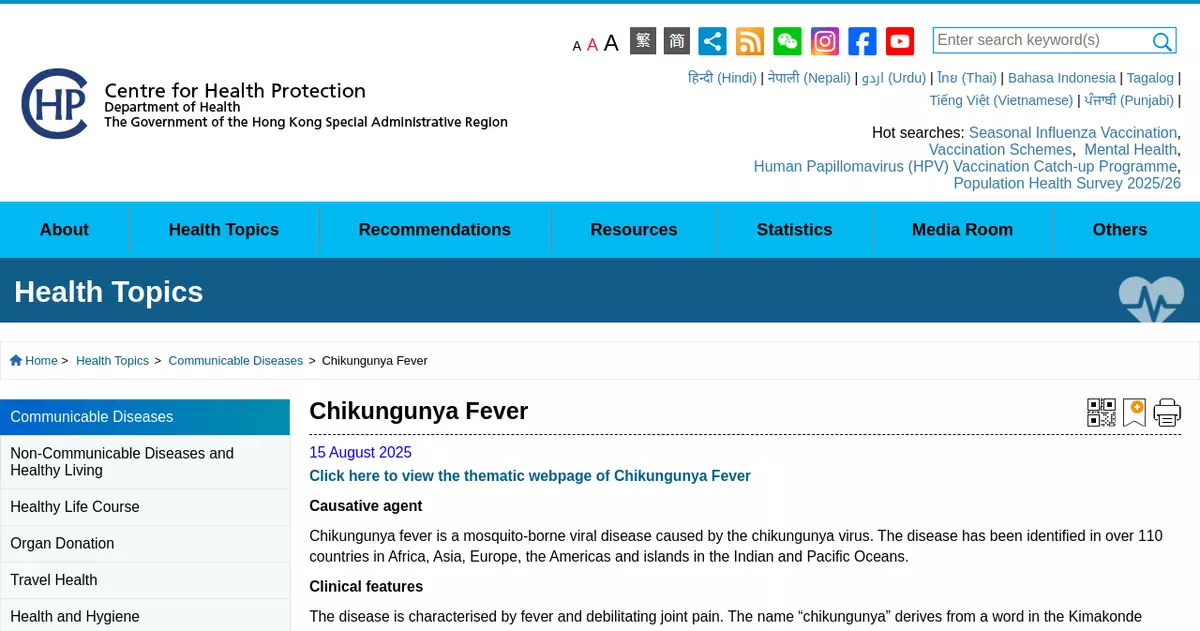
    The public should call1823in case of mosquito problems, and may visit the following pages for more information: the CF page of theCHPand theTravel Health Service, the latestTravel Health News,tips for using insect repellents, and the CHPFacebook Page,Instagram AccountandYouTube Channel, and also theMosquito Prevention and Control dedicated pageof the FEHD.

    Source: AI-found images
    Source: AI-found images

    Speech by CE at welcome dinner of 6th US-China Hong Kong Forum (with photos/video)

    Following is the speech by the Chief Executive, Mr John Lee, at the welcome dinner of the 6th US-China Hong Kong Forum today (November 17):

    Honourable Deputy Commissioner Hua You of the Office of the Commissioner of the Ministry of Foreign Affairs in the Hong Kong Special Administrative Region, Honourable Mr John Zhao (Chairman of China-United States Exchange Foundation), Honourable Mr Shen Xin (Vice President of the Chinese People's Association for Friendship with Foreign Countries), distinguished guests, ladies and gentlemen,

    Good evening. I'm very delighted to be here, tonight, for this welcome dinner of the sixth US-China Hong Kong Forum.

    I would like to begin by thanking the China-United States Exchange Foundation for, once again, bringing us together. Working with the Chinese People's Association for Friendship with Foreign Countries, the Foundation stages this important forum to bring us together. Bring the two largest economies in the world together.

    You believe, as I do- as the vast majority of the world does - that a constructive relationship between China, our country, and the United States is essential for global well-being. And for the global economy, in pursuing mutually rewarding opportunities.

    As we all know, mutually rewarding opportunity is having a difficult, even daunting, year, for China-US relations.

    President Xi Jinping, in his October meeting with the US President Trump, pointed out that China and the US, and I quote, "should be partners and friends. This is what history has taught us and reality needs."

    Unfortunately, "reality" has often been sidelined in China-US relations today. That means that Hong Kong-US ties - a special component within the China-US relationship - are also affected, despite a US diplomatic presence here, going back more than 180 years.

    The US has ensnared Hong Kong in its world-wide tariffs' web. Its self-made-up story of reciprocal tariffs for the so-called unfair, unbalanced trade in the case of Hong Kong is absolutely flawed. The US has been enjoying one of the largest bilateral merchandise trade surpluses with Hong Kong. Last year alone, the trade surplus surpassed US$ 21 billion, the second-largest among its trade partners. Over the past decade, the US has run up a trade surplus with Hong Kong worth more than US$ 271 billion, the largest among its trading partners.

    America's trade with Hong Kong supports more than 140 000 American jobs, from agriculture to fashion, manufacturing and much more.

    Not surprisingly, nearly 1 400 US companies were operating in Hong Kong as of last year. That makes the US Hong Kong's second-largest source of foreign-affiliated companies. That, let me add, was up 117 companies, year-on-year.

    According to the American Chamber of Commerce in Hong Kong's 2025 Business Sentiment Survey, 75 per cent, three quarters, of its surveyed members reported either stable or increased revenue last year, compared to 2023.

    More than 80 000 US citizens live and work in Hong Kong, confident and comfortable in a city they share so many common values with.

    They can see, for themselves, the "one country, two systems" principle in action, in dynamic action, how Hong Kong connects East and West, and in so many ways, for so many economies and businesses and peoples.

    Under the unique "one country, two systems" principle, Hong Kong is the only world city that converges both the China advantage and the global advantage. We boast a long and established tradition of the rule of law, a common law system shared by most global financial hubs, and a judiciary that exercises its judicial power independently, free from any interference.

    Equally important, our people, and business owners, share Hong Kong's commitment to open and free trade. We are, after all, a founding member of the World Trade Organization.

    The so-called "reciprocal tariff" for Hong Kong is therefore out of sense given that the trade balance between us is tilted heavily in favour of the US. And the fact that Hong Kong does not impose customs tariffs on goods from the US - or any other country.

    Hong Kong will continue, I assure you, to do what we've always done. We champion free trade and create opportunities for local businesses and investors, and the economies, companies and investors they do business with.

    With the firm support of our country, Hong Kong is fast developing its eight centres of excellence, and maintain a pivotal role in such national strategies as the Belt and Road Initiative and the Guangdong-Hong Kong-Macao Greater Bay Area. We are flush with opportunities - mutual opportunities. And in that, we continue to roll out a welcome mat for the US businesses and investors.

    They can take confidence in our free trade policies, our simple and low tax regime - free from sales tax, capital gains tax, estate duty and tax on dividends - and our free flow of information, capital, goods and talent.

    Speaking of talent, the Swiss-based International Institute for Management Development, in its 2025 World Talent Ranking, rated Hong Kong fourth in the world, and tops in Asia.

    Our talent initiatives of the past three years are working. And well. Since we rolled out an enhanced talent attraction regime at the end of 2022, we have received applications from over 550 000 professionals and young talent around the world. Over 376 000 applications have been approved, and around 250 000 of them have already arrived in Hong Kong. They are graduates from top universities, high earners in their industries, technology talent, and more. They bring with them expertise, experience and, more importantly, impetus to our economy.

    More than talent, Hong Kong has also proved highly attractive to a world of business. Last month, OASES, the Office for Attracting Strategic Enterprises I set up three years ago, welcomed nearly 20 new key companies to Hong Kong, including three of the world's top pharmaceutical corporations. That takes the number of strategic companies in Hong Kong, thanks to OASES, to 102, 16 of which are, yes, American companies - more than any other overseas country.

    We're pleased to have them here, creating employment, initiating R&D (research and development) projects and investing in Hong Kong's future - and theirs.

    No doubt, they will also love Hong Kong's rising place as the world's East meets West centre for international cultural exchange.

    In the end, ladies and gentlemen, dialogue is always better than confrontation. Collaboration is more effective than unilateralism.

    But, of course, no one knows that better than the China-United States Exchange Foundation, and all of you here this evening.

    Your theme for this year's two-day Forum, "Circles for Peace", surrounds AI (artificial intelligence), geopolitics and people-to-people ties. And I understand that some 50 prominent speakers, from all over the world, will engage those issues and their global import before an audience of some 500 strong.

    Beyond this Forum, you also engage a broader, and even more diverse, audience. Thanks to the Foundation's efforts, more than 3 000 students have taken part in exchange programmes between our country and the US over the years.

    And this year, the Foundation hosted the first US-China Art Dialogue in Hong Kong during Art March and the annual Art Basel art fair. Nearly 100 artists and arts aficionados from the US and China discussed how arts and artists can encourage people-to-people ties between the US and China.

    In hosting inspirational events, and in many other ways, we will make it abundantly clear that global peace, and prosperity, can only be achieved through dialogue, mutual respect and leadership.

    In that, China and the United States must play the leading roles.

    The world also needs moderators and mediators. And I believe that Hong Kong and the China-United States Exchange Foundation have more than some experience to offer.

    My thanks to the Foundation, and to the Chinese People's Association for Friendship with Foreign Countries, for once again organising this very important US-China Hong Kong Forum.

    I wish you all a rewarding Forum, and a very enjoyable evening. Thank you.

    Speech by CE at welcome dinner of 6th US-China Hong Kong Forum (with photos/video) Source: HKSAR Government Press Releases

    Speech by CE at welcome dinner of 6th US-China Hong Kong Forum (with photos/video) Source: HKSAR Government Press Releases

    Speech by CE at welcome dinner of 6th US-China Hong Kong Forum (with photos/video) Source: HKSAR Government Press Releases

    Speech by CE at welcome dinner of 6th US-China Hong Kong Forum (with photos/video) Source: HKSAR Government Press Releases

    Recommended Articles