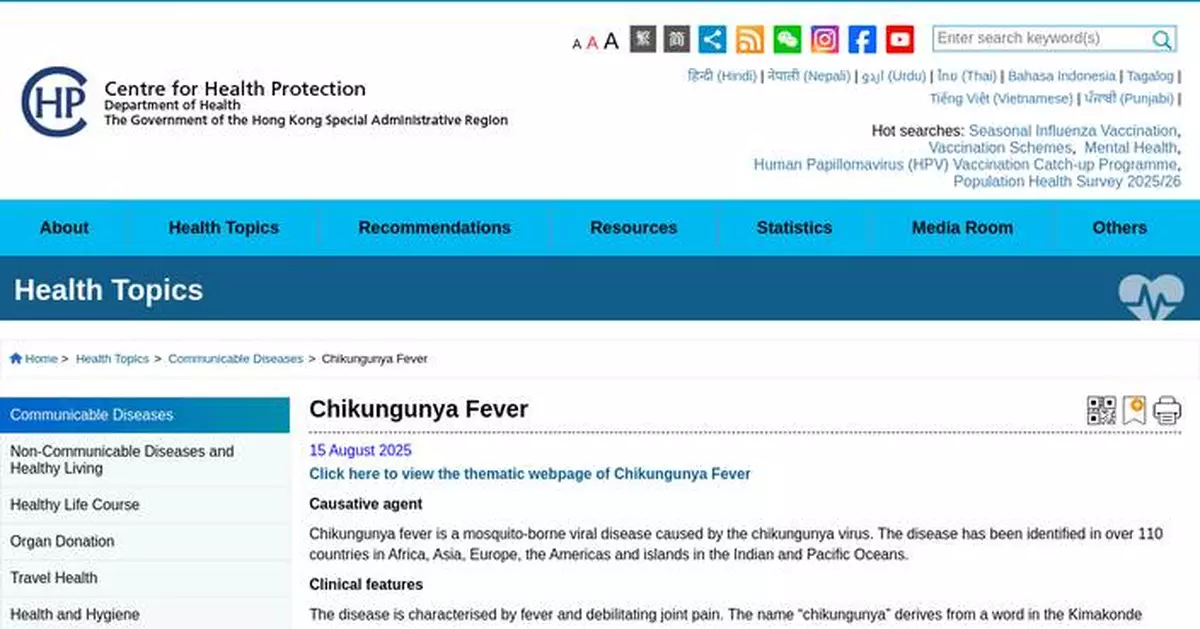
Update on chikungunya fever
The Centre for Health Protection (CHP) of the Department of Health announced that as of 5pm today (October 15), three new cases of chikungunya fever (CF) had been recorded.
Latest cases information
The first case involves a 77-year-old male living in Eastern District. A preliminary investigation revealed that he visited Guangzhou in Guangdong between September 30 and October 13. He developed a fever and joint pain on October 13, and rash yesterday (October 14). He then sought medical attention at a private hospital. His household contact, who travelled with him to Guangzhou, is currently asymptomatic and under medical surveillance.
The second case involves a 34-year-old male living on Lantau Island. A preliminary investigation revealed that he travelled alone to Indonesia between October 2 and 4. He also travelled to Macao between October 6 and 7, and Shenzhen and Dongguan in Guangdong between October 10 and 12. He developed a fever, joint pain and rash on October 13. He sought medical attention at the Accident and Emergency Department of North Lantau Hospital yesterday. He has two household contacts. His travel companions included his relatives (including one household contact) and colleagues. All are currently asymptomatic and under medical surveillance.
The third case involves a 72-year-old male living alone in Central and Western District. A preliminary investigation revealed that he visited Foshan in Guangdong alone between October 4 and 12. He developed a fever and joint pain on October 13 and sought medical attention at the Accident and Emergency Department of Queen Mary Hospital yesterday.
All three males were admitted to the hospitals for treatment in a mosquito-free environment and are in stable condition. Their blood samples tested positive for the CF virus upon laboratory testing. Since they visited areas affected by CF during their incubation periods, the CHP considered that they were infected during travel. The cases were classified as imported. The CHP's epidemiological investigations are ongoing, and it has reported the cases to relevant health authorities.
Latest surveillance data
So far this year, Hong Kong has recorded a total of 38 confirmed CF cases. All are imported cases. From 2016 to 2019, Hong Kong recorded between one and 11 imported cases annually.
Since the beginning of 2025, and as of September 30, a total of 445 271 suspected and confirmed CF cases and 155 CF-related deaths have been reported in 40 countries/territories. Cases have been reported in the Americas, Africa, Asia, and Europe. CF outbreaks currently occur in many countries worldwide. Members of the public should check the situation of the destinations before travelling abroad.
Continuously strengthening prevention and control
The Food and Environmental Hygiene Department (FEHD) continues to conduct vector investigations and targeted mosquito control operations, and intensify mosquito prevention and control measures at the residences of recently confirmed patients, as well as at locations visited after the onset of symptoms. These measures include:
carrying out intensive fogging in scrubby areas within a 250-metre radius of the relevant locations to kill adult mosquitoes;
carrying out inspections of the locations, removing stagnant water, applying insecticides and disposing of abandoned water containers every week with a view to preventing mosquito breeding; and
enhancing public education efforts through organising health talks, setting up mobile education stations, and distributing publicity leaflets.
The CHP urged schools to follow the FEHD's anti-mosquito guidelines to strengthen efforts to clear stagnant water on school premises and eliminate mosquito breeding sites. It is also imperative to remind staff members and students to consistently implement mosquito prevention and personal protective measures to guard against the spread of mosquito-borne diseases within school premises.
Additionally, the CHP's Port Health Division continues to step up inspections at boundary control points and remind cross-boundary public transport operators and other relevant parties to ensure good environmental hygiene and effective implementation of anti-mosquito measures. Furthermore, staff members of the Port Health Division distribute leaflets to travellers, conduct temperature screenings for inbound travellers, conduct health assessments for travellers with fever or related symptoms and refer them to hospitals for follow-ups when necessary.
Proper use of DEET-containing insect repellents or other effective active ingredients can prevent mosquito bites, but the following precautions should be taken when using them:
read the label instructions carefully first;
apply right before entering an area with a risk of mosquito bites;
apply on exposed skin and clothing;
use DEET of up to 30 per cent for pregnant women and up to 10 per cent for children (For children who travel to countries or areas where mosquito-borne diseases are endemic or epidemic and where exposure is likely, those aged 2 months or above can use DEET-containing insect repellents with a DEET concentration of up to 30 per cent);
apply sunscreen first, then insect repellent;
reapply only when needed and follow the instructions; and
in addition to DEET, there are other insect repellents available on the market containing different active ingredients, such as IR3535 and picaridin. When using any insect repellent, the public should follow the usage instructions and precautions on the product label.
The FEHD also appeals to members of the public to continue to stay alert and work together to carry out mosquito prevention and control measures early, including inspecting their homes and surroundings to remove potential breeding grounds, changing water in vases and scrubbing their inner surfaces, removing water in saucers under potted plants at least once a week, and properly disposing of containers such as soft drink cans and lunch boxes. The FEHD also advises members of the public and estate management bodies to keep drains free of blockage and level all defective ground surfaces to prevent the accumulation of water. They should also scrub all drains and surface sewers with an alkaline detergent at least once a week to remove any mosquito eggs.
The public should call1823in case of mosquito problems, and may visit the following pages for more information: the CF page of theCHPand theTravel Health Service, the latestTravel Health News,tips for using insect repellents, and the CHPFacebook Page,Instagram AccountandYouTube Channel, and also theMosquito Prevention and Control dedicated pageof the FEHD.
Source: AI-found images

HKSAR Government strongly condemns Washington Post editorial on Subsidiary Legislation safeguarding national security
The Government of the Hong Kong Special Administrative Region (HKSAR) today (June 13) strongly condemns the wanton slander and groundless allegations made by The Washington Post in its article entitled "Hong Kong's nightmare gets darker", criticising the Safeguarding National Security (Procedural Matters) Regulation (Procedural Matters Regulation). The article clearly exposes The Washington Post's irrational anti-China stance and double standards, falling well short of what is expected of professional journalism.
A spokesperson for the HKSAR Government stated, "In accordance with international law based on the Charter of the United Nations, it is each and every sovereign state's inherent right, as well as an international practice, to enact laws safeguarding national security. With at least 21 pieces of legislation in the United States (US) safeguarding national security, anti-China media, in particular The Washington Post, shamelessly display its hypocrisy and double standards by pointing fingers at the HKSAR as we continuously improve our legal system to fulfill a constitutional duty to safeguard national security."
In response to the article's baseless allegations, the spokesperson points out that, "The Procedural Matters Regulation only aims to state clearly the classification mechanism under the Law of the People's Republic of China on Safeguarding National Security in the Hong Kong Special Administrative Region (HKNSL) and the Safeguarding National Security Ordinance (SNSO) for 'other offences endangering national security under the law of the HKSAR', thereby bringing even greater certainty to the implementation of the relevant provisions under the HKNSL, the SNSO and other laws.
"Any reasonable and objective person who has studied the three provisions of the Procedural Matters Regulation with care, and observed the relevant discussions at the Legislative Council (LegCo) meetings would have no difficulty in finding that the Procedural Matters Regulation has no retrospective effect at all. It does not create any new offence or alter the penalties of any offence. It certainly does not turn any lawful conduct into an offence. It is not applicable to legal proceedings that are concluded. Yet, The Washington Post falsely and maliciously claimed that 'people can now be charged retroactively for crimes that didn't exist when they allegedly committed them'. Its ignorance of facts and betrayal of the basic tenets of responsible journalism are shocking, irresponsible, and totally unacceptable behaviour for any media organisation.
"More important, the Procedural Matters Regulation will in no way infringe any legitimate right of a defendant. Hong Kong is a place underpinned by the rule of law. The guilt or innocence of a defendant remains a matter to be adjudicated by the court independently and in accordance with law. The court will, as always, ensure a defendant's right to a fair trial. Article 4 of the HKNSL stipulates that human rights shall be respected and protected in safeguarding national security. The rights and freedoms, which the residents of the HKSAR enjoy under the Basic Law and the provisions of the International Covenant on Civil and Political Rights and the International Covenant on Economic, Social and Cultural Rights as applied to Hong Kong, shall be protected in accordance with the law. Article 5 stipulates that the principle of the rule of law shall be adhered to in preventing, suppressing, and imposing punishment for offences endangering national security, which includes protection for the right to defend oneself and other rights in judicial proceedings that a criminal suspect and defendant are entitled to under the law. Section 2 of the SNSO also clearly stipulates that the Ordinance is based on the above principle of respect and protection for human rights and the principle of the rule of law."
The spokesperson pointed out, "Another allegation by The Washington Post about the issuance of a certificate by the Chief Executive under Article 47 of the HKNSL or section 115 of the SNSO is plainly wrong. The issuance of the certificate by the Chief Executive is a rigorous and solemn action. As the top official with primary responsibility for safeguarding national security in the HKSAR, the Chief Executive has access to all relevant information, including extremely sensitive intelligence and information on acts and activities endangering national security, which are not suitable for public disclosure. Such confidential information may even pertain to threats by state actors. It follows that the Chief Executive must shoulder the important responsibility, and indeed is in the best position, to make the necessary assessments and exercise the power to issue certificates on whether a criminal act involves national security. It must be firmly stated that this is a very rigorous and cautious process, leaving absolutely no room for uncertainty.
"As a matter of fact, it is a well-established principle at common law, upheld by the highest courts of common law jurisdictions including Hong Kong, the US and the United Kingdom, that the courts accord deference to the assessments and judgments of the executive authorities on national security. Constitutionally, the executive authorities have the responsibility for assessing and addressing risks to national security, whereas the court is tasked to administer justice and adjudicate disputes independently. For institutional reasons, the executive has the requisite experience, expertise, resources and access to information and intelligence, which make it best suited to making evaluative judgments on those matters. Notably, a judgment of the Supreme Court of the US in 2010 (which has been applied in many subsequent Supreme Court judgments) explained why the judiciary must defer to the executive authorities' assessment of national security issues, stating that 'national security and foreign policy concerns arise in connection with efforts to confront evolving threats in an area where information can be difficult to obtain and the impact of certain conduct difficult to assess', and 'the lack of competence on the part of the courts is marked'. Turning a blind eye to the above simply demonstrates The Washington Post's double standards and ignorance."
The spokesperson also stressed that the legislative process on the Procedural Matters Regulation is entirely in compliance with all legal and procedural requirements. "The Procedural Matters Regulation is a piece of subsidiary legislation made under section 110 of the SNSO. It is subject to scrutiny by the LegCo under the negative vetting procedure, as in the case of many other pieces of legislation that are currently in force in Hong Kong. In accordance with section 34 of the Interpretation and General Clauses Ordinance (Cap. 1), the LegCo may pass resolution to amend the subsidiary legislation in any manner consistent with the power to make such subsidiary legislation. As a matter of fact, the LegCo convened a subcommittee on June 11 to study the Procedural Matters Regulation. Members of the subcommittee asked Government officials numerous questions concerning the policy, legal and drafting aspects of the Procedural Matters Regulation, and were satisfied that it is in order in all respects."
Regarding The Washington Post's baseless claim that Hong Kong is ow "a less secure place to visit or do business", the spokesperson said, "It is most appalling that The Washington Post has to resort to dirty tricks and tell bold-faced lies to smear the HKSAR. In fact, a simple online "fact-check" will reveal this is completely at odds with how investors and businesses around the world perceive the HKSAR: Hong Kong has been heralded the world's freest economy for decades; in the World Competitiveness Yearbook 2025, Hong Kong's ranking improved by two places to third globally; Hong Kong continues to rank among the top three international financial centres, and is number one in the world in terms of initial public offering (IPO) fundraising in the first quarter of 2026, as well as the largest cross-boundary wealth management centre.
"Foreign businesses have no reason to worry about the laws safeguarding national security in the HKSAR. In fact, many entrepreneurs welcome such laws, which ensure a safer and more stable environment for investments and economic development. The findings of a survey by the American Chamber of Commerce in Hong Kong earlier this year, showed increased confidence in Hong Kong's business environment for 2026; 94 per cent of the respondents expressed confidence in Hong Kong's rule of law, a marked increase from 83 per cent in 2025. It is time for The Washington Post to face facts and respect the truth, including honest opinions expressed by their fellow countrymen who invest their money and do business in and with Hong Kong.
"The HKSAR Government will, as always, resolutely, fully and faithfully implement the HKNSL, the SNSO and other relevant laws safeguarding national security in the HKSAR, to effectively prevent, suppress and impose punishment for acts and activities endangering national security in accordance with the law, while upholding the rights and freedoms of Hong Kong people in accordance with the law, so as to ensure the steadfast and successful implementation of the principle of 'one country, two systems'."
Source: AI-found images