Shaanxi Province in northwest China has made remarkable progress in reconciling high-quality development with ecological protection in recent years, featuring improvements in the Qinling Mountains, the Yellow River and the Yangtze River, as well as air quality, sewage treatment and business environment, said a local official in Xi'an, the provincial capital, on Monday.
At a press conference, Wu Zhongtao, deputy director of the Department of Ecology and Environment of Shaanxi, made the remarks when briefing on the province's achievements in ecological and environmental protection and restoration.
"In 2024, the ecological quality index for the Shaanxi section of the Qinling Mountains reached the highest category of Class I, and the area with excellent ecological environment remained over 99 percent. The water quality of the main stream of the Yellow River section in Shaanxi has met the national Class II standard for three consecutive years. In the Yangtze River section in Shaanxi, the water quality of all national and provincial monitored parts have met the Class II standard or higher, with eight national monitored ones reaching Class I," said Wu.
From January to September this year, the air quality index improved by 8.3 percent compared with the previous year across the province's 10 cities, while the average PM2.5 concentration decreased by 9.8 percent. Notably, the province has seen good air quality every day. In terms of improving rural environment, the province has completed sanitary sewage treatment in 8,547 villages.
"We will continue to optimize the business environment in the ecological and environmental sector and take concrete actions to promote ecological protection so as to meet the local people's new expectations for a beautiful environment and a better life, and support high-quality economic and social development across the province with a high-quality ecological environment," he said.

Shaanxi makes remarkable progress in ecological protection
China's 42nd Antarctic Expedition team has started unloading supplies for scientific exploration after arriving at waters near the Zhongshan Station, a Chinese research base in Antarctica.
The ongoing seven-month scientific exploration mission is supported by Chinese icebreakers the Xuelong and the Xuelong 2, which set sail from Shanghai on Nov 1.
The two icebreakers will deliver about 2,000 tons of supplies to the Zhongshan Station for scientific exploration.
The Xuelong 2 arrived first at a designated unloading spot about 12 kilometers from the Zhongshan Station. Later, the ship's Ka-32 helicopter transported in batches more than 300 tons of polar fuel to the research base when weather conditions were favorable.
"Nearly 90 members of the expedition team carried by the two ship are already at the Zhongshan Station, preparing for receiving supplies and assignments for scientific exploration," said Wang Tao, person in charge of unloading operations at the Zhongshan Station.
Thanks to more than 30 hours of efforts by the Xuelong 2 to widen the channel and lead the way, the Xuelong, which was carrying about 1,500 tons of supplies, has also arrived at the unloading spot.
The unloading operations, involving a combination of sea-ice transport and helicopter lifts, are expected to be finished within two weeks.
And then, the Xuelong and the Xuelong 2 will proceed to China's Qingling Station and Changcheng Station in Antarctica, respectively.
The expedition team includes more than 500 members from over 80 institutions on the Chinese mainland, along with researchers from more than 10 other countries and regions, such as Thailand, Chile and Portugal, as well as China's Hong Kong and Macao Special Administrative Regions, in support of broader international scientific collaboration.
They will conduct multi-disciplinary scientific surveys, advance several major national research projects, and test domestically developed equipment under polar conditions.
Particularly, scientific drilling experiments in lakes deep in the Antarctic inland ice sheet will be carried out for the first time.
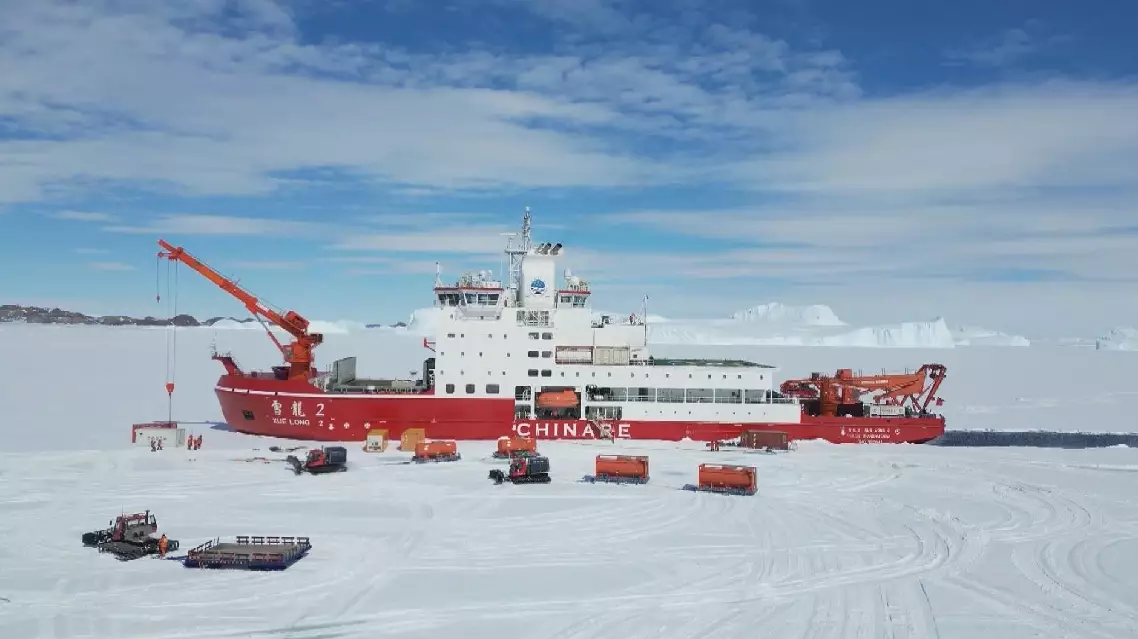
China's 42nd Antarctic Expedition team unloads supplies at Zhongshan Station