CHICAGO--(BUSINESS WIRE)--Oct 15, 2025--
Adtalem Global Education Inc. (NYSE: ATGE), the nation's largest healthcare educator, today announced the launch of the first comprehensive AI credentials program that will be designed specifically for healthcare professionals at scale, reaching students and practicing clinicians across its institutions and partner health systems. Through a strategic partnership with Google Cloud, Adtalem will deliver curriculum powered by Google Cloud's industry-leading AI technology, providing students with direct, hands-on experience with tools reshaping clinical practice.
This press release features multimedia. View the full release here: https://www.businesswire.com/news/home/20251015291770/en/
This comes at an important time. While healthcare organizations have invested billions in AI technologies to address capacity constraints and workforce shortages, only 28% of physicians feel prepared to leverage AI’s benefits while protecting patients from potential risks, and 36% of nurses cite a lack of knowledge on how to use AI-based technology and tools as a top concern. This AI readiness gap leaves healthcare systems unable to fully realize their technology investments precisely when they need them most.
"We're moving at the speed healthcare demands," said Michael Betz, Chief Digital Officer, Adtalem Global Education. "This partnership with Google Cloud gives our students a competitive edge in their careers—whether they're treating patients, providing mental health counseling or leading healthcare teams. Our graduates will enter the workforce confident in using AI to enhance their clinical decisions, spend less time on paperwork and more time connecting with patients. Healthcare providers are telling us they need professionals who can help drive responsible AI innovation and adoption, and our students will be ready to lead that change from day one."
The partnership will equip Adtalem with Google Cloud’s full AI-optimized tech stack, delivering the secure, compliant and scalable infrastructure vital for managing sensitive healthcare data, agentic systems and new pedagogical experiences. This differentiated AI stack features Google Cloud AI technologies and expertise, including Gemini, Google's advanced family of AI models, and Vertex AI services, to collaboratively develop a highly relevant and practical AI curriculum. This ensures students are equipped with the precise, in-demand skills required to drive innovation in healthcare.
“To unlock the true potential of AI in healthcare, we must empower the clinicians who use it," said Brent Mitchell, vice president, Google Public Sector. “By partnering with Adtalem, we're ensuring that both future and current healthcare professionals have the specialized knowledge to implement AI tools safely, responsibly and effectively in clinical practice. This partnership will help healthcare organizations unlock the full potential of their AI investments while maintaining the highest standards of patient care.”
The AI credentials program launches in 2026 with plans to expand across all Adtalem's institutions, including Chamberlain University, Walden University, American University of the Caribbean School of Medicine, Ross University School of Medicine and Ross University School of Veterinary Medicine —collectively serving over 91,000 students. Participants will complete specialized coursework covering AI applications in clinical practice, ethical considerations, patient safety protocols and hands-on experience with healthcare-specific AI tools commonly used across hospital systems and clinical practices.
Healthcare professionals seeking continuing education can access this same AI credentials program through the Adtalem institution of their choice, with flexible coursework built for working clinicians' schedules that delivers practical, job-ready skills.
This partnership advances Adtalem's strategy to become the clinical workforce partner of choice for healthcare providers nationwide. It combines Adtalem's deep expertise in clinical education with Google Cloud's AI technologies to create a comprehensive learning experience that prepares healthcare professionals to leverage AI as a tool for improving patient outcomes while maintaining human-centered care.
To see how Adtalem's AI initiatives address the healthcare workforce crisis, visit Adtalem.com/about-us/innovation and for more on how Google Cloud is driving innovation in education, visit goo.gle/higher-ed.
About Adtalem Global Education
Adtalem Global Education is the leading provider of healthcare education in the U.S., shaping the future of healthcare by preparing a dynamic workforce with high-quality academic programs. We innovate education pathways, align with industry needs and empower individuals to reach their full potential. Our commitment to excellence and access is reflected in our expansive network of institutions, serving over 91,000 students and supported by a strong community of approximately 365,000 alumni and over 10,000 dedicated employees. Visit Adtalem.com for more information and follow us on LinkedIn and Instagram.

Adtalem Global Education and Google Cloud Partner to Launch New AI Credentials Program for Healthcare Professionals
ADEN, Yemen (AP) — The United Arab Emirates said early Saturday it had withdrawn all its troops from Yemen.
The move comes after days of airlifts by UAE military aircraft following an order to withdraw from anti-Houthi forces in Yemen following Saudi Arabia pushing back against the advance of Emirati-backed separatists there.
“The UAE forces follows the implementation of a previously announced decision to conclude the remaining missions of counter-terrorism units,” a Defense Ministry statement said. “The process has been conducted in a manner that ensured the safety of all personnel and carried out in coordination with all relevant partners.”
THIS IS A BREAKING NEWS UPDATE. AP’s earlier story follows below.
ADEN, Yemen (AP) —
Yemen 's separatist movement on Friday announced a constitution for an independent nation in the south and demanded other factions in the war-torn country accept the move in an escalation of a confrontation that has pitted Gulf powerhouses Saudi Arabia and the United Arab Emirates against each other.
The UAE-backed Southern Transitional Council depicted the announcement as a declaration of independence for the south. But it was not immediately clear if the move could be implemented or was largely symbolic. Last month, STC-linked fighters seized control of two southern provinces from Saudi-backed forces and took over the Presidential Palace in the south's main city, Aden. Members of the internationally recognized government — which had been based in Aden — fled to the Saudi-capital Riyadh.
On Friday, Saudi warplanes bombed camps and military positions held by the STC in Hadramout province as Saudi-backed fighters tried to seize the facilities, a separatist official said. It was the latest direct intervention by Saudi Arabia, which in recent weeks has bombed STC forces and struck what is said was a shipment of Emirati weapons destined for the separatists.
Ostensibly, Saudi Arabia and the UAE and their allies on the ground in Yemen have all been part of a Saudi-led coalition fighting Iranian-backed Houthi rebels who control the north in the country's decade-long civil war. The coalition's professed goal has long been to restore the internationally recognized government, which was driven out of the north by the Houthis. But tensions between the factions and the two Gulf nations appear to be unraveling the coalition, threatening to throw them into outright conflict and further tear apart the Arab world's poorest country.
The head of the STC, Aidarous al-Zubaid, issued a video statement Friday saying that the constitution his group issued would be in effect for two years, after which a a referendum would be held on “exercising the right to self-determination for the people of the South.” During those two years, he said, the “relevant parties” in north and south Yemen should hold a dialogue on “a path and mechanisms that guarantee the right of the people of the South.”
He said that if the other factions don't agree to his call or if they take military action, “all options remain open.”
The 30-article “constitution” proclaimed the creation of “the State of South Arabia," covering the same territory of the former People’s Democratic Republic of Yemen, the independent southern state that existed from 1967-1990.
It seemed to be the most overt move yet by the STC toward its long-proclaimed goal of independence. In the confusion that has reigned in the south in recent weeks, it was not clear what practical impact it would have. But the declaration could set back efforts to avert an outright conflict between the separatists and the rest of the Saudi-led coalition.
The UAE’s Foreign Ministry said in a statement Friday that the country was dealing with the situation “with restraint, coordination, and a deliberate commitment to de-escalation, guided by a foreign policy that consistently prioritizes regional stability over impulsive action.”
The Saudi-led coalition in Yemen demands the withdrawal of the STC-linked Southern Shield forces from the two governorates they seized, Hadramout and Mahra, as part of de-escalation efforts. The STC has so far refused to hand over its weapons and camps.
Saudi-backed fighters, known as the National Shield Forces, advanced on two STC-camps in Hadramout, said a senior STC official, Ahmed bin Breik, a former governor of the province. The separatist forces refused to withdraw and in response, Saudi planes struck the camps, he said.
Mohamed al-Nakib, spokesperson for the STC-backed forces, said the strikes caused fatalities, without providing details. The Associated Press couldn’t independently verify that claim.
He told the AP later Friday that “intense clashes” erupted between his forces and the National Shield forces across several areas of Hadramout.
It was not clear if the Saudi-backed forces succeeded in retaking the camps.
Salem al-Khanbashi, the governor of Hadramout who was chosen Friday by Yemen's internationally recognized government to command the Saudi-led forces in the governorate, said the move to reclaim the camps was “not a declaration of war and is not seeking an escalation.” He said it was a “pre-emptive measure to remove weapons.”
In a post on X, the Saudi ambassador to Yemen, Mohammed al-Jaber, said the kingdom had tried “all efforts with STC” for weeks "to stop the escalation" and to urge the separatists to leave Hadramout and Mahra, only to be faced with “continued intransigence and rejection from Aidarous al-Zubaidi."
Al-Jaber said the STC had not permitted a Saudi delegation's jet to land in Aden, despite having agreed on its arrival with some STC leaders to find a solution that serves “everyone and the public interest.”
Yemen’s Transportation Ministry, aligned with STC, said Saudi Arabia on Thursday imposed requirements mandating that flights to and from Aden International Airport undergo inspection in Jeddah. The ministry denounced the decision. There was no confirmation from Saudi authorities.
ِA spokesperson with the transport ministry told the AP late Thursday that all flights from and to the UAE were suspended until Saudi Arabia reverses these reported measures.
Khaled reported from Cairo. Associated Press writer Bassem Mroue in Beirut contributed to this report.

Yemeni workers chat at a popular market in Sanaa, Yemen, Thursday, Jan. 1, 2026. (AP Photo/Osamah Abdulrahman)

A Southern Yemen soldier of Southern Transitional Council (STC) stands at a check point, in Aden, Yemen, Wednesday, Dec. 31, 2025. (AP Photo)
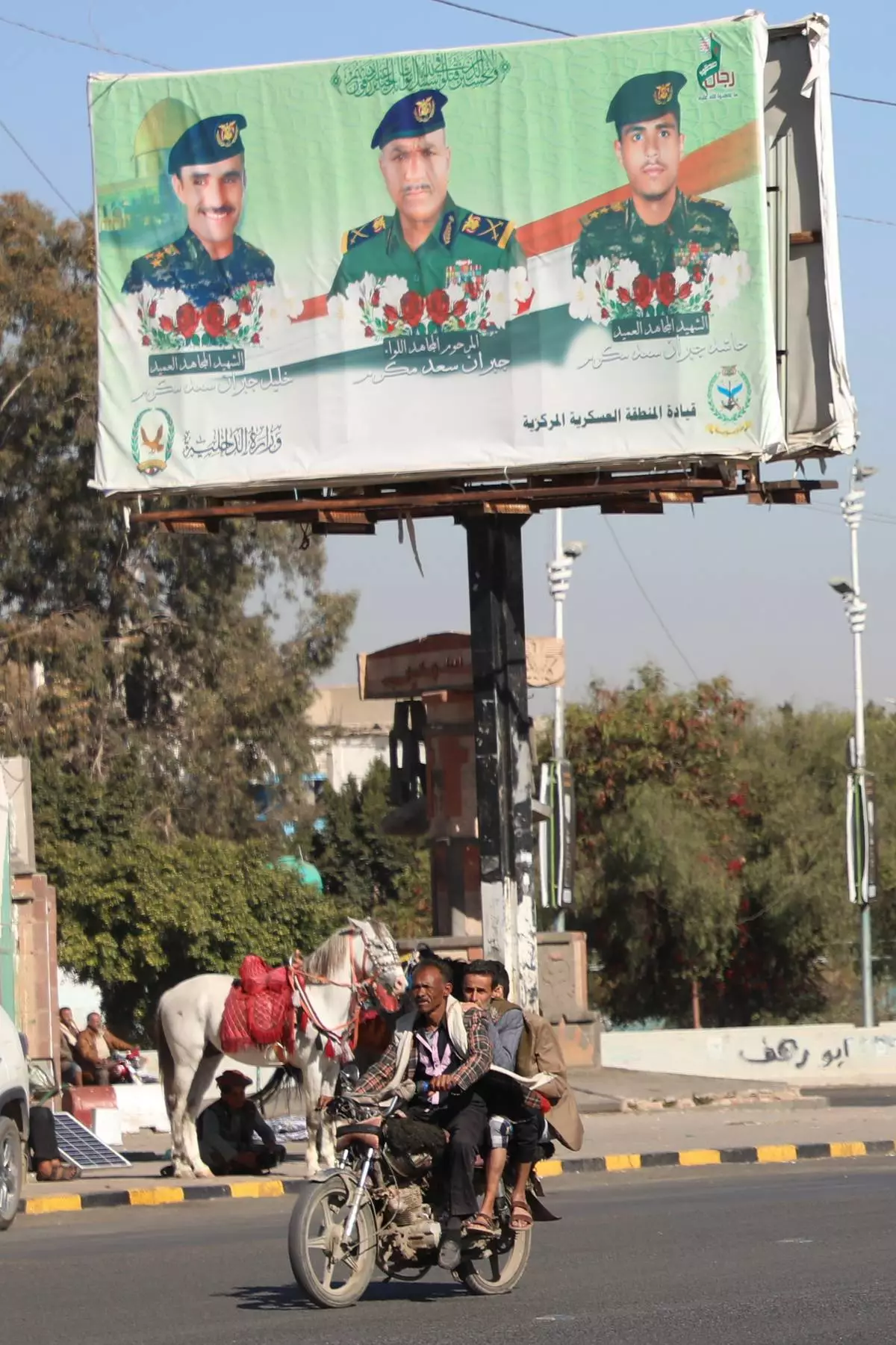
A Yemeni rides his motorbike under a banner honoring Houthi leaders who were killed during Israeli airstrikes, in Sanaa, Yemen, Thursday, Jan. 1, 2026. (AP Photo/Osamah Abdulrahman)

Supporters of the Southern Transitional Council (STC), a coalition of separatist groups seeking to restore the state of South Yemen, hold South Yemen flags during a rally, in Aden, Yemen, Friday, Jan. 2, 2026. (AP Photo)
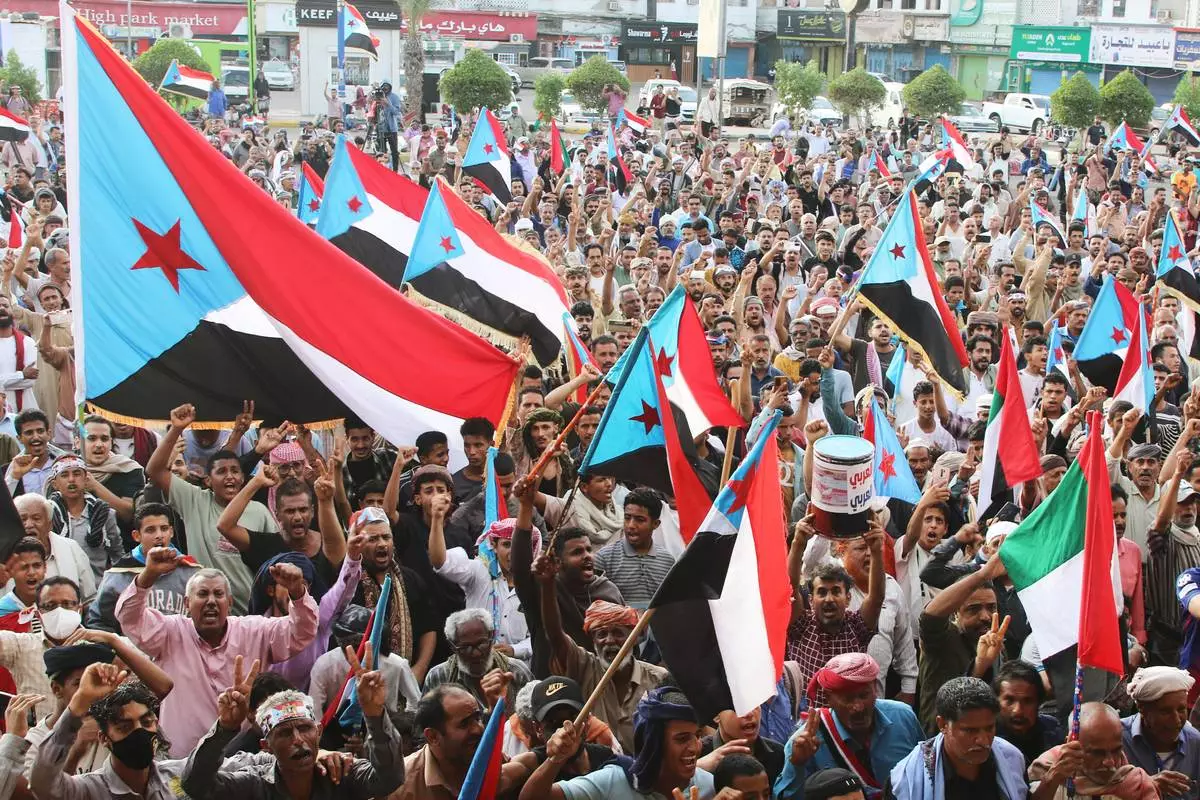
Supporters of the Southern Transitional Council (STC), a coalition of separatist groups seeking to restore the state of South Yemen, hold South Yemen flags during a rally, in Aden, Yemen, Friday, Jan. 2, 2026. (AP Photo)

Southern Yemen soldiers of Southern Transitional Council (STC) at a check point, in Aden, Yemen, Wednesday, Dec. 31, 2025. (AP Photo)