Skip to Content Facebook Feature Image

Big Tech is paying millions to train teachers on AI, in a push to bring chatbots into classrooms

ENT

Big Tech is paying millions to train teachers on AI, in a push to bring chatbots into classrooms
ENT

ENT

Big Tech is paying millions to train teachers on AI, in a push to bring chatbots into classrooms

2025-10-21 05:02 Last Updated At:05:10

SAN ANTONIO (AP) — On a scorching hot Saturday in San Antonio, dozens of teachers traded a day off for a glimpse of the future. The topic of the day’s workshop: enhancing instruction with artificial intelligence.

After marveling as AI graded classwork instantly and turned lesson plans into podcasts or online storybooks, one high school English teacher raised a concern that was on the minds of many: “Are we going to be replaced with AI?”

More Images
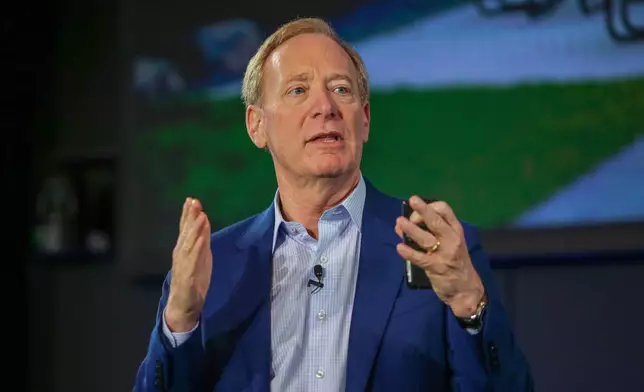
Microsoft Vice Chair and President Brad Smith speaks about the company's initiative to increase access to AI software and training for teachers and students across Washington on Thursday, Oct. 9, 2025 at the company's headquarters in Redmond, Wash. (AP Photo/Cedar Attanasio)
Microsoft Vice Chair and President Brad Smith speaks about the company's initiative to increase access to AI software and training for teachers and students across Washington on Thursday, Oct. 9, 2025 at the company's headquarters in Redmond, Wash. (AP Photo/Cedar Attanasio)

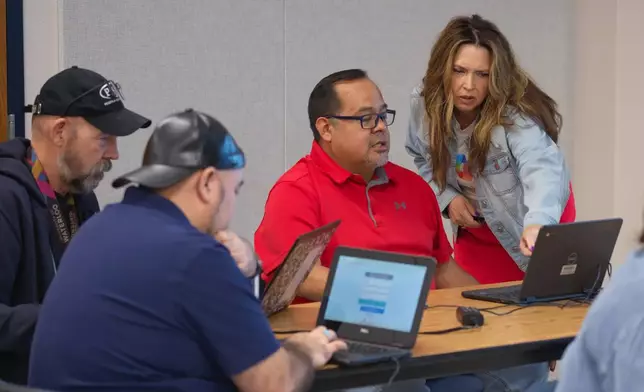
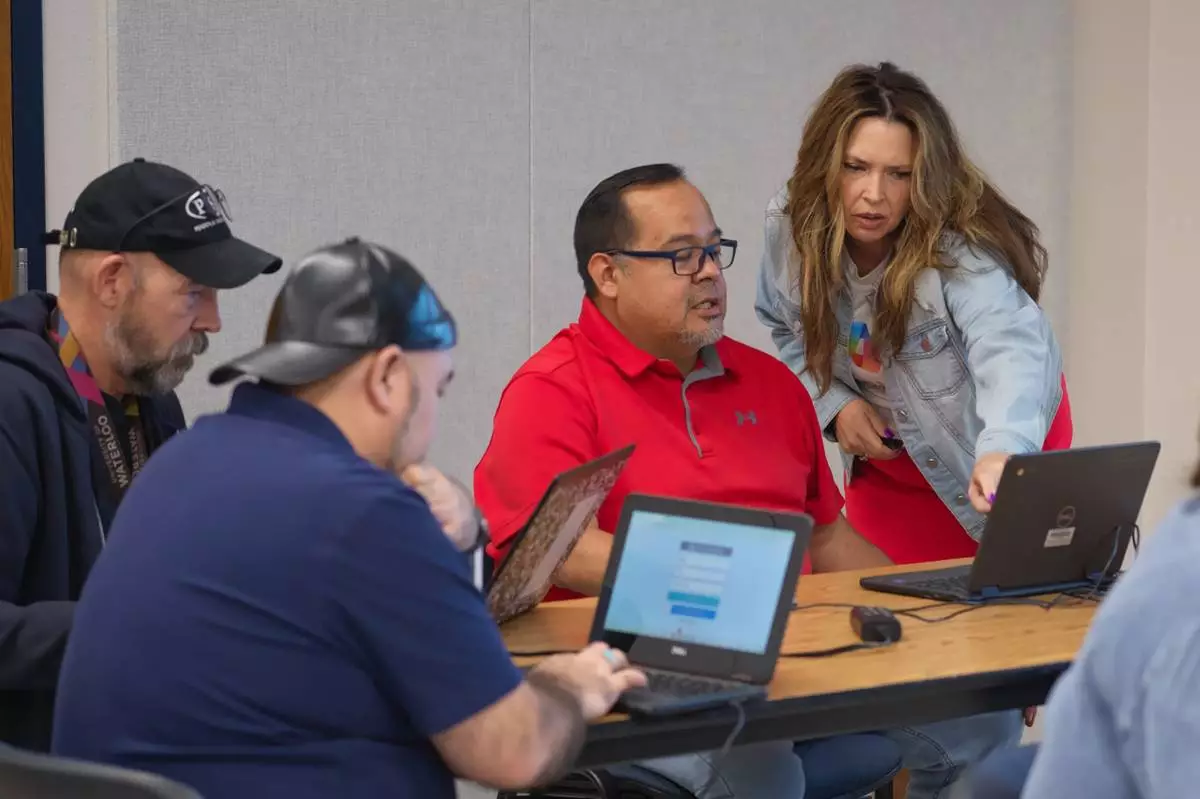
Dr. Geri Gillespy, Microsoft industry advisor, right, speaks with attendees during a Microsoft AI skilling event, Saturday, Sept. 27, 2025, in San Antonio. (AP Photo/Darren Abate)
Dr. Geri Gillespy, Microsoft industry advisor, right, speaks with attendees during a Microsoft AI skilling event, Saturday, Sept. 27, 2025, in San Antonio. (AP Photo/Darren Abate)
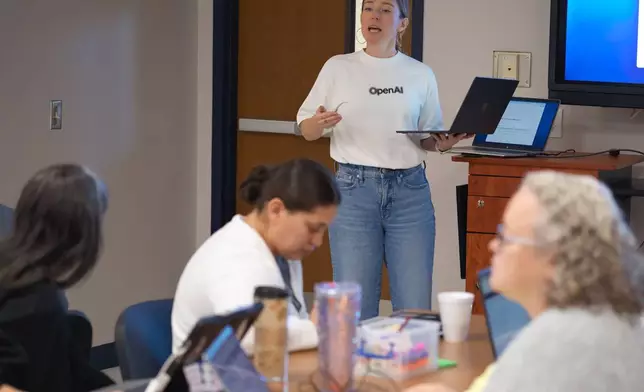
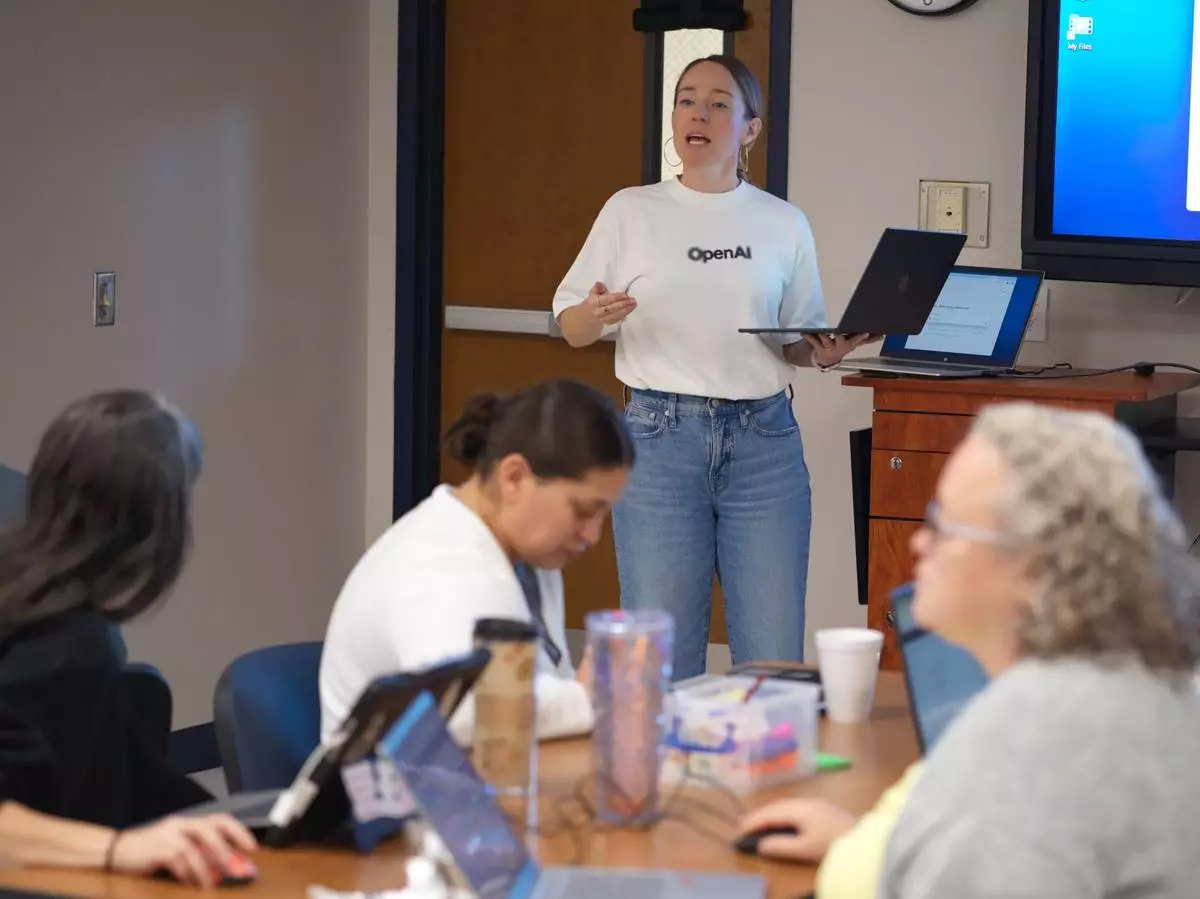
Natalie Cone, head of OpenAI Forum, center, speaks with attendees during a Microsoft AI skilling event, Saturday, Sept. 27, 2025, in San Antonio. (AP Photo/Darren Abate)
Natalie Cone, head of OpenAI Forum, center, speaks with attendees during a Microsoft AI skilling event, Saturday, Sept. 27, 2025, in San Antonio. (AP Photo/Darren Abate)

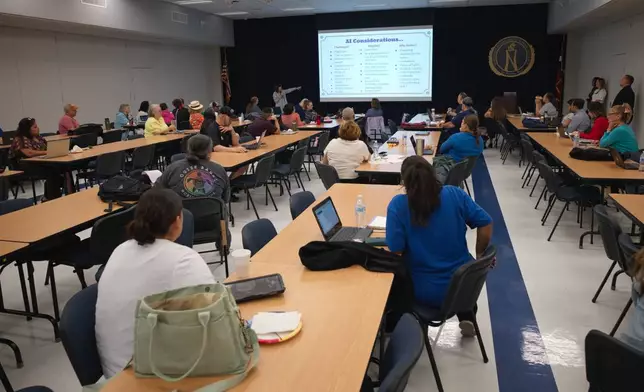
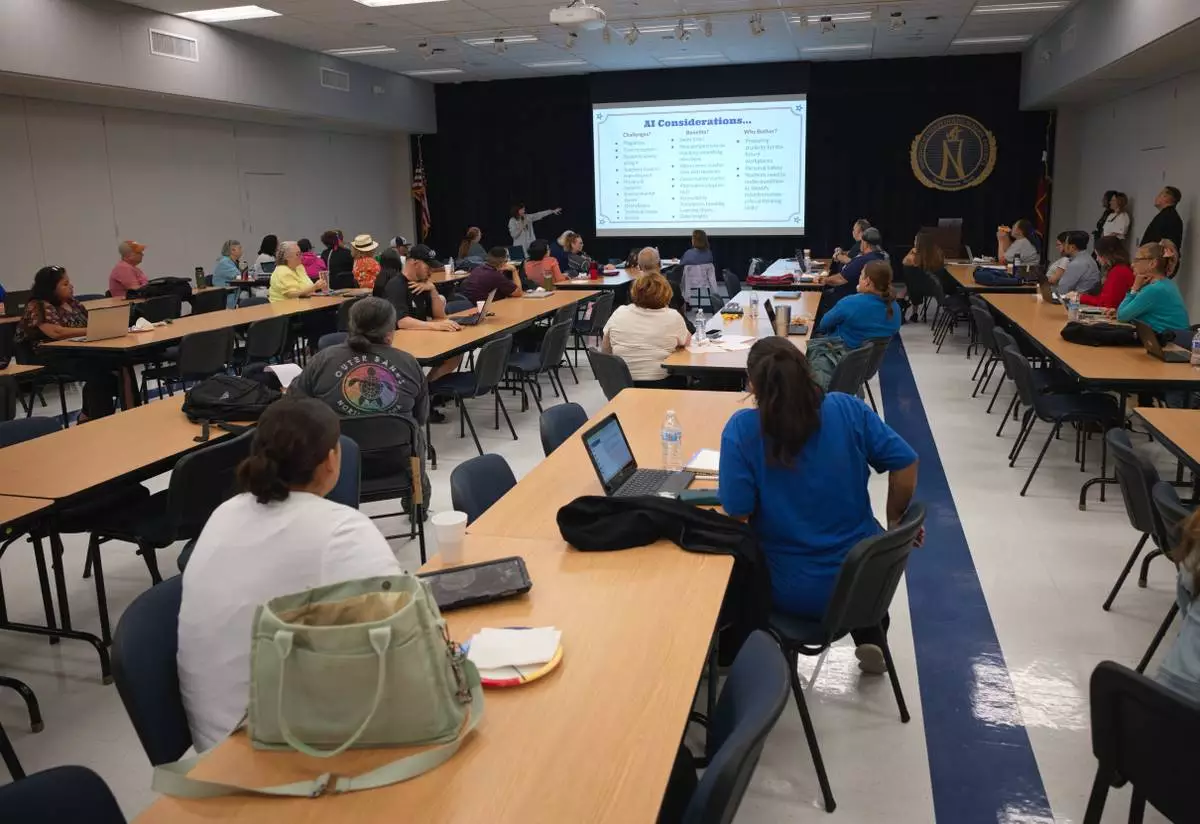
Kathleen Torregrossa, Ed.D, rear, lectures during a Microsoft AI skilling event, Saturday, Sept. 27, 2025, in San Antonio. (AP Photo/Darren Abate)

Kathleen Torregrossa, Ed.D, rear, lectures during a Microsoft AI skilling event, Saturday, Sept. 27, 2025, in San Antonio. (AP Photo/Darren Abate)

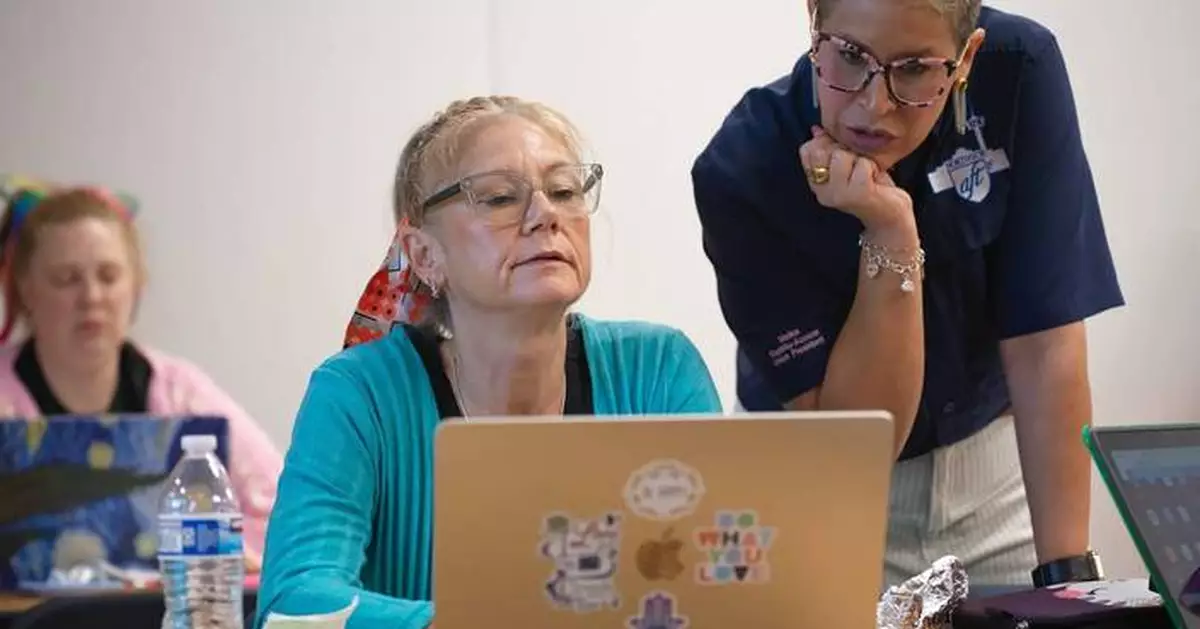
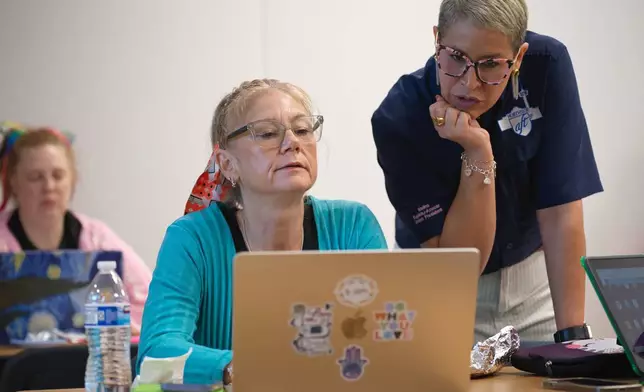
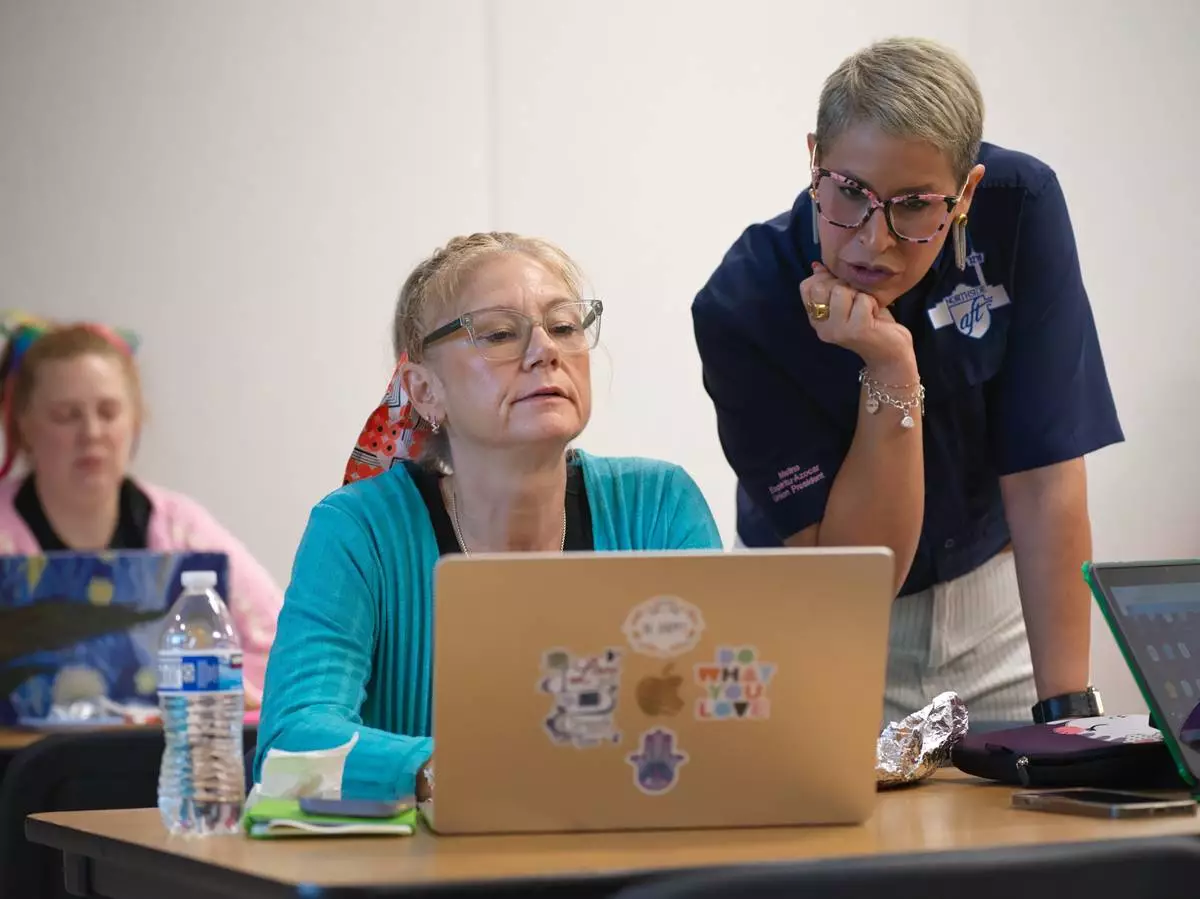
Northside American Federation of Teachers President Melina Espiritu-Azocar, right, speaks with middle school teacher Celeste Simone during a Microsoft AI skilling event, Saturday, Sept. 27, 2025, in San Antonio. (AP Photo/Darren Abate)

Northside American Federation of Teachers President Melina Espiritu-Azocar, right, speaks with middle school teacher Celeste Simone during a Microsoft AI skilling event, Saturday, Sept. 27, 2025, in San Antonio. (AP Photo/Darren Abate)

That remains to be seen. But for the nation’s 4 million teachers to stay relevant and help students use the technology wisely, teachers unions have forged an unlikely partnership with the world’s largest technology companies. The two groups don’t always see eye to eye but say they share a common goal: training the future workforce of America.

Microsoft, OpenAI and Anthropic are providing millions of dollars for AI training to the American Federation of Teachers, the country’s second-largest teachers union. In exchange, the tech companies have an opportunity to make inroads into schools and win over students in the race for AI dominance.

AFT President Randi Weingarten said skepticism guided her negotiations, but the tech industry has something schools lack: deep pockets.

“There is no one else who is helping us with this. That’s why we felt we needed to work with the largest corporations in the world,” Weingarten said. “We went to them — they didn’t come to us.”

Weingarten first met with Microsoft President and Vice Chairman Brad Smith in 2023 to discuss a partnership. She later reached out to OpenAI to pursue an “agnostic” approach that means any company's AI tools could be used in a training session.

Under the arrangement announced in July, Microsoft is contributing $12.5 million to AFT over five years. OpenAI is providing $8 million in funding and $2 million in technical resources, and Anthropic has offered $500,000.

With the money, AFT is planning to build an AI training hub in New York City that will offer virtual and in-person workshops for teachers. The goal is to open at least two more hubs and train 400,000 teachers over the next five years.

The National Education Association, the country’s largest teachers union, announced its own partnership with Microsoft last month. The company has provided a $325,000 grant to help the NEA develop AI trainings in the form of “microcredentials” — online trainings open to the union’s 3 million members, said Daaiyah Bilal, NEA’s senior director of education policy. The goal is to train at least 10,000 members this school year.

“We tailored our partnership very surgically,” Bilal said. “We are very mindful of what a technology company stands to gain by spreading information about the products they develop.”

Both unions set similar terms: Educators, not the private funders, would design and lead trainings that include AI tools from multiple companies. The unions own the intellectual property for the trainings, which cover safety and privacy concerns alongside AI skills.

The Trump administration has encouraged the private investment, recently creating an AI Education Task Force as part of an effort to achieve "global dominance in artificial intelligence.” The federal government urged tech companies and other organizations to foot the bill. So far, more than 100 companies have signed up.

Tech companies see opportunities in education beyond training teachers. Microsoft unveiled a $4 billion initiative for AI training, research and the gifting of its AI tools to teachers and students. It includes the AFT grant and a program that will give all school districts and community colleges in Washington, Microsoft’s home state, free access to Microsoft CoPilot tools. Google says it will commit $1 billion for AI education and job training programs, including free access to its Gemini for Education platform for U.S. high schools.

Several recent studies have found that AI use in schools is rapidly increasing but training and guidance are lagging.

The industry offers resources that can help scale AI literacy efforts quickly. But educators should ensure any partnership focuses on what’s best for teachers and students, said Robin Lake, director of the Center on Reinventing Public Education.

“These are private initiatives, and they are run by companies that have a stake,” Lake said.

Microsoft's Brad Smith agrees that teachers should have a “healthy dose of skepticism” about the role of tech companies.

“While it’s easy to see the benefits right now, we should always be mindful of the potential for unintended consequences,” Smith said in an interview, pointing to concerns such as AI’s possible impact on critical thinking. “We have to be careful. It’s early days.”

At the San Antonio AFT training, about 50 educators turned up for the three-hour workshop for teachers in the Northside Independent School District. It is the city's largest, employing about 7,000 teachers.

The day started with a pep talk.

“We all know, when we talk about AI, teachers say, ‘Nah, I’m not doing that,’” trainer Kathleen Torregrossa told the room. “But we are preparing kids for the future. That is our primary job. And AI, like it or not, is part of our world.”

Attendees generated lesson plans using ChatGPT, Google’s Gemini, Microsoft CoPilot and two AI tools designed for schools, Khanmingo and Colorín Colorado.

Gabriela Aguirre, a 1st grade dual language teacher, repeatedly used the word “amazing” to describe what she saw.

“It can save you so much time,” she said, and add visual flair to lessons. She walked away with a plan to use AI tools to make illustrated flashcards in English and Spanish to teach vocabulary.

“With all the video games, the cellphones you have to compete against, the kids are always saying, ‘I’m bored.’ Everything is boring,” Aguirre said. “If you can find ways to engage them with new technology, you’ve just got to do that.”

Middle school teacher Celeste Simone said there is no turning back to how she taught before.

As a teacher for English language learners, Simone can now ask AI tools to generate pictures alongside vocabulary words and create illustrated storybooks that use students' names as characters. She can take a difficult reading passage and ask a chatbot to translate it into Spanish, Pashto or other languages. And she can ask AI to rewrite difficult passages at any grade level to match her students' reading levels. All in a matter of seconds.

“I can give my students access to things that never existed before,” Simone said. “As a teacher, once you’ve used it and see how helpful it is, I don’t think I could go back to the way I did things before.”

This story was first published on Oct 17, 2025. It was re-published on Oct. 20, 2025, to show Brad Smith is the president and vice chairman of Microsoft, not the CEO.
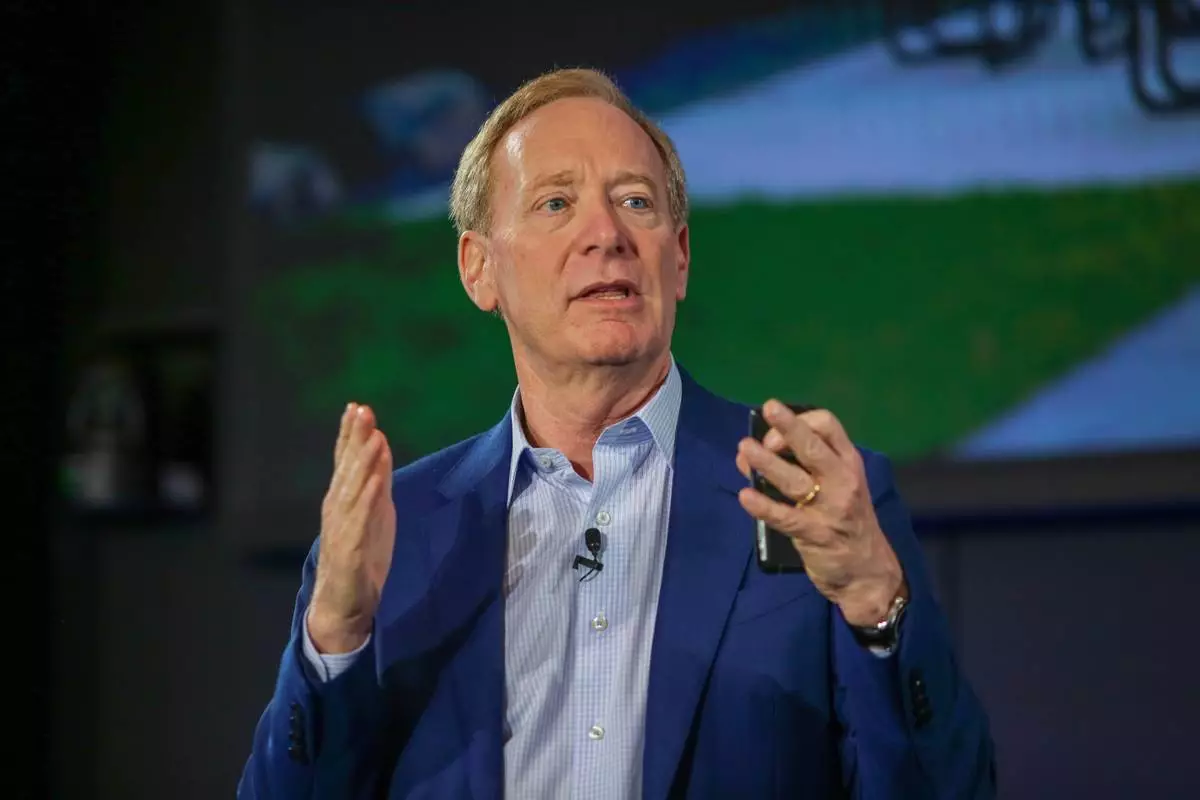
Microsoft Vice Chair and President Brad Smith speaks about the company's initiative to increase access to AI software and training for teachers and students across Washington on Thursday, Oct. 9, 2025 at the company's headquarters in Redmond, Wash. (AP Photo/Cedar Attanasio)
Microsoft Vice Chair and President Brad Smith speaks about the company's initiative to increase access to AI software and training for teachers and students across Washington on Thursday, Oct. 9, 2025 at the company's headquarters in Redmond, Wash. (AP Photo/Cedar Attanasio)

Dr. Geri Gillespy, Microsoft industry advisor, right, speaks with attendees during a Microsoft AI skilling event, Saturday, Sept. 27, 2025, in San Antonio. (AP Photo/Darren Abate)
Dr. Geri Gillespy, Microsoft industry advisor, right, speaks with attendees during a Microsoft AI skilling event, Saturday, Sept. 27, 2025, in San Antonio. (AP Photo/Darren Abate)
Natalie Cone, head of OpenAI Forum, center, speaks with attendees during a Microsoft AI skilling event, Saturday, Sept. 27, 2025, in San Antonio. (AP Photo/Darren Abate)
Natalie Cone, head of OpenAI Forum, center, speaks with attendees during a Microsoft AI skilling event, Saturday, Sept. 27, 2025, in San Antonio. (AP Photo/Darren Abate)
Kathleen Torregrossa, Ed.D, rear, lectures during a Microsoft AI skilling event, Saturday, Sept. 27, 2025, in San Antonio. (AP Photo/Darren Abate)
Kathleen Torregrossa, Ed.D, rear, lectures during a Microsoft AI skilling event, Saturday, Sept. 27, 2025, in San Antonio. (AP Photo/Darren Abate)
Northside American Federation of Teachers President Melina Espiritu-Azocar, right, speaks with middle school teacher Celeste Simone during a Microsoft AI skilling event, Saturday, Sept. 27, 2025, in San Antonio. (AP Photo/Darren Abate)
Northside American Federation of Teachers President Melina Espiritu-Azocar, right, speaks with middle school teacher Celeste Simone during a Microsoft AI skilling event, Saturday, Sept. 27, 2025, in San Antonio. (AP Photo/Darren Abate)

CINCINNATI (AP) — The Baltimore Ravens served notice that they have plenty of fight left as they pursue a third straight AFC North title.

The Ravens snapped a two-game losing streak and had what coach John Harbaugh said was their most complete game of the season as they blanked the Cincinnati Bengals 24-0 on Sunday.

Lamar Jackson threw for two touchdowns and the Baltimore defense sacked Joe Burrow three times. Kyle Van Noy and Alohi Gilman teamed up for a 95-yard pick-6 in the fourth quarter that served as the knockout punch, and Burrow was shut out for the first time in his six-year career.

“Complementary football in all three phases, coming off our best week of practice. We’ve had really good weeks of practice, very intentional weeks of practice, and this was another level,” Harbaugh said. “At this point in time, to see that is really what is impressive about these guys.”

The Ravens (7-7) won their fourth straight road game and pulled within a half-game of Pittsburgh in the AFC North. The Steelers host Miami on Monday night.

Baltimore avenged a 32-14 loss to the visiting Bengals on Thanksgiving night.

The Ravens shut out the Bengals for the fourth time. It was the first time the Bengals have been shut out since their 2017 opener, which was also against Baltimore.

“I think we were (ticked) off we lost to them the first time; I’m not going to lie,” Gilman said. "It was good to go out there and just put that on tape and let everyone know that we’re ready to roll.”

Jackson threw first-half TD passes to Rasheen Ali and Zay Flowers and finished 8 of 12 for 150 yards. Derrick Henry rushed for 100 yards on 11 carries, his sixth game of 100 or more this season.

Baltimore's offense was on the field for just 20:41, but scored on three straight drives late in the second quarter and early in the third.

“I believe all of us on offense had good rhythm. It felt like us, and we just have to keep pushing the envelope. We got positive yards and stayed ahead of the sticks,” Jackson said.

Cincinnati (4-10) — eliminated from playoff contention with the loss — drove into Baltimore territory four times but couldn't score.

“It starts with our offense getting shut out. Never saw that coming,” coach Zac Taylor said. “There’s a huge amount of accountability I have to take with that. It’s frustrating to score zero points. That’s unacceptable.”

Burrow completed 25 of 39 passes for 225 yards but went 4 of 10 for 59 yards and was picked off twice when under pressure. The game capped a frustrating week for Burrow, who earlier in the week said he wasn't having fun playing football.

“I mean, I think this is one of the worst games I've played. When your quarterback plays like that, your team is not going to have a chance to win,” said Burrow, who has thrown four interceptions in the last five quarters.

Ja’Marr Chase had 10 receptions for 132 yards.

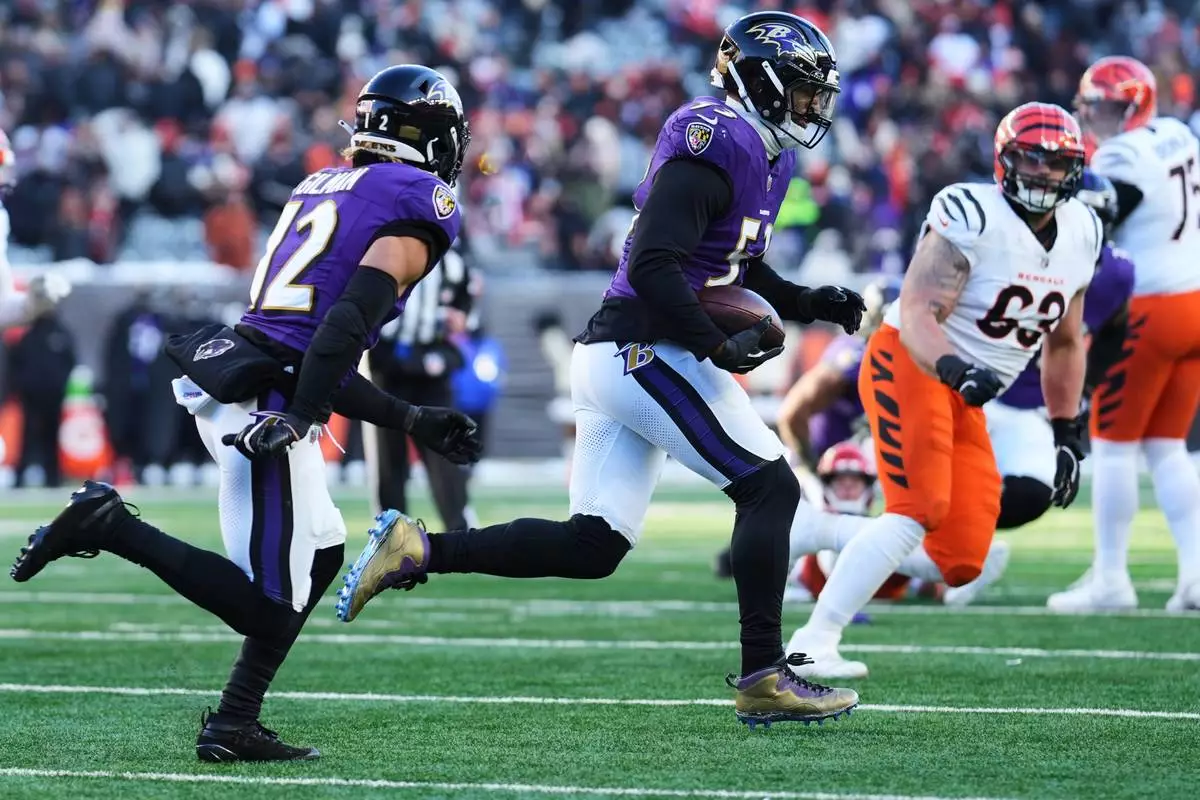
Midway through the fourth quarter, Burrow drove the Bengals to the Ravens 7. On third-and-goal, Burrow tried to avoid the rush of Baltimore linebacker Tavius Robinson when he was picked off by Van Noy at the 5. Van Noy handed it off at the 16 to Gilman, who went 84 yards up the right sideline for the first defensive touchdown of his five-year career.

Gilman said he wasn't surprised that Van Noy handed the ball off.

“I was actually yelling at him to pitch the ball after he caught it, so it worked out,” he said. “I saved some hamstrings for him. Put it on me. So, shout out to Kyle Van Noy. It was a great play.”

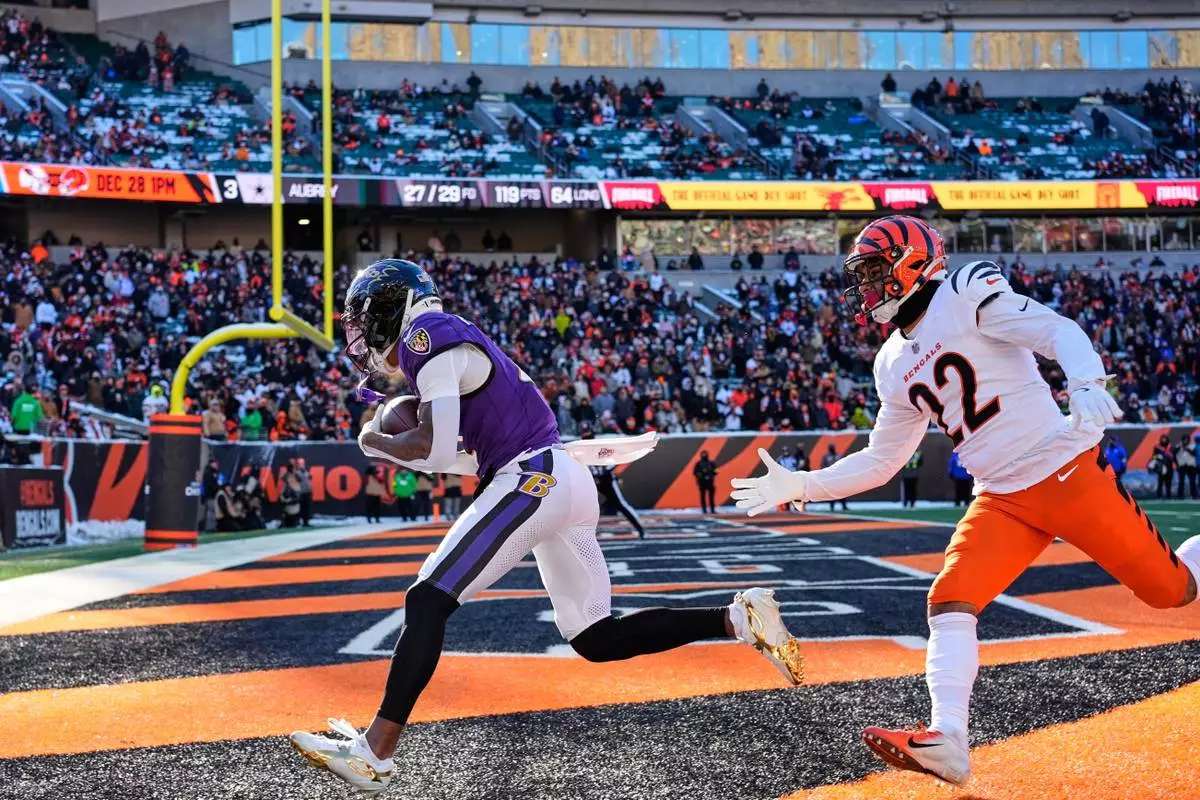
The Ravens extended their lead to 14-0 with 23 seconds left in the first half on Jackson's 28-yard strike to Flowers in the back left corner of the end zone. Bengals safety Geno Stone was late on coverage as the Ravens took only 42 seconds to go 80 yards in five plays.

On the second play of the drive, cornerback DJ Turner had a potential interception deflect off his facemask at the Bengals 17 when Jackson overthrew Mark Andrews.

“To get down there and to get the seven points, take it the 14, two-score game going into halftime — it was a huge drive,” Harbaugh said.

Ravens: LB Teddye Buchanan (knee) left in the first half. CB Chidobe Awuzie (foot) and CB Marlon Humphrey (knee) were injured in the second half. Humphrey returned to the game.

Bengals: WR Charlie Jones (right ankle) came out in the second quarter. TE Noah Fant (right ankle), DT Kris Jenkins Jr. (left ankle) and RT Amarius Mims (right knee) were injured in the second half and did not return.

Ravens: Host New England next Sunday night.

Bengals: At Miami next Sunday.

AP NFL: https://apnews.com/hub/nfl

Baltimore Ravens linebacker Kyle van Noy (53), with safety Alohi Gilman (12) running next to him, returns an interception during the second half of an NFL football game against the Cincinnati Bengals, Sunday, Dec. 14, 2025, in Cincinnati. (AP Photo/Jeff Dean)

Baltimore Ravens linebacker Kyle van Noy (53), with safety Alohi Gilman (12) running next to him, returns an interception during the second half of an NFL football game against the Cincinnati Bengals, Sunday, Dec. 14, 2025, in Cincinnati. (AP Photo/Jeff Dean)

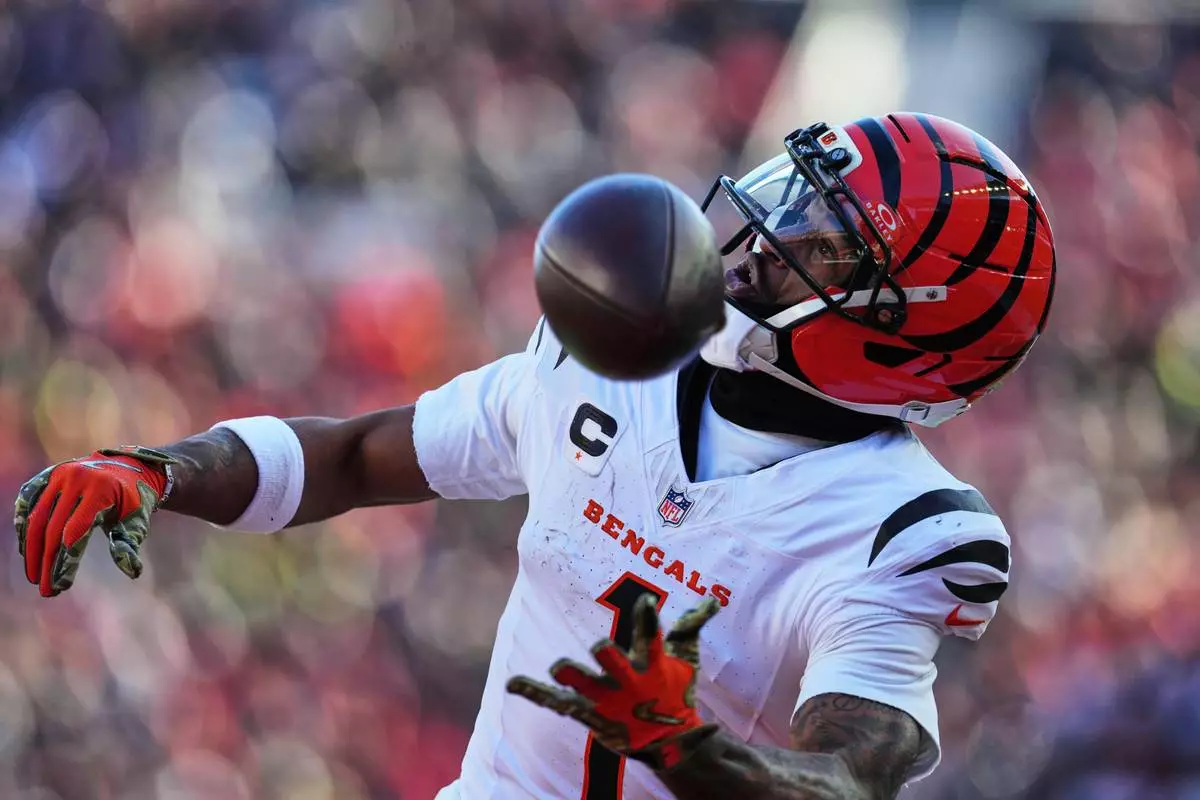
Cincinnati Bengals wide receiver Ja'Marr Chase (1) is unable to complete a pass during the first half of an NFL football game against the Baltimore Ravens, Sunday, Dec. 14, 2025, in Cincinnati. (AP Photo/Jeff Dean)

Cincinnati Bengals wide receiver Ja'Marr Chase (1) is unable to complete a pass during the first half of an NFL football game against the Baltimore Ravens, Sunday, Dec. 14, 2025, in Cincinnati. (AP Photo/Jeff Dean)

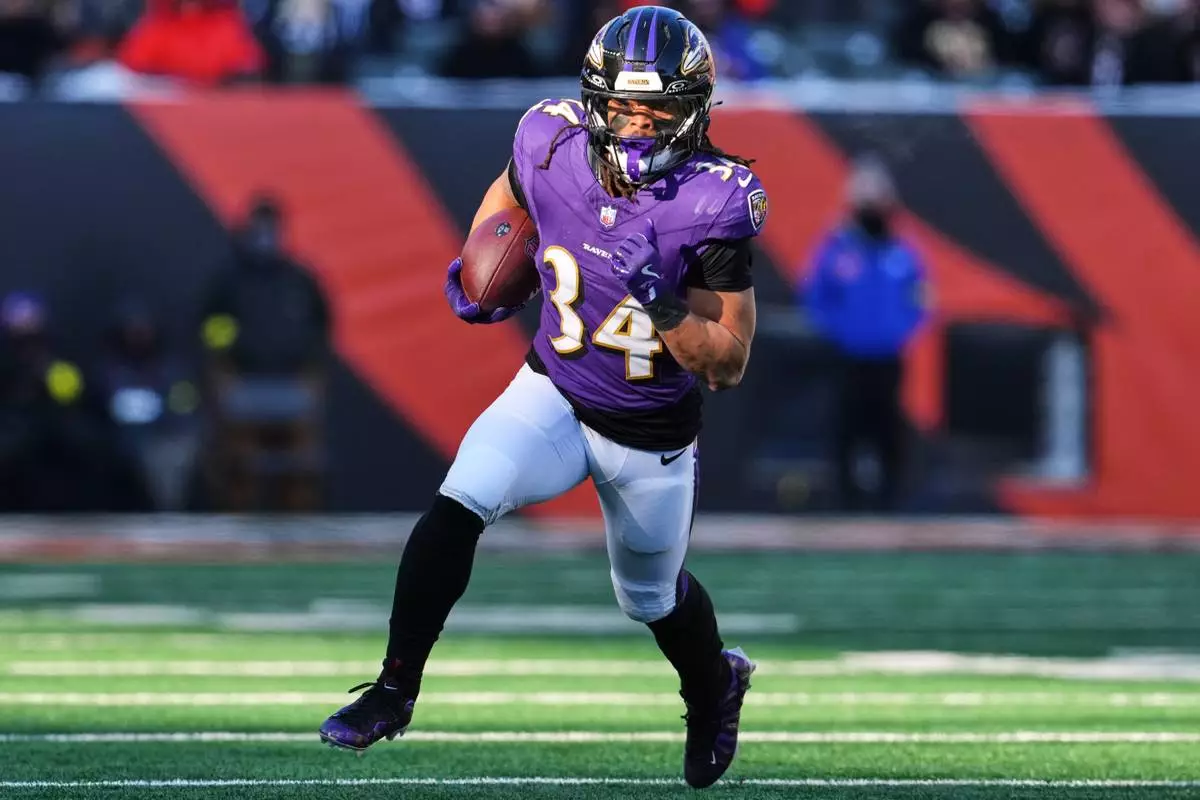
Baltimore Ravens running back Keaton Mitchell (34) runs the ball during the first half of an NFL football game against the Cincinnati Bengals, Sunday, Dec. 14, 2025, in Cincinnati. (AP Photo/Jeff Dean)

Baltimore Ravens running back Keaton Mitchell (34) runs the ball during the first half of an NFL football game against the Cincinnati Bengals, Sunday, Dec. 14, 2025, in Cincinnati. (AP Photo/Jeff Dean)

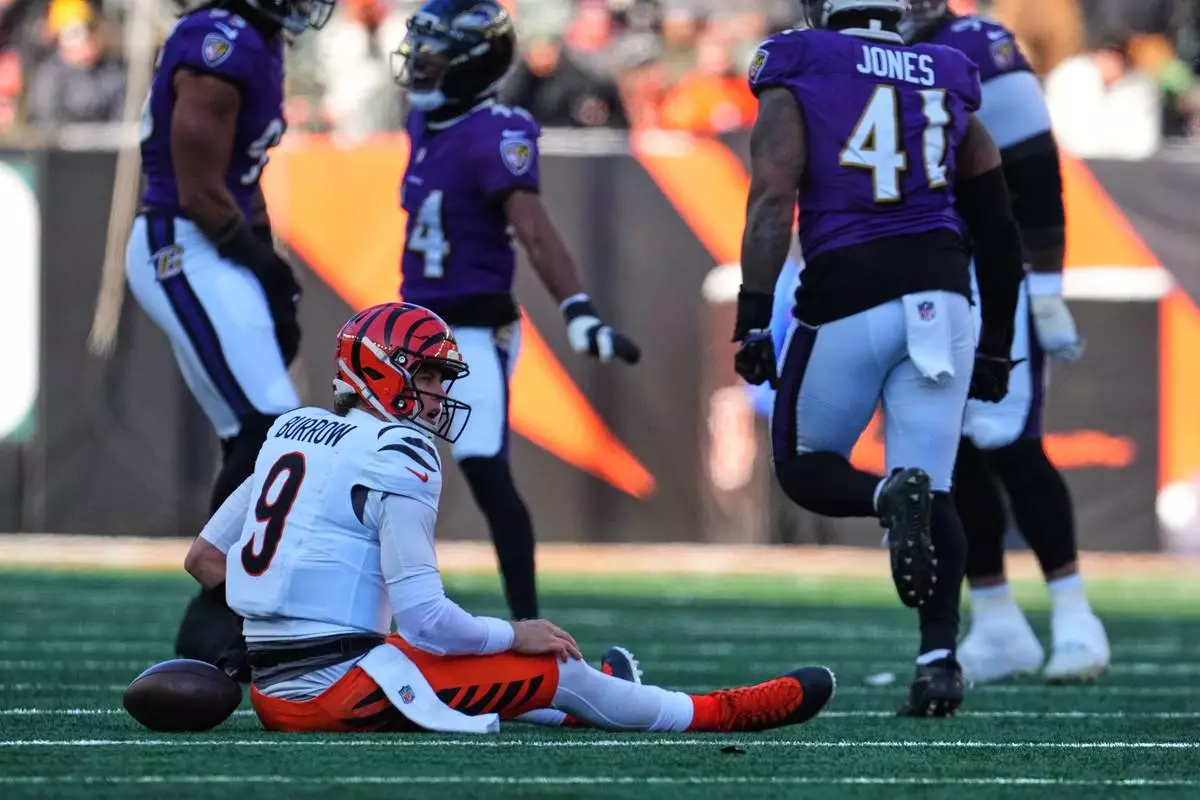
Cincinnati Bengals quarterback Joe Burrow (9) reacts after being sacked by Baltimore Ravens linebacker Tavius Robinson during the first half of an NFL football game, Sunday, Dec. 14, 2025, in Cincinnati. (AP Photo/Jeff Dean)

Cincinnati Bengals quarterback Joe Burrow (9) reacts after being sacked by Baltimore Ravens linebacker Tavius Robinson during the first half of an NFL football game, Sunday, Dec. 14, 2025, in Cincinnati. (AP Photo/Jeff Dean)

Baltimore Ravens wide receiver Zay Flowers, left, makes a catch for a touchdown past Cincinnati Bengals safety Geno Stone (22) during the first half of an NFL football game, Sunday, Dec. 14, 2025, in Cincinnati. (AP Photo/Carolyn Kaster)

Baltimore Ravens wide receiver Zay Flowers, left, makes a catch for a touchdown past Cincinnati Bengals safety Geno Stone (22) during the first half of an NFL football game, Sunday, Dec. 14, 2025, in Cincinnati. (AP Photo/Carolyn Kaster)

Recommended Articles