CAIRO (AP) — Iranian-backed Houthi rebels detained two dozen U.N. employees Sunday, a day after they raided another U.N. facility in the capital Sanaa, a U.N. official said.
Jean Alam, a spokesman for the U.N. resident coordinator for Yemen, told The Associated Press that the U.N. staffers were detained inside the facility in Sanaa’s southwestern neighborhood of Hada.
He said those detained Sunday include five Yemenis and 15 international staff. He said the rebels released another 11 U.N. staffers after questioning.
He said the U.N. was contact with the Houthis and other parties to “to resolve this serious situation as swiftly as possible, end the detention of all personnel, and restore full control over its facilities in Sanaa.”
A second U.N. official, speaking on condition of anonymity to discuss the raid, said the rebels confiscated all communications equipment from the facility, including phones, servers and computers.
The official said the detained employees belong to multiple U.N. agencies including the World Food Program, UNICEF and the Office for the Coordination of Humanitarian Affairs.
The Houthis have launched a long-running crackdown against the U.N. and other international organizations working in rebel-held areas in Yemen including Sanaa, the coastal city of Hodeida and the rebel stronghold in Sadaa province in northern Yemen.
Dozens of people, including over 50 U.N. staffers, have been detained so far. A World Food Program worker died in detention earlier this year in Sadaa.
The rebels have repeatedly alleged without evidence that the detained U.N. staffers and those working with other international groups and foreign embassies were spies. The U.N. fiercely denied the accusations.
The crackdown forced the U.N. to suspend its operations in Saada province in northern Yemen following the detention of eight staffers in January. The U.N. also relocated its top humanitarian coordinator in Yemen from Sanaa to the coastal city of Aden, which serves as seat for the internationally recognized government.

Houthi supporters dance as they celebrate following the announcement that Israel and Hamas have agreed to the first phase of a peace plan to pause the fighting, in Sanaa, Yemen, Friday, Oct. 10, 2025. (AP Photo/Osamah Abdulrahman)
President Donald Trump on Monday said he will defer to a federal appeals court on whether the administration moves ahead with plans to detonate several tons of degraded bomb-making material at an Iowa ammunition plant.
The detonation of 68 barrels of lead azide was initially planned for Friday, but the Army has since changed the date three times following an outpouring of public concern about potential health and environmental effects. They had planned for a detonation on Wednesday, saying the weather was most favorable that day.
The Army had no immediate comment when asked about the president’s social media post. Environmentalists sued last week in an effort to stop the detonation, winning a stay from the appeals court pending a decision on the validity of an emergency permit approved by the U.S. Environmental Protection Agency that cleared the way for the operation. Trump said he prefers to take care of the volatile material as soon as possible and that a controlled detonation would be much safer. “At the same time, have ordered the military not to do so until such time as the 8th Circuit agrees that we can go forward, and am further making this decision fully subject to the incoming Gov.-elect Rob Sand agreeing to the operation,” Trump said in a statement. If Sand and the court don’t agree, Trump said the administration will have no choice but to not proceed with the planned detonation, adding that he would hold the incoming governor responsible for “any and all death or destruction caused by this very unfortunate, and longterm, situation.”
Sand said in a social media post on Sunday that because of previous decisions that have already been made, “No good options exist and the situation is more dangerous and unpredictable than it ever should have been.”
He questioned why a contract to remove the explosive risk was canceled, why nothing was done and “why we are rushing to demolition now in late November.”
“The safety of Iowans should be the top priority of everyone involved,” he said. “All relevant federal, state and local government resources should be focused on protecting everyone that could be impacted.”
Some residents near Middletown, where the ammunition plant is located, have been sealing their windows and doors as a precaution to keep out any lead dust that might result from the detonation. Others who live farther away were raising concern on social media about the possible paths that the plume could take depending on shifts in the wind.
Officials acknowledge that lead is toxic and have recommended that people stay indoors whenever the detonation happens and to clean off outdoor surfaces with water afterwards to limit exposure to any lead particles.
In court filings over the weekend, Army Col. Aaron Teller, a munitions emergency response specialist, explained that less liquid inside the barrels means the solution inside is more susceptible to freezing, which increases the sensitivity of the crystals that have formed around the inside of the rim and underside of the lids.
“Even a small amount of friction can break the crystal formation, causing an explosive chain reaction,” he said in his declaration to the court.
In March, staff at the Iowa Army Ammunition Plant found several dozen barrels of degraded lead azide, which is used in munitions production. Crystallization of the material created an unstable and dangerous situation, prompting the Army to assemble experts in munitions chemistry, engineering and environmental safety to come up with a plan.
According to EPA documents, alternatives such as neutralizing and decomposing the drums’ contents with other chemicals were considered. But officials said handling the drums would increase the probability of an accidental, fatal detonation.
The environmental groups disagreed, arguing in their court filings that other alternatives were not fully considered. They also criticized officials for not sharing more information with the public.
Officials contend that the risk of an uncontrolled explosion is growing, particularly as temperatures drop. They said there is a risk that the chemicals may explode as temperatures are expected to drop below 30 degrees Fahrenheit (-1 Celsius) in the coming days.
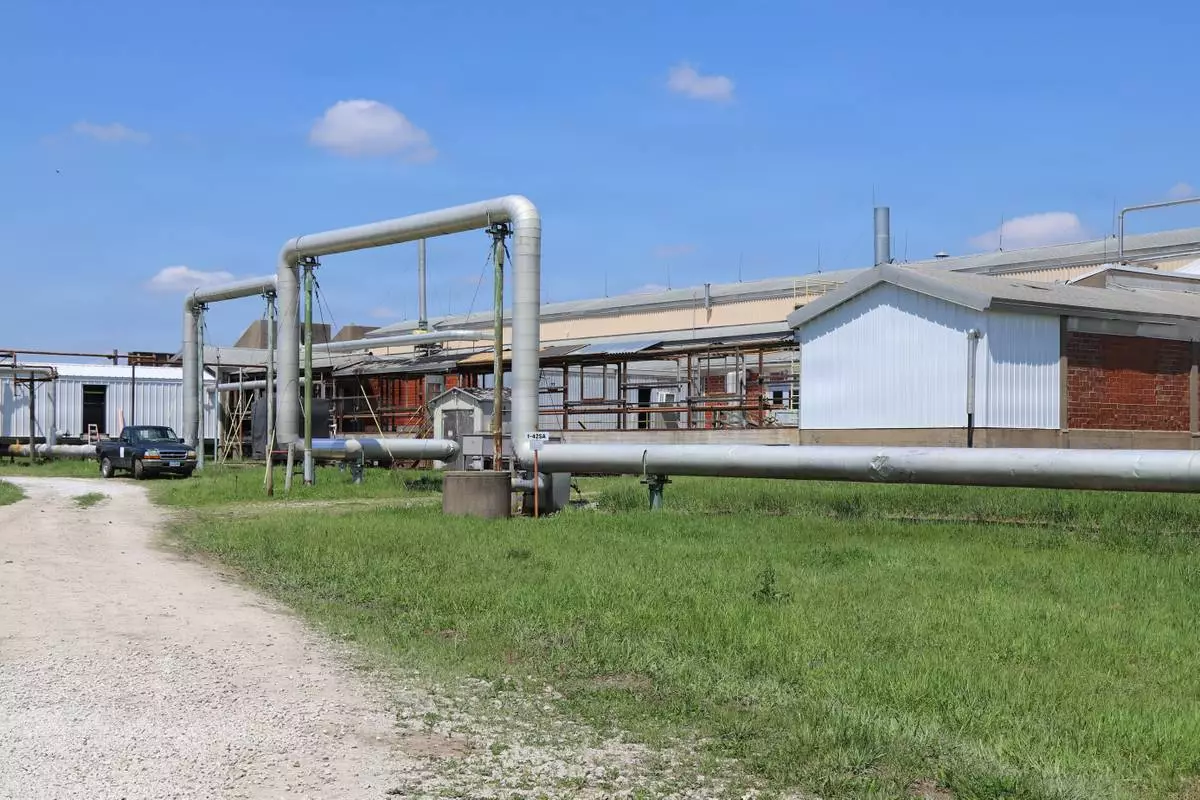
This photo provided by the U.S. Army shows the Iowa Army Ammunition Plant in Middletown, Iowa, on May 14, 2024. (Shawn Eldridge/U.S. Army via AP)