Preparation for the maiden flight of China's reusable rocket Zhuque-3 has entered a critical phase after the completion of joint fueling drills and static ignition tests from Saturday to Monday.
The successful tests also laid the groundwork for the rocket's official launch and first-stage recovery later this year.
With a diameter of 4.5 meters and a total length of around 66 meters, the Zhuque-3 rocket can carry up to 18 satellites per launch, making it an ideal choice for launching satellites for large-scale constellation networks.
Equipped with landing legs and grid fins for controlled descent, the rocket is designed to vertically recover its most expensive component -- the first stage, which accounts for 70 percent of the total rocket cost.
As its first stage is designed to be reused at least 20 times, the rocket has the potential to reduce launch costs by 80 to 90 percent compared with single-use rockets.
Powered by a parallel cluster of nine liquid oxygen-methane engines, the first-stage can achieve meter-level landing precision, as five of the engines are capable of gimballing.
In addition, these engines produce a combined thrust of more than 7,500 kilonewtons, setting a new record for Chinese commercial liquid-fueled rockets.
LandSpace, the rocket's developer, is a leading Chinese private space company.

Maiden flight preparation for China's reusable rocket Zhuque-3 enters critical phase
Uhas Sulayman, a model physician in Yumin County of northwest China's remote Xinjiang Uygur Autonomous Region, has devoted his career to safeguarding the health of local nomadic herders.
Sulayman was one of the eight recipients of the July 1 Medal, the Chinese Communist Party's highest honor, personally conferred by Xi Jinping, general secretary of the Communist Party of China (CPC) Central Committee, at a ceremony held in the Great Hall of the People in central Beijing on Wednesday morning.
For decades, Sulayman traveled through rugged mountains to provide medical care for herders in Yumin County.
"It was Dr. Uhas who brought me back from the brink of death. I'm 68 years old now, and I'm deeply grateful to him. Many of the people he saved have grown old or passed away, and he has delivered so many children here. He even delivered my brother's two kids. He is like family to us, and we respect him deeply," said Mushelbek Rahymbay, a local herder.
Since graduating in 1975, Sulayman turned down comfortable jobs in the city, choosing instead to serve these pastoral communities.
"The hospital told me back then that doctors were desperately needed in the pastoral areas and the herders had so many illnesses and hardships. So I said, 'I'll go.' The roads were terrible in those days. Most of the time, we had to walk for hours. In winter, the snow was so deep that we had to ride horses," he said.
Over the decades, Sulayman has treated over 100,000 patients and delivered more than 3,200 babies.
After retirement, he continues to serve at a health center in a community, offering free clinics three days a week.
Local herders speak of him with deep gratitude and affection. One of his patients recalled a life-threatening obstructed labor in the winter of 1987 and said he is a doctor that truly cares about people.
"When the baby was finally born, she was all purple and didn't make a sound. But Dr. Uhas didn't even hesitate, he just leaned right down and used his own mouth to suck the fluids out of her throat, bringing my baby back to life. He is a doctor who truly cares about people," said Algha Raykhan, a local herder, adding that the baby Sulayman saved is now a 39-year-old mother of four.
Sulayman knew that long-term healthcare could not rely on one man alone. In 2023, he launched a voluntary medical service project that has since grown into a 300-member team. Inspired by his spirit, a new generation has stepped up.
"I have been patrolling the pastures with him for 20 years. Seeing him -- day or night, in rain or snow -- always rushing to the herders whenever they needed him deeply moved me. His sense of responsibility inspired me to stay, take over his baton, and keep serving the herders," said Erjan Kukan, a pastoral doctor of the Yumin County Pastoral Hospital.
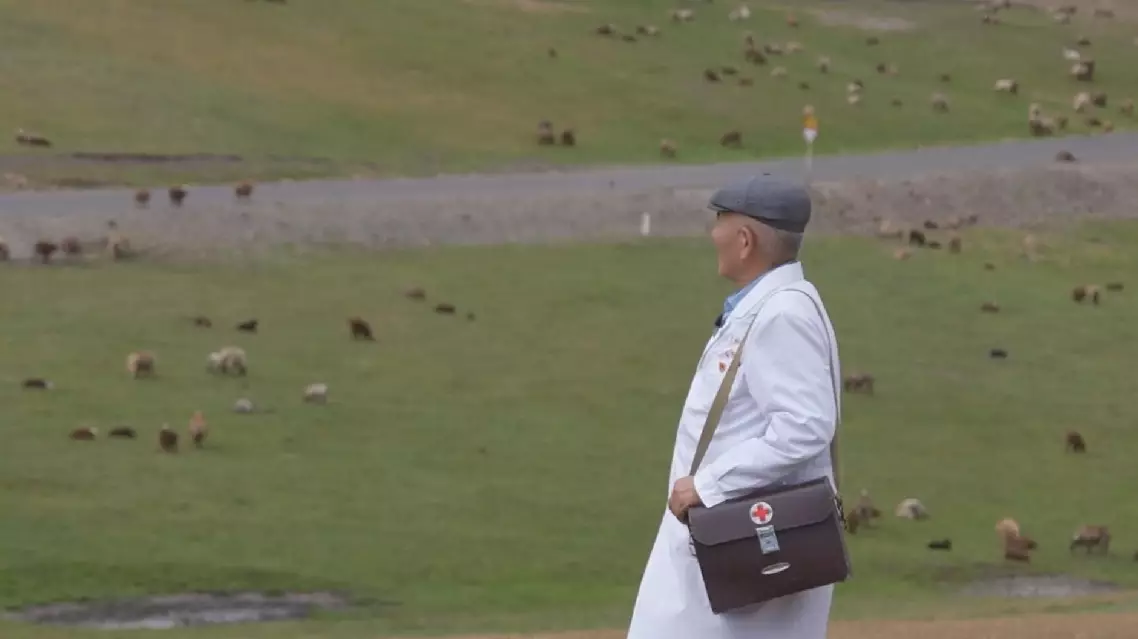
Model physician devoted to providing medical care for nomadic herders in northwest China's Xinjiang