JENBACH, Austria & HOUSTON, U.S.--(BUSINESS WIRE)--Oct 21, 2025--
INNIO Group today announced the largest order by power delivery in its history: a groundbreaking 2.3 GW power infrastructure project featuring 92 power packs, each delivering 25 MW of output. The initiative with VoltaGrid strengthens INNIO’s position as a key energy solutions provider for the rapidly expanding U.S. data center sector.
This press release features multimedia. View the full release here: https://www.businesswire.com/news/home/20251021503080/en/
“This landmark order underscores the strength of INNIO’s technology and our ability to power the AI revolution with smart, high-performance energy solutions,” said Dr. Olaf Berlien, President and CEO of INNIO Group. “We are proud to partner with VoltaGrid in shaping the energy infrastructure of tomorrow.”
“This is a major step toward building the energy infrastructure for the AI era,” added Nathan Ough, CEO of VoltaGrid. “Together with INNIO, we’re delivering a scalable solution that combines grid-grade performance with ultra-fast response, zero battery reliance, and near-zero criteria air emissions. Our partnership provides the speed, reliability, and sustainability required to power next-generation data centers.”
Developed in collaboration with VoltaGrid, INNIO’s advanced energy solution is engineered to accelerate data center deployment and maximize GPU performance for AI-driven operations. Powered by INNIO’s Jenbacher technology, the system provides prime, backup, and peak power within a single integrated platform—offering exceptional operational flexibility.
The solution maintains full power and efficiency even at ambient temperatures up to 122°F (50°C) and delivers superior transient performance, capable of handling highly volatile load fluctuations. We estimate that, compared to alternative technologies, it is up to 10 percentage points more efficient, enabling fuel savings of over USD 300 million annually across the 2.3 GW installed capacity.
About INNIO Group
INNIO Group is a leading energy solution and service provider that empowers industries and communities to make sustainable energy work today. With its Jenbacher and Waukesha product brands and its AI-powered myplant digital platform, INNIO Group offers innovative solutions for data center power infrastructure, distributed power generation, and compression applications. With its flexible, scalable, and resilient energy solutions and services, INNIO Group enables its customers to drive the energy transition across the energy value chain and ensures reliable energy supply even where the grid is not available.
For more information, visit INNIO Group’s website at innio.com. Follow INNIO Group on X and LinkedIn.
About VoltaGrid
VoltaGrid is a U.S.-based clean energy innovator delivering ultra-responsive, low-emission natural gas power solutions for data centers, industrial operations, and grid resiliency. Its proprietary platform combines industry-leading performance with modular, scalable deployment, making VoltaGrid a preferred partner for next-generation energy infrastructure.

INNIO Secures Largest Order in Company History (c) INNIO
SUNRISE, Fla. (AP) — Maybe the end for the Florida Panthers came when Brad Marchand was shut down for the season last month. Or maybe it was when Seth Jones broke his collarbone and wound up missing 26 games. Or, maybe it was 20 minutes into training camp, when captain Aleksander Barkov blew out his knee.
Nobody knows when the season was officially doomed.
Doesn't matter now. The Panthers are out.
Games remain, but the Panthers were mathematically eliminated from playoff contention on Saturday with a 9-4 loss in Pittsburgh. For the first time since 2022, a team other than Florida will represent the Eastern Conference in the Stanley Cup Final and for the first time since 2023, a team other than the Panthers will be the one hoisting the greatest chalice in sports.
They've known this was coming for a while. It's just official now.
“Obviously, no one’s happy about the situation," Panthers forward Sam Bennett said. "But it’s about really just sticking together as a team and going through this as a team. We're all sticking together. It's not fun sometimes. But we’re just trying to make the best of it.”
By the time the regular season ends in a couple of weeks, the Panthers will have gone well past the 500 man-games-missed mark this season because of injury. Barkov, the captain who Panthers coach Paul Maurice believes is the best player in the world, missed the entire year and a chance to captain Finland at the Milan Cortina Olympics as well.
Jonah Gadjovich will wind up missing 72 games with an upper-body injury. Tomas Nosek missed 60 games with a knee injury. Dmitry Kulikov is nearing 60 games missed, most with a shoulder injury and now a badly broken nose. Matthew Tkachuk missed 47 games while recovering from surgery to repair a sports hernia and torn adductor.
Cole Schwindt missed more than half the season with a pair of injuries. Marchand will miss 29 games and Jones missed 26. Niko Mikkola, Evan Rodrigues, Sam Reinhart, Uvis Balinskis and Anton Lundell were all shut down for the season at least a couple of weeks ago. Aaron Ekblad broke a finger this week and he won't play until next season.
And it was no laughing matter at the time, but Eetu Luostarinen missed nine games — after getting burned while barbecuing.
“I'd say we had some adversity,” Maurice said.
Add it all up, and Florida is likely going to finish the season with no more than eight players who dressed in last year's Cup-clinching win against Edmonton on the ice. The Panthers bent, bent, bent all season, and finally broke.
“They’ve been true to it," Maurice said, speaking of the team's culture. "And we’ve had some tough nights, but the bench has been right and they’re cheering for each other. They’re engaged in the game. They’re talking about the game. It’s just, you’re just not going to be able to produce, not going to be able to execute a whole bunch of things that you normally expect to.”
Put simply, the Panthers might just need a break.
They were in 67 playoff games over the last three seasons, the most in the NHL — and unbelievably, more than 17 other franchises played in that span combined. They've logged tons of miles, taken tons of hits and done it all with very short offseasons because their Cup runs kept stretching into June while non-playoff teams are done in April.
“I think we all know ... how good this hockey team is," Bennett said. “We know how good we're going to be when we have everyone healthy and everyone back. So, there’s obviously a ton of excitement, I think, in anticipation for next year.”
With good reason. Hockey operations president and general manager Bill Zito has had the vast majority of the core under contract for some time: Barkov, Tkachuk, Reinhart, Bennett, Marchand, Carter Verhaeghe, Jones, Ekblad, Gustav Forsling, Lundell, Rodrigues, Mikkola, Kulikov, Balinskis, Reinhardt and Jesper Boqvist are among those who are signed. The biggest question is at goalie, where Sergei Bobrovsky will be a free agent, but one who is believed to want to remain with the Panthers.
All that talk can wait, at least for a couple more weeks.
“We're just focused on this year,” Jones said after the loss Saturday.
Things, if the Panthers are lucky, should look very different next season. Or put another way, things could look like how they were in June 2024 and June 2025, when Florida won the Cup. The celebrations started like this: NHL Commissioner Gary Bettman would say a few words, then hand the Cup to Barkov, who would skate away and hoist.
The Panthers felt like that could have happened again this season. For about 20 minutes, anyway. It was at the 20-minute mark of the first full-team training camp practice where Barkov blew out the ACL and MCL in his knee.
“You know right away. Oh, you knew it was bad," Maurice said. “He's a tough one. He doesn’t go down lightly. It was as close to being at a funeral as there can be. The 19th minute, we are humpin', up and down the ice. And I’m taking it all in thinking, ‘Oh, we’re right there. These guys are focused, they’re fit, they’re pushing themselves. I’m not even yelling at them anymore.’ And then that happens.
“The next three days were a prolonged funeral service,” Maurice added. “We didn’t know it was going to be for our season.”
If the Panthers were in the playoff chase, Barkov might be playing now. If there was a Game 1 of Round 1 sometime in the next couple weeks, the expectation is Barkov would have been ready. And now, the Panthers will pivot to Game 1 of next season.
They won't be the defending Cup champions anymore. It might actually rekindle the desire to win it again.
“Bill Zito’s vision for this team has just been so bang on," Maurice said. "We have full faith in the vision that he has for the group, and the core is going to be here next year. We'll all be excited about that.”
AP NHL: https://apnews.com/hub/nhl
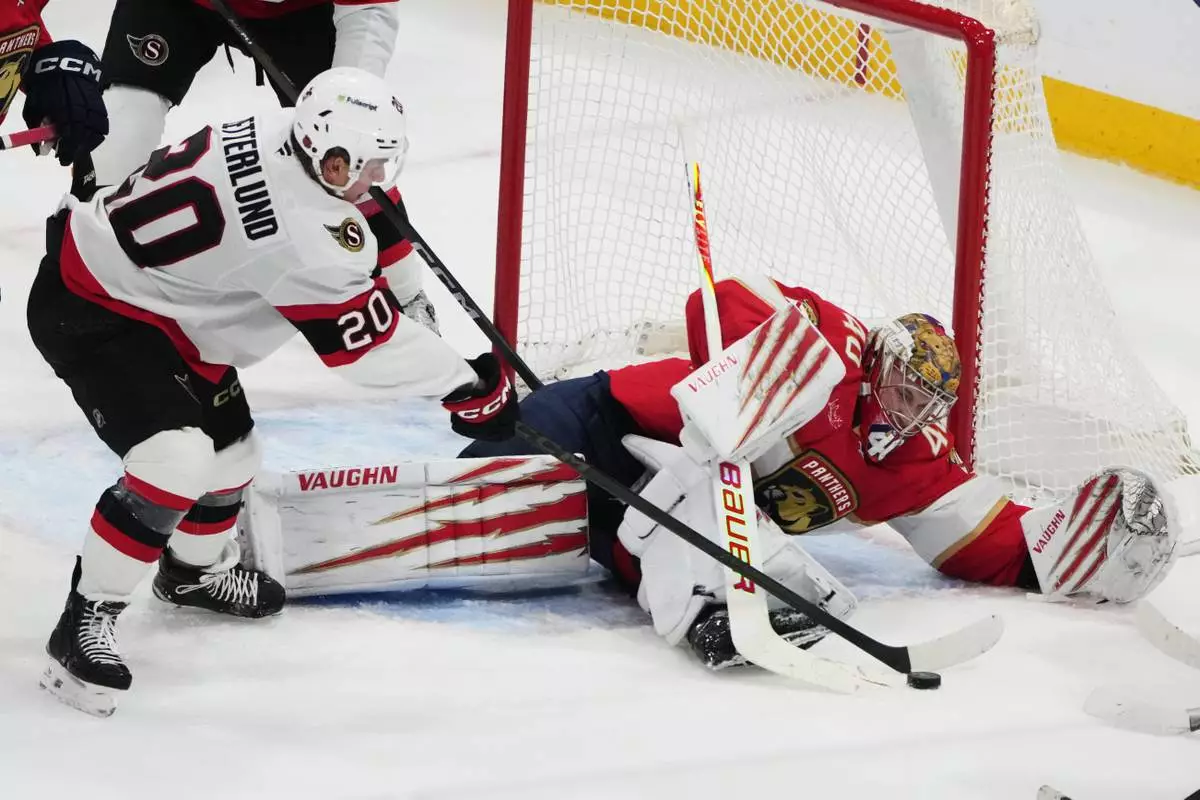
Florida Panthers goaltender Daniil Tarasov (40) defends the goal against Ottawa Senators left wing Fabian Zetterlund (20) during the third period of an NHL hockey game, Tuesday, March 31, 2026, in Sunrise, Fla. (AP Photo/Lynne Sladky)
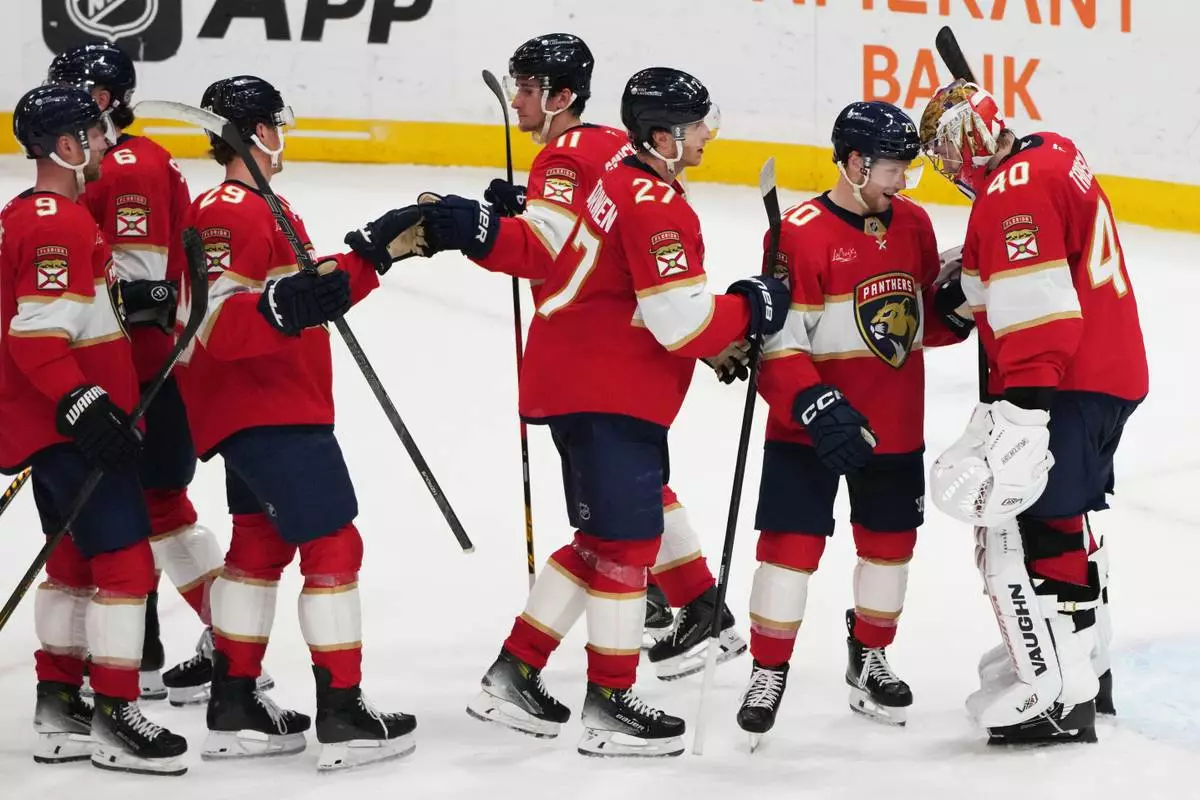
Florida Panthers goaltender Daniil Tarasov (40) is congratulated after the Panthers defeated the Ottawa Senators in an NHL hockey game, Tuesday, March 31, 2026, in Sunrise, Fla. (AP Photo/Lynne Sladky)

Florida Panthers left wing Matthew Tkachuk skates on the ice after being named the first star of the game after an NHL hockey game against the Ottawa Senators, Tuesday, March 31, 2026, in Sunrise, Fla. (AP Photo/Lynne Sladky)