WASHINGTON--(BUSINESS WIRE)--Oct 21, 2025--
Searching for your next great escape or inspiration for an upcoming adventure? National Geographic today revealed its top picks for BEST OF THE WORLD, the brand’s annual list of the most awe-inspiring, meaningful and immersive travel experiences for the upcoming year.
This press release features multimedia. View the full release here: https://www.businesswire.com/news/home/20251021909487/en/
Drawing on the expertise of its editors, travel contributors and international partners, National Geographic’s BEST OF THE WORLD 2026 is the definitive guide to the top destinations to visit in 2026. From Rwandan safaris to Pittsburgh museums, this year’s edition encourages readers to rethink how they travel, embracing deeper connections with nature, culture and communities. The selections span the globe — from the Philippines to Finland — and include four U.S. locations.
Designed as a curated selection of options to inspire travelers, BEST OF THE WORLD 2026 includes something for everyone: families, foodies, animal lovers, adventurers and more. This year’s list stands apart by featuring destinations that celebrate distinctive cultural moments, one-of-a-kind events and experiences, awe-inspiring natural wonders and sustainable travel. Whether exploring the Badlands or touring the “snow monsters” of the Zao mountains in Japan, this year’s selections offer a diverse range of options that cater to both seasoned explorers and first-time adventurers.
“At Nat Geo, we know that travel has the power to inspire and transform us,” said Nathan Lump, editor-in-chief of National Geographic. “In this year’s BEST OF THE WORLD, we especially wanted to highlight unexpected destinations that the algorithms are probably not serving you — for instance, Uzbekistan’s Khiva or Rwanda’s Akagera National Park. Of course, we know that not every trip can be an off-the-beaten-path adventure, so we were mindful to include some surprisingly compelling places that are also more easily accessible. Whatever kind of traveler you are, our goal is to ensure we’re sharing fresh ideas that help you connect with that feeling of discovery and joy that comes from a great travel experience.”
National Geographic also celebrated the launch on social media with a “Readers’ Choice” campaign in the weeks leading up to this year’s BEST OF THE WORLD announcement. @NatGeoTravel invited audiences to share their favorite travel destination recommendations in the lead-up to the full list reveal. Over the last few weeks, @NatGeoTravel followers have nominated hundreds of destinations and ultimately voted for Cinque Terre, Banff, Taipei and the Atacama Desert in Chile as the four finalists. Audiences officially named Banff, Canada, as the Readers’ Choice winner, which is highlighted on this year’s list at NatGeo.com/BestOfTheWorld.
BEST OF THE WORLD 2026 can be found online now at NatGeo.com/BestOfTheWorld, where readers can be transported to each destination through striking photography and immersive reporting.
Visuals are available here. To follow the conversation on social, use #BestoftheWorld.
About National Geographic Content
Representing the largest brand on social media with over 780 million followers and 1.1 billion impressions each month, National Geographic Content's award-winning and critically acclaimed storytelling inspires fans of all ages to connect with, explore and care about the world through factual storytelling. National Geographic Content, part of a joint venture between The Walt Disney Company and the National Geographic Society, reaches over 532 million people worldwide in 172 countries and 33 languages as a digital, social and print publisher and across the global National Geographic channels (National Geographic Channel, Nat Geo WILD, Nat Geo MUNDO), National Geographic Documentary Films, and direct-to-consumer platforms Disney+ and Hulu. Its diverse content includes Oscar®- and BAFTA award-winning film Free Solo, Oscar-nominated films Sugarcane, Fire of Love and Bobi Wine: The People's President, Emmy® Award-winning franchise 9/11: One Day in America and JFK: One Day in America, Emmy® Award-winning series Animals Up Close, series Trafficked with Mariana van Zeller, Life Below Zero and Secrets of the Whales, in addition to multiple National Magazine Awards, Pulitzer Prize Finalists and Webby wins. Visit nationalgeographic.com and natgeotv.com or explore Instagram, Threads, Facebook, LinkedIn, YouTube, TikTok and Reddit.

Sports fans heading to the 2026 Winter Olympics, hosted primarily in Italy’s Dolomite Mountains, should consider exploring beyond the venues to take in picturesque scenery such as Lago di Braies (Lake Braies) in the Tyrol. (Photo by Chris Burkard, Verb Photo)
OKLAHOMA CITY (AP) — Shai Gilgeous-Alexander isn't scoring the way he usually does, but the Oklahoma City Thunder are still winning the way they normally do.
Gilgeous-Alexander, the reigning NBA MVP, averaged 31.1 points during the regular season. In the Western Conference semifinals against the Los Angeles Lakers, he is averaging 20 points and taking only 14 shots per game.
Oklahoma City has still won the first two games by an average of 18 points. Gilgeous-Alexander and Chet Holmgren each scored 22 points, and the defending champion Thunder beat the Lakers 125-107 on Thursday night.
Ajay Mitchell, starting in place of injured Jalen Williams, is averaging 19 points on 50% shooting in the series for Oklahoma City.
“I think the coaching staff does a good job at just getting all of us ready,” said Mitchell, a second-year guard. "And we have a lot of competitors. Like, everyone’s a competitor on our team. So every time the lights are bright, everyone’s ready to go.”
Holmgren is the leading scorer for the Thunder in the best-of-seven series with 23 points per game. The 2026 All-Star also is averaging 10.5 rebounds and 2.5 blocks.
Jared McCain, a midseason acquisition from the Philadelphia 76ers, barely played in the first round against Phoenix but has averaged 15 points and made 8 of 10 3-pointers in the series.
“He goes in there, stays in character, stays aggressive," Thunder coach Mark Daigneault said. "He’s going to shoot the next shot. He makes the right plays, plays inside the team. He competes defensively, has had good defensive possessions for us. And he was huge tonight. You need that in a playoff series.”
The Lakers again were without scoring champion Luka Doncic, who is out indefinitely with a strained left hamstring. They also were missing forward Jarred Vanderbilt, the reserve forward who dislocated the pinkie on his right hand during the second quarter of Game 1. The Lakers had three players finish with five fouls, limiting their aggressiveness late in the game.
Los Angeles guard Austin Reaves, who struggled with his shot in Game 1, scored 31 points on 10-for-16 shooting in Game 2. LeBron James, coming off a 27-point effort in Game 1, followed that up with 23.
With the Lakers up 63-61 early in the third quarter, Gilgeous-Alexander got tied up with Reaves and was called for his fourth foul. Upon review, it was upgraded to a flagrant 1 for Gilgeous-Alexander's follow through. Oklahoma City's Alex Caruso was called for a technical foul as the situation was being sorted out.
Gilgeous-Alexander left the game with the Lakers up 65-61, but the Thunder rallied and took control without him. On a fast break, Holmgren found a trailing Jaylin Williams, who hit a 3-pointer and was fouled. His free throw put the Thunder up 85-74.
The Thunder outscored the Lakers 32-15 while Gilgeous-Alexander was out in the third quarter to take a 93-80 lead into the fourth.
“It was amazing," Gilgeous-Alexander said. “They strung together stops, they’re playing the right way offensively and things are going their way. Full confidence in those guys. They know how to win basketball games. And we've proven that. They’ve proven that no matter who’s on the floor, they know how to get the job done. And they just did it again tonight."
The Lakers cut Oklahoma City's lead to five in the fourth quarter before the Thunder pulled away again.
Los Angeles will host Game 3 on Saturday.
“We just stuck with it,” Holmgren said. “It’s the game of basketball. It’s not always going to go your way. It’s about how you respond. And this team has proven many times that we know how to respond. And we did so tonight.”
This story has been corrected to show that Shai Gilgeous-Alexander is averaging 20, not 19, points per game against the Lakers.
AP NBA: https://apnews.com/hub/NBA
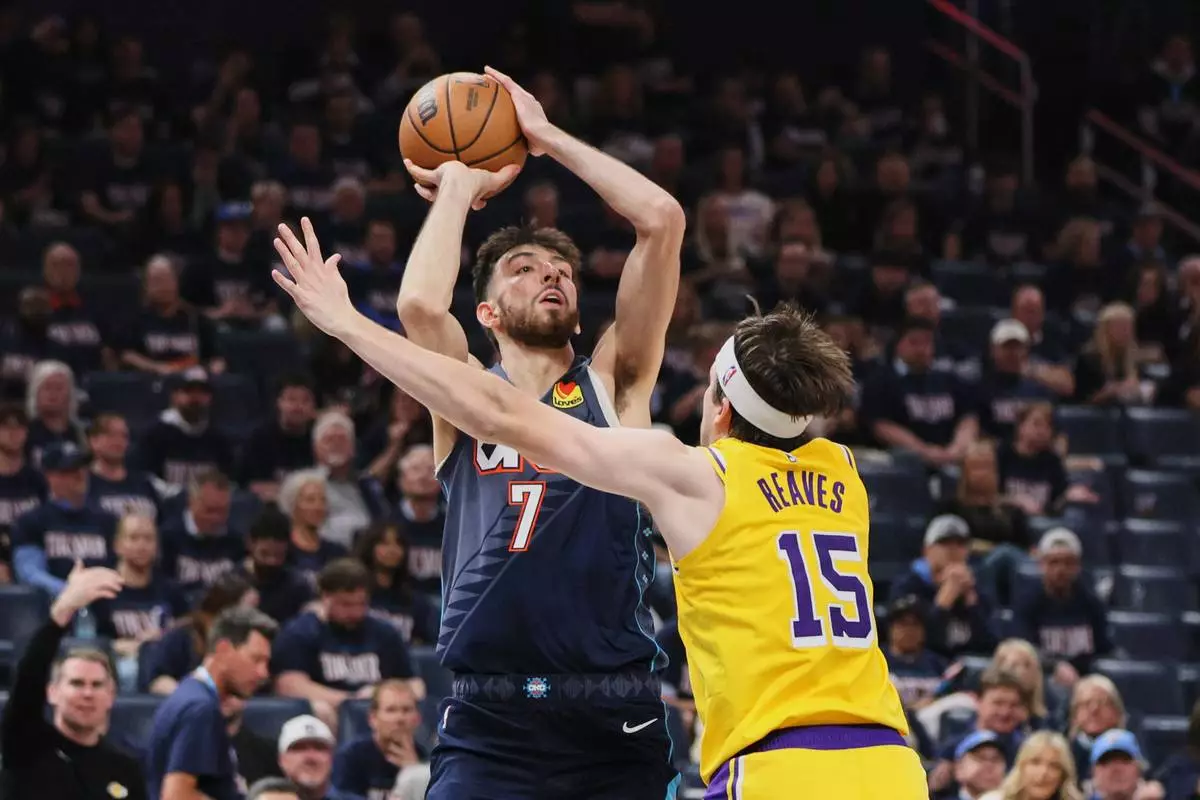
Oklahoma City Thunder's Chet Holmgren (7) shoots over Los Angeles Lakers' Austin Reaves (15) in the second half of Game 2 in a second-round NBA basketball playoffs series Thursday, May 7, 2026, in Oklahoma City. (AP Photo/Nate Billings)
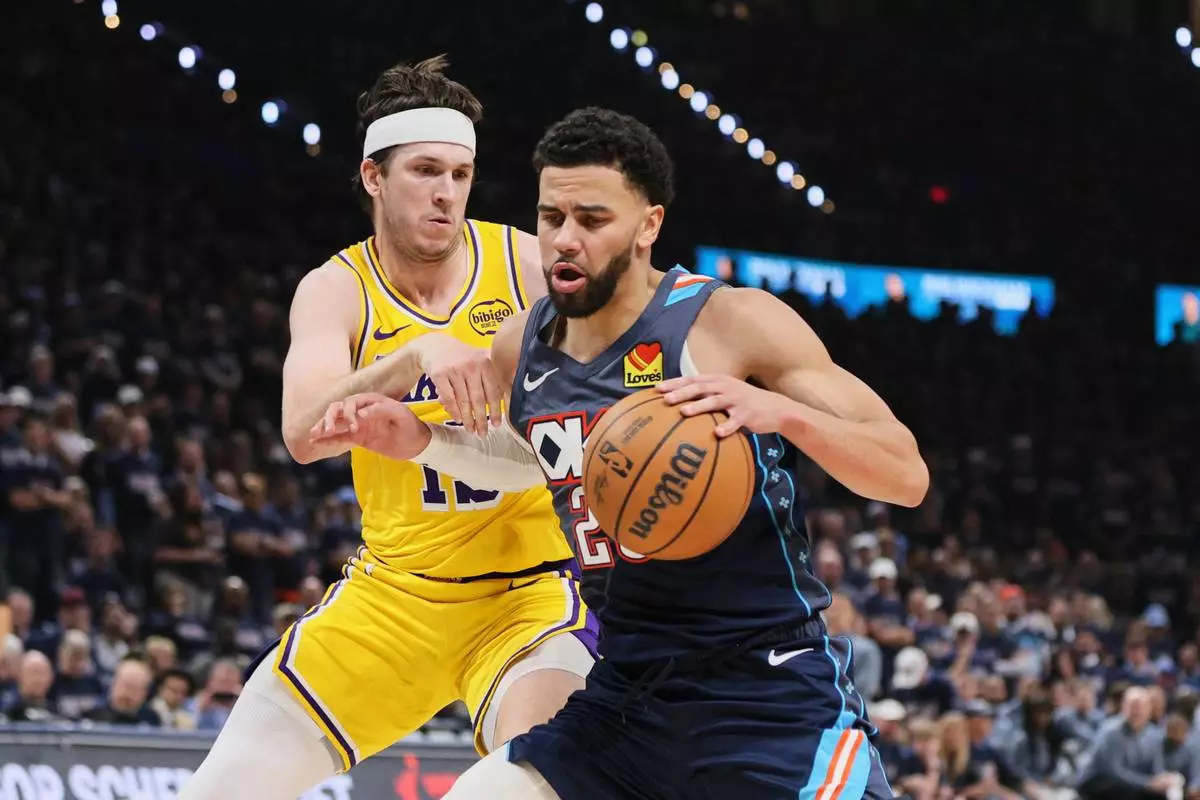
Oklahoma City Thunder guard Ajay Mitchell, front, works for a shot as Los Angeles Lakers' Austin Reaves, rear, defends in the second half of Game 2 in a second-round NBA basketball playoffs series Thursday, May 7, 2026, in Oklahoma City. (AP Photo/Nate Billings)
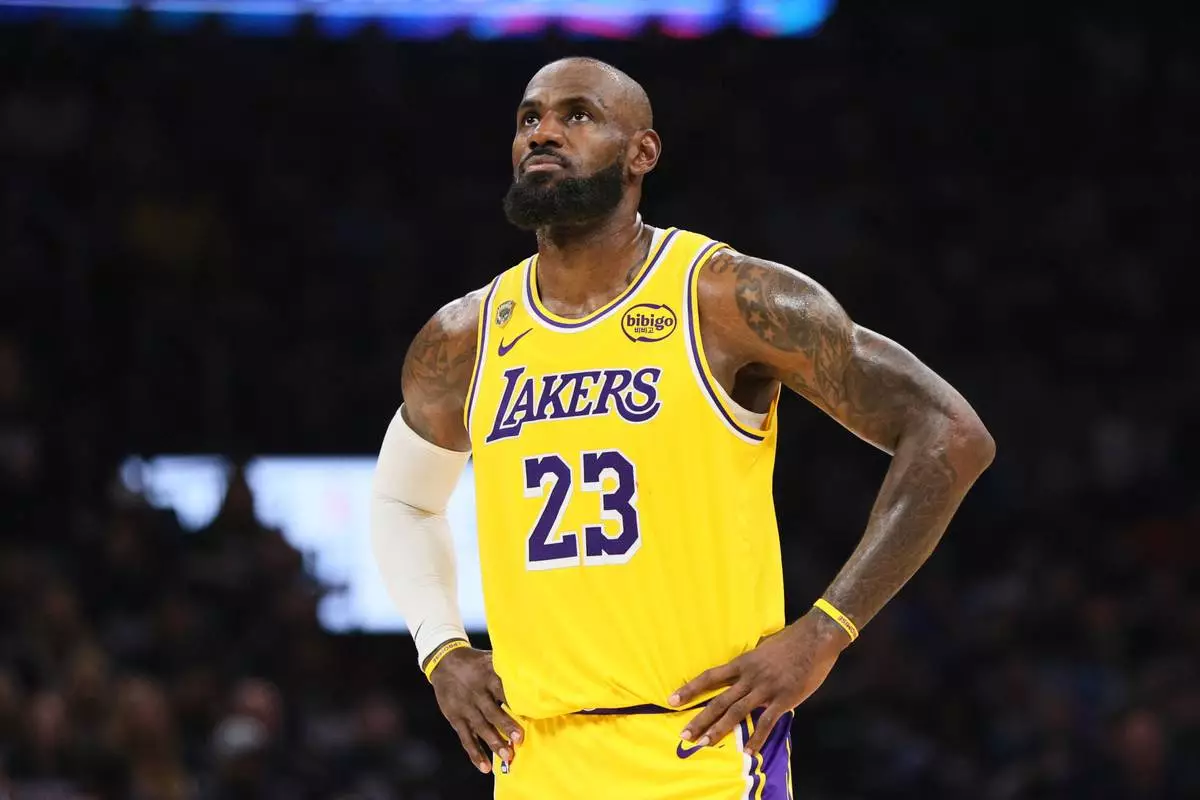
Los Angeles Lakers' LeBron James stands on the court in the second half of Game 2 in a second-round NBA basketball playoffs series against the Oklahoma City Thunder Thursday, May 7, 2026, in Oklahoma City. (AP Photo/Nate Billings)
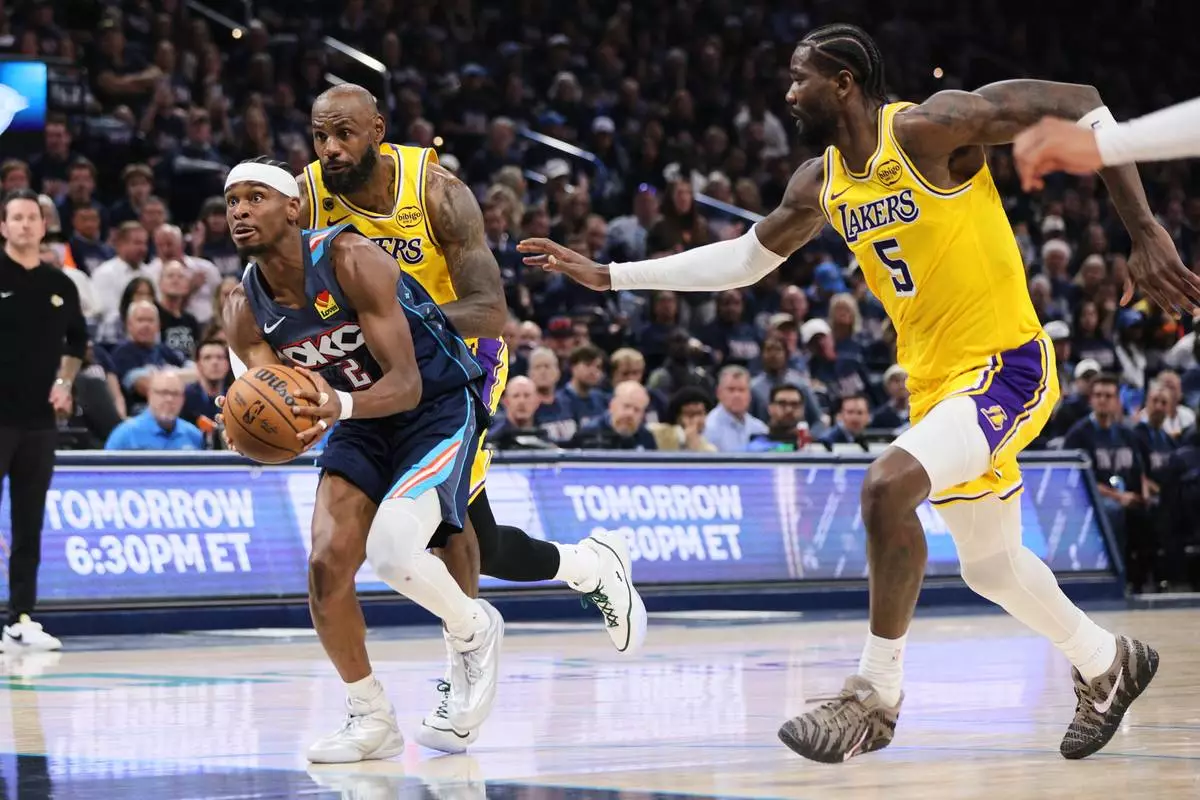
Oklahoma City Thunder guard Shai Gilgeous-Alexander (2) drives to the basket past Los Angeles Lakers' Deandre Ayton (5) and LeBron James, rear, in the second half of Game 2 in a second-round NBA basketball playoffs series Thursday, May 7, 2026, in Oklahoma City. (AP Photo/Nate Billings)
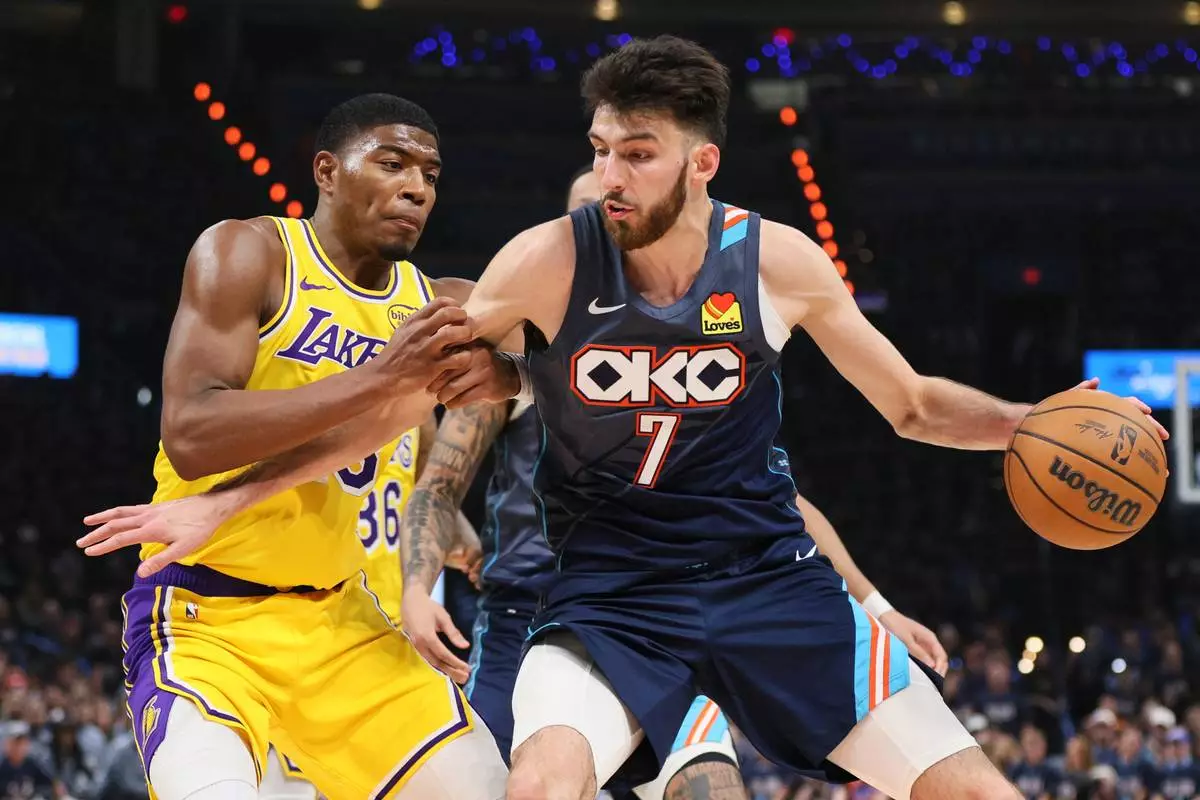
Oklahoma City Thunder center Chet Holmgren (7) works to the basket against Los Angeles Lakers forward Rui Hachimura (28) in the second half of Game 2 in a second-round NBA basketball playoffs series Thursday, May 7, 2026, in Oklahoma City. (AP Photo/Nate Billings)