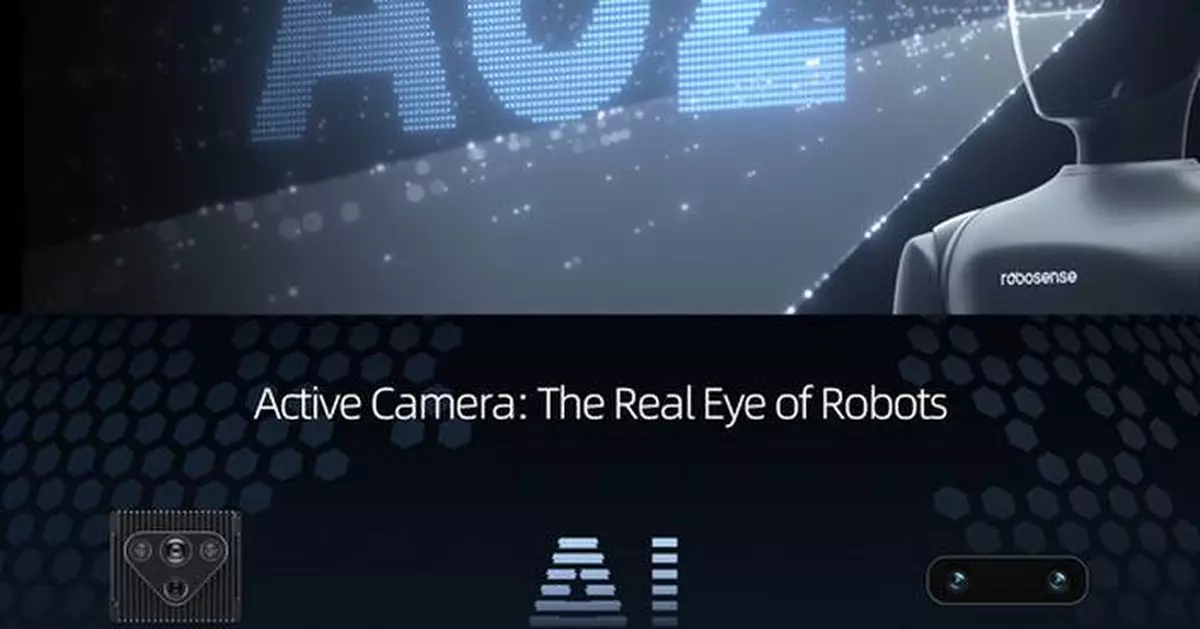
HANGZHOU, China, Oct. 24, 2025 /PRNewswire/ -- RoboSense (2498.HK), a pioneering AI-driven robotics technology company, hosted the "Eyes of Robots" themed salon during the International Conference on Intelligent Robots and Systems (IROS 2025) in Hangzhou, where it officially launched the latest product of its Active Camera series — the "Robot Manipulation Eye" AC2. The invitation-only beta testing was also announced simultaneously.
Perry Wang, President of RoboSense's Innovation Division, shared insights on industry trends and technological breakthroughs in the "Eyes of Robots" field, while Dr. Yang Xiansheng, Vice President of the LiDAR Division, provided a comprehensive introduction to the performance advantages and key features of the AC2. During the roundtable forum, four leading scholars — Sun Fuchun, Zhu Yanhe, Li Qingdu, and Li Miao — conducted an in-depth discussion on the theme of "Robotic Perception Breakthroughs and Industry Prospects."
The Industry's Only Large-Area Array: dToF Delivers Millimeter-Precision Sensing
Perry Wang stated that the "eye" is the core of robotic perception, and obtaining 3D visual depth information has long been a technical bottleneck for robot vision. Stereo vision, monocular vision, and active illumination-based structured light and ToF are all mainstream depth perception solutions in the industry. Among these, dToF offers the strongest ranging capability, highest interference resistance, and lowest computational requirements. The large-area dToF array further addresses the shortcomings of traditional dToF in terms of cost and short-range accuracy, making it the optimal solution for depth measurement in machine vision.
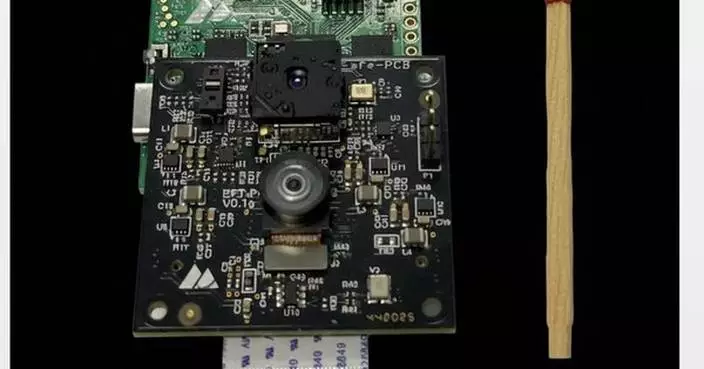
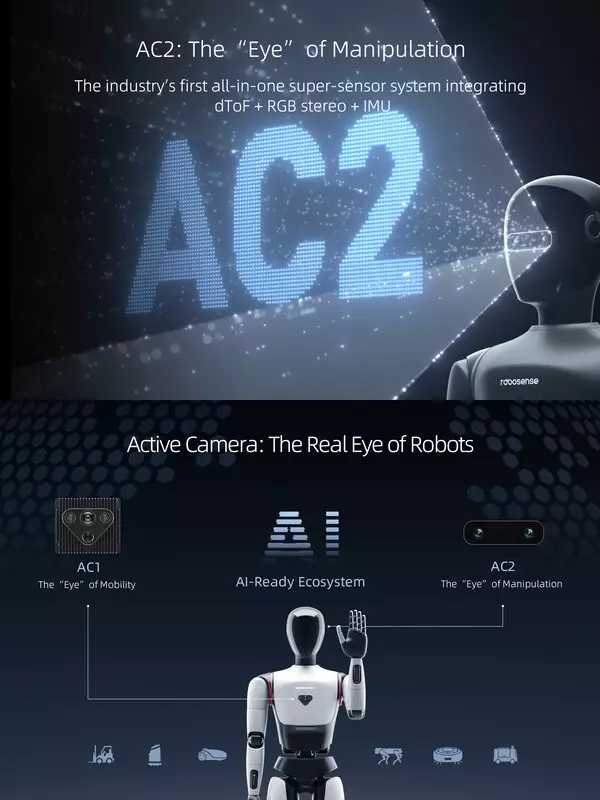
The AC2 is the culmination of RoboSense's breakthroughs in large-area dToF technology. Positioned as the "Robot Manipulation Eye," AC2 is the industry's first integrated super-sensor system combining dToF, RGB stereo, and IMU. It can flexibly output fused or independent depth, image, and motion pose data with high precision, delivering uniformly clear perception across the entire field. RoboSense's industry-leading chip-level hardware synchronization technology ensures that depth and image data are highly aligned in both time and space in most scenarios, with a synchronization accuracy of up to 1 ms, fundamentally guaranteeing the quality and effectiveness of fused perception.
Millimeter-Level High-Precision Perception
Due to limitations in perception accuracy, most robots today remain at a basic operational level. High-precision perception across all scenarios and conditions has become a prerequisite for expanding robotic operation ranges. RoboSense ensures the AC2's extreme precision through hardware-level data fusion and synchronization across multiple dimensions:
- A newly redesigned fully solid-state large-area dToF depth sensing solution overcomes the industry challenge of 3D vision sensor accuracy varying with distance, enabling AC2 to achieve millimeter-level perception precision of ±5 mm within an 8 m range;
- The integrated stereo vision system further enhances AC2's depth accuracy at ultra-short ranges within 1 m;
- A 1600×1400 high-resolution RGB camera supplements ultra-clear color image information on top of depth data, improving the fine-grained quality of AC2's fused perception.
Ultra-Large FoV and Compact, Cutting-Edge Design
To ensure efficient robotic manipulation, the AC2 achieves one of the largest FoV in the 3D vision sensor industry. Whether in fused perception or using individual sensors, it provides an ultra-wide 120°×90° FoV, allowing robots to "see" more manipulation objects at once and minimizing additional errors caused by frequent head or tilt movements to adjust the view.
With compact dimensions of 100 mm × 30 mm × 45 mm (L × H × D), the AC2 can be flexibly mounted in tight spaces such as humanoid robot faces, robot dog heads, or the end of robotic arms, enabling safe and efficient manipulation across a wide range of robotic platforms.
High Stability and Reliability, Strong Ambient Light Resistance
High reliability is also key to ensuring effective robotic manipulation. Based on the dToF depth sensing solution, the AC2 offers excellent resistance to ambient light interference, maintaining stable performance in complex lighting conditions such as low light, strong light, or alternating brightness. Even under intense 100 klux illumination, accuracy remains unaffected.
Designed to automotive-grade standards, the AC2 meets IP65 dust and water resistance ratings and operates within a temperature range of –10° to 55°C. Equipped with a GMSL2 interface and FAKRA connector, it provides a more stable connection than USB, effectively preventing disconnections while offering higher transmission bandwidth, ensuring a stable and smooth perception link for robotic systems.
Robots equipped with the AC2 can achieve high-precision, large-range perception across all scenarios and operating conditions. They can effortlessly perceive and manipulate small objects such as toothbrushes and hangers, as well as highly reflective materials like glass and metal. Even during large-scale robot movements, the fused perception images remain undistorted, enabling robots to unlock a wider range of manipulation applications.
AI-Ready, Out-of-the-Box Developer Services
To better support robotic development needs, RoboSense has updated its AI-Ready ecosystem alongside the AC2 hardware launch, adding open-source algorithms tailored for AC2 use cases, including pose estimation and human skeleton recognition. The AI-Ready ecosystem is a key component of the Active Camera series, offering a full suite of open-source tools and algorithms such as the AC Studio toolkit, Wiki documentation, and multi-scenario datasets, helping developers save time on routine tasks and accelerate development.
Together with the AI-Ready ecosystem, the AC2 addresses current issues of sensor stacking and redundant development in robotics, making it the optimal perception solution for robotic manipulation applications. In mature sectors such as industrial, logistics, and home service robots, the AC2 can accelerate commercialization, improve operational efficiency, and unlock more application scenarios. In high-potential areas like embodied intelligence and digital twins, the AC2 will facilitate functional validation and application deployment, unleashing greater possibilities.
Expert Consensus: Perception Revolution is the Key to Robotics Technology Breakthroughs
During the roundtable forum, leading academics gathered to discuss the evolution of robotic visual perception, current technological bottlenecks, resource allocation decisions, and methods to enhance generalization capabilities. Many scholars expressed appreciation and anticipation for RoboSense's "Eyes of Robots," the AC2 launch, and its application potential.
According to Professor Sun Fuchun, Chair of the Department of Computer Science and Technology at Tsinghua University and Deputy Director of the State Key Laboratory of Intelligent Technology and Systems, enabling robots to learn in immersive, real-world environments makes RoboSense's "Eyes of Robots" particularly important. Currently, robotic visual perception faces numerous challenges, including adapting to dynamic environments, accurately capturing complete data, multi-sensor collaborative modeling, calibration errors, and computational efficiency. By integrating multiple sensors into a unified system, RoboSense's "Eyes of Robots" effectively addresses these issues and holds significant application potential, particularly in humanoid robots and industrial logistics.
Professor Zhu Yanhe, Professor and Doctoral Advisor at the School of Mechatronics Engineering, Harbin Institute of Technology (HIT), and Deputy Director of the National Key Laboratory of Robotics Technology and Systems, noted that, from a natural science perspective, human eyes may not even match the performance of some animal eyes. He emphasized that embodied intelligent robots should not be limited by our understanding of human vision, but instead develop perception capabilities that surpass human eyes. In this sense, the Active Camera can be regarded as a "Super Eye," integrating cameras, LiDAR, and other sensors. Against the backdrop of the AI era, RoboSense's multi-sensor fusion capabilities have already surpassed overseas counterparts, leading innovation in the field.
Professor Li Qingdu, Executive Director of the Institute of Machine Intelligence at the University of Shanghai for Science and Technology and Director of the Central China Embodied Intelligence Lab, shared insights based on the latest developments of his team's humanoid robots, "Xingzhe-2" and "Xingzhe-3." He praised AC2's multi-sensor integrated design, noting that a single AC2 can address challenges in perception, computational load, and general compatibility. "With a fused FoV of 120°, AC2's wide field of view is highly suited for large-scale scenarios, perfectly meeting our requirements. It also demonstrates strong adaptability indoors and outdoors, with stable performance even under ambient light interference."
Professor Li Miao, Professor and Doctoral Advisor at the School of Robotics, Wuhan University, echoed a common industry saying to reflect on the evolution of robot eye technology and AC2's potential: "Each generation of hardware brings a new generation of algorithms and robots. With the advent of RoboSense's 'Eyes of Robots,' a new algorithm ecosystem will emerge to support complex robotic applications. I believe AC2 could evolve into a 'super species' — a perception system that surpasses human vision. Combined with RoboSense's AI-Ready ecosystem and open algorithm SDK, and in collaboration with Chinese robotics hardware companies, it can truly solve the challenges of multi-scenario embodied intelligence applications."
Leveraging its chip-level technological leadership and extensive experience in LiDAR industrialization, RoboSense has launched the Active Camera series, a new category of robotic vision products. With the release of AC2, Active Camera now forms a complete robotic perception product lineup, addressing the two core tasks of robot mobility and manipulation.
AC2 has completed preliminary application validation and is now sending invitation-only beta access to academic and industry developers. RoboSense will continue to build the optimal perception technology foundation for large-scale commercial deployment in the robotics industry, exploring the limitless possibilities of intelligent robots with users worldwide.
About RoboSense
RoboSense (2498.HK), founded in 2014, is an AI-driven robotics technology company that supplies core components and solutions for the robotics market, committed to "Become the global leader in robotics technology platforms." Headquartered in Shenzhen, China, the company has offices in Shanghai, Suzhou, and Hong Kong; Stuttgart in Germany; Detroit and Silicon Valley in the United States. For more information, please visit: www.robosense.ai
** The press release content is from PR Newswire. Bastille Post is not involved in its creation. **
RoboSense Debuts Next-Gen "Eyes of Robots" -- Active Camera 2 at IROS 2025