ISLAMABAD (AP) — Pakistan’s defense minister warned Afghanistan on Wednesday that any new “terrorist or suicide attack” by militants on Pakistani soil would draw a stern response, hours after talks between the two countries in Istanbul failed to secure a peace agreement.
Earlier this month, Pakistan's military launched attacks on what it said were hideouts of the Pakistani Taliban in Afghanistan, killing dozens of people whom it described as insurgents. Afghanistan said that the people killed were civilians and struck Pakistani military posts in response, claiming 58 Pakistani soldiers were killed.
Pakistan's military said the border fighting left 23 soldiers dead.
The two sides agreed to a ceasefire brokered in the Qatari capital, Doha, on Oct. 19, followed by four days of talks this week in Istanbul that ended inconclusively.
In a post on X, Pakistan's Defense Minister Khawaja Mohammad Asif told Afghanistan’s Taliban government that “any terrorist attack or suicide bombing inside Pakistan shall give you the bitter taste of such misadventures.”
There was no immediate comment from Kabul on the collapse of peace talks or on Asif’s remarks, but Afghanistan’s state broadcaster RTA reported that the negotiations stalled because of what it called “irrational demands” from Pakistan.
According to RTA, Islamabad sought assurances that no attacks would be launched from Afghan territory, while the Taliban delegation said the Pakistani Taliban, also known as Tehrik-e-Taliban Pakistan, was an internal issue for Islamabad.
Pakistan has long accused Afghanistan's Taliban government of turning a blind eye to Pakistani Taliban and other militants operating from its territory. Kabul denies the charge.
The Pakistani military said Wednesday it killed seven Pakistani Taliban militants in an operation in Kurram, a district in the Khyber Pakhtunkhwa province. Six soldiers were also killed, the statement said, adding that a search was underway for runaway gunmen.
Pakistan has witnessed a surge in militant attacks, most claimed by the Pakistani Taliban, which is a separate group from the Afghan Taliban but has been emboldened since the latter returned to power in Kabul in 2021. Many Pakistani Taliban leaders and fighters have been living in Afghanistan since then.
Asif, in a strongly worded post on X, also accused Kabul of “blindly pushing Afghanistan into yet another conflict” to preserve what he described as its “usurped rule and war economy.”
“Let me assure them that Pakistan does not require to employ even a fraction of its full arsenal to completely obliterate the Taliban regime and push them back to the caves for hiding,” he said.
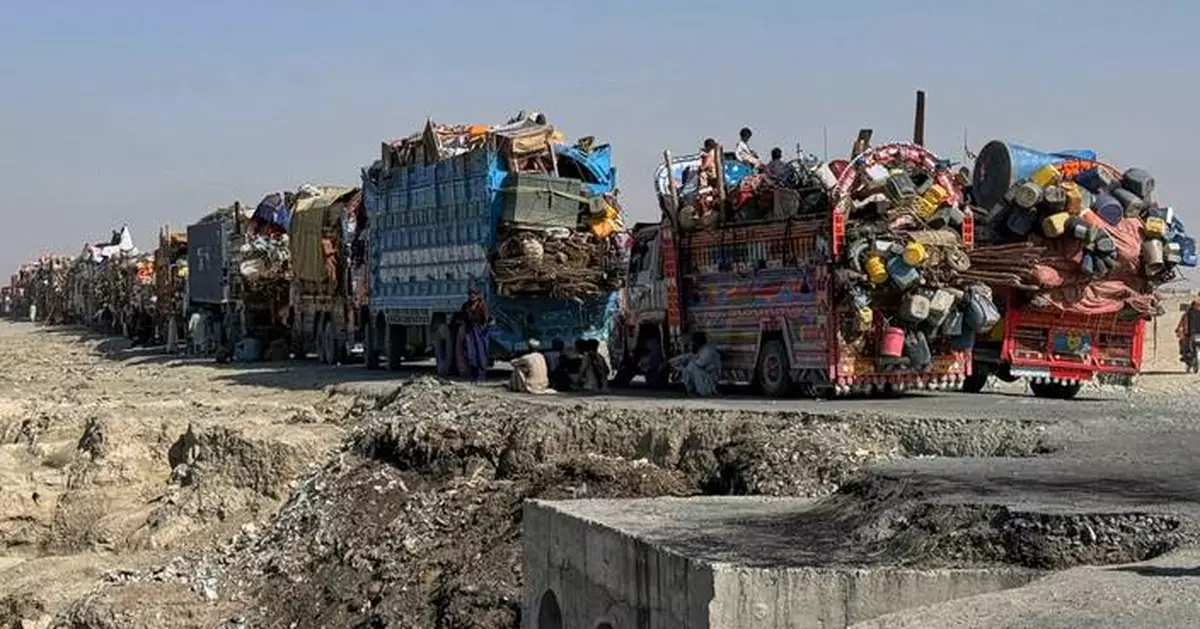
Despite the failure of the talks, a ceasefire remained in place, and no new clashes were reported along the border. Both countries have shut all major crossings, leaving hundreds of trucks carrying goods and refugees stranded on each side.
Asif told reporters in Islamabad that reopening the border for bilateral and transit trade with Afghanistan was conditional on Kabul’s assurance that Afghan territory would not be used for militant attacks against Pakistan.
He said Pakistan had evidence showing that Afghan soil was used to stage violence in Pakistan, and that information was shared with the Afghan delegation during the Istanbul talks.
Asif said that “terrorists who come from across the border to attack Pakistan will be pursued there, even if they have come from Afghanistan," and that Pakistan could go deep inside Afghanistan to hit such militants.
At the Chaman border crossing in southwestern Balochistan province in Pakistan, hundreds of Afghan refugee families and traders voiced frustration and anxiety over the failed talks.
“We came to know that the talks failed,” said Ajab Khan, an Afghan refugee waiting in a long queue of trucks loaded with household goods. “Now we are going back to Afghanistan, but it’s a scary situation. We don’t know how we will survive there.”
Associated Press writers Abdul Qahar in Jalalabad, Afghanistan, Javed Hussain in Kurram, Pakistan and Riaz Khan in Peshawar, Pakistan, contributed to this report.
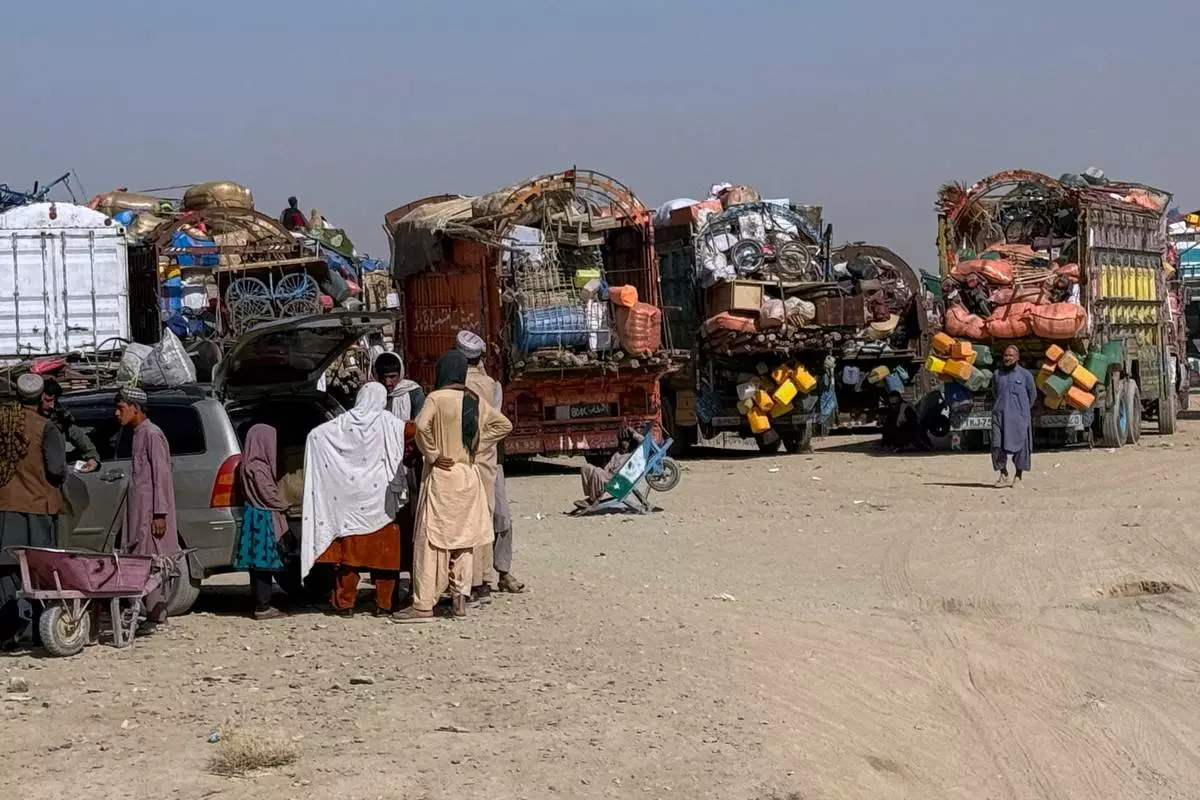
Afghan refugees gather beside trucks loaded with their belongings as they wait their turn to leave for their homeland through a border crossing point which partially opens following Oct.19 ceasefire, on the outskirts of Chaman, a border town on the Pakistan Afghan border, Wednesday, Oct. 29, 2025. (AP Photo/H. Achakzai)
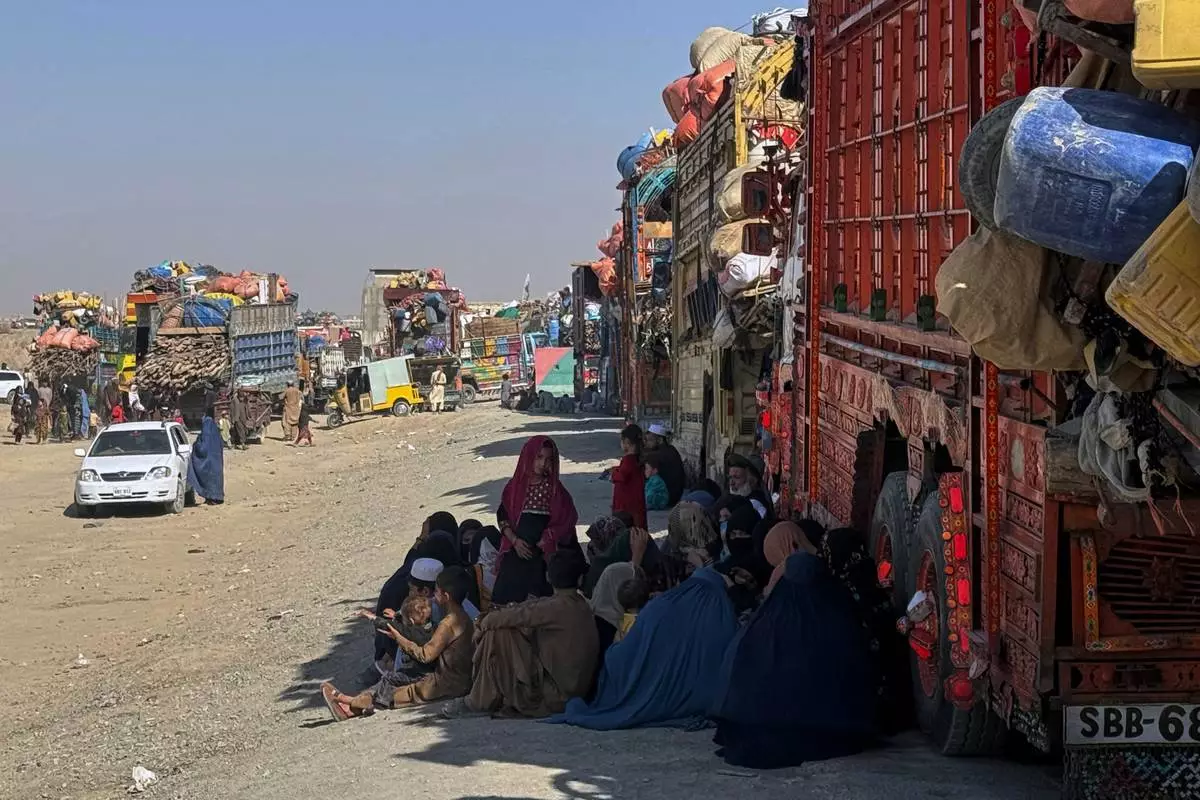
Afghan refugees sit beside trucks loaded with their belongings as they wait their turn to leave for their homeland through a border crossing point which partially opens following Oct.19 ceasefire on the outskirts of Chaman, a border town on the Pakistan Afghan border, Wednesday, Oct. 29, 2025. (AP Photo/H. Achakzai)
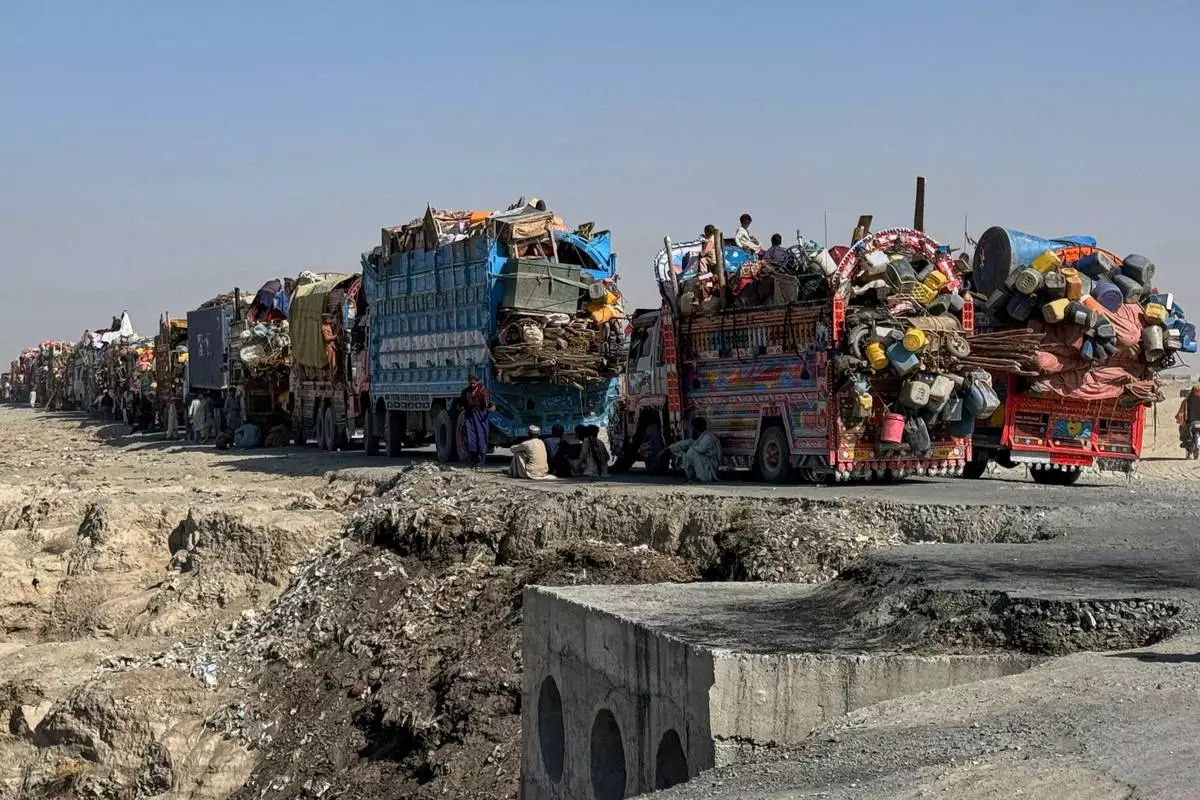
Afghan refugees sit beside trucks loaded with their belongings as they wait their turn to leave for their homeland through a border crossing point which partially opens following Oct.19 ceasefire, on the outskirts of Chaman, a border town on the Pakistan Afghan border, Wednesday, Oct. 29, 2025. (AP Photo/H. Achakzai)
RHO, Italy (AP) — No ice is colder and harder than speedskating ice. The precision it takes has meant that Olympic speedskaters have never competed for gold on a temporary indoor rink – until the 2026 Milan Cortina Winter Games.
In the pursuit of maximum glide and minimum friction, Olympic officials brought on ice master Mark Messer, a veteran of six previous Olympic speedskating tracks and the ice technician in charge of the Olympic Oval in Calgary, Canada — one of the fastest tracks in the world with over 300 records.
Messer has been putting that experience to work one thin layer of ice at a time since the end of October at the new Speed Skating Stadium, built inside adjacent trade fair halls in the city of Rho just north of Milan.
“It’s one of the biggest challenges I’ve had in icemaking,’’ Messer said during an interview less than two weeks into the process.
If Goldilocks were a speedskater, hockey ice would be medium hard, for fast puck movement and sharp turns. Figure skating ice would be softer, allowing push off for jumps and so the ice doesn’t shatter on landing. Curling ice is the softest and warmest of all, for controlled sliding.
For speedskating ice to be just right, it must be hard, cold and clean. And very, very smooth.
“The blades are so sharp, that if there is some dirt, the blade will lose the edge,’’ Messer said, and the skater will lose speed.
Speedskater Enrico Fabris, who won two Olympic golds in Turin in 2006, has traded in his skates to be deputy sports manager at the speedskating venue in Rho. For him, perfect ice means the conditions are the same for all skaters — and then if it's fast ice, so much the better.
"It's more of a pleasure to skate on this ice,'' he said.
Messer’s first Olympics were in Calgary in 1988 — the first time speedskating was held indoors. “That gave us some advantages because we didn’t have to worry about the weather, wind blowing or rain,’’ he said. Now he is upping the challenge by becoming the first ice master to build a temporary rink for the Olympics.
Before Messer arrived in Italy, workers spent weeks setting up insulation to level the floor and then a network of pipes and rubber tubes that carry glycol — an antifreeze — that is brought down to minus 7 or minus 8 degrees Celsius (17.6 to 19.4 degrees Fahrenheit) to make the ice.
Water is run through a purification system — but it can’t be too pure, or the ice that forms will be too brittle. Just the right amount of impurities “holds the ice together,’’ Messer said.
The first layers of water are applied slowly, with a spray nozzle; after the ice reaches a few centimeters it is painted white — a full day’s work — and the stripes are added to make lanes.
“The first one takes about 45 minutes. And then as soon as it freezes, we go back and do it again, and again and again. So we do it hundreds of times,’’ Messer said.
As the ice gets thicker, and is more stable, workers apply subsequent layers of water with hoses. Messer attaches his hose to hockey sticks for easier spreading.
What must absolutely be avoided is dirt, dust or frost — all of which can cause friction for the skaters, slowing them down. The goal is that when the skaters push “they can go as far as possible with the least amount of effort,’’ Messer said.
The Zamboni ice resurfacing machine plays a key role in keeping the track clean, cutting off a layer and spraying water to make a new surface.
One challenge is gauging how quickly the water from the resurfacing machine freezes in the temporary rink.
Another is getting the ice to the right thickness so that the Zamboni, weighing in at six tons, doesn’t shift the insulation, rubber tubing or ice itself.
“When you drive that out, if there’s anything moving it will move. We don’t want that,’’ Messer said.
The rink got its first big test on Nov. 29-30 during a Junior World Cup event. In a permanent rink, test events are usually held a year before the Olympics, leaving more time for adjustments. “We have a very small window to learn,’’ Messer acknowledged.
Dutch speedskater Kayo Vos, who won the men’s neo-senior 1,000 meters, said the ice was a little soft — but Messer didn’t seem too concerned.
“We went very modest to start, now we can start to change the temperatures and try to make it faster and still maintain it as a safe ice,’’ he said.
Fine-tuning the air temperature and humidity and ice temperature must be done methodically — taking into account that there will be 6,000 spectators in the venue for each event. The next real test will be on Jan. 31, when the Olympians take to the ice for their first training session.
“Eighty percent of the work is done but the hardest part is the last 20 percent, where we have to try to find the values and the way of running the equipment so all the skaters get the same conditions and all the skaters get the best conditions,’’ Messer said.
AP Winter Olympics: https://apnews.com/hub/milan-cortina-2026-winter-olympics

Serpentines are set on the ice of the stadium where speed skating discipline of the Milan Cortina 2026 Winter Olympics will take place, in Rho, outskirt of Milan, Tuesday, Nov. 11, 2025. (AP Photo/Luca Bruno)

Ice Master Mark Messer poses in the stadium where speed skating discipline of the Milan Cortina 2026 Winter Olympics will take place, in Rho, outskirt of Milan, Tuesday, Nov. 11, 2025. (AP Photo/Luca Bruno)
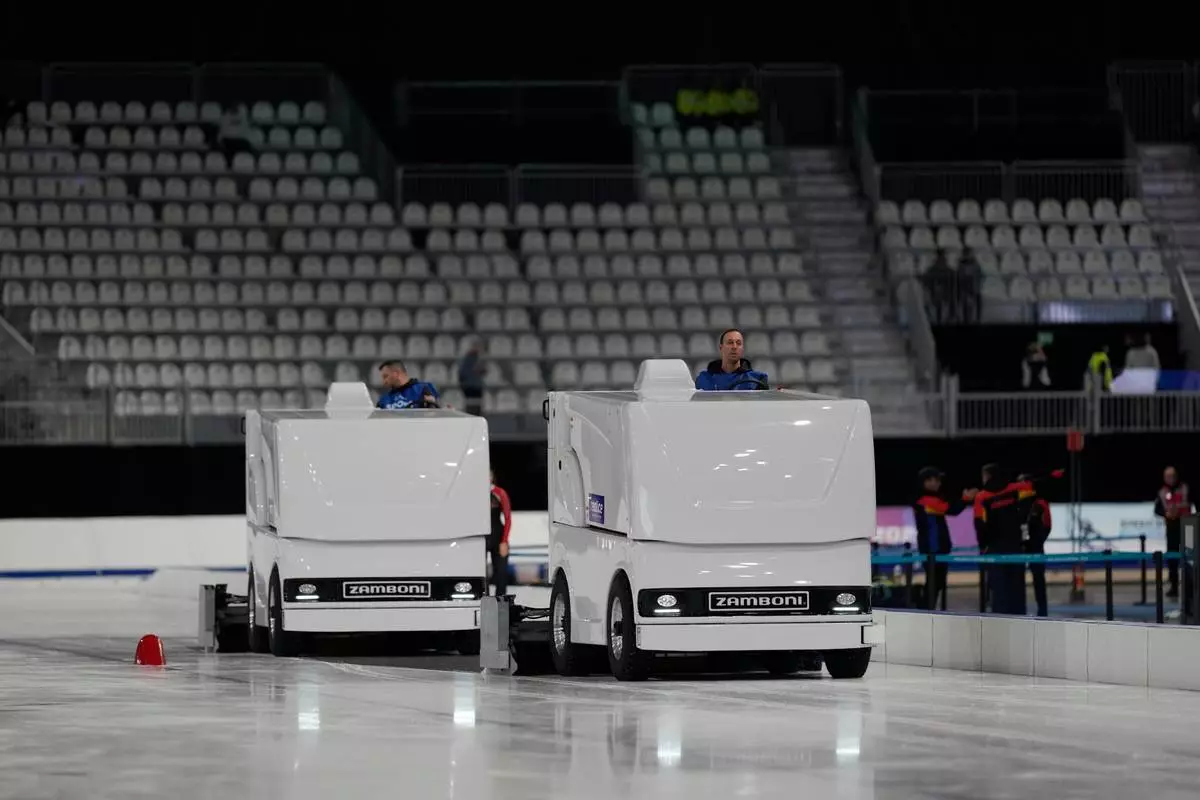
Workers clean the ice surface during a peed skating Junior World Cup and Olympic test event, in Rho, near Milan, Italy, Saturday, Nov. 29, 2025. (AP Photo/Luca Bruno)

Ice Master Mark Messer poses in the stadium where speed skating discipline of the Milan Cortina 2026 Winter Olympics will take place, in Rho, outskirt of Milan, Tuesday, Nov. 11, 2025. (AP Photo/Luca Bruno)

Ice Master Mark Messer poses in the stadium where speed skating discipline of the Milan Cortina 2026 Winter Olympics will take place, in Rho, outskirt of Milan, Tuesday, Nov. 11, 2025. (AP Photo/Luca Bruno)