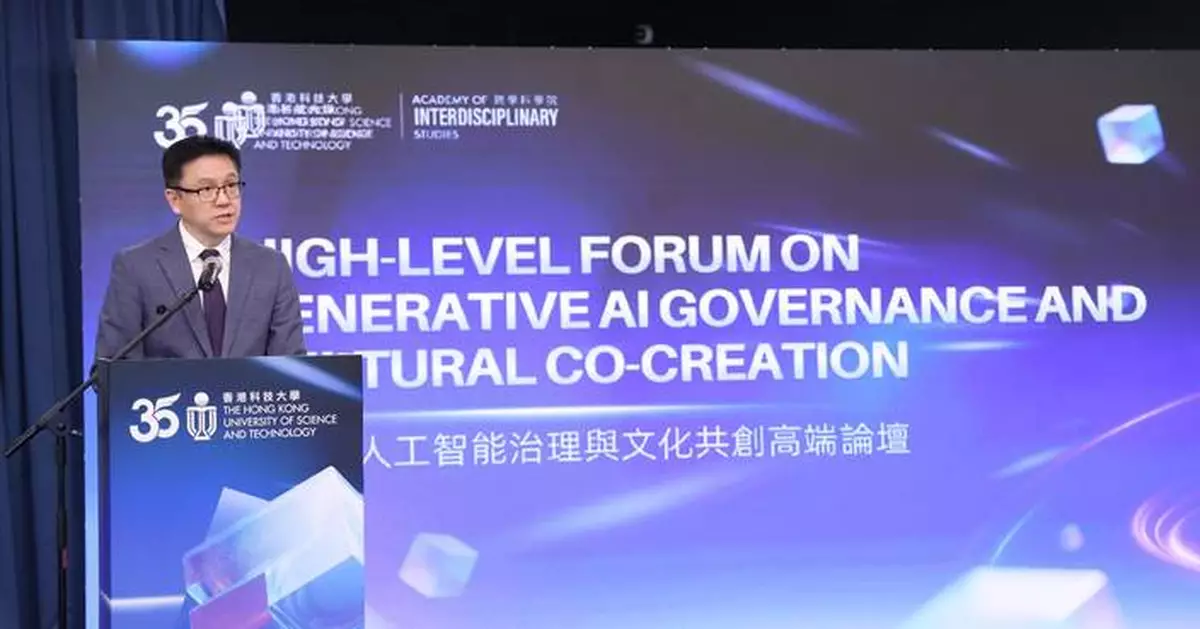
Speech by SITI at High-Level Forum on Generative AI Governance and Cultural Co-Creation
Following is the speech by the Secretary for Innovation, Technology and Industry, Professor Sun Dong, at the High-Level Forum on Generative AI Governance and Cultural Co-Creation today (October 30):
Professor Guo (Provost of the Hong Kong University of Science and Technology, Professor Guo Yike), Professor Qu (Dean of Academy of Interdisciplinary Studies, the Hong Kong University of Science and Technology, Professor Huamin Qu), Professor Song (Director of the Media Intelligence Research Center, the Hong Kong University of Science and Technology, Professor Celine Song), distinguished guests, ladies and gentlemen,
Good morning. It is my pleasure to join this forum, which brings together visionary minds to explore how trust, governance and innovation can shape the future of artificial intelligence. Let me begin by extending my warmest congratulations on the inauguration of the Media Intelligence Research Center of the HKUST (Hong Kong University of Science and Technology).
First of all, I am happy to share with you that the National 15th Five-Year Plan has just confirmed the support for Hong Kong in building an international I&T (innovation and technology) centre. We are standing at the forefront of a global technological shift. AI is rapidly reshaping industries, economies and societies. According to the United Nations Conference on Trade and Development, the global AI market is expected to reach about US$4.8 trillion by 2033, which is a 25-fold increase in 10 years from now. This remarkable growth underscores the urgent need for economies around the world to formulate and implement policies that balance the immense potential and the underlying risks of AI, ensuring its sustainable and inclusive development.
The Government has spared no effort in promoting sound AI governance while fostering the advancement of industry. One of the cornerstones is the Ethical Artificial Intelligence Framework, first introduced in 2021, which covers 12 core principles from fairness and transparency to human oversight, implementation guidelines and risk assessment tools. The aim is to help organisations embed ethical considerations when implementing IT projects, ensuring that their AI systems are not only effective but also responsible. To keep up with the evolving AI landscape, the updated version introduced in 2023 further sharpened its relevance and recommended clearer practices to address emerging risks.
Complementing our ethical framework is the Principles of Data Governance promulgated by the Government in 2024, which provide a foundational layer for reliable AI development. As data powers every stage of the life cycle of an AI system, from training to application, its quality, integrity and responsible use are essential. This Data Governance document promotes lawful sharing, privacy protection and accountability, helping organisations unlock the value of data in a responsible and ethical manner. This is crucial to our broader governance efforts.
In view of the growing use of generative AI across sectors, the Government sees the merits in developing a practical framework for safe and responsible adoption that is tailored to Hong Kong's context with contribution from professionals. The Hong Kong Generative AI Research and Development Center (HKGAI), under the leadership of Professor Guo Yike, was commissioned to put together the Hong Kong Generative Artificial Intelligence Technical and Application Guideline for release in April 2025. By leveraging the HKGAI's experience in building Hong Kong's first locally adapted large language model, the guideline provides clear, pragmatic and actionable advice for developers, service providers and users in the application of AI technology, covering key risks of data leakage, model bias and misinformation, and recommendations on safeguarding model training, deployment and content integrity.
The Government also takes the lead in building a vibrant AI ecosystem by advancing the integration of AI into public services, recognising its potential to enhance efficiency, responsiveness and citizen experience. As announced in the 2025 Policy Address, a dedicated AI Efficacy Enhancement Team is set up to promote AI applications across government departments and explore process re-engineering to elevate public services. In parallel, the Digital Policy Office will roll out various AI applications in respect of data analysis, customer service and document processing.
Alongside various initiatives to expand AI application scenarios in public services, the Government introduced the AI Adoption Guide for Government bureaux and departments earlier this year. It outlines strategies, practical guidelines and facilitation measures for AI adoption, with a strong emphasis on top-down leadership and a business-led "AI+" approach. It further encourages departments to identify operational challenges and explore the deployment of AI to enhance efficiency and improve service quality, serving as a catalyst for public service transformation.
A thriving AI ecosystem counts not only on innovation and technology, but also strong and adaptive governance. Compliance across both public and private sectors is vital to protect data, uphold standards and build public trust. I appreciate the cross-sectoral effort in promoting responsible innovation and reliable AI governance.
Before I close, I wish this forum every success, and look forward to witnessing Hong Kong's AI development scaling new heights. Thank you.
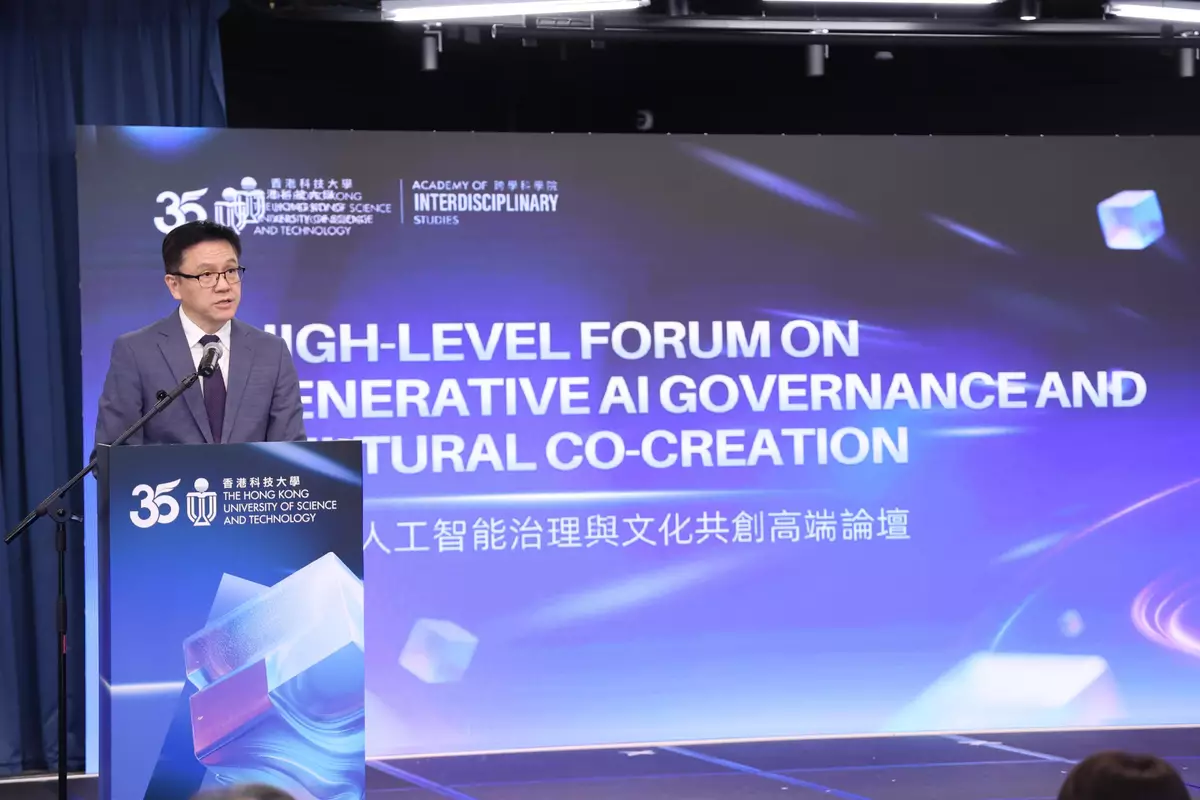
Speech by SITI at High-Level Forum on Generative AI Governance and Cultural Co-Creation Source: HKSAR Government Press Releases