GYEONGJU, South Korea (AP) — A hot mike caught U.S. President Donald Trump saying that his much-anticipated meeting Thursday with Chinese President Xi Jinping, meant to settle the most important trade relationship in the world, would be “three, four hours” and he would then fly back to Washington.
It was actually much shorter, an hour and 40 minutes, but true to his word he was on a plane well before the 21-member Asia-Pacific Economic Cooperation summit was to begin Friday.
Trump’s decision to skip APEC fits with his well-known disdain for the big, multi-nation forums that have been traditionally used to address huge global problems, and his relish of the kind of one-on-one diplomacy that can result in big deals, or at least interesting headlines.
But his blunt dismissal of this weekend's APEC diplomacy risks worsening America's reputation at a forum that represents nearly 40% of the world’s population and more than half of global goods trade.
It also stands in contrast to China's approach.
Showing up matters in Asian diplomacy, and the Chinese leader is scheduled to be in South Korea until the forum ends this weekend, hoping to gain wins in Trump's absence.
On social media Trump celebrated his meeting with Xi in South Korea as a “G2,” a recognition of America and China’s status as the world’s two biggest economies and a play on the multi-national Group of Seven and Group of 20 forums.
Still, Trump tried to emphasize American ties to the broader region throughout his trip, which started in Malaysia with the annual Association of Southeast Asian Nations.
Xi did not go, and Trump told the “spectacular leaders” there that he remained committed to the region and was “on a mission of friendship and goodwill, and to deepen our ties of commerce, to strengthen our common security and really to promote strongly stability, prosperity and peace.”
Some analysts, however, describe a rudderless Asia policy by the Trump administration.
“He does not appear to want his hands tied by a disciplined, coherent strategy,” Michael Green, who worked on former U.S President George W. Bush’s National Security Council and now leads the United States Studies Centre in Sydney, Australia, said of Trump’s Asia efforts.
It remains to be seen whether Trump’s personalized brand of foreign policy will erode U.S. influence and leadership, said Go Myong-hyun, an analyst at South Korea’s Institute of National Security Strategy.
“Of course, the United States’ reputation will worsen compared to the idealistic internationalism the rest of the world had long associated with America,” Go said. “But it’s too early to say for sure whether the United States’ status and strengths are really in decline.”
APEC is a much less important gathering than it used to be, especially since Washington began dismantling global trading norms under Trump, whose sweeping U.S. tariffs have rattled friends and foes alike.
While the nations at APEC may agree on small issues, such as environmental protection or job training, the forum’s biggest value is now probably as an opportunity for leaders to meet on the sidelines.
Trump’s unilateral push to reset global trade especially rattles countries like South Korea, whose export-driven economy depends on the postwar expansion of free trade.
Oh Hyunjoo, a deputy director of South Korea’s presidential national security office, told reporters this week that it has been difficult to produce a joint statement between APEC members “because the basic rule-based order based on the World Trade Organization is now beginning to crack.”
Even without Trump’s participation in the main event, however, the APEC forum in South Korea will allow Seoul to expand international discussions over AI, aging populations and other global issues, said Ban Kil Joo, a professor at South Korea’s National Diplomatic Academy.
“We’re entering an era shaped by AI, while also facing global challenges such as population decline and climate change, so even if the agenda doesn’t explicitly include ‘free trade,’ there are many issues that countries must jointly confront and solve together,” Ban said.
Trump’s absence focuses attention on Xi and on a rising China, but that’s not entirely a good thing for Beijing.
“The world is preparing for a post-U.S. era,” said Wang Yiwei, an international relations professor at Renmin University of China in Beijing. “It has become a common consensus that there is no U.S. in APEC, or there is a U.S. with less input or without leadership. The world has higher expectations for China.”
At the same time, Wang said, China hopes Trump will attend next year’s APEC leaders meeting, which China will host.
“Without China-U.S. cooperation, China cannot lead the world, nor does it want to,” he said. “It is hoped that the U.S. could return to the APEC family and the globalization family.”
China has been positioning itself as a defender of free trade and an alternative economic partner to countries facing Trump’s tariffs, as Premier Li Qiang did at a meeting of the Association of Southeast Asian Nations this week — after Trump had already left the gathering.
China’s state-owned Global Times newspaper said Xi will deliver an important speech at APEC at a time of global economic uncertainty, rising protectionism and rapid technological transformation.
“‘Chinese wisdom’ and ‘Chinese solutions’ have become one of the focal points of attention at this APEC meeting,” an editorial by the newspaper said.
AP writers Chris Megerian in Gyeongju and Ken Moritsugu in Beijing contributed to this story. Klug reported from Tokyo.
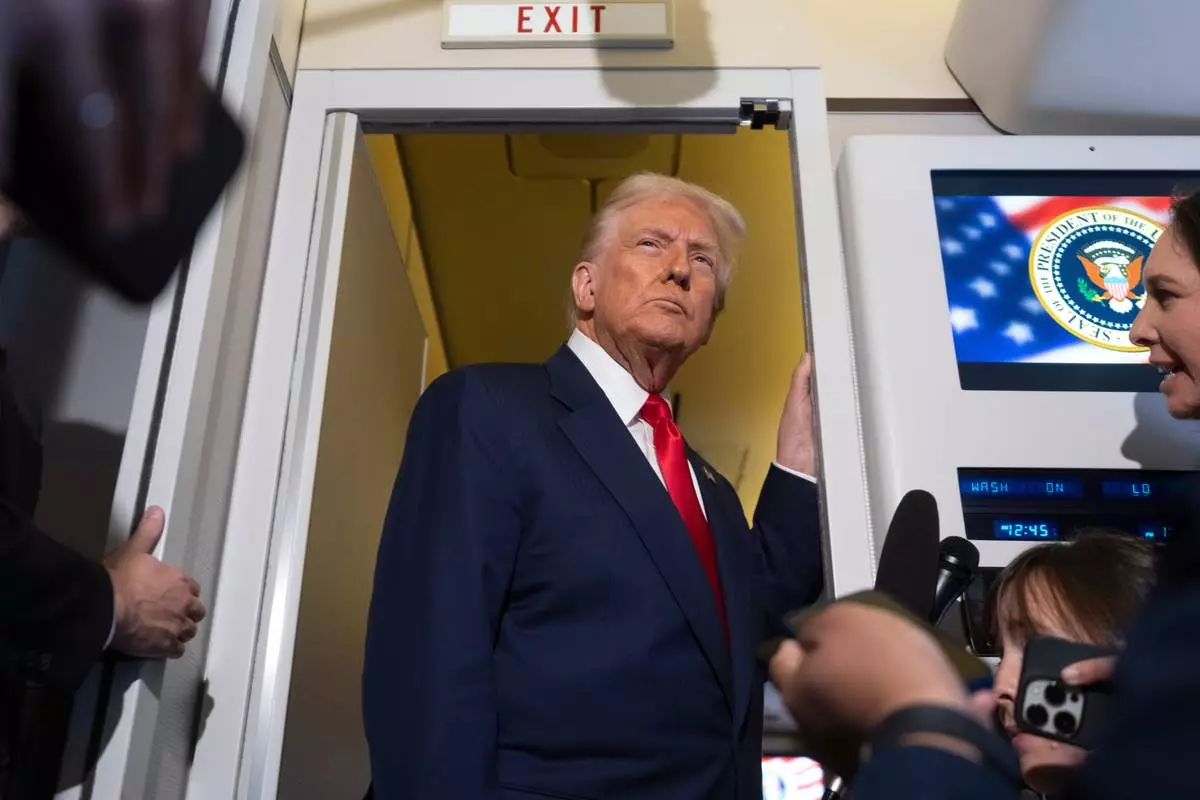
President Donald Trump speaks with reporters aboard Air Force One shortly after taking off from Busan, South Korea, en route to Joint Base Andrews, Md., Thursday, Oct. 30, 2025. (AP Photo/Mark Schiefelbein)
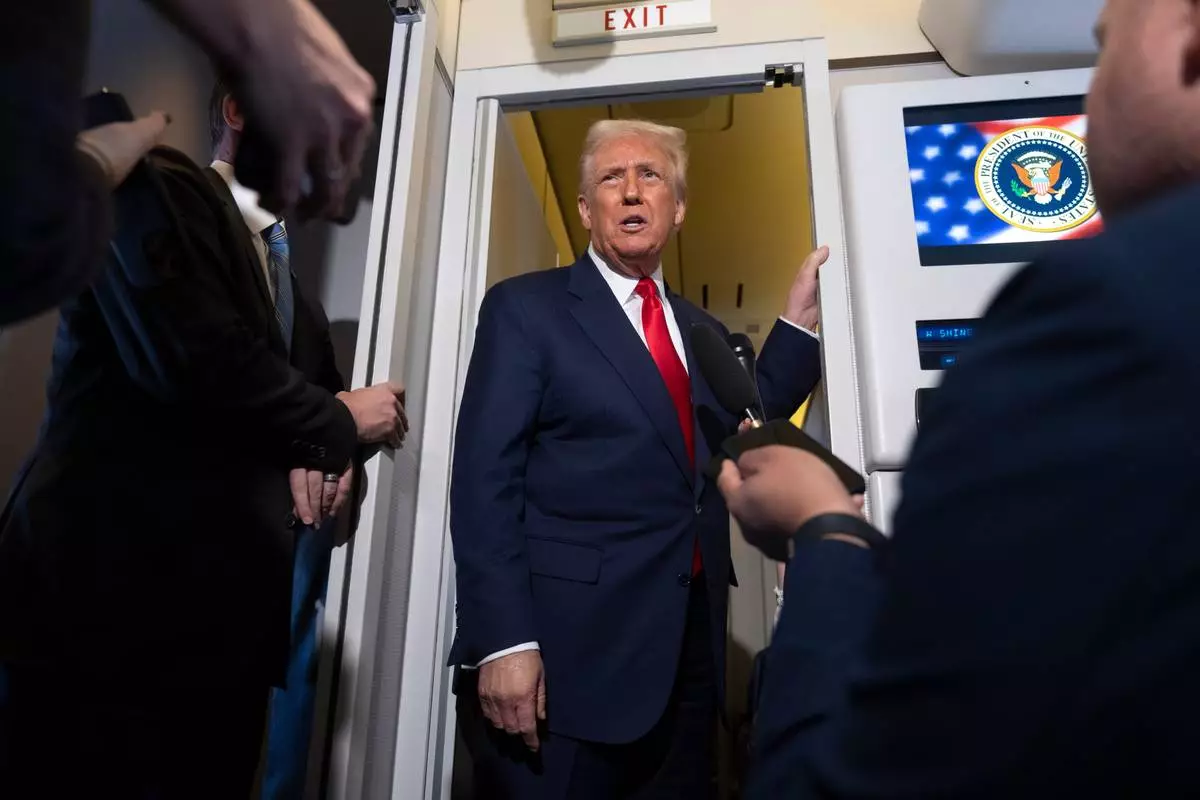
President Donald Trump speaks with reporters aboard Air Force One shortly after taking off from Busan, South Korea, en route to Joint Base Andrews, Md., Thursday, Oct. 30, 2025. (AP Photo/Mark Schiefelbein)
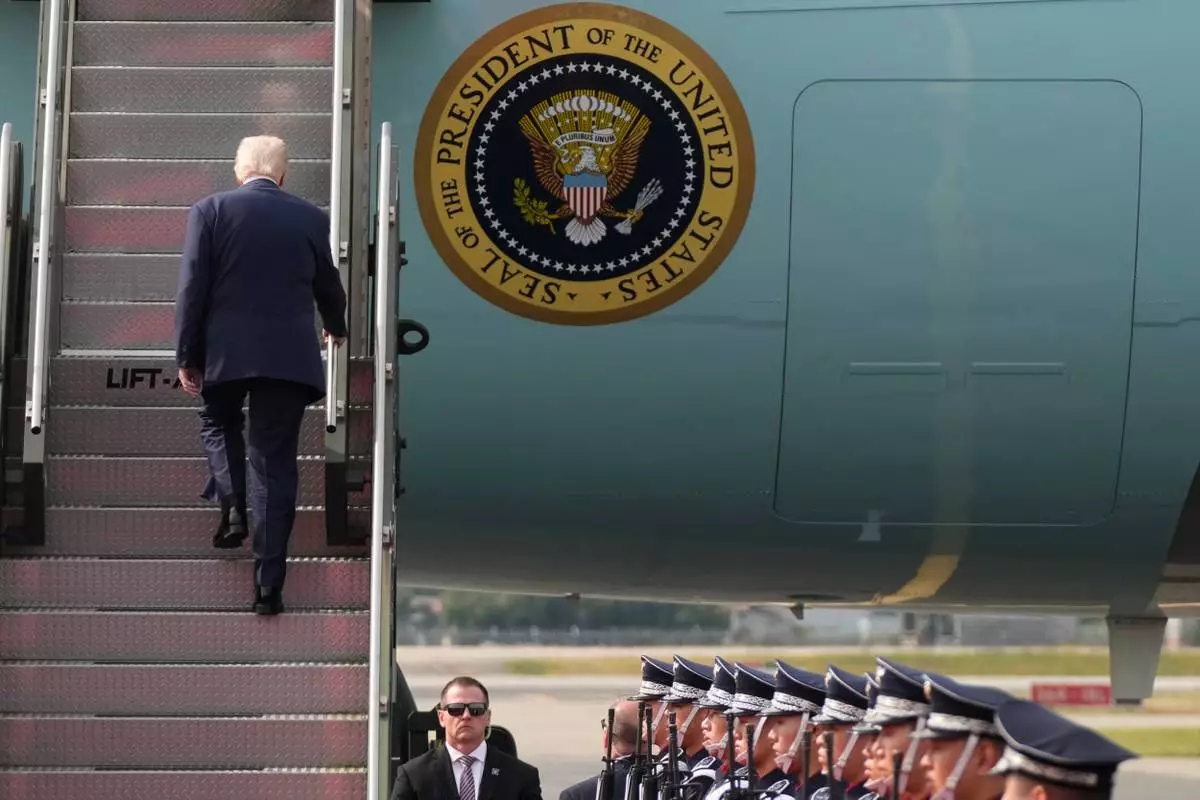
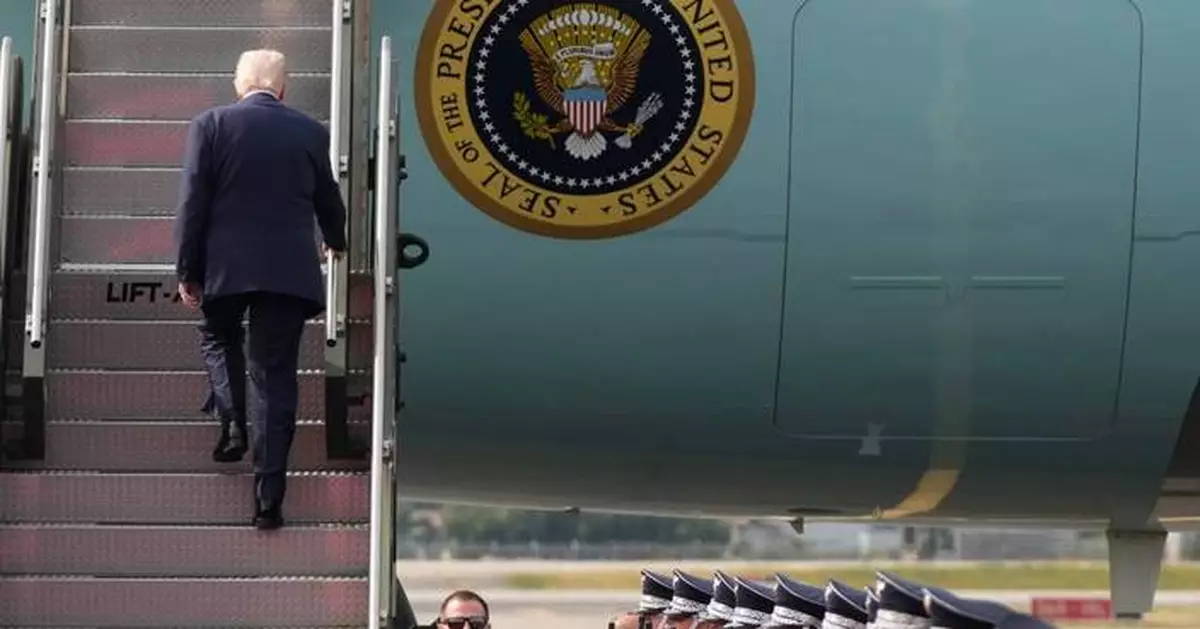
President Donald Trump boards Air Force One at Gimhae International Airport in Busan, South Korea, Thursday, Oct. 30, 2025, en route to Joint Base Andrews, Md. (AP Photo/Mark Schiefelbein)