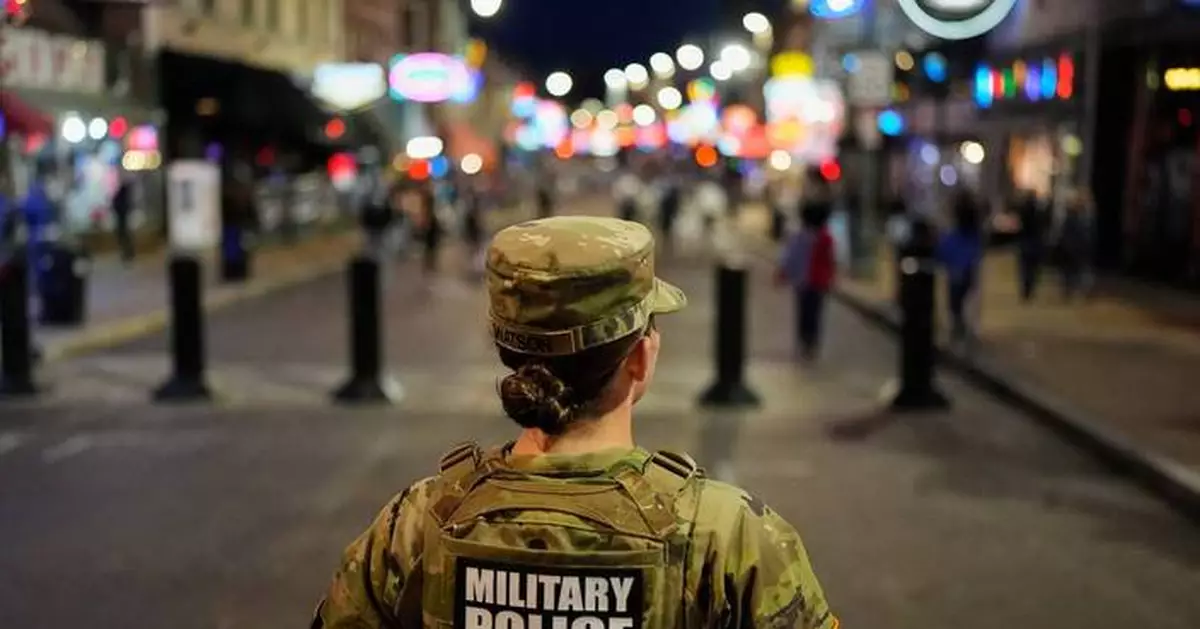
WASHINGTON (AP) — Military leaders have ordered the National Guard in every state to develop a “quick reaction force” of troops trained to deal with civil disturbances and riots that can be ready to deploy with just hours' notice, the latest indication of longer-term Trump administration plans to more readily dispatch soldiers to U.S. streets.
A set of memos circulated this month directs Guard units in all 50 states and U.S. territories, except for the District of Columbia, to train a contingent of soldiers in a specialized course that includes the proper use of batons, body shields, stun guns and pepper spray.
Signed by Major Gen. Ronald Burkett, operations director for the National Guard, the memos reviewed by The Associated Press give various numbers for each state's force — often 500 each — that total more than 23,000 troops in all. The memos direct Washington, D.C., to maintain a “specialized” military police battalion with 50 National Guard soldiers on active duty orders.
It presses forward with President Donald Trump's broader vision for a muscular role for the U.S. military in targeting illegal immigration and crime. He has already pushed traditional boundaries by sending the National Guard into American cities, often over the objection of Democratic local leaders.
The memos, reported earlier by The Guardian, come after Trump signed an executive order in August that directed the Pentagon to create quick reaction forces that would be “available for rapid nationwide deployment.” The executive order is cited as one of the authorities for the memo, about which the Pentagon did not immediately respond to a request for comment.
The National Guard has always had troops that were on standby to deploy at a moment's notice, but they traditionally have been used to quickly react to natural disasters and did not receive special training.
The new, specialized quick reaction forces will be able to deploy a fourth of all their troops within eight hours and all of those assigned to the units within a day, according to the memo.
During a roundtable at the White House last week with homeland security officials, Defense Secretary Pete Hegseth was asked about a memo detailing similar plans. Hegseth said he would not comment on the “particulars” but went on to say that there were “multiple layers of National Guard response forces.”
“We’ve got a lot of different ways that, constitutionally and legally, we can employ” Guard troops, and “we will do so when necessary,” Hegseth said.
While Trump has sent the National Guard into cities including Los Angeles and D.C., his efforts to deploy troops in other places have faced swift legal challenges. The Trump administration is blocked from sending troops into the Chicago area until at least the latter half of November, following a U.S. Supreme Court order calling on the sides to file additional legal briefs. And a federal trial seeking to block a troop deployment in Portland, Oregon, got underway this week.
The memos, which were sent out to the states early this month, mandate that each state and territory have its quick reaction forces operational by Jan. 1, 2026. To help with that goal, units will be provided 100 sets of crowd control equipment as well as two full-time trainers by the National Guard Bureau.
The units also will be allowed to use an additional five days of training for soldiers to get through the “Interservice Nonlethal Individual Weapons Instructor Course.”
According to one of the memos, the initial portion of the course includes topics like “crowd management techniques,” “domestic civil disturbance training,” and “proper use of baton and body shields.” The intermediate portion focuses on the use of non-lethal weapons like Tasers and pepper spray.
Each National Guard unit is required to update military leaders monthly on its progress in meeting this new mandate.
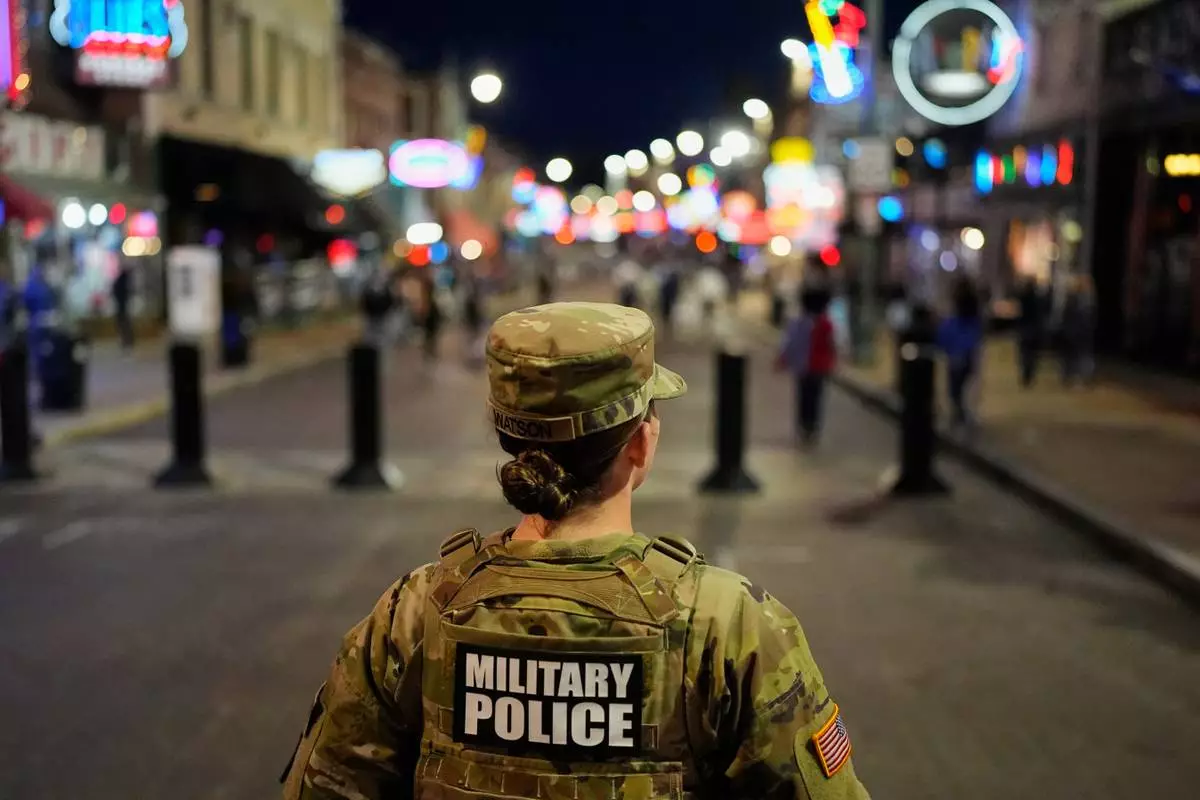
A member of the National Guard stands watch on Beale Street, Friday, Oct. 24, 2025, in Memphis, Tenn. (AP Photo/George Walker IV)
NEW DELHI (AP) — Protests have spread across India in the past week as opposition parties and civil society groups demand the resignation of the country’s election chief over alleged manipulation of voter lists.
The campaign has been led in part by India’s “Cockroach” youth movement, which previously organized street protests that forced the education minister to resign in July.
Protesters demand the resignation of Chief Election Commissioner Gyanesh Kumar and an end to the poll body's ongoing revision of voter lists. They accuse the revision could disenfranchise millions of voters and benefit Prime Minister Narendra Modi’s ruling Hindu nationalist Bharatiya Janata Party, or BJP. The commission and government deny any wrongdoing.
Here’s what to know:
India is the world’s largest democracy with hundreds of millions of people voting in national and state elections. The Election Commission plays a central role in determining voter eligibility and administering elections, making changes to electoral lists politically significant.
The dispute centers on a nationwide voter list revision known as the Special Intensive Revision, or SIR. It began last year in the eastern state of Bihar ahead of local elections and has since expanded to most of India’s states and federally administered territories.
Under the process, voters are required to provide documents showing they are eligible to remain on the lists.
The Election Commission says the exercise is needed to remove duplicate and ineligible entries and ensure legitimate voters remain registered. Critics say it could instead exclude legitimate voters, particularly poorer and other vulnerable communities.
They also say the requirements are confusing and difficult for many people to provide, particularly those who lack older government records or other documents.
India’s Election Commission is an independent constitutional body overseeing elections and maintaining voter lists, but opposition parties accuse the commission of favoring Modi's party. They allege the changes could remove people more likely to support opposition parties while preserving or adding voters who favor the BJP.
The BJP and the Election Commission reject the allegations and say the revision has no political motive. Modi's party says the list is being updated to weed out what they call “infiltrators.”
The issue was prominent in West Bengal’s crucial state elections earlier this year after a voter list revision removed about 9 million names, or roughly 12% of the electorate. The deletions left millions of eligible voters unable to cast ballots. Modi’s party won the state for the first time.
Indian law requires a majority vote of commission members to enact changes making disagreements among its members potentially significant.
The Indian Express newspaper reported in September that two of the three election commissioners had formally objected to several decisions involving voter list revisions, registration procedures and the commission’s digital systems.
The newspaper reported Kumar, the election chief, rejected those objections.
The Election Commission said the report reflected “differing views and deliberations” rather than formal written objections.
The “Cockroach” movement, opposition parties and civil society groups have called for Kumar to resign or be removed and for an inquiry into his conduct, including possible criminal proceedings. They want the current revision halted and the previous electoral lists used for future elections.
They also demand a more independent and transparent process for appointing election commissioners.
Election Commission data indicates voter lists in some regions could shrink by as much as 30%, fueling concerns among opposition parties and protest groups over potential exclusions.
The dispute is likely to intensify as the changes resulting from the revision expand throughout India, which is facing a series of state elections early next year.
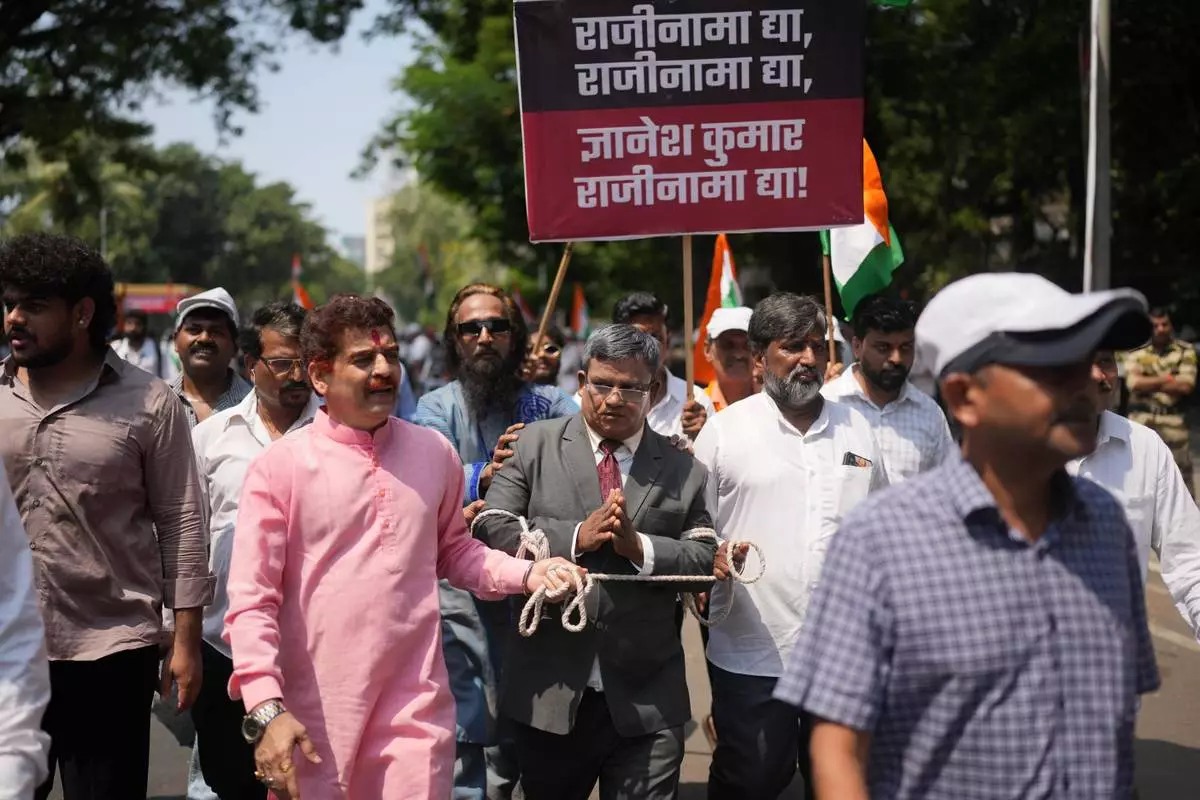
A protester dressed as Chief Election Commissioner Gyanesh Kumar arrives with his hands tied during a protest organized by Shiv Sena (UBT) and the Maharashtra Navnirman Sena (MNS), demanding Kumar's resignation and the suspension of the Special Intensive Revision (SIR) of electoral rolls, in Mumbai, India, Sunday, Oct. 4, 2026.(AP Photo/Rafiq Maqbool)
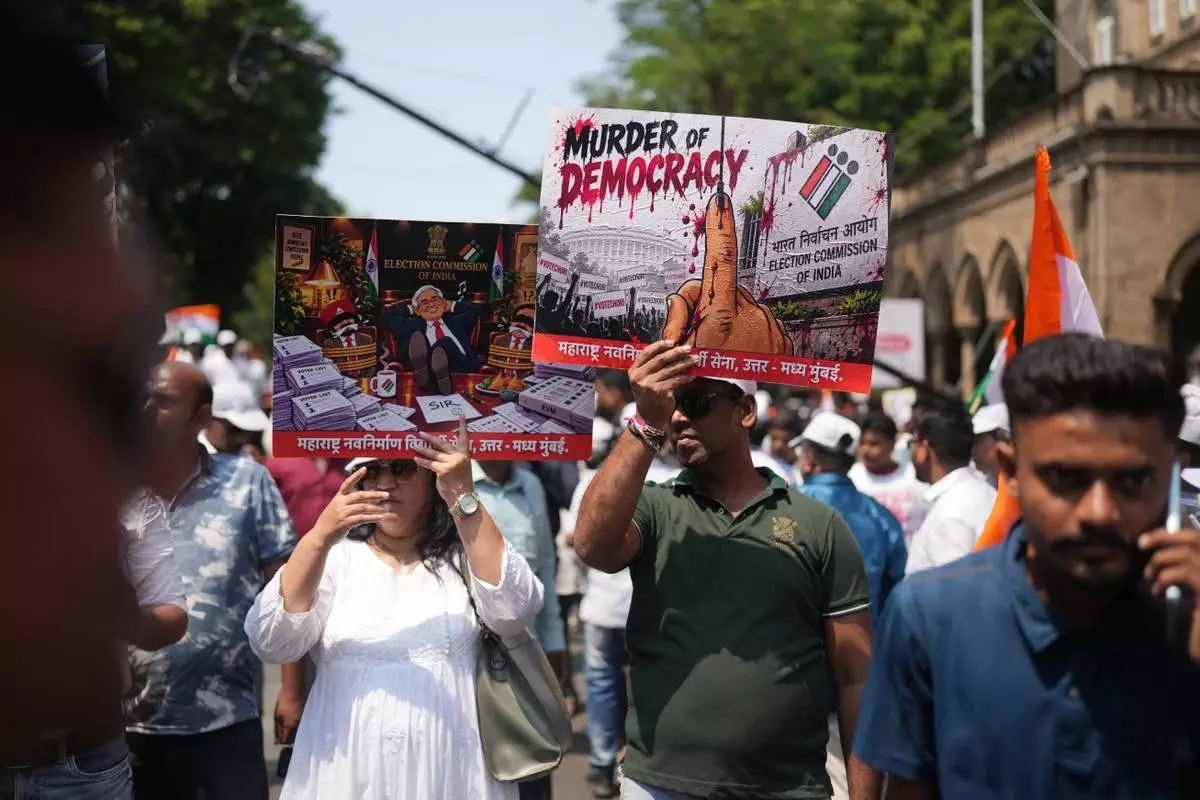
Protesters hold placards during a protest organized by Shiv Sena (UBT) and the Maharashtra Navnirman Sena, demanding the resignation of Chief Election Commissioner Gyanesh Kumar and the suspension of the Special Intensive Revision (SIR) of electoral rolls, in Mumbai, India, Sunday, Oct. 4, 2026.(AP Photo/Rafiq Maqbool)
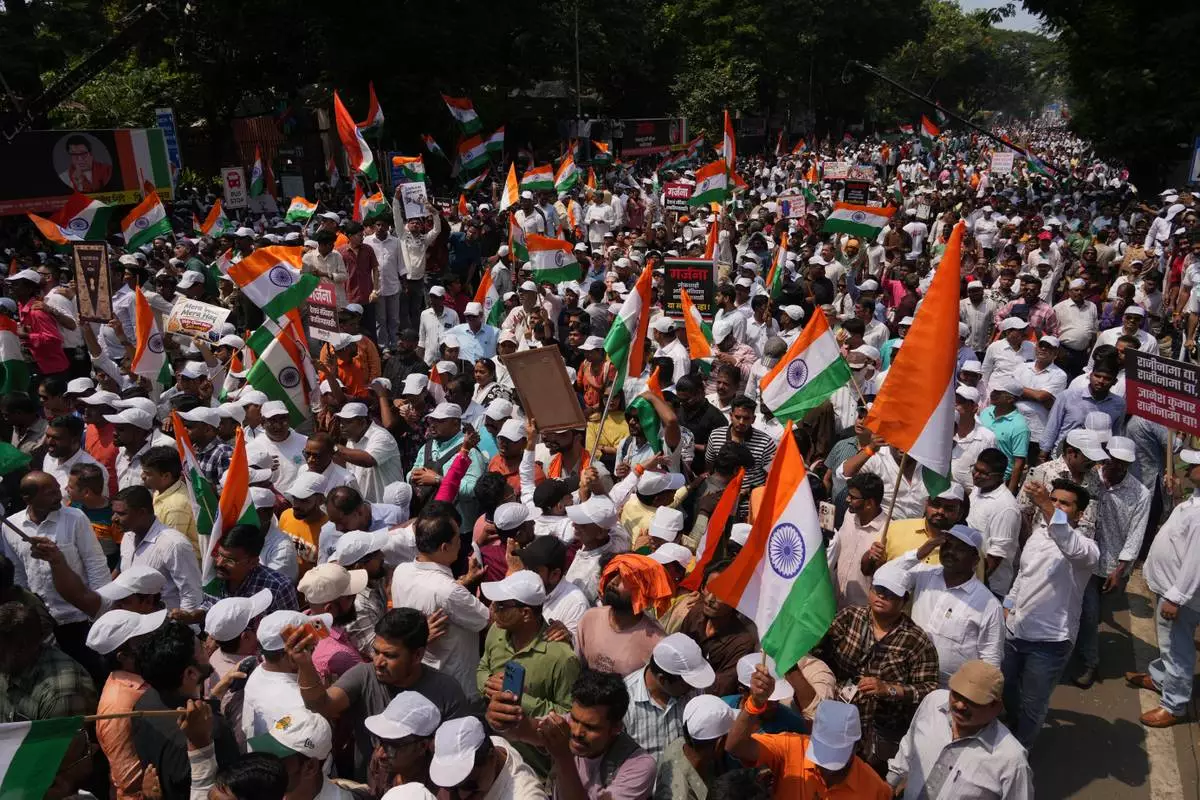
Protesters hold placards during a protest organized by Shiv Sena (UBT) and the Maharashtra Navnirman Sena, demanding the resignation of Chief Election Commissioner Gyanesh Kumar and the suspension of the Special Intensive Revision (SIR) of electoral rolls, in Mumbai, India, Sunday, Oct. 4, 2026.(AP Photo/Rafiq Maqbool)
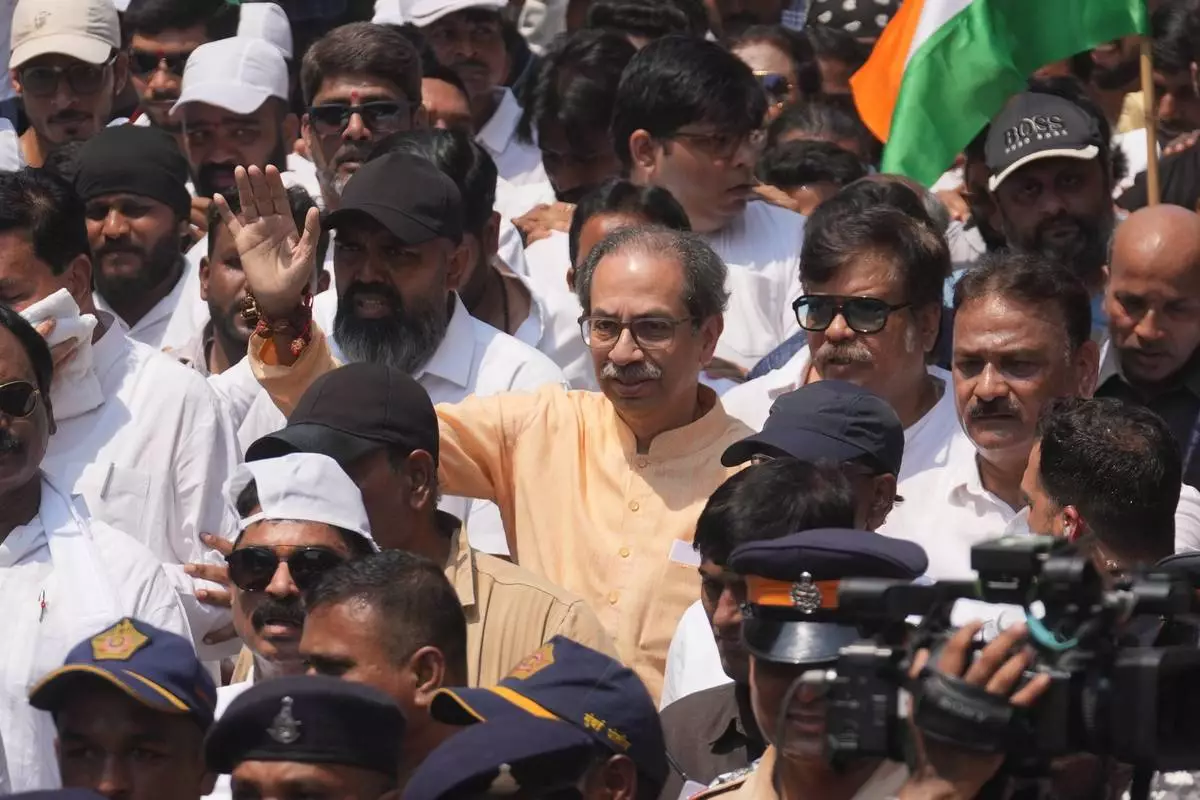
Shiv Sena (UBT) leader Uddhav Thackeray waves as he marches during a protest organized by his party and the Maharashtra Navnirman Sena (MNS), demanding the resignation of Chief Election Commissioner Gyanesh Kumar and the suspension of the Special Intensive Revision (SIR) of electoral rolls, in Mumbai, India, Sunday, Oct. 4, 2026.(AP Photo/Rafiq Maqbool)
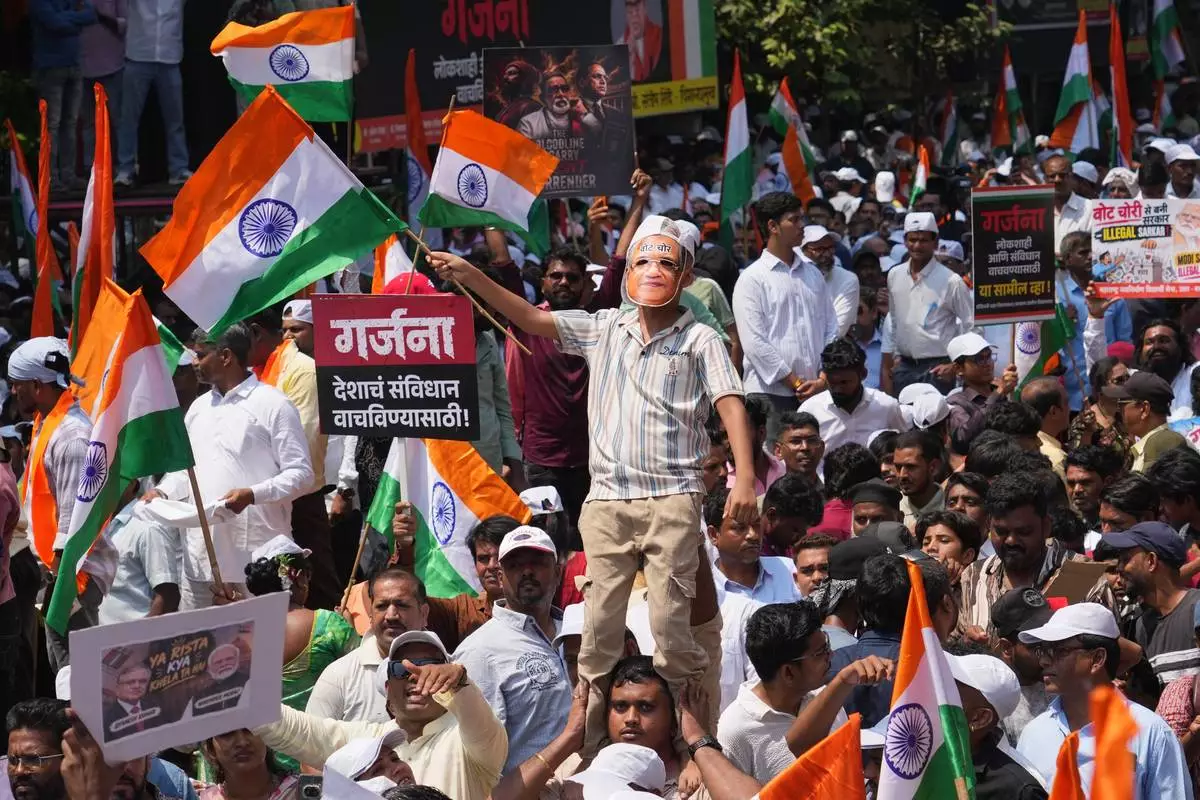
A protester wears a mask depicting Chief Election Commissioner Gyanesh Kumar with the words "vote theft" during a protest organized by Shiv Sena (UBT) and the Maharashtra Navnirman Sena , demanding his resignation and the suspension of the Special Intensive Revision (SIR) of electoral rolls, in Mumbai, India, Sunday, Oct. 4, 2026.(AP Photo/Rafiq Maqbool)