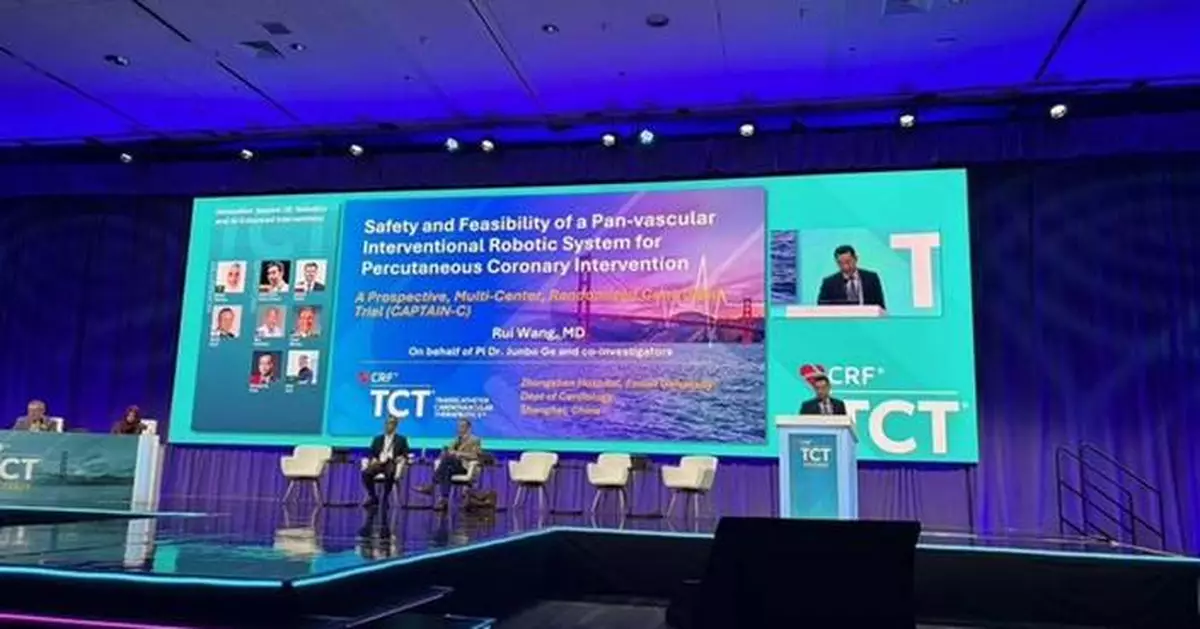
SHANGHAI, Nov. 3, 2025 /PRNewswire/ -- The 37th Annual Transcatheter Cardiovascular Therapeutics (TCT2025) symposium was held grandly in San Francisco, USA, attracting widespread attention from the global cardiovascular community. On the morning of October 28th (local time), during the "Innovation Session: Robotics and AI-Enhanced Interventions," Dr. Wang Rui, representing the team of Academician Ge Junbo from Zhongshan Hospital Affiliated to Fudan University, presented to the world for the first time the safety and efficacy data from the multicenter randomized controlled trial of China's independently developed PANVIS STAR Vascular Interventional Surgery Control System. The results were encouraging ——in the field of Percutaneous Coronary Intervention (PCI), the introduction of robotic technology is gradually transforming traditional surgical paradigms.
I. Research Background: Why Robot-Assisted PCI?
In traditional PCI procedures, vascular interventional physicians must wear heavy lead aprons and operate for extended periods under X-ray , facing multiple occupational risks such as an increased incidence of orthopedic and ophthalmic diseases. With the advancement of precision medicine and telemedicine, robot-assisted PCI has become a key pathway to address these challenges. However, most current interventional robots rely on joystick control, making it difficult to simulate physicians' techniques and operating habits. Additionally, limited compatible instruments restrict their widespread clinical adoption. The emergence of the PANVIS STAR system aims to break through this bottleneck.
II. PANVIS STAR System: Design Innovations and Functional Highlights
Independently developed by Shenzhen Institute of Advanced Biomedical Robot Co., Ltd. (abrobo) , the PANVIS STAR system boasts the following outstanding features:
- Equipped with a globally unique PANVIS COF (Catheter On Finger) intuitive operating system: The controller mimics manual operation, aligning better with physicians' traditional operating habits and reducing the learning curve.
- Separate sterile cassette design: Supports operation of dual guidewires, dual rapid-exchange devices, and microcatheters, enhancing procedural flexibility.
- Multiple control motion modes: Improves the system's flexibility and adaptability, suitable for different vascular environments and various operators' surgical habits.
- Ultra-long travel design: Supports the entire procedural workflow after catheter sheath insertion, possessing pan-vascular compatibility.
- 5G remote operation support: Lays the foundation for performing long-distance remote PCI.
III. CAPTAIN-C Study Design: A Rigorous Multicenter RCT
This prospective, multicenter, randomized controlled trial, led by Principal Investigator Academician Ge Junbo, aimed to evaluate the safety and efficacy of PANVIS STAR in PCI.
Inclusion criteria: Obstructive coronary artery disease, coronary artery stenosis ≥50%, with clinical indication for a single PCI procedure.
Exclusion criteria: Included recent stroke, acute MI within 48 hours, severe comorbidities, and complex coronary anatomy, among others.
The primary endpoint was clinical procedural success, defined as: final TIMI flow grade 3; residual stenosis <30%; and no Major Adverse Cardiovascular Events (MACE) during hospitalization.
IV. Core Results: Safe, Feasible, and Remarkably Effective
The study results showed:
Robotic group: 71 cases; Conventional manual group: 73 cases. There were no significant differences between the two groups in age, gender, underlying diseases (hypertension, hyperlipidemia, diabetes), or clinical diagnosis at admission.
Interventional process and angiographic characteristics: Lesion type, rate of subtotal occlusion lesions, lesion length, and stent length showed no significant differences between groups. Almost all interventions were performed via the transradial approach.
The selected lesions were relatively complex, with B2 and C type lesions exceeding 60% in both groups, and approximately 20% of patients in both groups had subacute STEMI and NSTEMI.
Safety and Efficacy Results:
Clinical success rate: 97.18% in the robotic group.
Robotic technical success: 100%, with no conversions to manual procedure and no device deficiencies.
Remarkable effect in reducing radiation exposure for the primary operator: 97.2% reduction in iatrogenic radiation.
No significant differences were observed between the two groups regarding patient radiation dose and contrast agent volume.
These data not only validate the operational stability of PANVIS STAR in complex coronary lesions but also demonstrate its clear value in reducing physicians' occupational risks.
V. Innovation and Breakthrough: From "Operable" to "Well-Operable"
The breakthrough of PANVIS STAR lies not only in the technology itself but also in its human-centric ergonomic design philosophy. Its controller simulates the traditional vascular interventional operation mode and techniques, allowing physicians to achieve precise, stable, and remote operation without changing their established habits.
Furthermore, the system supports remote intervention in a 5G environment. A successful remote PCI procedure over a distance of 5,200 kilometers was performed jointly by the team of Academician Ge Junbo and Professor Shen Li from Zhongshan Hospital, Fudan University, along with the team of Director Chen Qingxing (an expert from Zhongshan Hospital assisting in Xinjiang), Director Abulimiti Jamali, and Director Maimaitiaili Tuerxun from Kashi Second People's Hospital in Xinjiang. This lays a practical foundation for future "cross-hospital," "cross-regional," and even "cross-border" PCI surgeries
VI. Clinical Value and Future Prospects
The clinical success of PANVIS STAR signifies that China possesses the capability for independent R&D and clinical translation in the field of interventional robotics. Its pan-vascular compatibility further expands its application prospects in areas such as neurovascular and peripheral vascular interventions.
With the integration of 5G networks and artificial intelligence technologies, future robot-assisted interventions will no longer be limited to "replacing human hands" but will advance towards new stages featuring intelligent navigation, automatic planning, and remote collaboration.
VII. Opening a New Chapter in Precision Intervention
The CAPTAIN-C study is not just a "coming-of-age ceremony" for the PANVIS STAR system; it is a solid step forward for Chinese interventional cardiology in the direction of intelligent and remote procedures. As Academician Ge Junbo's team stated: "What we pursue is not only technological leadership but also enabling more physicians to perform each procedure safely and efficiently, allowing more patients to benefit from the warmth of technology."
Media Contact:
Yoyo Wang,
wangluyao@abrobo.com
** The press release content is from PR Newswire. Bastille Post is not involved in its creation. **
TCT 2025 | Robot-Assisted PCI Enters a New Era: Results of the PANVIS STAR Multicenter Randomized Controlled Trial
|
DAVOS, Switzerland, April 1, 2026 /PRNewswire/ -- The Philippines Social Security System (SSS) signed a Memorandum of Understanding (MOU) with Singapore-based fintech firm Surfin Meta Digital Technology (Surfin) outlining areas of collaboration to modernize and digitally enable selected SSS financial service programs. The MOU serves as a framework for cooperation, with both parties identifying opportunities to improve service delivery for members, pensioners, and their beneficiaries, while supporting financial inclusion and operational efficiency across the national pension and social insurance system.
The MOU was signed at the first ever InvestPhilippines Business Pavilion, following a panel session on the potential of AI to strengthen public-sector and pension-fund service delivery. This was held during the World Economic Forum in Davos, Switzerland, from January 19 to 23, 2026.
Under the MOU, SSS and Surfin will explore the potential integration of AI credit scoring, big data modelling, and chatbot technology into its existing platforms, including loan administration, member servicing, and back‑end risk management processes. Focus areas may also include digital enhancements to loan administration, workflow automation to improve operational efficiency, and explainable, auditable analytics to support oversight and compliance.
As part of the exploratory collaboration, Surfin will make its proprietary risk management engines and analytics platforms available for assessment, while both parties co-develop pilot programs and knowledge-sharing initiatives within the local financial ecosystem. The engagement reflects Surfin's growing presence in the Philippines and its experience in designing digital financial applications for large institutions.
SSS is exploring digital upgrades to selected financial service programs through artificial intelligence and data-driven tools as part of a broader push to modernize its services.
Quote from Surfin
"The Philippines remains a strategically important market for Surfin, and the signing of this MOU is an important step toward advancing digital financial solutions for underserved communities in the country, including the Overseas Filipino Worker (OFW) community," said Dr. Yanan Wu, Founder and CEO of Surfin.
"As a global fintech company committed to transparent and accessible digital financial services, this collaboration reflects our continued efforts to leverage artificial intelligence and data-driven technologies to support individuals and small businesses that face challenges within traditional financial infrastructure. This collaboration will allow us to explore how AI-enabled financial technologies can support broader financial inclusion initiatives. We look forward to contributing insights and technical expertise as SSS explores the development of its digital financial tools."
Quote from SSS
"The MOU marks an initial step towards assessing how AI, advanced data analytics, and conversational AI tools could support SSS' financial services, in line with the Philippines' broader digital transformation agenda, following the directive of Department of Finance Secretary and Social Security Commission Chairman Frederick D. Go to maximize the use of technology in delivering efficient and accessible services to SSS members." said Robert Joseph M. de Claro, President and Chief Executive Officer of SSS.
De Claro notes that artificial intelligence presents opportunities for pension funds to manage large volumes of member and financial data more efficiently, support informed long-term decision-making, and automate routine processes. "AI can help strengthen governance and enable personalised member services, from retirement-planning tools to interactive digital assistants. We look forward to exploring Surfin's risk management tools and pilot initiatives in support of the Philippines' digital agenda, with the goal of delivering faster and more inclusive services to Filipino workers."
About Surfin Meta Digital Technology
Surfin is a global fintech platform providing digital financial services for the unbanked and underbanked across emerging markets, including consumer lending, credit cards, payments and remittances, wealth management, and Fintech-as-a-service.
Leveraging AI, big data analytics, and proprietary risk management technologies, Surfin has developed a scalable cross-border platform designed to deliver transparent and inclusive financial solutions.
For more information, please visit www.surfinglobal.com.
About SSS
The SSS is a state-run social insurance program providing retirement, disability, maternity, sickness and other benefits to millions of Filipino workers and their families. SSS continues to pursue digital modernisation initiatives to improve service delivery and accessibility for members and beneficiaries across the Philippines and overseas.
Media Contact:
media@surfinglobal.com
DAVOS, Switzerland, April 1, 2026 /PRNewswire/ -- The Philippines Social Security System (SSS) signed a Memorandum of Understanding (MOU) with Singapore-based fintech firm Surfin Meta Digital Technology (Surfin) outlining areas of collaboration to modernize and digitally enable selected SSS financial service programs. The MOU serves as a framework for cooperation, with both parties identifying opportunities to improve service delivery for members, pensioners, and their beneficiaries, while supporting financial inclusion and operational efficiency across the national pension and social insurance system.
The MOU was signed at the first ever InvestPhilippines Business Pavilion, following a panel session on the potential of AI to strengthen public-sector and pension-fund service delivery. This was held during the World Economic Forum in Davos, Switzerland, from January 19 to 23, 2026.
Under the MOU, SSS and Surfin will explore the potential integration of AI credit scoring, big data modelling, and chatbot technology into its existing platforms, including loan administration, member servicing, and back‑end risk management processes. Focus areas may also include digital enhancements to loan administration, workflow automation to improve operational efficiency, and explainable, auditable analytics to support oversight and compliance.
As part of the exploratory collaboration, Surfin will make its proprietary risk management engines and analytics platforms available for assessment, while both parties co-develop pilot programs and knowledge-sharing initiatives within the local financial ecosystem. The engagement reflects Surfin's growing presence in the Philippines and its experience in designing digital financial applications for large institutions.
SSS is exploring digital upgrades to selected financial service programs through artificial intelligence and data-driven tools as part of a broader push to modernize its services.
Quote from Surfin
"The Philippines remains a strategically important market for Surfin, and the signing of this MOU is an important step toward advancing digital financial solutions for underserved communities in the country, including the Overseas Filipino Worker (OFW) community," said Dr. Yanan Wu, Founder and CEO of Surfin.
"As a global fintech company committed to transparent and accessible digital financial services, this collaboration reflects our continued efforts to leverage artificial intelligence and data-driven technologies to support individuals and small businesses that face challenges within traditional financial infrastructure. This collaboration will allow us to explore how AI-enabled financial technologies can support broader financial inclusion initiatives. We look forward to contributing insights and technical expertise as SSS explores the development of its digital financial tools."
Quote from SSS
"The MOU marks an initial step towards assessing how AI, advanced data analytics, and conversational AI tools could support SSS' financial services, in line with the Philippines' broader digital transformation agenda, following the directive of Department of Finance Secretary and Social Security Commission Chairman Frederick D. Go to maximize the use of technology in delivering efficient and accessible services to SSS members." said Robert Joseph M. de Claro, President and Chief Executive Officer of SSS.
De Claro notes that artificial intelligence presents opportunities for pension funds to manage large volumes of member and financial data more efficiently, support informed long-term decision-making, and automate routine processes. "AI can help strengthen governance and enable personalised member services, from retirement-planning tools to interactive digital assistants. We look forward to exploring Surfin's risk management tools and pilot initiatives in support of the Philippines' digital agenda, with the goal of delivering faster and more inclusive services to Filipino workers."
About Surfin Meta Digital Technology
Surfin is a global fintech platform providing digital financial services for the unbanked and underbanked across emerging markets, including consumer lending, credit cards, payments and remittances, wealth management, and Fintech-as-a-service.
Leveraging AI, big data analytics, and proprietary risk management technologies, Surfin has developed a scalable cross-border platform designed to deliver transparent and inclusive financial solutions.
For more information, please visit www.surfinglobal.com.
About SSS
The SSS is a state-run social insurance program providing retirement, disability, maternity, sickness and other benefits to millions of Filipino workers and their families. SSS continues to pursue digital modernisation initiatives to improve service delivery and accessibility for members and beneficiaries across the Philippines and overseas.
Media Contact:
media@surfinglobal.com
** This press release is distributed by PR Newswire through automated distribution system, for which the client assumes full responsibility. **

Surfin Meta Digital Technology signs MOU with the Philippine Social Security System to explore digital financial service enhancements