HKSAR Government welcomes implementation of new measures to support expansion of opening up and high-quality development by Mainland authorities
The Government of the Hong Kong Special Administrative Region (HKSAR Government) welcomes the announcement by the Mainland authorities today (November 3) about a series of new measures to support high-level opening up and high-quality development. These measures include the expansion of application of the exit endorsement for talents to Tianjin, Hebei Province, Jiangsu Province, Zhejiang Province and Anhui Province, as well as all pilot free trade zones across the country with effect from November 5, 2025; implementation of "facial recognition" intelligent exit-entry clearance at various ports in the Chinese Mainland, including the Huanggang, Luohu, Liantang, Futian and Wenjindu Ports in Shenzhen, as well as the Hong Kong-Zhuhai-Macao Bridge Port; facilitating the efficient cross-boundary flow of production factors within the Shenzhen Park of the Hetao Shenzhen-Hong Kong Science and Technology Innovation Cooperation Zone (HTCZ SZ Park); and the addition of four ports connecting Hong Kong as the entry ports under the 240-hour visa-free transit policy.
The talent exit endorsement has been implemented in the Mainland cities of the Guangdong-Hong Kong-Macao Greater Bay Area (GBA) on a pilot basis since February 20, 2023, with a view to facilitating specified categories of GBA Mainland talents' travel to Hong Kong for exchanges and visits. Its scope of application was expanded to Beijing and Shanghai in May 2024. As of October 2025, more than 74 000 arrivals in Hong Kong were visitors holding the talent exit endorsement. On the solid policy foundation of promoting "southbound and northbound" two-way talent flow, the current measure of expanding the application of the talent exit endorsement will attract and bring more Mainland talents to Hong Kong for exchanges, thereby enhancing Hong Kong's attractiveness in pooling talents and strengthening its unique role as the country's international talent hub.
On the other hand, theHKSAR Government also welcomes the implementation of "facial recognition" intelligent exit-entry clearance by the Mainland authoritiesat various ports in the Chinese Mainland that are open for navigation and passage with Hong Kong. This arrangement allows travellers to complete clearance without presenting their physical travel documents, making cross‑boundary travel more convenient and efficient. TheHKSAR Government will continue to enhance clearance efficiencyat the control points in Hong Kong and improve visitors' experience, capitalising on these measures.
The HKSAR Government welcomes the implementation of a series of measures at the HTCZ SZ Park, which facilitate Hong Kong-Shenzhen innovation and technology collaboration and the efficient cross-boundary flow of factors of production. The Government will continue to actively collaborate with the Mainland authorities, including introducing innovative and convenient clearance arrangements at the Hong Kong Park, thereby promoting efficient and convenient cross-boundary travel for innovation and technology talents, and further contributing to the high-quality development of the GBA.
At the same time, the HKSAR Government also welcomes the Mainland authorities to further enhance the 240-hour visa-free transit policy by adding four ports connecting Hong Kong as the entry ports under the policy, thereby attracting international visitors to take Hong Kong as their entry stop or transit point in their multi-destination travel itineraries to our country, and fully leveraging Hong Kong's position as an international tourism hub.
The HKSAR Government will continue to maintain close liaison with the Mainland authorities, with a view to facilitating exchanges through more innovative policies and enabling Hong Kong to further integrate into the national development, thereby creating stronger impetus of growth for Hong Kong and the entire GBA.

EDB reminds parents to choose primary schools under Central Allocation process for their children
The Education Bureau (EDB) today (January 12) reminded parents that children who have joined the Primary One Admission (POA) System for 2026 but have not yet secured a discretionary place can take part in the Central Allocation process for a Primary One (P1) place in a government or aided primary school. Parents concerned should make their choice of schools within the period from January 19 to 25.
Digitalisation of POA
---------------------------
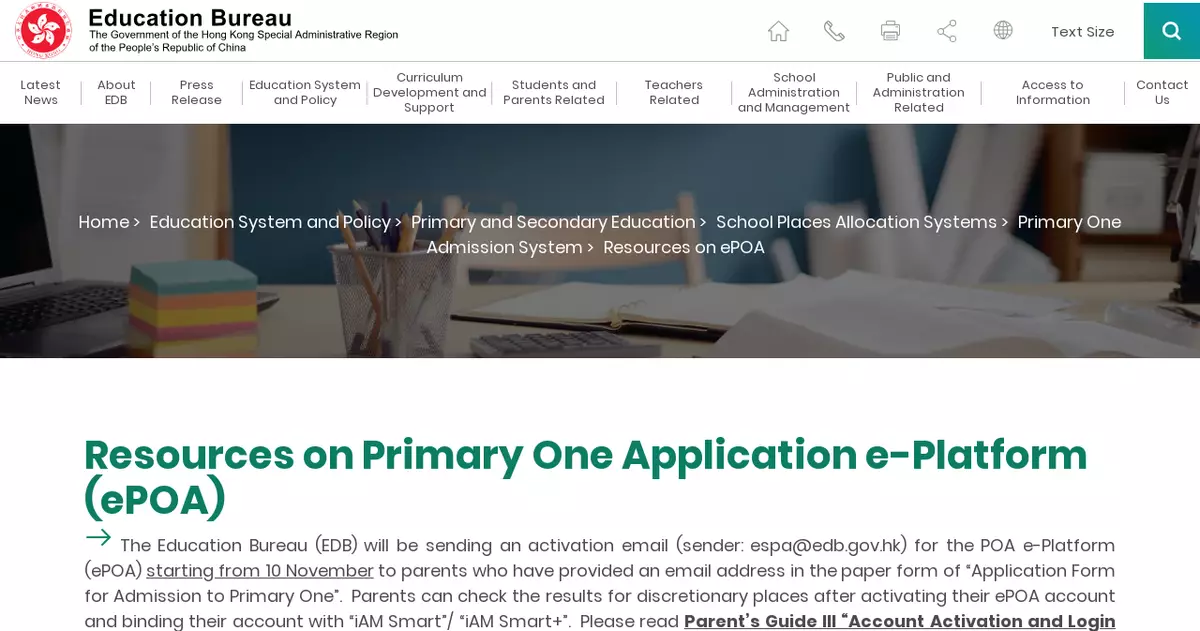
In line with the Smart Government strategy, the EDB has fully implemented digitalisation of the POA. Parents who have registered as POA e-Platform (ePOA) users and have bound their account to "iAM Smart+" may submit the Choice of Schools Form for Central Allocation from January 19 to 25 through the ePOA. Please refer to the related videos and Parent's Guide on the EDB's website (www.edb.gov.hk/en/edu-system/primary-secondary/spa-systems/primary-1-admission/poa_eplatform/index.html) for details of the procedures for activating and logging into an ePOA account and for making school choices for the Central Allocation of POA via the e-Platform.
Making school choices at Central Allocation Centres
-----------------------------------------------------------------
The EDB will send letters to parents on January 14 inviting them to make their choice of schools. To cater for the needs of different parents, parents can still submit the Choice of Schools Form in paper form by visiting the designated Central Allocation Centre at the suggested time slot (i.e. 9.30am to 12.30pm or 1.30pm to 4.30pm on January 24 (Saturday) or 9.30am to 12.30pm on January 25 (Sunday)) stated in the letter.
Parents who are ePOA users may choose to submit the Central Allocation Application via the ePOA or in paper form to the Central Allocation Centre but should not submit duplicate applications. Parents who have not yet received the letter by January 19 should call the School Places Allocation Section of the EDB (Hotline: 2832 7700) as soon as possible.
Only one parent of an applicant child is required to complete the school choice-making procedures. Parents are advised not to take their children to the Central Allocation Centre if possible. Parents who cannot make school choices within the suggested time slot can go to the designated Central Allocation Centre from 1.30pm to 4.30pm on January 25. The Choice of Schools Form will be sent together with the letter to parents who have submitted a paper Application Form at the Discretionary Places stage for filling out in advance.
In the event of adverse weather or other special conditions on any day during the period of making school choices, please pay heed to radio or television announcements on the relevant special arrangements.
Unable to submit application within specified choice-making period
------------------------------------------------------------------------------------
For individual parents who are unable to use the ePOA or go to the Central Allocation Centre to make school choices, they can authorise in writing a representative to bring the completed Choice of Schools Form and their signed Letter of Authorisation to the Central Allocation Centre to proceed with the related procedures.
To apply for POA 2026 for their children after January 25, parents need to complete necessary procedures with the School Places Allocation Section, which will separately arrange P1 places for the applicant children in June.
Change of residential address
--------------------------------------
An EDB spokesman reminded parents that, if they have recently moved their residence or have such plans in the near future, they are required to inform the School Places Allocation Section as soon as possible so that they can make school choices in the POA School Net where their new home is located. Parents should fill in the actual residential address of their child. If they provide a false address for securing a P1 place, the POA application of their child will be rendered void and the P1 place allocated will be withdrawn.
The EDB has put in place a monitoring mechanism to verify the residential addresses of applicant children as given by the parents. Random checks have also been stepped up. The public may call the School Places Allocation Section to report suspected cases of using a false address by parents for their children's POA application. The EDB will take action against false address cases.
Mechanism of Central Allocation
----------------------------------------
Central Allocation is composed of two parts. Part A, which takes up 10 per cent of the P1 places earmarked for Central Allocation, is for unrestricted school choices. Parents can choose up to three government or aided primary schools in any school net. Part B takes up the remaining 90 per cent of the P1 places earmarked for Central Allocation. Parents of applicant children residing in the school net concerned are to select schools from the "Choice of Schools List for Central Allocation (Primary One Admission 2026)" of their school net, while parents of applicant children who intend to commute daily to schools in Hong Kong are to select schools from the "2026 Choice of Schools List for Central Allocation (For Applicant Children who intend to commute daily to schools in Hong Kong)". Parents should fill in the Choice of Schools Form in the order of their preference.
The mechanism of the Central Allocation is based on parents' choices in general. The computer-programmed allocation will first process the school choices in Part A and then the school choices in Part B. For oversubscribed schools, the order of priority in allocating places will be determined by random numbers generated by the computer for individual applicants to ensure fairness.
For information about the procedures for Central Allocation, please call the EDB's 24-hour automatic telephone enquiry service at 2891 0088.
Release of Central Allocation results
----------------------------------------------
For parents who have already activated their ePOA account via "iAM Smart" or "iAM Smart+", they will receive their Central Allocation results through the ePOA from 10am on June 3. Parents who wish to receive the allocation results via SMS on June 3 may choose such an option in the Choice of Schools Form. In addition, the allocation results will be sent to parents by post on June 3 and 4.
Source: AI-found images