Skip to Content Facebook Feature Image

Specially designed hot air oven allows Chinese astronauts to cook in orbit

China

China

China

Specially designed hot air oven allows Chinese astronauts to cook in orbit

2025-11-04 15:26 Last Updated At:15:37

Astronauts aboard China's space station have, for the first time, used an onboard oven to bake food in orbit, marking a significant upgrade to the "space kitchen."

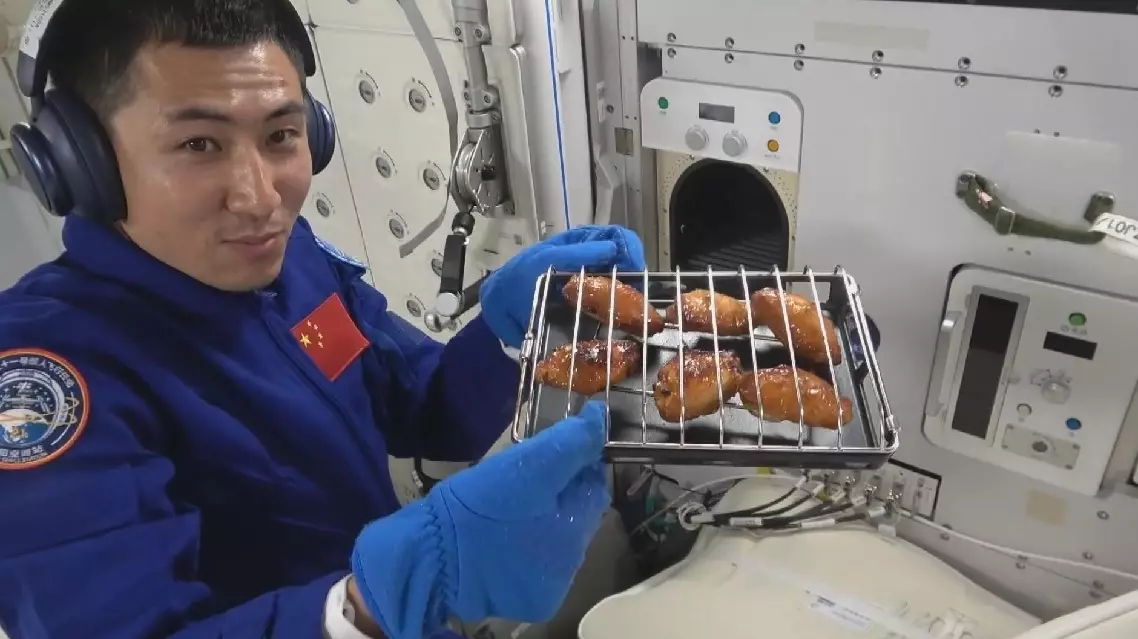
The hot air oven, delivered by the Shenzhou-21 spacecraft, has allowed crew members of the Shenzhou-20 and Shenzhou-21 missions to enjoy freshly baked dishes like chicken wings and steak. This achievement represents a major step forward from simple reheating to actual cooking and baking in China's space program.

"We used high-temperature catalysis and multi-layer filtration technologies to enable smoke-free baking. Given the special conditions in orbit, we have made sure that the hot air oven is completely reliable and safe. Every part of the oven astronauts may touch remains cool so as to prevent burns," said Xuan Yong, a researcher at the China Astronaut Research and Training Center.

"We have built the range hood inside the oven, so it's a hot-air oven with built-in purification. It's the first-ever oven in the world that can actually be used aboard a space station," said Liu Weibo, deputy chief designer of astronaut system with China Astronaut Research and Training Center.

Engineers have also equipped the oven with a residue collector, heating mesh, baking tray, and rotating basket, solving the problem of food floating in zero gravity. They have also increased the maximum heating temperature from 100 to 190 degrees Celsius.

"By raising the temperature to 190 degrees Celsius, astronauts can now really cook in orbit. Previous food heating is purely physical warming, but this is actual cooking, with chemical reactions included. The food can now come out golden and crispy," said Liu.

The oven also has preset programs for different ingredients, such as corn, chicken wings, and cake.

"They can bake cakes, roast peanuts, or grill meat, and it's really delicious. This means astronauts can enjoy special meals on weekends, birthdays, or holidays. It greatly helps to enrich their dining experience and improves overall living conditions in orbit," Liu said.
Specially designed hot air oven allows Chinese astronauts to cook in orbit
Specially designed hot air oven allows Chinese astronauts to cook in orbit

The three astronauts of China's recently-returned Shenzhou-20 mission on Friday shared the experiences of their dramatic 204-day space mission, including detailing the emergency procedures which were implemented to bring them safely home after their return capsule was struck by space debris.

The trio -- Chen Dong, Chen Zhongrui, and Wang Jie -- met with the press in Beijing on Friday afternoon, marking their first public appearance since returning to Earth in November.

When detailing the emergency response mechanisms which were enacted prior to their scheduled return, the astronauts explained that upon discovering a triangular crack on the spacecraft's viewport window, they immediately took photos for documentation and transmitted them to the ground team, who swiftly activated an emergency plan to get the trio home safely.

Experienced mission commander Chen Dong explained how the crew had complete faith in their colleagues on the ground to find a solution to these unforeseen circumstances which led to their return being delayed.

"First, we must trust the ground team, who would anticipate everything and develop the safest return plan for us. Second, we must believe in ourselves; as well-trained astronauts, we have the ability to manage various unexpected failures. I believe that with the collaboration of astronauts and researchers on the ground, our space home will surely go farther, more steadily, and for a longer time," he said.

Following their extended stay in space as a result of the debris incident, the Shenzhou-20 crew spent a total 204 days in orbit, setting a new record for the longest duration by a single group of Chinese astronauts.

During their mission, they completed multiple payload operations, conducted extensive scientific experiments, and carried out four extravehicular activities.

"Our crew worked together with the ground team in unity and coordination, completing four extravehicular activities, several payload entry and exit tasks, and a large number of scientific experiments. It was a fulfilling yet challenging mission. The path to exploring the heavens is long and arduous, but I firmly believe that China's space missions will succeed," said Chen Zhongrui, a former air force pilot who was making his first spaceflight during the mission.

"From the ground to space, from learning to application, I have deeply felt the solid progress of Chinese space endeavors and the quiet dedication of countless personnel behind the scenes. In the future, I will accomplish each mission with full commitment, living up to the trust of the motherland and the people," said fellow astronaut Wang Jie, who was also making his debut spaceflight.

After returning to Earth on Nov 14, the trio successfully completed their isolation recovery and rehabilitation and will now resume normal training following health assessments.

The crew's return, originally scheduled for Nov 5, was postponed due to safety concerns, with the astronauts later using the return capsule belonging to their successor crew of the Shenzhou-21 mission to get back to Earth. China later launched the unmanned Shenzhou-22 spacecraft which will serve the future return of the crew now aboard the Tiangong Space Station.

Shenzhou-20 astronauts share experiences after safely returning from debris incident

Shenzhou-20 astronauts share experiences after safely returning from debris incident

Recommended Articles